01
Loose-leash walking
A walk you would choose to take. Your dog stops pulling because checking in with you pays better than dragging you, not because a piece of equipment is holding it back.


The everyday skills that make a dog easy to live with: loose-leash walking, a recall that holds, waiting at doors, and settling when the house gets busy. Trained in your home and on your own streets, from $700.
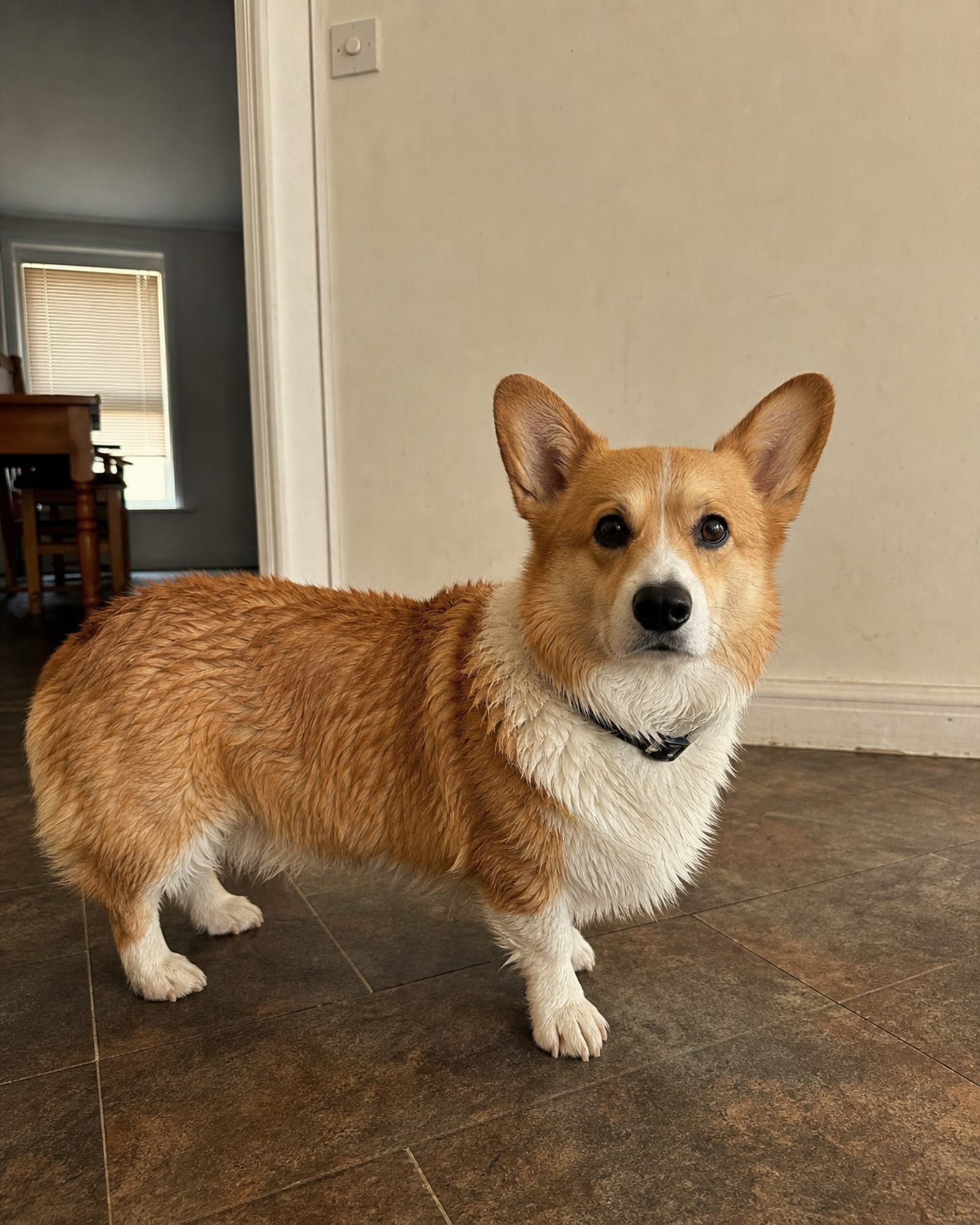
A dog standing square and settled in a plain interior, full body
Loose-leash walking, recall, door manners, and a dog that can settle. Started in your home, proofed where it counts.
Obedience training with me is the practical set of behaviors that decide whether living with your dog is easy or exhausting: walking on a loose leash, coming back when called, waiting at a door or a gate instead of barging through it, and settling down when the house is busy. It starts at $700 for in-home private lessons, which covers an evaluation plus four one-hour sessions, and you get lifetime trainer support once the face-to-face work is done.
I teach it where your dog actually lives. Dogs show their best and their worst behavior at home, in their own neighborhood, and in the places you really take them, so that is where we work rather than in a training hall. There is no transition to manage afterwards, and new places become something we build up to on purpose instead of a distraction we started in.
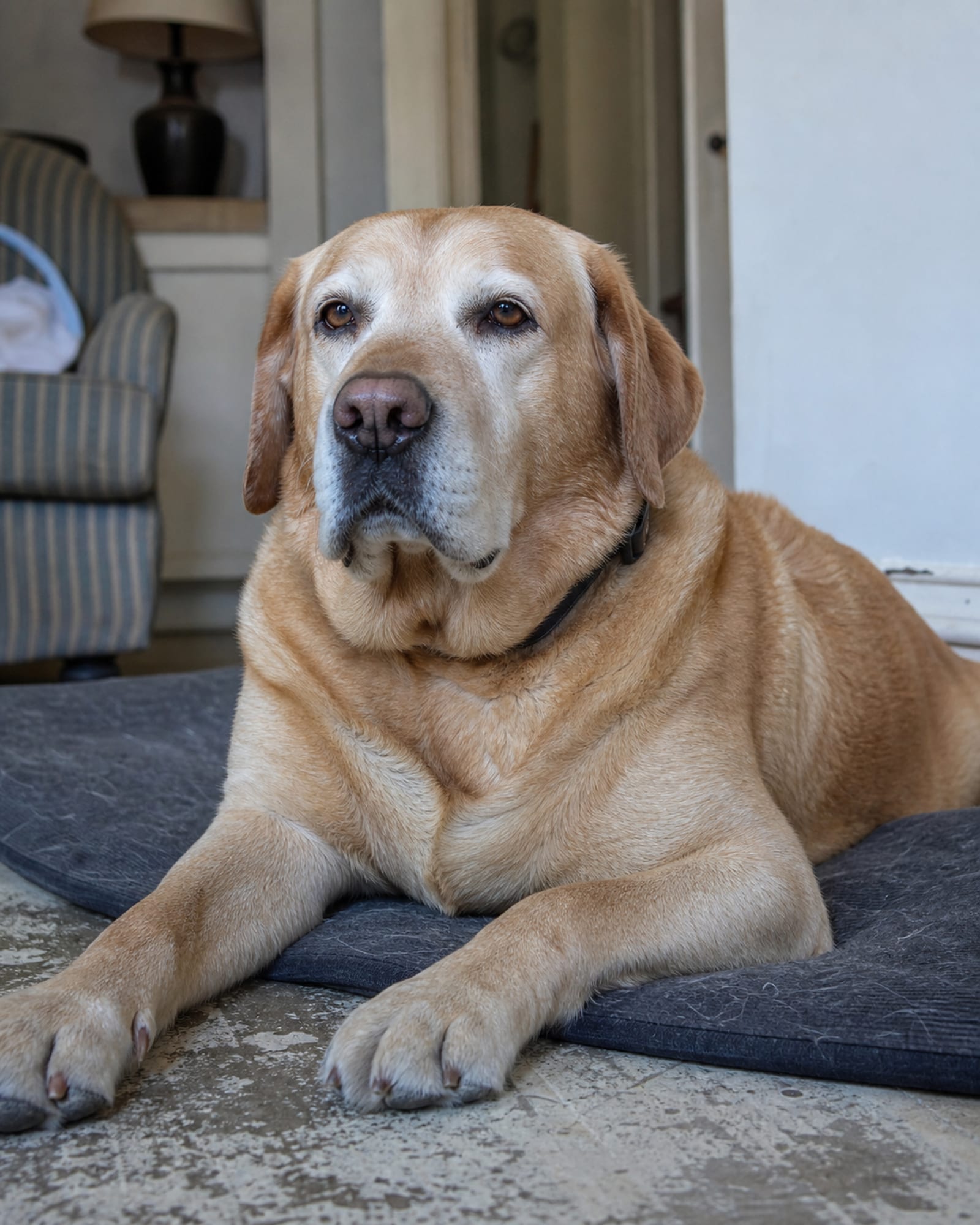
A dog lying calm on a bed in a family living room
Almost everything owners actually want sits on the leash. A dog that walks without dragging you, notices another dog without losing its mind, turns with you when you change direction, and stops when you stop. Get those and the daily grind of owning a dog mostly disappears.
The order matters. We start with engagement, meaning your dog checking in with you by choice, because a dog that has forgotten you exist cannot be walked politely no matter what is attached to its collar. Then position, then duration, then distraction, in that sequence. Skipping to distraction is the single most common reason home training stalls.
I fit and explain the equipment rather than handing it over. Whatever we use, you should be able to say what it does, why it suits this dog, and how to use it without me standing there. Equipment that only works when the trainer is holding the leash has not taught anyone anything.
You will get homework, and it will be specific. Not thirty minutes of drilling, but a handful of repetitions in the doorway you struggle with, on the walk you actually do, at the time of day that is hardest. Short and frequent beats long and occasional every time.
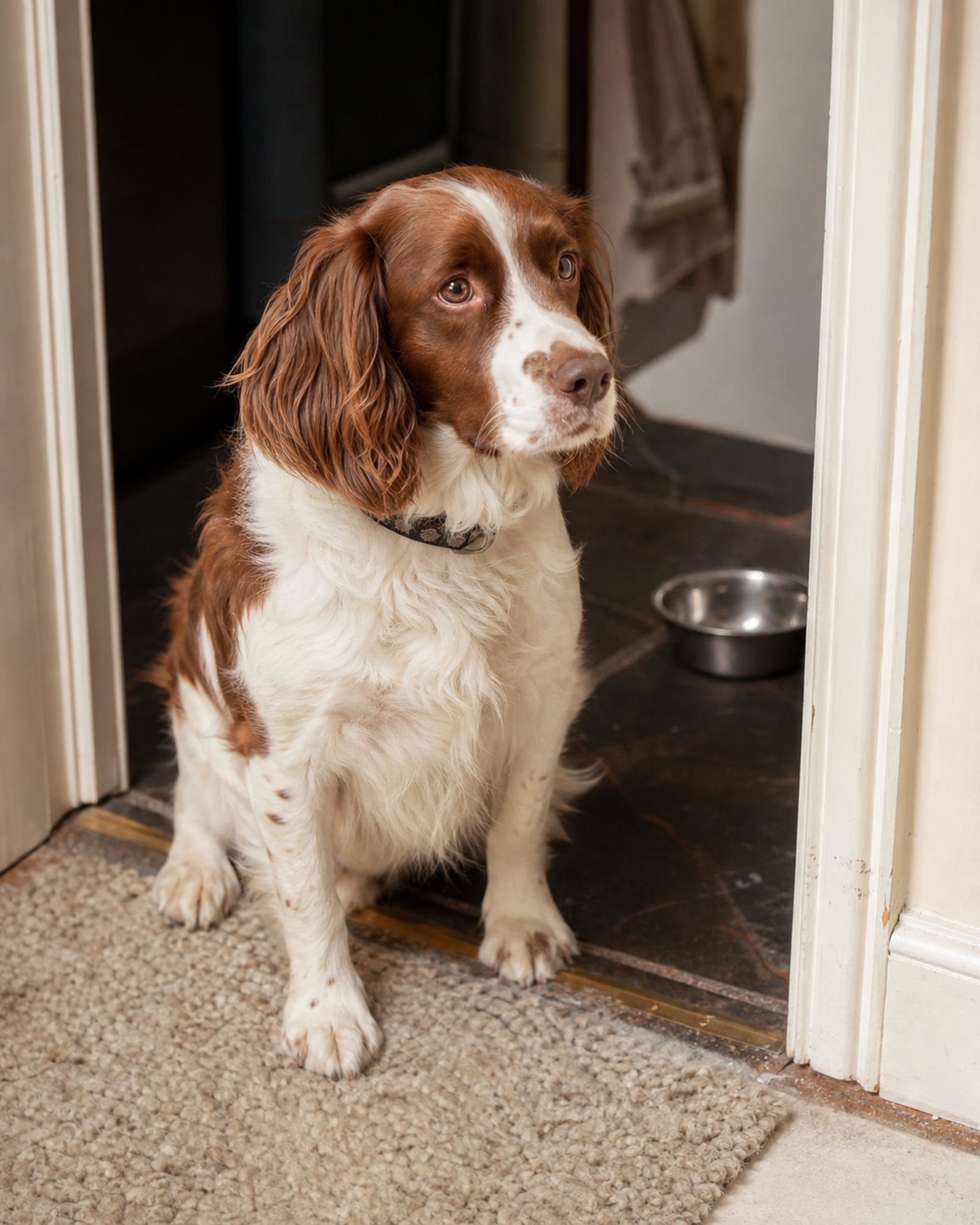
A dog sitting at a threshold waiting to be released
Off-leash freedom is the goal a lot of owners have in mind when they call, and it is a real one. It is also the one most often misunderstood, so here is the honest version.
Knowing a cue in a quiet yard is not off-leash reliability. Reliability is what your dog does when a squirrel breaks cover, when another dog appears at forty feet, when a jogger comes past from behind, and when you are two hundred yards away with nothing but your voice. That depends on the dog, the environment, the distraction, the recall history, the equipment, and your judgment on the day.
So it is a progression, not a switch. We build recall on a long line long before anything comes off, we proof it against the specific things that pull your dog, and we test it where failing is safe rather than where failing is a road. Some dogs get all the way there. Some dogs get a reliable recall in specific settings and a long line everywhere else, and that is a perfectly good result rather than a failure.
Off-leash work also belongs only in legal, controlled places. Maryland leash rules apply regardless of how well trained your dog is, and a training program does not remove your responsibility for what your dog does. Any trainer who implies otherwise is selling you something.
This is where an e-collar often comes in, and I use the terms e-collar or remote collar because that is what the tool is. It is fitted properly, conditioned properly, and taught to you as a communication tool at a level your dog barely notices. I do not use one to push a frightened dog through something, and I do not use one as a shortcut around fear or aggression.
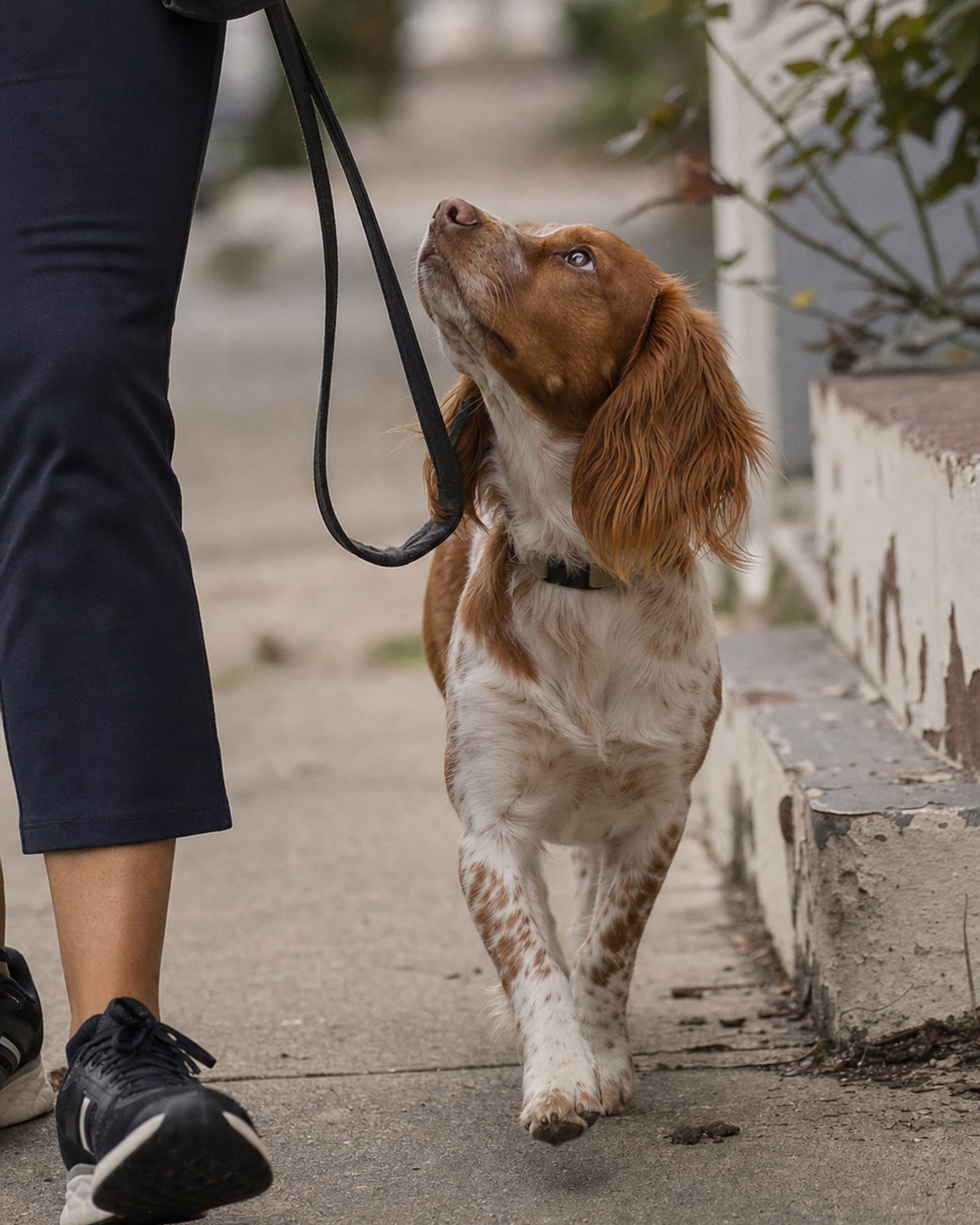
A dog walking at heel beside a handler's lower legs, cropped at the knee
These are the behaviors most obedience programs here are built around. Which ones we prioritise comes out of the first conversation and what I see in your house.
01
A walk you would choose to take. Your dog stops pulling because checking in with you pays better than dragging you, not because a piece of equipment is holding it back.
02
Coming back the first time, including when something interesting is happening. Built on a long line, proofed against real distraction, and never punished on arrival.
03
Waiting at thresholds instead of barging. In a rowhouse with a door straight onto the sidewalk, or a house at the top of steps, this is a safety behavior rather than a nicety.
04
Going to a spot and staying there while dinner happens, guests arrive, or a delivery comes. The single most useful behavior for a busy household.
05
Calm exposure at a distance your dog can handle, so it learns to watch the world go by and recover. Not forced greetings with every dog on the block.
06
Where it suits the dog and the goal. Fitted, conditioned, and taught to you properly, with clear rules for when it is used and when it is not.
Obedience is what you are training. The program is how it gets delivered, and there are three, so pick the one that fits your household rather than the biggest one.
In-home private lessons start at $700 for an evaluation plus four one-hour sessions. You are in every session, the work happens exactly where the problem is, and it suits a specific issue on a specific street. This is the most common choice and usually the right one.
Kick Start is $1,600 and puts a trainer in your home five days running, one hour a day, working your house, your neighborhood, and local parks. On the sixth day you get your own lesson on the behaviors you want addressed, and there is a follow-up two weeks later. All training equipment is included, and there is a continuation program if you want to keep building on it.
Board and train is $3,600 for two weeks on-leash or $4,800 for three weeks covering on and off leash, with your dog staying in my home rather than a kennel. It suits a dog that needs concentrated foundation work when the household genuinely cannot find consistent daily time. There is a la carte work at $175 per hour plus $60 per day for boarding, and a payment plan is available.
Whichever you choose, the transfer lesson is not optional. A dog does not automatically perform the same way for a different handler in a different place, so the point where the work moves from me to you is where results either hold or quietly unwind.
You tell me what your dog is doing and what you want changed. I tell you which program fits and whether I am the right person for it. That second answer is an honest one, not a sales call.
For serious behavior or an unusual household I come and see it myself. It is $100, it rolls into your training fee if you go ahead, and there is no obligation to go ahead.
Engagement and the core behaviors in the lowest-distraction version of your real environment, which is usually your own living room and your own back door.
The same behaviors on your street, at the park you use, and around the things that actually pull your dog. This is the part that decides whether the training survives contact with real life.
You learn the handling and the timing, with written homework you can actually do. Lifetime trainer support after face-to-face training, so if something shifts a year later you can still call.
If your dog pulls, ignores you outdoors, or cannot settle when the house is busy, call me at (443) 429-0445. I answer 6 AM to 7 PM, seven days a week. Tell me what is happening and I will tell you honestly what I would do about it and what it would cost.