

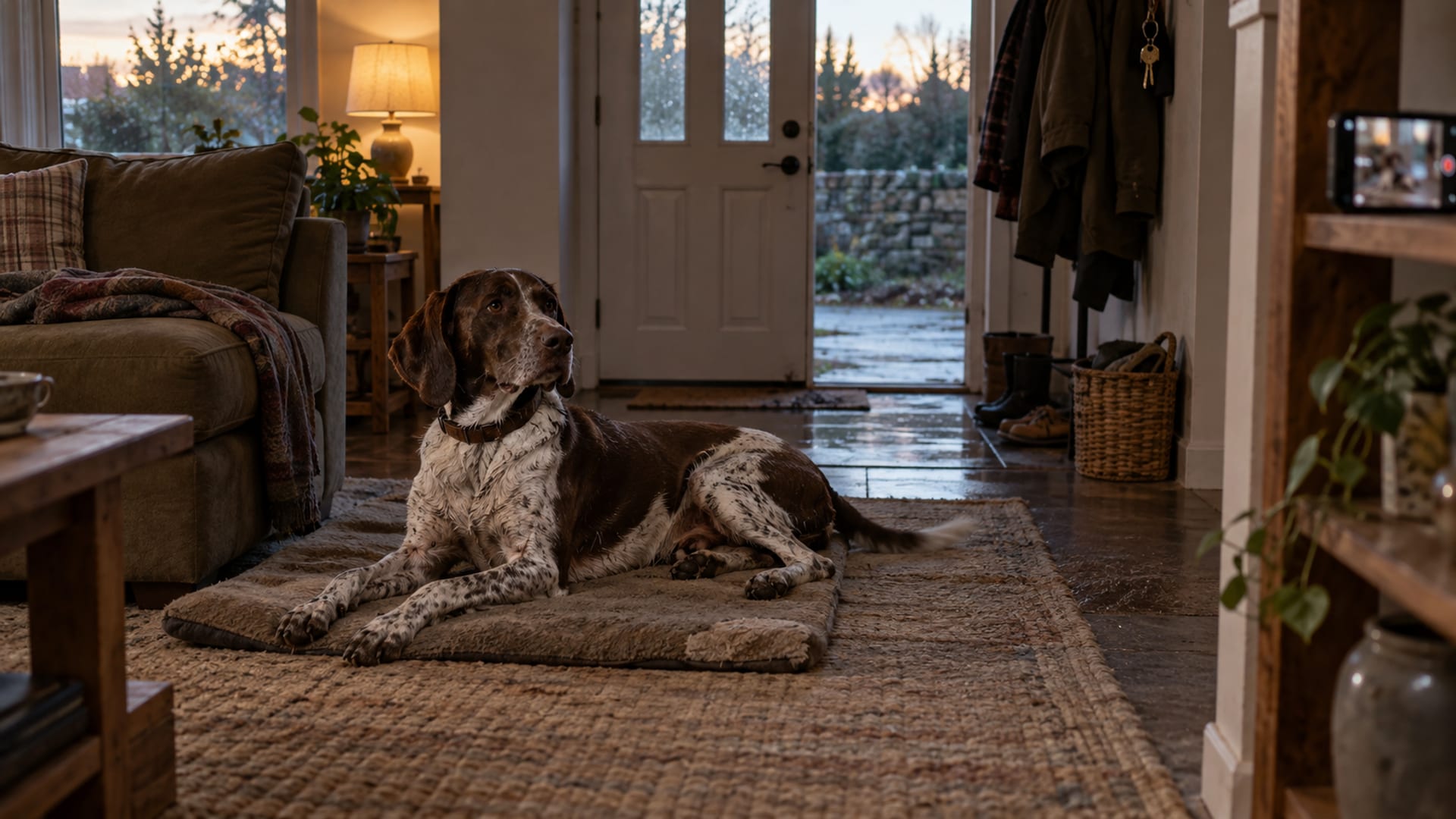
Separation anxiety is distress that is tied to being left, or to the moment just before you leave. Cornell's veterinary college and the RSPCA both describe it that way. It is worked on with small, gradual absences your dog can handle, plus a plan for the rest of the day so your dog is not panicking while the training happens. Crating the dog, a long run before you leave, or letting the dog cry it out will not fix it. Start with a vet visit, because pain and illness can look like anxiety. As for how long it takes, no schedule fits every dog, and I will give you the one published number there is and its limits further down.
Key takeaways
Hover or tap a card to bring it forward.
- Separation anxiety is distress tied to being left; see the vet first, because pain and illness can look like it.
- Training uses small absences below your dog's threshold, with a camera to catch early signs of worry.
- Patricia McConnell's six to eight weeks is her own estimate; the 2006 trial reported improvement at 12 weeks in its 30 cases, and neither is a promise.
- Covering the rest of the day with a sitter, walker, daycare or a friend keeps your dog from rehearsing panic.
- Medication is a vet's decision, used alongside behavior work and never in place of it.
Is it separation anxiety or something else?
You need to know what you are treating before you start. The RSPCA says the signs usually begin before you leave or within a few minutes to 30 minutes after you go, and they are tied to your absence. That means destruction at doors and windows, howling or other distress calls, toileting, pacing, drooling, vomiting, or refusing food. A dog that chews the couch out of boredom, barks at a delivery truck, or has accidents because house training is not finished has a different problem with a different fix.
If your dog is doing some of this and you are not sure which it is, the post on 7 surprising signs your dog has separation anxiety walks through the signs to watch for. Then put a camera on the dog, which I cover below, because what happens when you are gone is the only real answer.
Some things send you to the vet before any training. Go first when the change is sudden, when the distress is severe, when the dog is older, or when it comes with pain, vomiting, diarrhea, increased thirst or urination, trouble moving, confusion, seizures, hurting itself, or a change in sleep. The Merck Veterinary Manual says a behavior diagnosis needs a detailed history, a physical and neurological exam, and tests the signs call for. Pain, urinary and digestive disease, hormone problems, failing eyesight or hearing, and cognitive decline can all produce restlessness, accidents and anxious behavior. Cornell calls cognitive dysfunction a diagnosis of exclusion in older dogs, meaning the vet has to rule out the other causes first. Tufts adds that pain, itching, illness and discomfort can lower the point at which a dog becomes anxious, so a dog that is often anxious should see a vet soon.
Hover or tap a row to highlight it.
| What you see | What it usually points to |
|---|---|
| Distress that starts before you leave or within minutes to 30 minutes after | Separation anxiety, tied to your absence |
| Destruction at doors and windows, howling, toileting, pacing, drooling, vomiting, refusing food | Separation anxiety, when it happens around your absence |
| Chewing the couch | Boredom |
| Barking at a delivery truck | Reacting to what is outside |
| Accidents when you are home too | House training that is not finished, or a medical cause |
| A sudden change, or distress with pain, vomiting, diarrhea, thirst, confusion or seizures | A vet visit before any training |
Who gets it, and what the numbers do and do not mean
You may be wondering whether something you did caused it. The research on this is mostly clinic records and questionnaires, so it shows patterns, not causes.
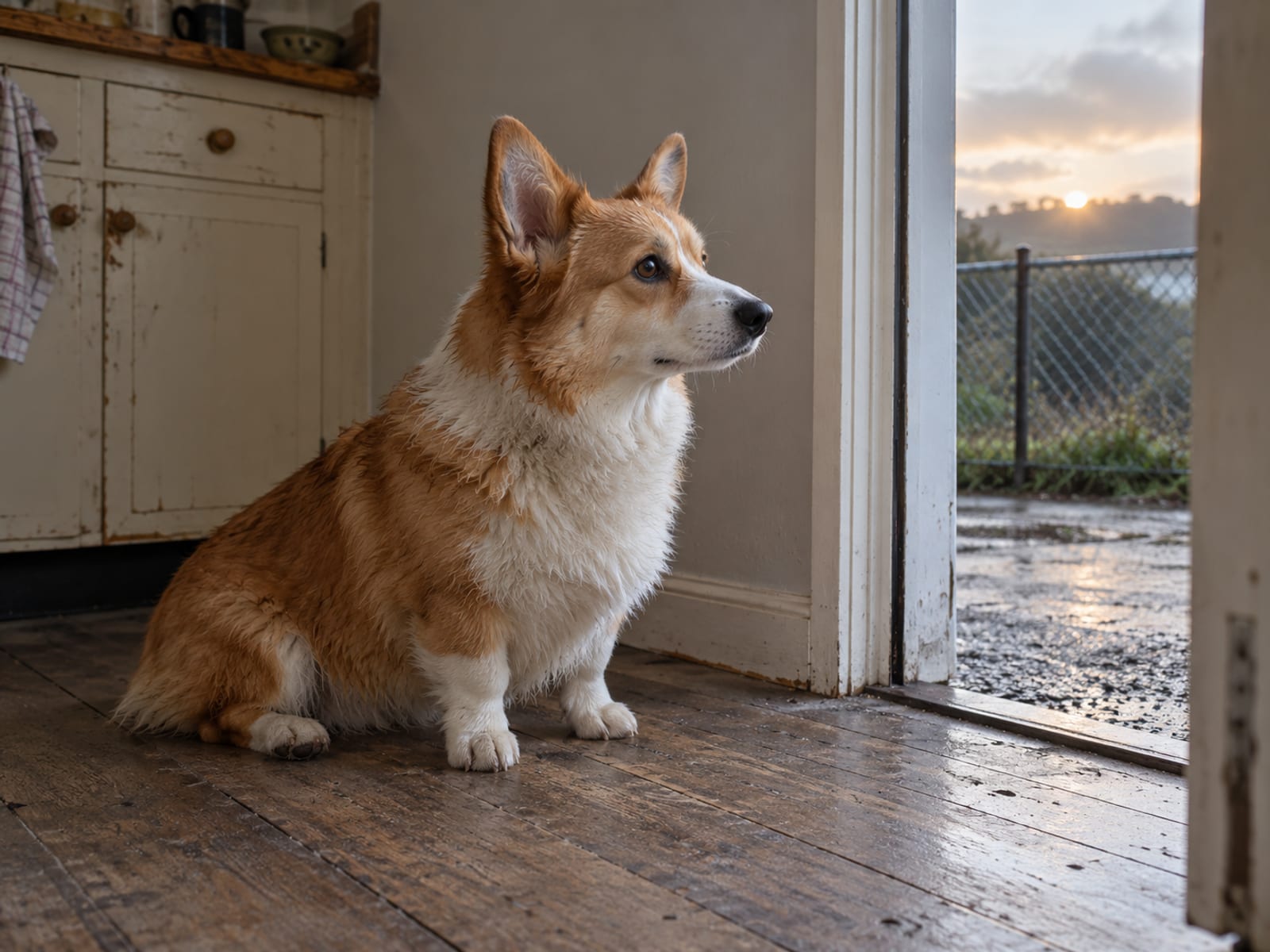
Flannigan and Dodman compared 200 dogs with separation anxiety to 200 dogs with other behavior problems, in a 2001 paper in the Journal of the American Veterinary Medical Association. Dogs from homes with a single adult were about 2.5 times as likely to have separation anxiety. Extreme following, distress at departure cues and over-the-top greeting were also linked to it. Other pets in the home were not. The paper worked from clinic records, so it does not show that a one-adult household causes the problem.
Storengen and colleagues looked at 215 dogs at a behavior clinic in 2014, who made up 22.6 percent of 952 patients. Of those 215, 82.8 percent had another behavior diagnosis too, and noise sensitivity was the most common at 43.7 percent. That is a clinic sample, not a count of all dogs. It does tell you that a dog who panics alone may also be afraid of storms or fireworks, and my post on common dog phobias and their solutions is worth reading if that sounds like your dog.
In a 2011 study of 45 family dogs, Konok, Doka and Miklosi found that dogs whose owners reported separation problems showed more stress behavior, more contact with the door and more intense greetings in a short separation test. The test was short, so it says little about a full workday alone.
Then there is a UK study that followed 1,807 dogs through COVID restrictions. Reported signs fell from 22.1 percent to 17.2 percent as time alone shrank, and 9.9 percent of dogs developed new signs by the follow-up. That is an association from an unusual stretch of time. If your household has just moved, changed jobs or lost a person, New Home, New Rules covers how dogs react to those changes.
Hover or tap a row to highlight it.
| Study | Who was studied | What it reported |
|---|---|---|
| Flannigan and Dodman, 2001 | 200 dogs with separation anxiety, 200 with other problems | Single-adult homes about 2.5 times as likely; other pets in the home not linked |
| Storengen and colleagues, 2014 | 215 dogs, 22.6 percent of 952 clinic patients | 82.8 percent had another diagnosis; noise sensitivity in 43.7 percent |
| Konok, Doka and Miklosi, 2011 | 45 family dogs | More stress behavior, door contact and intense greetings in a short separation test |
| UK study through COVID restrictions | 1,807 dogs | Signs fell from 22.1 to 17.2 percent as time alone shrank; 9.9 percent developed new signs |
How the training is done
The usual method is desensitization and counter-conditioning below your dog's threshold. You expose the dog to a departure or a short absence at a level that does not upset it, keep the dog calm, and make it a little harder over time. The threshold is the point where your dog is still comfortable. Cornell's starting point is to walk out of the room and straight back, then lengthen the time out of sight little by little.
Malena DeMartini's published guidance puts it plainly: keep every absence at or under the threshold. For some dogs that starts at seconds, or at an even smaller step such as a change in distance. There is no standard first number, and the threshold can move from day to day. If the next absence needs to be shorter or easier, make it shorter or easier.
Patricia McConnell's I'll Be Back approach starts with the cues that tell your dog you are leaving. Pick up your keys, give a treat, put the keys down, walk away and sit back down. Repeat it five times. Then you work through each of your dog's other departure cues the same way. She also asks for calm arrivals and departures, and for no punishment when you come home to a mess.
Karen Overall's relaxation protocol builds a different skill: staying physically relaxed while you move away. You reward relaxed body signals, make the exercise easier when worry appears, and use very small steps. The goal is a loose dog, not a dog held in a stiff sit. It is a foundation for the rest of the work, not a promise that your dog will handle a long absence.
Use a camera, and watch the early signs
You cannot see the dog's real response from inside the house. The UC Davis behavior service asks owners for 20 minutes of footage with the camera aimed at the exit door and you actually out of the house, not hiding in the next room. If the dog is crated, they want footage in the crate and out of it.
Watch for the early signs, which come before barking or destruction: scanning, stiffness, lip licking, panting, a change in posture, or stopping food. When the footage shows worry, the next absence gets shorter or easier. That is how you stay under the threshold instead of finding it by blowing past it.
McConnell's Departure-Cue Exercise
- Pick up your keysPick up the keys and give your dog a treat.
- Put the keys downSet them down again.
- Walk awayWalk away and sit back down.
- Repeat five timesRun the whole sequence five times.
- Move to the next cueWork through each of your dog's other departure cues the same way.
How long it takes
Here is the honest answer. McConnell's published estimate is six to eight weeks for cases that follow her schedule exactly. That is her figure for her program, not a promise for your dog. A 2006 controlled trial of a behavior-modification program included 30 individualized cases, and the owners reported improvement after 12 weeks. That supports a 12-week window for that program, and it does not mean every dog improves in 12 weeks.
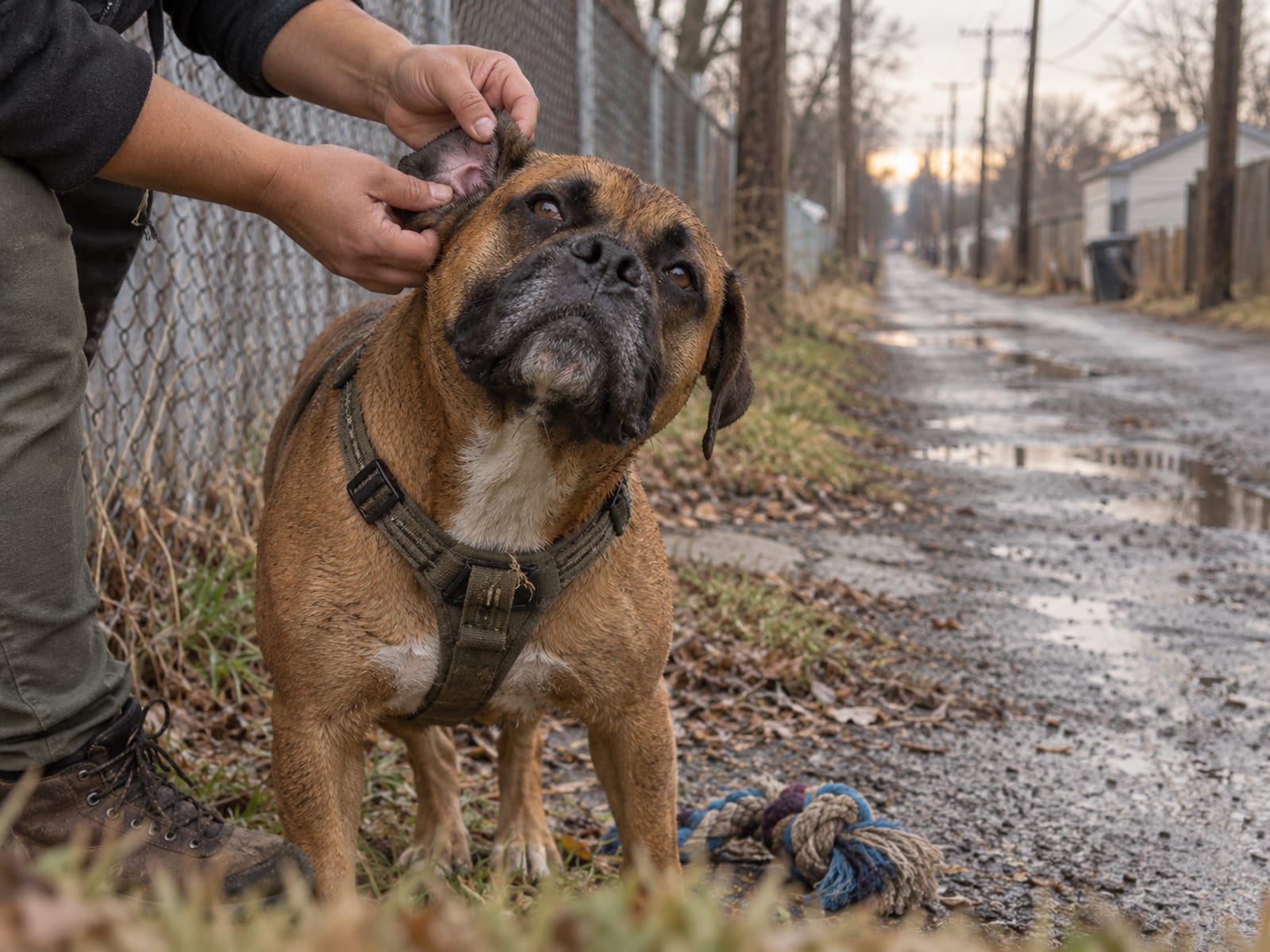
Some dogs take longer. The Takeuchi, Houpt and Scarlett study followed 52 dogs for six to 64 months after their behavior exam, and 62 percent had improved. So, plan in weeks to months, expect the pace to follow your dog's threshold and not the calendar, and judge progress by whether the dog is calmer at each step.
Hover or tap a row to highlight it.
| Source | What it reported | What it does not mean |
|---|---|---|
| Patricia McConnell | Six to eight weeks for cases that follow her schedule exactly | A promise for your dog |
| 2006 controlled trial | 30 individualized cases, owners reported improvement after 12 weeks | Every dog improves in 12 weeks |
| Takeuchi, Houpt and Scarlett | 52 dogs followed for 6 to 64 months, 62 percent improved | Every dog improves |
The rest of the day decides whether the training works
This is the part owners skip, and it is the part that makes or breaks the plan. Every long absence where your dog panics is a full rehearsal of the panic. The RSPCA says each time a dog becomes highly distressed, stress hormones are released that can take days to settle, and that leaving a dog to cry it out can teach the dog that being alone is terrifying.
The RSPCA also says, "We recommend that you don't leave your dog alone for more than four hours; for puppies much less." A dog with this problem may panic within minutes of you leaving, or even before you go. So, for a dog in training, four hours is a ceiling for a dog without this problem, not a target for yours. The University of Illinois makes a related point: a dog that tolerates 30 minutes has not shown it can tolerate eight hours.
Your options for covering the gaps are a sitter, a dog walker, daycare, a friend or family member, or taking the dog with you. Tufts gives the same advice for separation-related destruction: do not leave the dog alone, and consider daycare or a sitter. Illinois lists daycare, boarding at a vet clinic, or bringing the dog to work.
A few more practical points:
- Crates are not automatic treatment. DeMartini warns that some dogs with separation anxiety also have confinement anxiety, and a crate or small gated area can make their distress worse. Illinois suggests an easy-to-clean restricted space with the crate left open as a resting place. That is why UC Davis wants footage both ways.
- Walk and toilet before you go. The RSPCA recommends a walk and some settling time before you leave. It will not replace the training when a dog is panicking, but it removes a competing need.
- Treat food toys as a test. A dog that eats a stuffed toy while you are home and refuses it when you are gone is telling you it is worried. A severely anxious dog may not eat at all.
- Calming pheromone has thin support for this. A placebo-controlled trial of 43 hospitalized dogs found fewer behaviors such as pacing and excessive licking in the pheromone group, but those dogs were hospital patients, not dogs with separation anxiety at home.
- Sound is optional. The RSPCA says a radio may muffle noise from outside. If you try a television or white noise, keep it only if your dog stays relaxed, and stop if you see panting, lip licking, watching the door, barking or other distress.
Separation anxiety at night
Night distress is not always separation anxiety. A dog that wakes, paces or cries at night may need to toilet, or may be in pain, losing sight or hearing, going through cognitive changes, or reacting to noise. If an older dog has new night waking, pacing, confusion or accidents, call the vet first. The Merck Veterinary Manual and Cornell both list those causes.
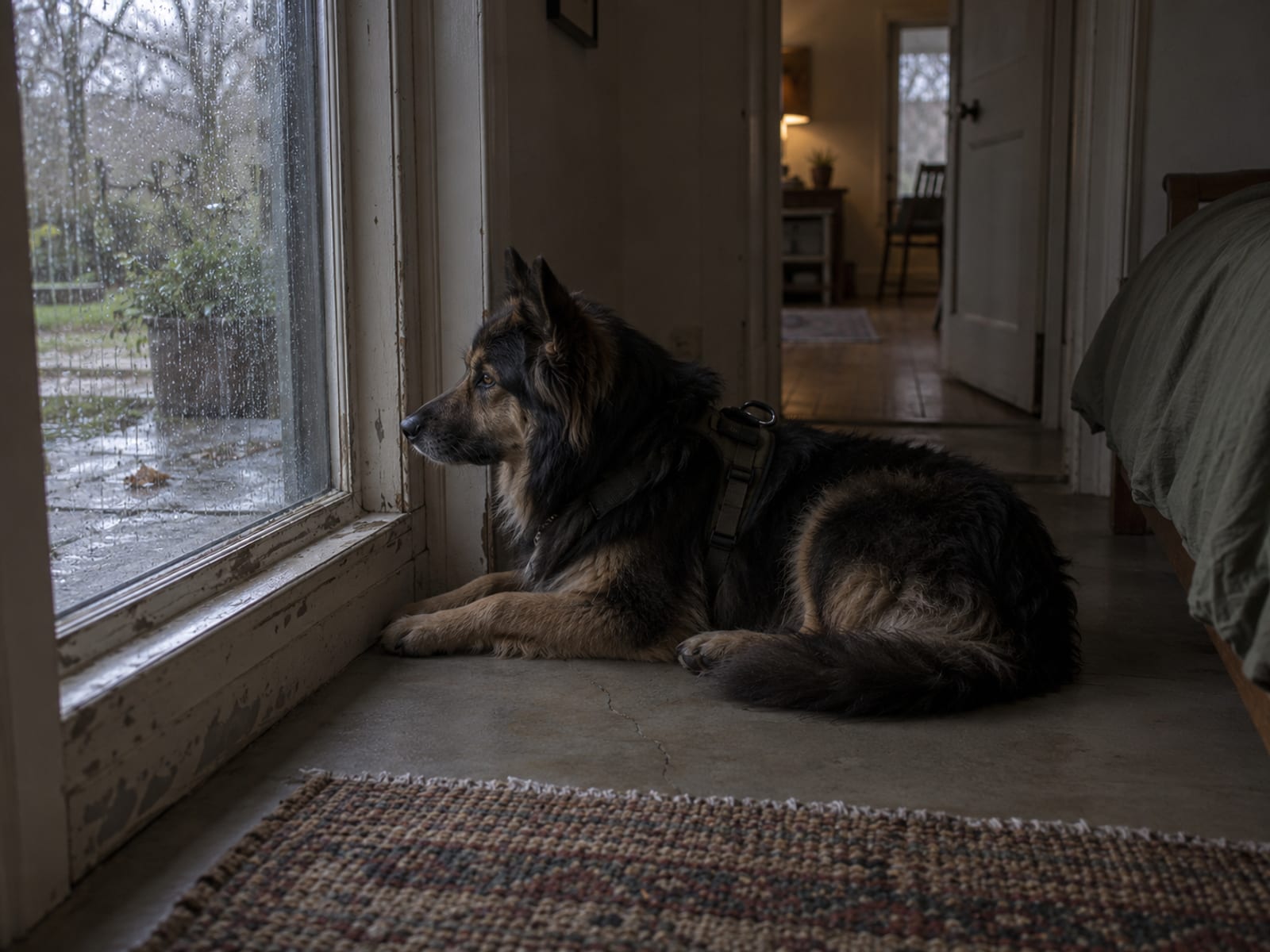
If your dog is very dependent on you and sleeps in your bed, the University of Illinois suggests a bed beside yours as an in-between step toward independence. That is a behaviorist's advice for building independence. It is not proof that the bed caused the problem.
The RSPCA's guidance for rescue dogs allows a newly settled dog to sleep in the bedroom or close by for a while, then learn to sleep alone gradually if that is your goal. Give a toilet opportunity, keep the routine calm, and watch whether the dog settles afterward.
Medication is a vet's call
Tufts, Cornell, UC Davis and Illinois all describe medication as an addition to behavior work, never a replacement for it. Cornell says it may be right when the dog, the owner or the relationship is suffering, and that it may be temporary or longer term. UC Davis says medication is never the sole answer and may help dogs with severe fear or anxiety whose quality of life is reduced.
The numbers come with limits. In the Takeuchi, Houpt and Scarlett follow-up, 27 of the 52 dogs also received amitriptyline or another medication, and 15 of those 27 improved. Treatment was not randomly assigned, so that study cannot tell you how medication compares with behavior work alone. A clomipramine trial was randomized, double-blind and placebo-controlled, and every dog also had behavior therapy; at some points more dogs on the drug were rated improved for destruction, soiling and overall behavior. A fluoxetine trial paired the drug with behavior management, and a review reports improvement in 72 percent of dogs on fluoxetine versus 50 percent on placebo. That is a group result. It does not mean every dog improves.
I do not recommend any product or dose, and no training article should. A vet has to consider medical causes, other conditions, side effects and how your dog can take part in training. Call your vet or a veterinary behaviorist.
Hover or tap a row to highlight it.
| Study | What it found | Keep in mind |
|---|---|---|
| Takeuchi, Houpt and Scarlett | 27 of 52 dogs also got medication; 15 of those 27 improved | Treatment was not randomly assigned |
| Clomipramine trial | At some points, more dogs on the drug were rated improved for destruction, soiling and overall behavior | Every dog also had behavior therapy |
| Fluoxetine trial | Improvement in 72 percent on fluoxetine versus 50 percent on placebo | A group result, paired with behavior management |
When it is urgent, and when to call me
Get veterinary help right away if your dog:
- breaks teeth or claws, or has bleeding or damaged paws
- breaks through doors, windows or crates
- vomits repeatedly or collapses
- refuses food and water
- shows sudden, severe distress, especially an older dog
The RSPCA, Tufts and UC Davis all treat self-injury as the most urgent safety issue. Get a veterinary behaviorist involved too if your dog's quality of life is clearly reduced or you cannot prevent the panic. If a dog this stressed has also started growling or snapping, When Stress Bites explains anxiety-based aggression and how to handle it safely.
My evaluation looks at your dog's whole day and the exits in your house. In-home lessons let me coach the graduated absences with your real door, and board and train in my home can help with parts of the training. Medication questions go to your vet. If you want to start, contact DW Dog Training.
FAQ
Can separation anxiety be trained out of a dog?
Many dogs improve with gradual training below their threshold, with a plan for the rest of the day. The Takeuchi, Houpt and Scarlett follow-up found 62 percent of 52 dogs improved. Improvement is not the same as a promise for your dog, so ask your vet and trainer what to expect.
How long can a dog stay alone before showing distress?
For a dog with separation anxiety, it can be minutes, and the RSPCA says panic can start before you even leave. The RSPCA's general advice is no more than four hours alone for a dog without this problem, and much less for puppies. Use a sitter, walker, daycare or a friend while you train.
Does a crate help with separation anxiety?
Not automatically. Some dogs also fear confinement, and a crate or small gated area can raise their distress. Film the dog in the crate and out of it before you decide.
What should I do about separation anxiety at night?
Rule out pain, toileting needs, sensory loss and cognitive change first, especially in an older dog with new night waking. If it is separation distress, a bed beside yours can be an in-between step toward sleeping apart.
Check What You Picked Up
What should you do before starting separation training?
What does "below threshold" mean in training?
Why use a camera?
Why does the rest of the day matter?
Is a crate automatic treatment for separation anxiety?
Who decides on medication?
Answer a question to see your score.