01
The dog who drags you toward people
The friendly version of the problem above. Extremely common, entirely fixable, and it usually needs the owner to stop letting the pulling work.
Half a mile of promenade between Tydings Park and Concord Point, First Fridays, festivals, four museums and a steady supply of visitors. Walking a dog here means somebody reaches for him roughly every three hundred yards, and most owners have never decided what they want to happen next.
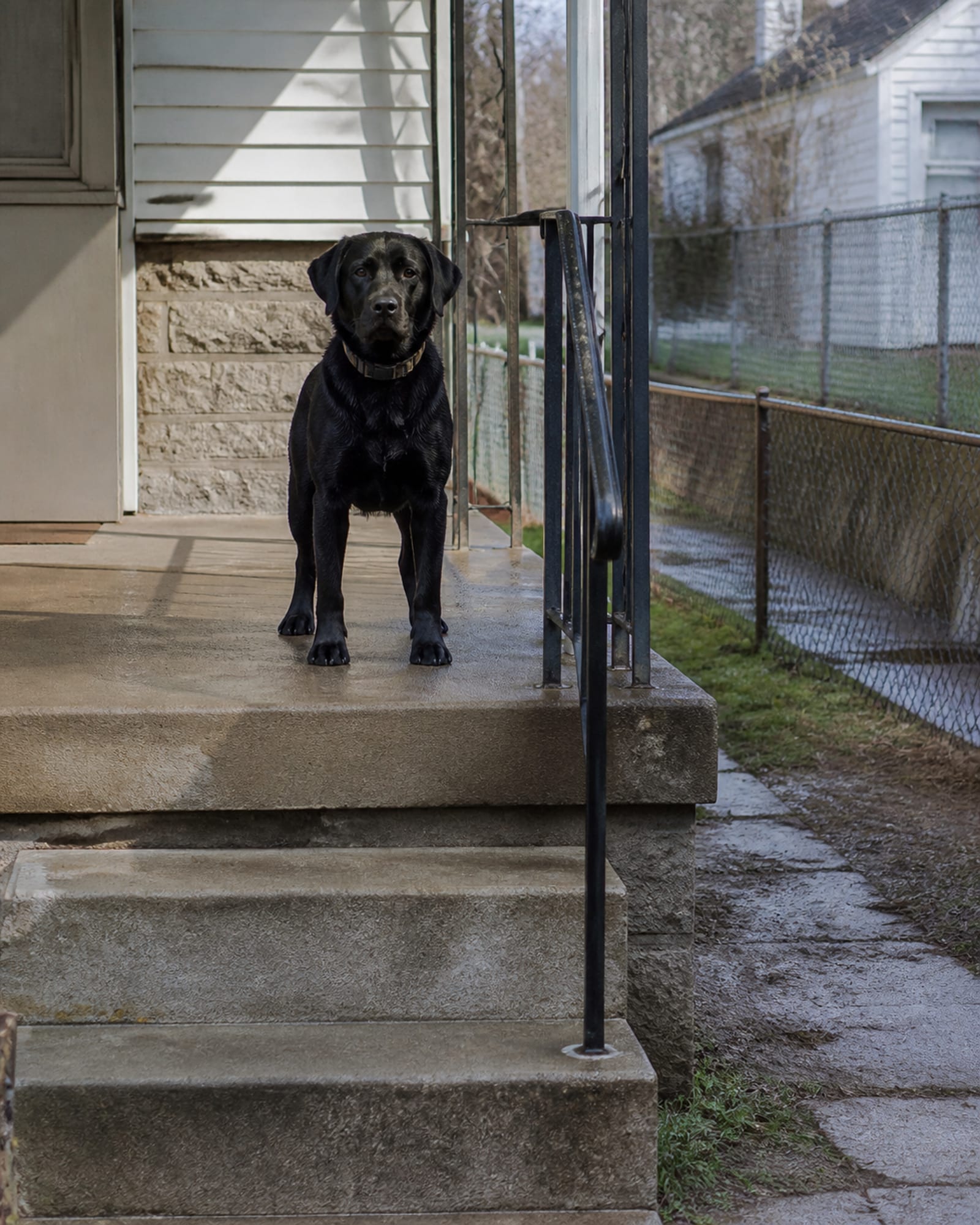
A dog standing alert with its weight even, tail neutral, in Havre de Grace, MD
It comes over the top of the head, usually. The person is smiling, they are being nice, and they are already touching your dog by the time the sentence finishes.
This town produces that moment more than anywhere else I work. The Promenade runs half a mile of wood decking, concrete and brick with observation decks and benches, and it is busy. Downtown carries First Fridays, summer concerts, the Children's Art Festival and a waterfront event calendar. The Decoy Museum, the Maritime Museum and the Lock House bring people in from outside, and the Lafayette Trail threads 57 historic sites through the streets. Add 15,222 residents in a compact town where 91.8% of people were here a year earlier, and everybody knows everybody's dog.
All of which is lovely. It also means your dog is being handled, unpredictably, by strangers, several times per walk, and whatever he learns from that he is learning whether you planned it or not.
Three quite different dogs, three quite different outcomes, and none of them is the one the stranger imagines.
A confident, sociable dog learns that strangers are a source of attention and that pulling toward them pays. That is the friendly dog who becomes impossible to walk past anybody, and owners rarely connect the two because the behavior looks like enthusiasm rather than a training failure. It is a training failure. It was just a pleasant one to build.
A cautious dog learns something worse, which is that his opinion does not count. He backs off, the hand follows, he freezes, the person says he is fine, and he tolerates it. What has been taught is that moving away does not work. The next dog in that sequence tries something that does work, and that is where a growl or a snap comes from, apparently out of nowhere, months later.
A puppy learns whichever of those two you allow, and it sticks. This is the age where it matters most and it is the age where people are least likely to intervene, because refusing a stranger who wants to greet a puppy feels rude.
So the skill is not really a dog skill. It is yours. You have to be willing to say no, out loud, to a pleasant person on a promenade, and most people would rather let their dog be mildly frightened than be thought unfriendly for four seconds. Once an owner gets comfortable with that sentence, a surprising amount of the dog's behavior sorts itself out.
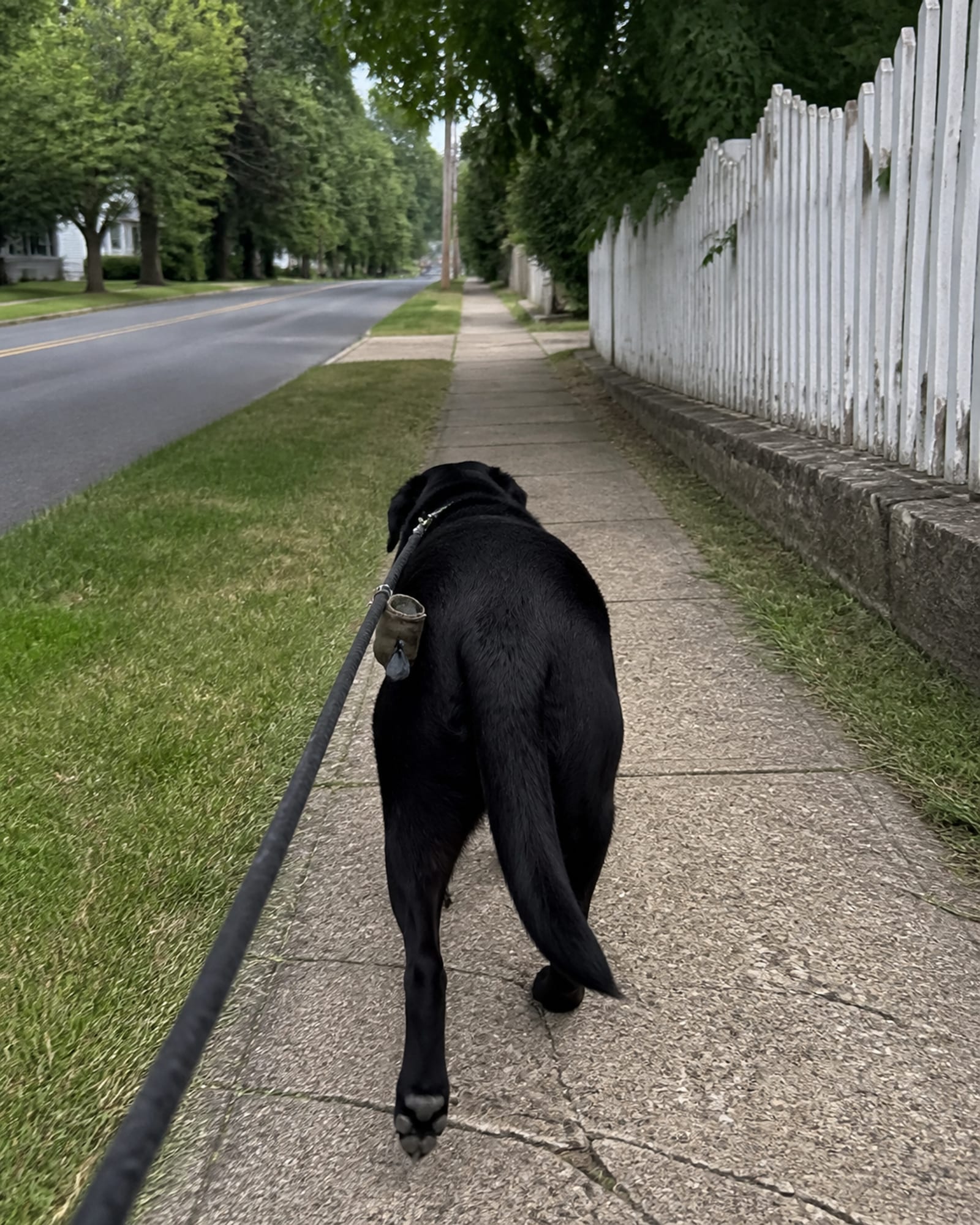
A dog walking away from camera down a pavement, seen from behind, in Havre de Grace, MD
Does your dog genuinely enjoy strangers, tolerate them, or dislike them? Be honest. Everything below depends on that answer and most owners have never actually asked the question.
One step, so your body is between the hand and the dog. It buys you three seconds and it does more than any sentence you could say.
"He is in training, thank you." It works because it is not an accusation and it is not up for discussion. Practice it aloud once so it arrives smoothly.
A sit, a hand touch, a look at you. A dog with something to do is not making a decision about the stranger, and it turns an awkward moment into a repetition in your favor.
If you want the greeting, ask the person to crouch sideways and let the dog approach them. That single change turns a threatening gesture into an ordinary one.
Leave while the dog is still comfortable rather than at the point he has had enough. Ending early is what makes him confident about the next one.
Children are the version of this that owners worry about most, and rightly.
Children move fast, make noise, arrive at head height and reach without pausing. A dog that is patient with adults may be entirely unprepared for that, and the Children's Art Festival, the summer concert crowds and an ordinary Saturday on the Promenade all supply it in quantity. The training answer is the same as above but the standard is higher, because a child cannot be relied upon to read a warning and back off.
My position on it is unfashionably firm. If your dog is uncertain about children, he does not get to practice being uncertain about children in a crowd. You work at a distance he can handle, in a place you choose, until he is genuinely relaxed, and until then you decline every approach. That is not depriving him of anything. It is stopping him rehearsing the thing you are trying to remove.
The town supplies some quieter alternatives when you need them. North Park, McLhinney Park, Jean Roberts Park and the Joe K Trail on the north side are far less trafficked than the waterfront, and Susquehanna State Park is minutes away if you want space. Bulle Rock has its own network of private paths, and it also has golf carts, which are worth mentioning because a silent wheeled vehicle appearing behind a dog is a surprise no amount of traffic work has prepared him for.
The waterfront itself has one more feature that matters. Geese, ducks and gulls sit on the water in numbers, and a dog who is otherwise perfectly polite with people can be a completely different animal when a flock lifts off. That is a recall question rather than a greeting one, and it needs building on a long line before it is ever tested near an open edge.
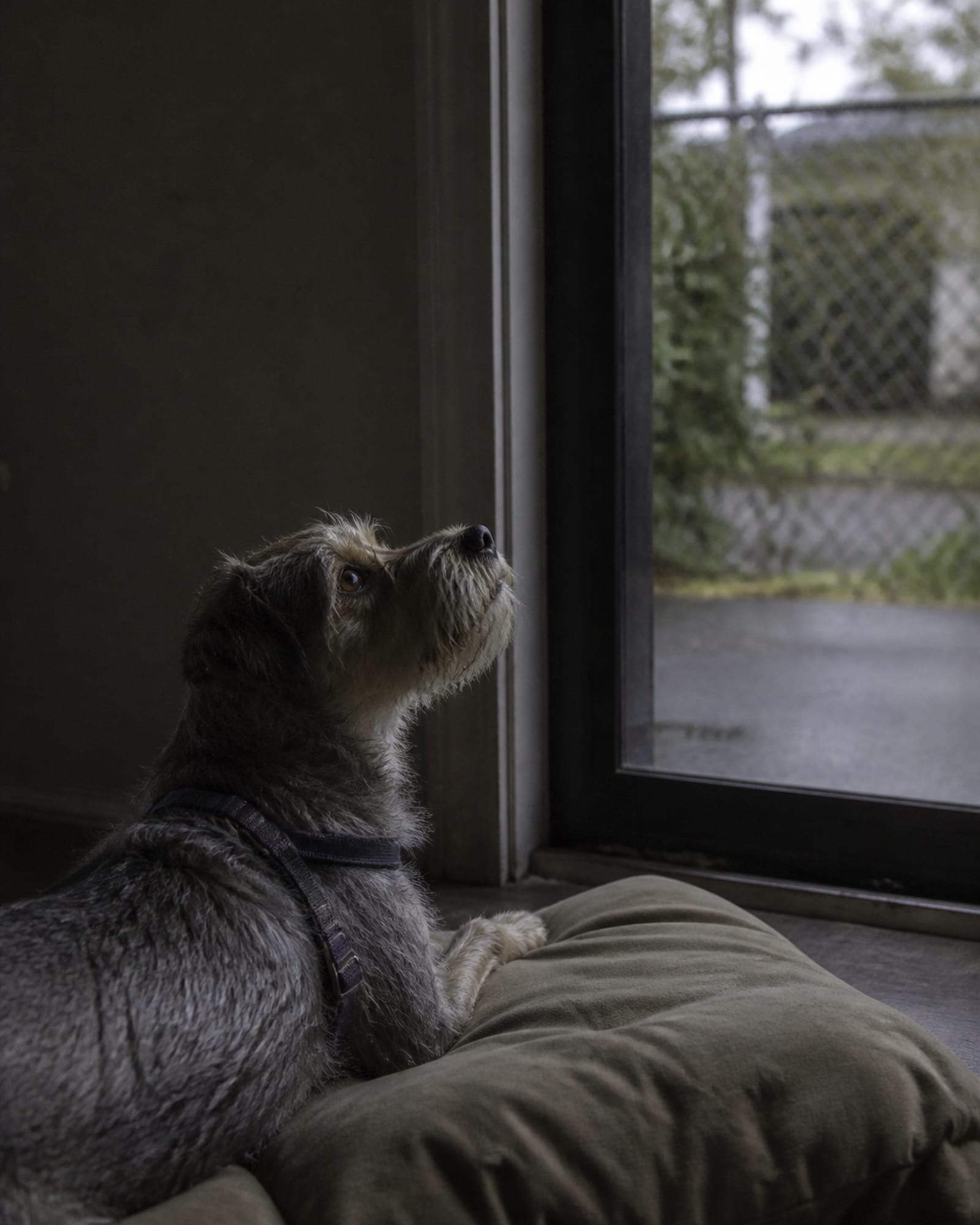
A dog looking up from a down, chin low, eyes raised, in Havre de Grace, MD
A compact waterfront town with a visitor calendar and an older resident profile.
01
The friendly version of the problem above. Extremely common, entirely fixable, and it usually needs the owner to stop letting the pulling work.
02
Almost always a dog whose earlier signals were ignored. It responds well to work and it needs an evaluation rather than a walking tip.
03
22.0% of residents here are 65 or older. Having a dog you can physically hold in a crowd is not a small thing, and equipment and position come before obedience.
04
Geese, ducks, gulls, boats and wind off the bay. A recall built in a yard has met none of it.
05
CSX and Amtrak lines run through, and US 40 crosses the Hatem Bridge. Sound and vibration on a schedule, which makes it trainable rather than random.
06
Historic downtown blocks with close sidewalks and shared halls, and planned communities like Bulle Rock and Greenway Farm with villas, condominiums and cart paths.
Phone (443) 429-0445, seven days a week from 6 AM to 7 PM. Tell me what your dog does when a stranger approaches, including the parts you have been calling friendliness.