01
Barking at sound, not sight
In a detached house a dog barks at what it sees. In an attached house it barks at what it hears through a wall, which is constant and invisible. The training has to address the sound itself, not the window.


Nearly half of Dundalk's homes are attached to another home. That single fact decides which behaviors matter here and which ones you can safely ignore.

A dog sitting beside a gatepost, upright and calm, in Dundalk, MD
46.7% of housing here is attached single-family, against 37.2% detached. Add the buildings of five units or more and the majority of Dundalk dogs live with someone on the other side of a wall. Two thirds of the housing stock was built before 1960, and a lot of that construction carries sound in a way newer building does not.
So the behaviors that get people evicted, reported or quietly hated in Dundalk are not the ones that get talked about most. Barking at footsteps in a stairwell. Howling from 8 AM. Scrabbling at a party wall because there is a dog on the other side of it. A dog that is a delight in the house and a menace at the front step because the front step is four feet from a public sidewalk. Those are the calls I get from this part of Baltimore County, and they are all fixable.
Old Dundalk was laid out as a Garden City style planned company town, with curving streets, mixed densities and a civic center, and the shape of it still governs daily life.
Turner Station carries twentieth century Colonial Revival housing and the Day Village rowhouse community. Elsewhere you get porches, narrow walks, alleys, basements and compact yards, with 37.2% of all housing built in the 1950s alone. Very little of Dundalk is a large detached lot with a deep buffer between you and anyone else.
That geometry means the dog gets far more rehearsals per day than its owner realizes. A dog on a porch in Rodgers-style close housing sees people at conversational distance dozens of times between breakfast and dinner. Each one is a repetition. If the dog barks and the person walks on, which they always do, the dog has just been rewarded for barking. Do that four hundred times and you have a habit that no amount of shouting will undo.
The practical answer is not more discipline. It is removing the rehearsal and replacing it with a behavior that pays better. That usually means changing what the dog can see, changing where it waits, and giving it something specific to do when the trigger appears. It is unglamorous and it works.
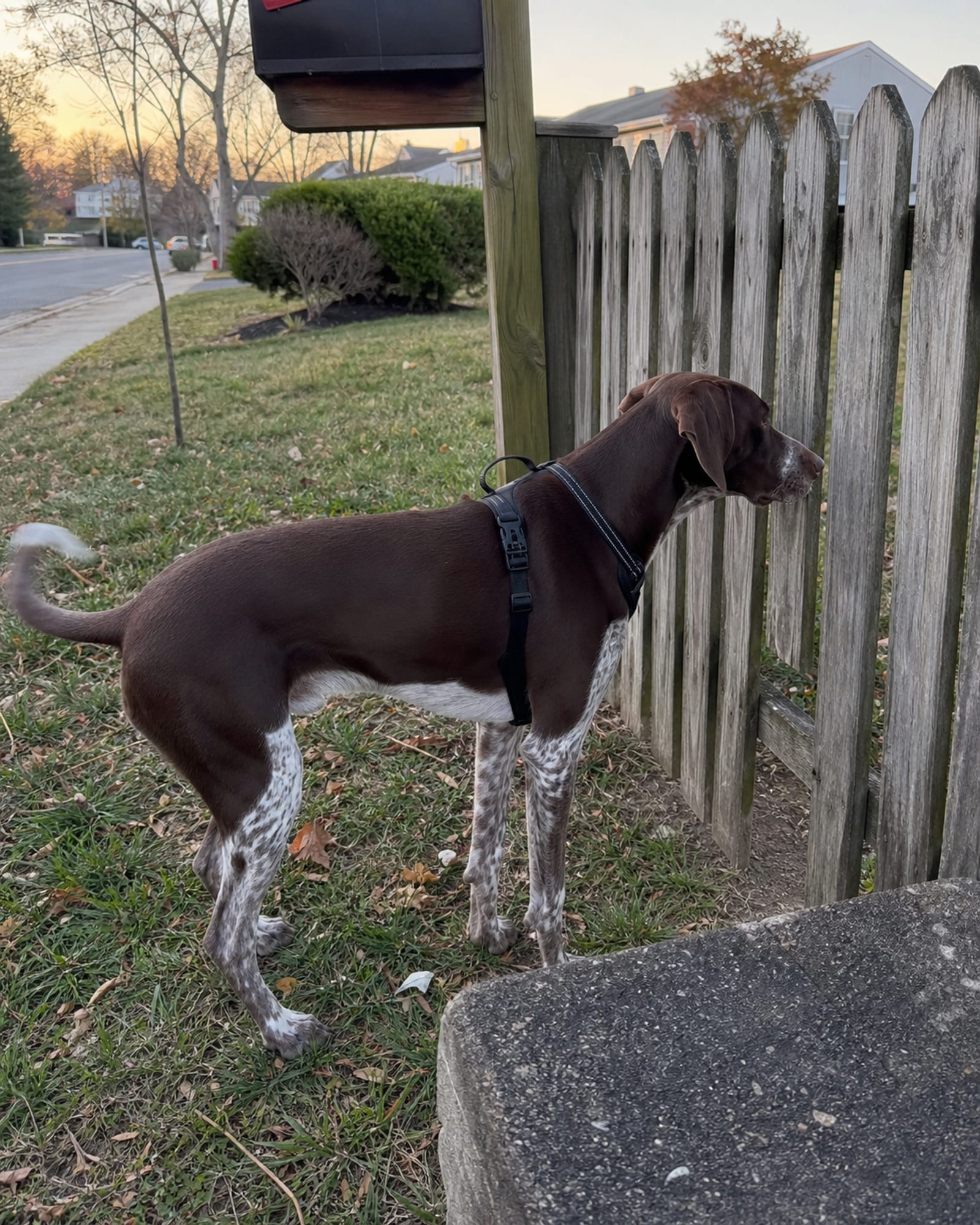
A dog standing beside a fence line, nose to a gap, in Dundalk, MD
Ranked by how often they come up on this side of the county.
01
In a detached house a dog barks at what it sees. In an attached house it barks at what it hears through a wall, which is constant and invisible. The training has to address the sound itself, not the window.
02
Howling and destruction while you are out is the fastest route to a complaint. It is also often anxiety rather than boredom, and the two need opposite plans. My anxiety and nervousness page sets out the difference.
03
A front door that opens onto a shared walk needs a dog that holds position while it opens. This is the single highest value behavior in Dundalk and it is very teachable.
04
Rear alleys and close fences let two dogs practice a fight through a barrier every day. Neither one ever gets to finish it, so it escalates rather than resolves.
05
There is no room to swing wide around an oncoming dog on a Dundalk sidewalk. Loose leash walking stops being a nicety and becomes the thing that lets you leave the house.
06
For the third of Dundalk households who rent, the shared entry is where every problem becomes public. A dog that can walk a stairwell calmly changes your whole tenancy.
Household incomes here sit well below the Baltimore County average, and I am not going to pretend a residential program is a casual purchase in Dundalk.
Board and train starts at $3,600 for two weeks. That is real money in any household and it is more noticeable in this one. So I would rather tell you where it is worth it and where it is not. It is worth it when the behavior needs daily repetition that your working week genuinely cannot supply, or when the problem is serious enough that inconsistent practice is making it worse. It is not worth it when the real issue is that nobody at home has been shown what to do, because then you are paying me to do something you could do yourself with four lessons.
In-home private lessons are $700 for an evaluation plus four one hour sessions spread over about two months, with lifetime support by phone afterward. For a lot of Dundalk households that is the right answer and I will say so. Kick Start, at $1,600, sits between the two: five consecutive daily sessions in your home and your neighborhood, then a lesson for you.
Payment plans are available on the in-home and board and train programs. And the evaluation itself is $100, in your home, with no obligation, and it comes off the training fee if you go ahead. If the honest answer after that evaluation is that you do not need me, you will hear it.
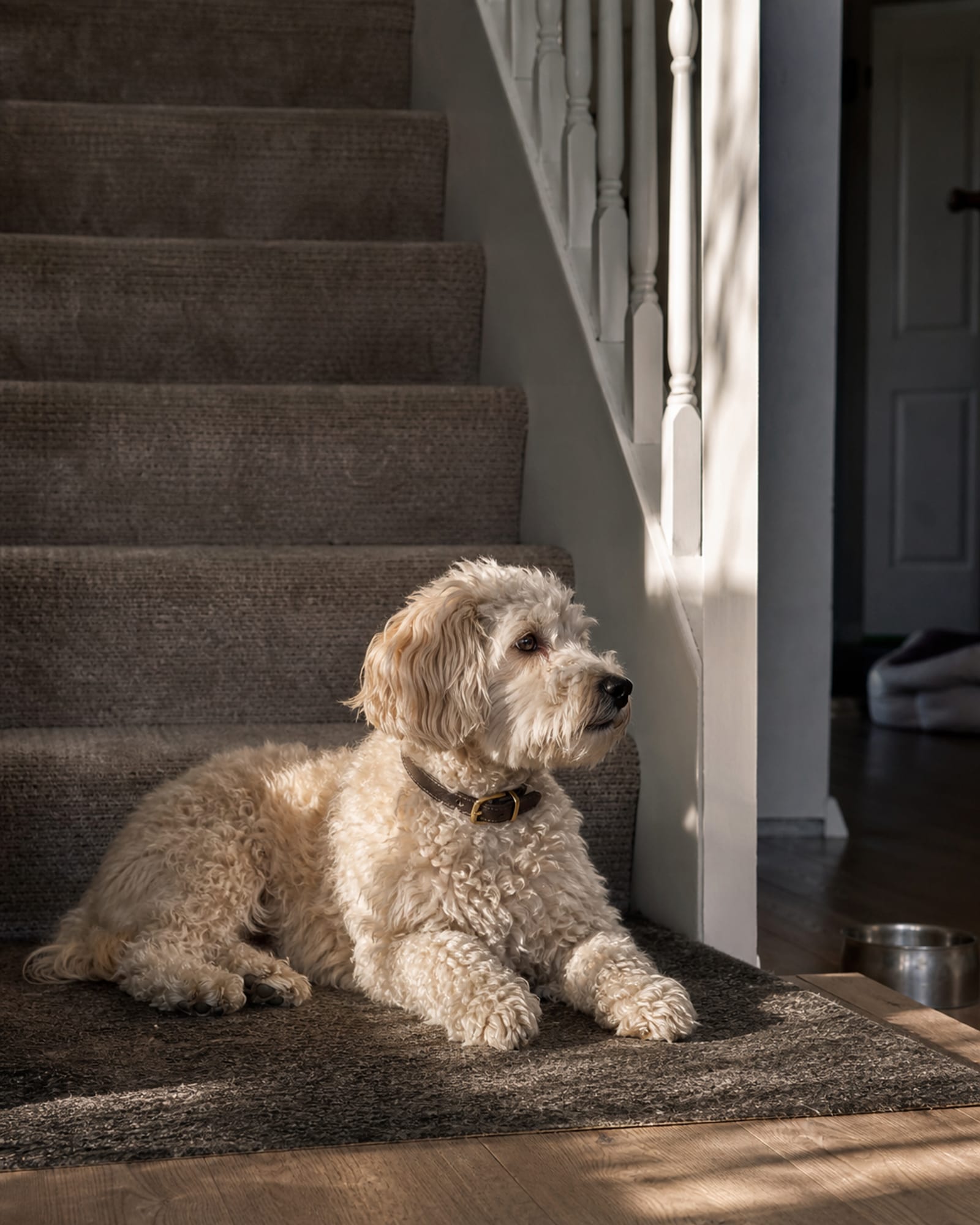
A dog lying along the foot of a staircase, banister rising, in Dundalk, MD
Training has to happen on the ground you use, and Dundalk's ground has some particular features.
Heritage Park on Playfield Street, Bear Creek Park, Stansbury Park with its pond and walking path, and the wider North Point Peninsula give you real practice space. The waterfront brings its own wildlife, and the county reports that Greater Dundalk holds roughly 3,851 acres of impervious surface with only about a tenth of the Sustainable Community draining to stormwater facilities that treat water quality. After a storm that means standing water, debris and closed routes.
There is also truck traffic. Dundalk Marine Terminal and the surrounding industrial roads put heavy vehicles through the area at volume, and air brakes are one of the loudest sudden noises a dog encounters in ordinary life. A dog that startles badly at that is not being dramatic, and the fix is graded exposure rather than repetition at full volume.
The events calendar is worth knowing too. The 92nd Independence Day Parade was scheduled for July 4, 2026 from Logan Village Shopping Center, and the Chamber supports a farmers market and other gatherings. The long running Heritage Fair ended after 49 years, so do not plan around it. Crowds, bands and road closures are the final exam for a nervous dog and never the first outing.

A dog looking straight down the lens, shoulders square and low, in Dundalk, MD
What the dog does, where, at what time of day, and who is home when it happens. In attached housing the time of day matters more than owners expect, because it tells us which neighbor's routine is the actual trigger.
In your home. I want to see the entry, the wall the dog reacts at, and the walk you take. Ten minutes in the real place beats an hour of description.
Including the option that costs you least. I will tell you which of the three fits and why, and if two would work I will say that too.
Quiet conditions first, then the noise and movement of a real Dundalk street, in that order and never the reverse.
The handover lesson, in your house, with your dog, until the behavior happens for you and not just for me. Then you have my number for as long as you own the dog.
Reach me on (443) 429-0445, 6 AM to 7 PM, any day of the week. I will tell you what I think it takes and roughly what it costs before you commit to anything.