01
A dog who does not come back down
The work above. It usually presents as a dog getting worse over a walk rather than as a single dramatic reaction.


Olney Manor packs a skate park, a swim center, a playground, lit sports fields and a dog park into 61 acres. Distractions there do not arrive one at a time, they arrive from several directions at once. What matters is not whether your dog jumps. It is how fast he comes back.
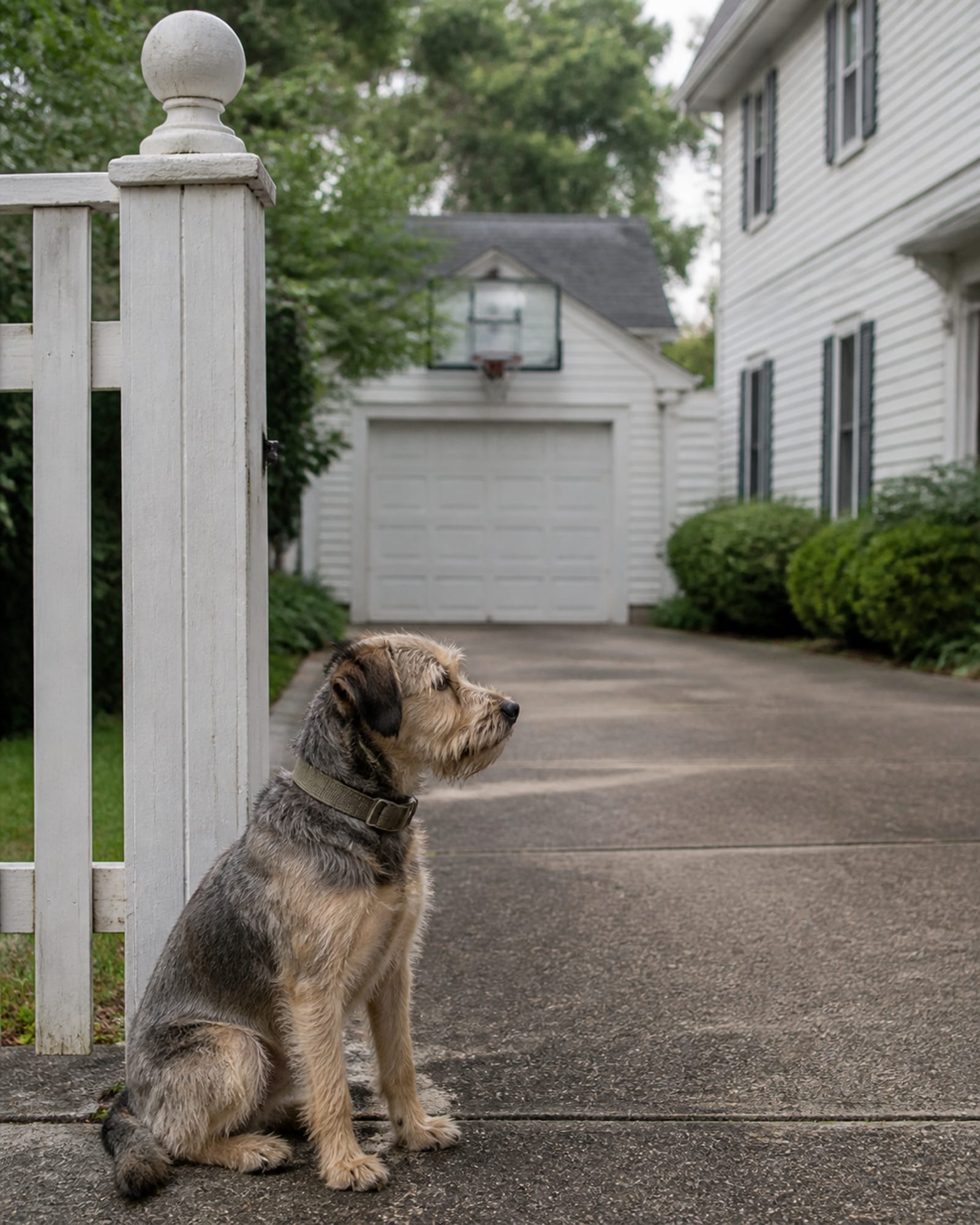
A dog sitting beside a gatepost, upright and calm, in Olney, MD
A skateboard lands. A whistle goes. A ball hits a fence. Your dog jumps.
Every dog jumps. That part is not the measurement and it never was. The measurement is what happens in the four seconds afterwards: whether he looks at you, shakes himself off and carries on, or whether he is still braced two minutes later, unable to take food, scanning for the next one.
That difference is called recovery, and it is the single most useful thing to know about a dog. It predicts how he will handle a vet visit, a thunderstorm, a stranger at the door and a bad moment on a walk. It is more informative than any obedience he can show me. And Olney, a settled place of 35,820 residents where 89.2% own their homes and 91.1% were in the same house a year earlier, happens to contain an unusually good place to observe it.
Two dogs can have identical sits and be in completely different shape.
A dog with good recovery has a nervous system that resets. Something startles him, the adrenaline rises, and then it comes back down and he is available again. A dog with poor recovery gets a rise that does not come down, so the second startle lands on top of the first, and the third on top of that. By the end of a walk he is not reacting to the thing in front of him, he is reacting to an accumulation, and the owner reasonably concludes that he has got worse over the course of an hour. He has.
This is why a dog can be fine at nine in the morning and impossible at six in the evening on the identical route. Nothing about the route changed. What changed is that he started the evening walk already partly loaded from the day.
It is also why pushing through does not work. The traditional advice is to keep going so he learns it is nothing, but a dog who has not come down cannot learn anything, because learning requires the thinking part of him to be available and it currently is not. Continuing simply adds repetitions of being overwhelmed.
The practical version is simple to say and hard to follow: after a fright, stop asking for anything until he can take food again. Taking food is the most reliable, most honest signal you have that a dog is back. A dog who refuses a piece of chicken he would normally sell you out for is not being fussy, he is telling you exactly where he is.
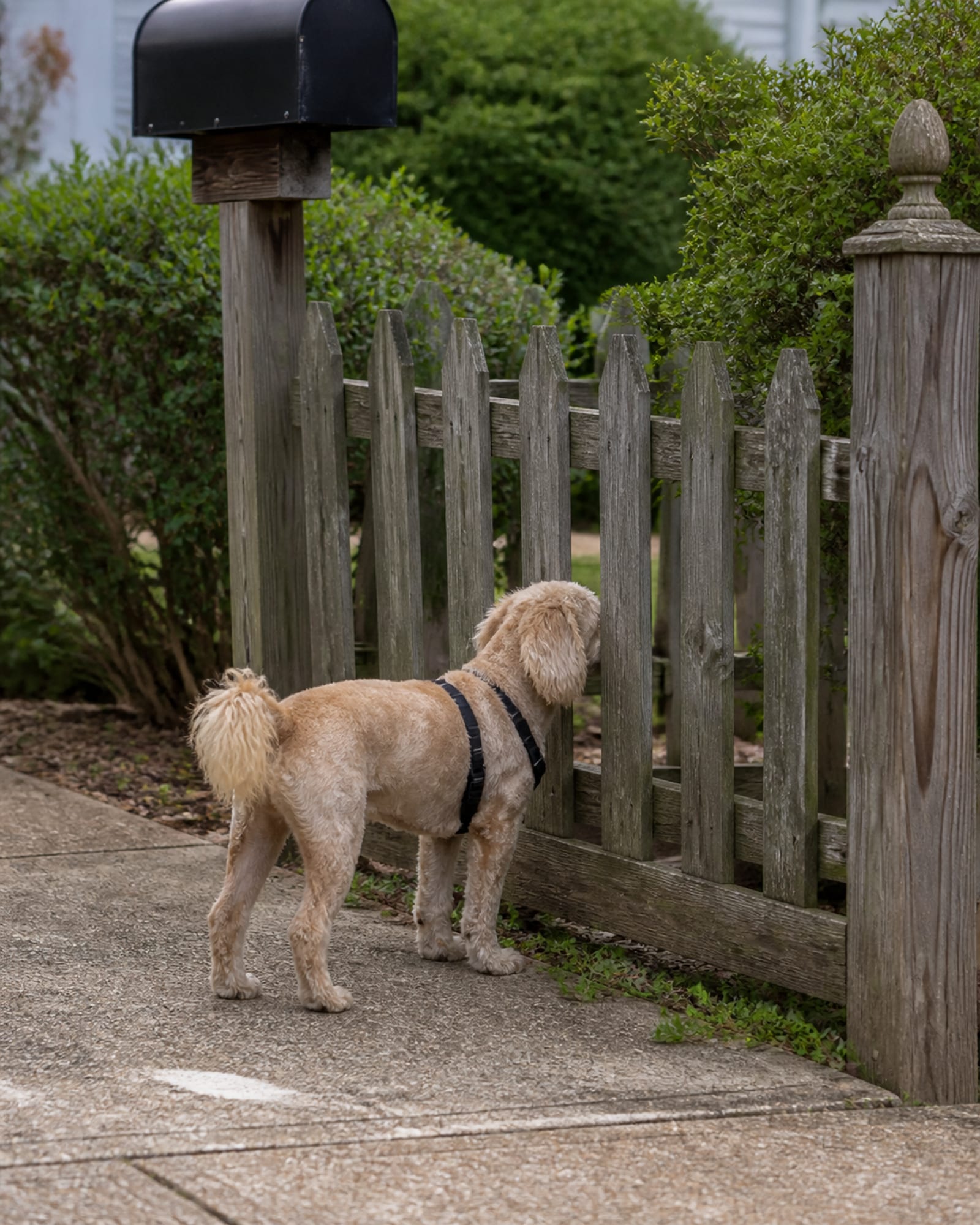
A dog standing beside a fence line, nose to a gap, in Olney, MD
A settled, family weighted community with a busy crossroads and rural roads a few minutes north.
01
The work above. It usually presents as a dog getting worse over a walk rather than as a single dramatic reaction.
02
Olney Manor's 61 acres put the skate park, swim center, playground and lit fields close together, so there is no single direction to face.
03
Georgia Avenue meets MD 108 at the commercial core, concentrating buses, turning traffic and pedestrians in one place at one time.
04
MD 200 traffic and its trail add speed and bicycles, which is a different kind of pressure from the steady noise of a main road.
05
North of town, Batchellors Forest Road and the other rural connectors are narrow, curving and sometimes have nowhere to step.
06
Reddy Branch, James Creek, the Hawlings River tributaries and North Branch bring deer, foxes, geese and concealed trail approaches close to houses.
Recovery is trainable. It is not a fixed temperament, and that is the good news in all of this.
The mechanism is repetition at a level the dog can handle. A dog who experiences a mild surprise, comes back down, and finds that nothing bad followed, has learned something about surprises in general rather than about that particular one. Do that a few dozen times and the recovery gets faster. Do it at a level he cannot handle and you teach the opposite.
So the work is deliberately unexciting. You go somewhere with a predictable amount of activity, at a distance where he notices things and still eats, and you do almost nothing for fifteen minutes. Watching is the exercise. Most owners find this harder than a training drill because it feels like nothing is happening, and that feeling is precisely the point.
Then you shorten the distance by a small amount, on a day when he is fresh rather than at the end of a busy week. And you leave while it is still going well, which is the discipline that separates households who make progress from households who repeatedly have one good session followed by a setback.
Sleep matters more here than people expect. A dog who is chronically short of rest recovers badly from everything, and a great many dogs in busy family households are short of rest without anyone noticing, because they are in the middle of the room all day. That is one of the reasons I ask where a dog sleeps and whether he ever gets to be genuinely off duty.
It is worth adding that recovery is easiest to work on close to home. The stream valley links along Reddy Branch, James Creek and the North Branch bring low-level activity into the subdivisions without the concentration of the big park, and Southeast Olney, Greenwood and Norbeck Meadows are quiet enough to be useful on a bad day. A dog who only ever practices recovering in a demanding place is not getting many repetitions, and repetitions are the whole mechanism.
A gray muzzled dog's head and chest, weight settled, in Olney, MD
Sit in the car with the door open, or at the far edge of the lot. Enough activity to notice, enough distance to think. Fifteen minutes, then leave.
Not a lap of the whole site. One vantage point where you can see the activity and control your distance from it, used repeatedly until it is dull.
He looks at the skate park, he looks back at you, he gets paid. You are teaching that noticing something is the cue to check in, which is what recovery looks like in practice.
The lit fields and the swim center have schedules. Going when the site is quiet gives you a version you can actually work with; going at six on a Saturday does not.
The moment he will not take food, the session is over regardless of how long you have been there. That is not failure, it is the measurement working.
Small steps, on good days. And keep the quieter alternatives, Southeast Olney, Greenwood, Norbeck Meadows and the North Branch stream valley, for the days when he needs something easy.
Phone (443) 429-0445, seven days a week from 6 AM to 7 PM. Tell me what startles him and, more usefully, what he is like ten minutes later.