01
A crate the dog refuses
The work above, and it is usually recoverable in a fortnight even when the first attempt went badly.


People apologize to me for the crate. They show me where it is, half folded behind a door, and explain that they felt bad about it so they stopped. That decision costs more households more sleep than almost anything else I see.
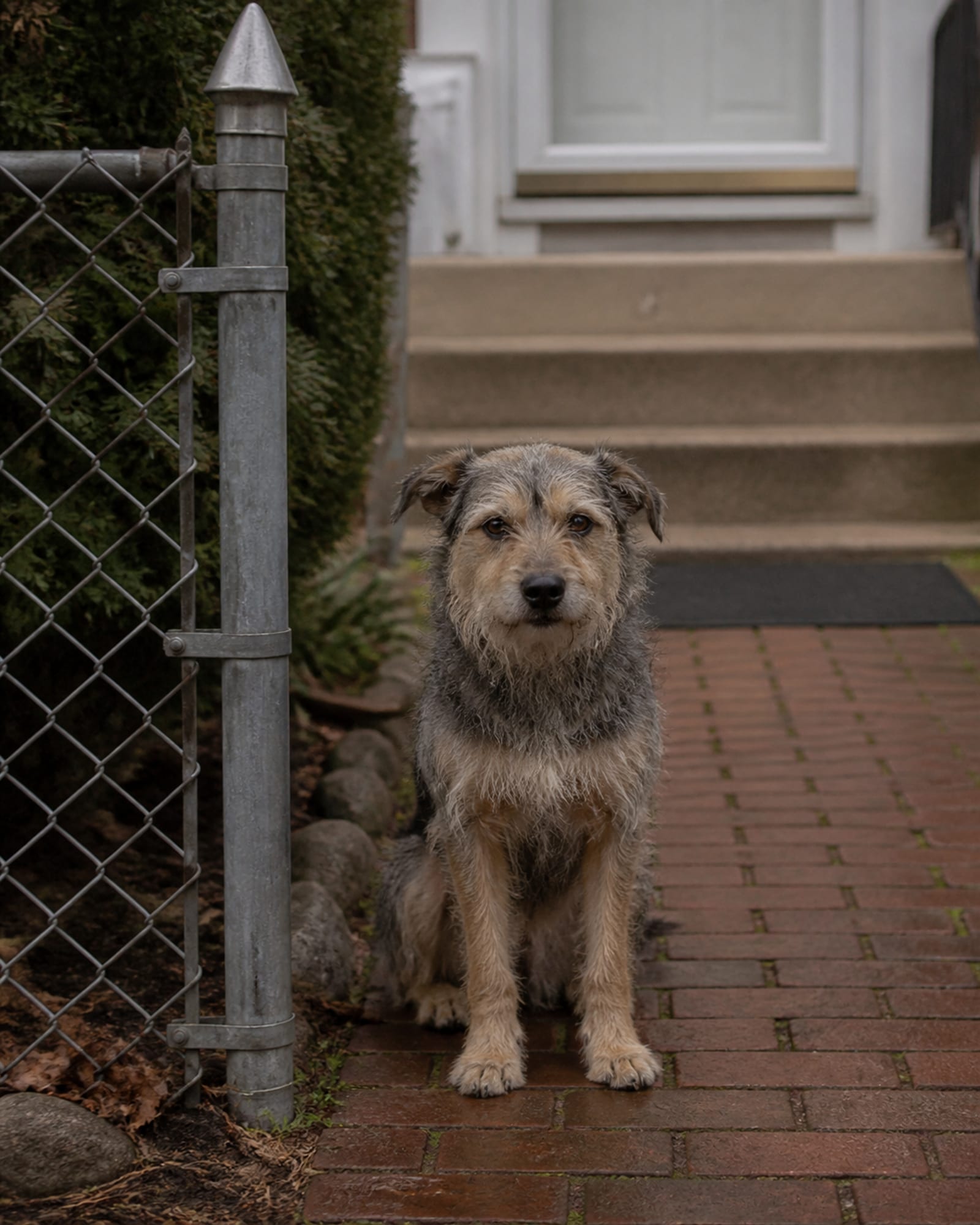
A dog sitting beside a gatepost, upright and calm, in Frederick, MD
It was bought with the puppy. It got used for a fortnight, he cried in it, somebody let him out, and it has been a clothes horse ever since.
I understand exactly why. A crate looks like a cage and nobody wants to put a dog they love in a cage. But the way a dog reads it and the way a person reads it are not the same, and the gap between those two readings is where a great deal of avoidable trouble lives.
Frederick makes both halves of this visible. The city went from 78,171 residents in 2020 to an estimated 92,059 in 2025, a rise of 17.8%, and it holds two completely different kinds of home. Downtown has Federal, Greek Revival, Victorian and Italianate buildings and rowhouses with narrow stairs, small rear yards, shared alleys and front doors that open beside the sidewalk. Whittier, Dearbought, Kellerton and Worman's Mill are new, open plan and set around common paths and ponds. A dog needs a place of his own in both, for opposite reasons.
Not punishment, and not storage. It does four jobs and only one of them is containment.
It gives the dog somewhere that nothing is required of him. In an open plan house, and in a full one, there is no room a dog can go to where he is not part of whatever is happening. Dogs need to be off duty and a lot of them never get to be. A dog with a den sleeps properly, and a dog who sleeps properly is a different animal by about week three.
It makes house training fast rather than slow, because it removes the opportunity to get it wrong unsupervised. That is the whole mechanism. Nothing about it is punitive.
It makes everything else in a dog's life easier later. A dog who is comfortable in a crate copes with the vet, with a night after surgery, with a car, with a hotel and with a stay somewhere unfamiliar. A dog who has never been in one meets his first crate on the worst day of his life, at a veterinary practice, already frightened. That is the argument that persuades most people, and it should.
And it protects the household during the months a young dog cannot be trusted, which is what stops the relationship souring. Most of the resentment I see between people and their dogs was built in a year of small damage that a closed door would have prevented.
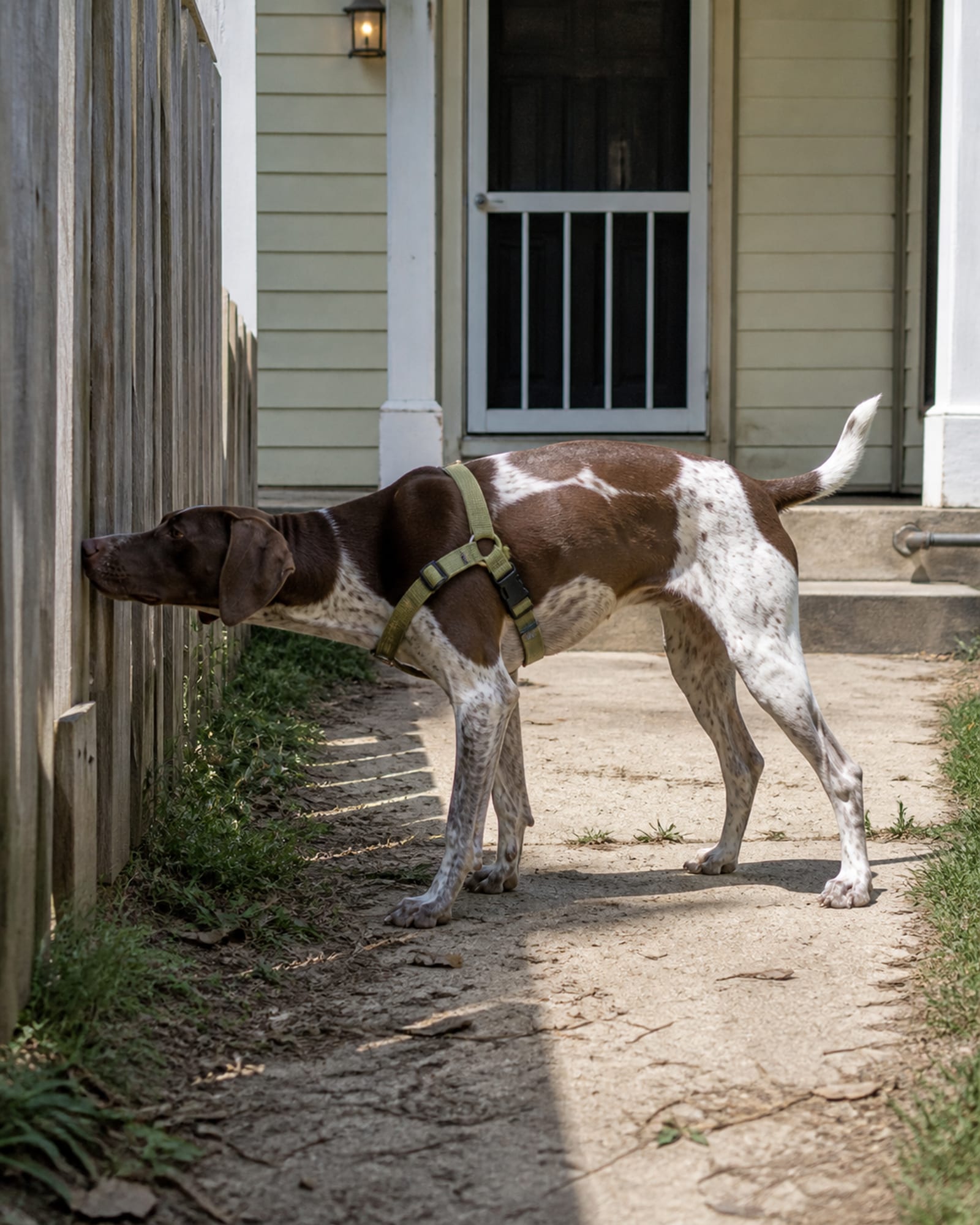
A dog standing beside a fence line, nose to a gap, in Frederick, MD
Living room, not the laundry. A den at the edge of everything is isolation, and isolation is what he objected to the first time.
For the first several days it is furniture, not a container. Nothing shuts. This is the step people skip and it is the one that changes his opinion.
Bowl at the back, dog walks in, dog walks out. No ceremony. A week of this does more than any amount of coaxing.
While he is eating, then open it before he finishes. Then five seconds. You are proving that closing predicts opening, which is the entire lesson.
Something worth chewing, door shut, you visible and boring. Minutes, not hours, and let him out while he is still settled rather than when he complains.
Briefly, unpredictably, without a goodbye. If he panics rather than grumbles, stop and call me: that is separation distress and it is a different piece of work.
The argument for a den is different downtown than it is in the new communities, and both are real.
In the historic core the constraint is space and proximity. Narrow stairs, small rooms, shared alleys, party walls, and a front door that opens straight onto a busy sidewalk. There is nowhere for a dog to be out of the way, and every noise from the street is close. A den gives him somewhere the world is not, which matters more the smaller the house is.
In Whittier, Kellerton, Dearbought and Worman's Mill the constraint is the opposite: open plan, sight lines through the whole ground floor, common paths and ponds outside the window, and a dog with a view of everything and no boundary anywhere. A crate or a defined place is the only way to say where he should be when there are no doors to close.
Either way the surrounding conditions are the same and they are not gentle. Frederick sits in a valley between Catoctin Mountain and Parrs Ridge with the Monocacy River, Carroll Creek, Tuscarora Creek and Rock Creek running through developed ground, so deer, geese and foxes are ordinary. Carroll Creek's linear park fills and echoes during events. I-70, I-270, US 15, freight rail, the MARC line, Fort Detrick and the municipal airport all contribute sound. A dog with nowhere to switch off is being asked to monitor all of that continuously.
There is a growth point worth making too, because it changes who is asking. A city that added roughly fourteen thousand people in five years is a city full of households in their first year somewhere, and a lot of those households got a dog at the same time as the move. Two big changes at once is hard on a dog, and the thing that steadies him fastest is not more attention, it is a fixed place he can retreat to that came with him and did not change. That is the argument for setting the den up in the first fortnight rather than after something has gone wrong.
One caution, because it is the failure mode. A crate is not a solution to a dog being alone too long, and a dog shut in one for a full working day is not being trained, he is being stored. If the hours are the problem then the hours are what we talk about, and my anxiety and nervousness page covers where ordinary settling ends and real distress begins.

A close vertical of a dog's face turned slightly, ears forward, in Frederick, MD
A fast-growing city with a genuine old core and a lot of new ground.
01
The work above, and it is usually recoverable in a fortnight even when the first attempt went badly.
02
Nearly always a supervision problem rather than a comprehension one. The crate is the tool that removes the unsupervised mistakes.
03
Downtown houses put a lot of household traffic through tight spaces, so a dog underfoot is a genuine hazard for an older handler.
04
In the newer communities there is no door to close, so a place has to be taught rather than built.
05
Carroll Creek Linear Park, Baker Park and the festival calendar change the street on set dates. Good for planned work at distance, poor as a surprise.
06
Two interstates, freight and MARC rail, Fort Detrick and the airport. Most dogs file it as background; the ones who do not need it worked deliberately.
Phone (443) 429-0445, seven days a week from 6 AM to 7 PM. Tell me what happened the first time you tried, and whether he protests or genuinely panics.