01
A dog who works only for food in view
The work above, and it is one of the more satisfying fixes because the behavior is already in there and simply needs finishing.

He sits beautifully when you have something in your hand. Show him an empty hand and he looks at you as though you have broken an agreement. That is not a dog who has been badly trained. It is a dog whose training was never finished, and the last step is the one nobody is taught.
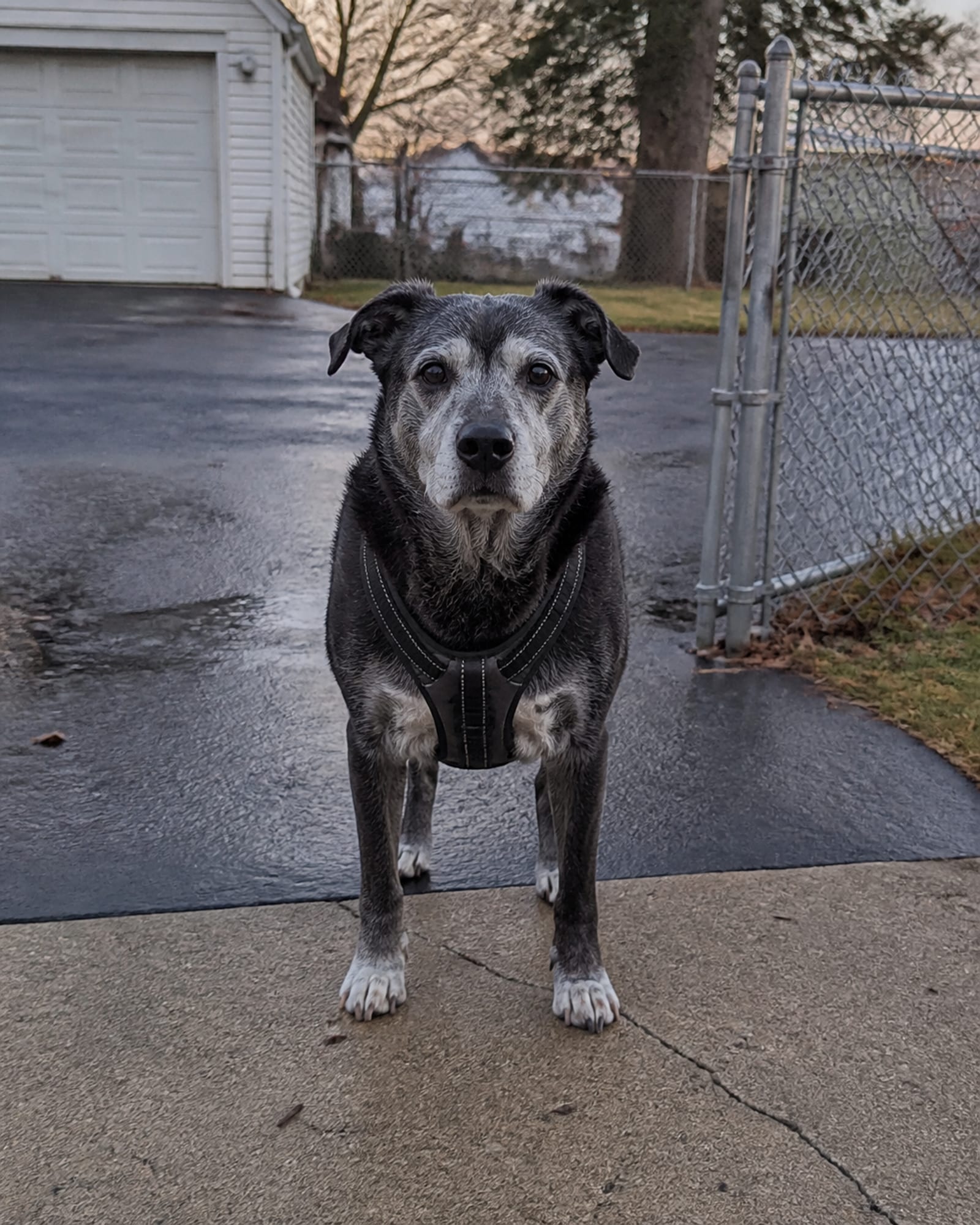
A dog standing square and settled, seen full body from the front, head up, in Rockville, MD
Try it now. Ask him to sit with nothing in your fingers, standing normally, without the little pinch of the thumb and forefinger you probably do without noticing.
If he sits, good. If he stares at your hand, or offers three other things, or wanders off, then what he has learned is not "sit". He has learned "when a hand holds food above me in that particular way, put my bottom down and the food arrives". Those are different behaviors and only one of them is any use to you.
This is the most common unfinished piece of training I meet, and Rockville produces a lot of it because Rockville produces a lot of conscientious owners. 26,976 households, more than half renting, across detached houses, historic streets, planned townhouses at New Mark Commons, Twinbrook and Hungerford, and apartments and mixed-use buildings along the Pike and around Town Center. People here read the advice, buy the treats and do the work. The step that gets missed is not a matter of effort.
Luring is a perfectly good way to start. It is a terrible place to stop.
A lure is a piece of food used to move a dog into a position. It works because it is easy for both of you, and there is nothing wrong with it as a first step. The problem is that the food is doing the teaching, and the dog is learning to follow food rather than to respond to a word.
The distinction shows up the moment the food is not there. That is why the sit in the kitchen vanishes in the vet's waiting room, or at the door, or on the Pike with a bus going past. It is not that those places are harder, though they are. It is that in those places nobody is holding a piece of chicken in front of his nose, and the chicken was the actual cue all along.
Fading the lure is the step that turns it into a real behavior, and it takes about a week per behavior. The food does not go away, which is the part people misunderstand. It moves. It stops being the thing that makes the behavior happen and becomes the thing that happens afterwards, which is a completely different job for the same piece of chicken.
That distinction is also the answer to the objection I hear most in this city, which is that people do not want to bribe their dog. A bribe is offered before, to persuade. A wage is paid after, for work done. The same treat is one or the other depending entirely on when it appears, and moving it from before to after is the whole of the technique.
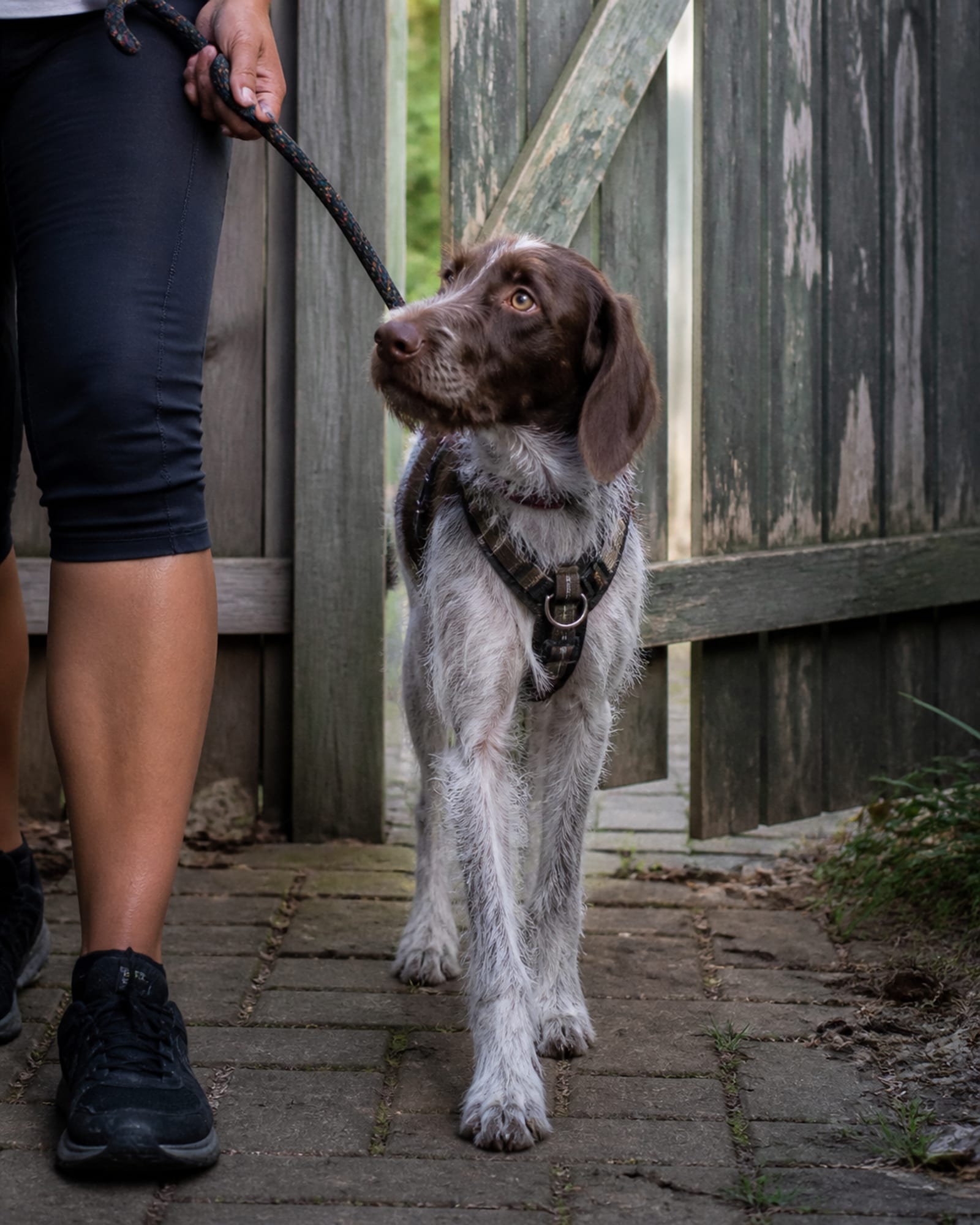
A dog walking at heel beside a handler's lower legs, both cropped at the knee, in Rockville, MD
Three repetitions is enough to show him the shape. More than that and you are building the hand movement into the behavior itself.
Same gesture, empty. He will almost always do it. Then pay him from the other hand, or from your pocket. This one change does most of the work.
Big movement, then smaller, then a flick of the fingers, then nothing but the word. Do it gradually enough that he never fails, because failing here teaches hesitation.
Word first, brief pause, then help if needed. Most households say the word and gesture simultaneously for months, which teaches the dog to watch the hand and ignore the word.
Once he is reliable, not every time. A behavior paid on a variable schedule is markedly more durable than one paid every single repetition, and it is where most of the resilience comes from.
The lobby, the garage, Town Square, the park. A faded behavior still has to be generalized, and the two jobs are separate.
Not one uniform suburb: the city's own land inventory counts detached, attached, multi-unit and mixed-use in serious quantities.
01
The work above, and it is one of the more satisfying fixes because the behavior is already in there and simply needs finishing.
02
A large yard in one neighborhood, a shared lift and parking garage in another, a narrow townhouse entrance or a historic street with almost no setback in a third.
03
Household members saying it three times and giving up. A cue repeated at a dog who does not have to answer stops being a cue.
04
Redevelopment around Town Center and the Pike relocates barriers, pedestrians and machinery week to week, so a settled route stops being settled.
05
Rock Creek, Watts Branch and the Cabin John tributaries concentrate deer, squirrels, geese and damp ground right through the built area.
06
I-270, MD 355, Metro, MARC and CSX. Sound arriving from several directions is harder for a dog than any single one of them.
Fading a lure is a mechanical skill, which is good news: it can be demonstrated and copied exactly.
That matters in a city where a third of residents were born outside the United States and nearly half speak a language other than English at home. Instructions that depend on a subtle description do not survive being passed between people. Instructions that can be watched and copied do, and the sequence above is entirely watchable: three lures, empty hand, pay from the other hand, shrink, word first.
So when I teach this I have every adult do it in front of me rather than explaining it once to whoever answered the door. It takes twenty minutes instead of five and it is the difference between one person who can do it and a household that can.
The common failure in a multi-person household is that one person fades the lure and another does not. The dog is not confused by that, he is simply efficient: he waits for the person who still shows food. Then the person who did the work concludes it is not working, when in fact it is working perfectly and being undone next door.
Write down which behaviors have been faded and which are still lured, and put it where everyone sees it. It is a scruffy solution and it is the one that actually holds a household to the same standard.
There is a Rockville-specific reason to get this right rather than muddle through. The city's own land inventory counts 2,433 acres of detached-house parcels against 331 acres of multi-unit housing and 332 of attached, which means a household here can move across town and land somewhere with completely different constraints without ever changing city. A behavior that has been properly faded travels between those. One that still depends on a hand holding food does not, and neither does one that only works in the room it was taught in.

A dog's head resting on a windowsill, light from the side, in Rockville, MD
Phone (443) 429-0445, seven days a week from 6 AM to 7 PM. Tell me what he does with an empty hand, and how many people in the house are asking him.