01
Older houses with mature yards
82.7% of homes are detached and a large share are 1950s Cape Cods, ranches and bungalows. Older fences, narrow doors and real gardens, which changes what containment means.


Linthicum sits against BWI, the hotel district and two light rail stops, and plenty of households here do not run on a nine to five. If your week has no fixed shape, your dog can still have a routine. It just cannot be built out of clock times.
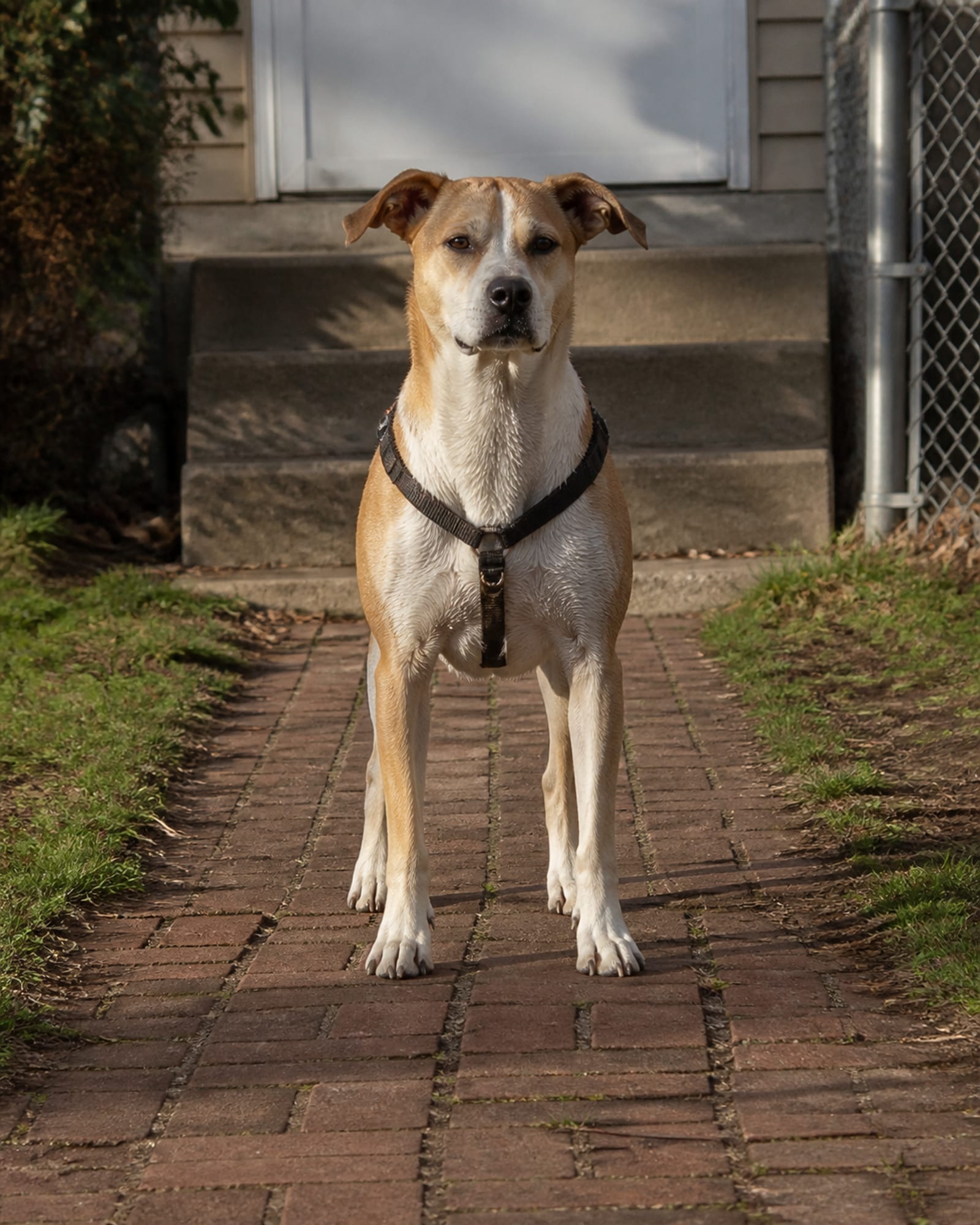
A dog standing square and settled, seen full body from the front, head up, in Linthicum, MD
Every piece of dog advice you have ever read assumes a household that leaves at the same time and comes back at the same time. Fed at seven, walked at eight, out at six, in for the evening. Consistency, everyone says, and they mean the clock.
That is not how a good number of Linthicum households work. The county's Region 1 takes in BWI Thurgood Marshall Airport along with the major transportation corridors, the hotel district sits right beside residential streets, and the Linthicum and North Linthicum light rail stops put people onto trains at hours most commuters never see. The mean commute here is short, at 23.2 minutes, and 90.3% of residents were in the same home a year earlier, so these are settled households. They are just not synchronized ones.
Here is the useful part. Dogs do not read clocks. They read sequences. So a household with no fixed hours can still give a dog a completely reliable routine, and it takes less rearranging than people expect.
This is the single most useful idea for a household whose hours move, and almost nobody is told it.
What a dog actually finds reassuring is not that dinner arrives at six. It is that dinner is always preceded by the same three things, and always followed by the same one. He is reading the order of events, and the order can hold perfectly well even when the times do not.
So the fix is to build fixed chains rather than fixed hours. Coming home always goes: in the door, dog stays on his mat, coat off, then greeting, then out to the yard. Leaving always goes: dog on the mat, a chew, keys, door, no goodbye. Feeding always follows the same short routine. None of that cares what the clock says, and after a fortnight the dog is anticipating the sequence instead of watching the door.
The second half of it is that a dog needs one thing per day that is genuinely fixed, and the easiest one to hold is the settle. Ten or fifteen minutes on a mat, in the same place, at whatever point in the day you are actually home. It is the anchor, and it works because it is a behavior rather than a time.
What does not work is the compromise most people arrive at, which is a household where the dog gets a long walk on days off and almost nothing on working days. A dog who has an unpredictable amount of activity has the worst of both, and it usually shows up as a dog who cannot settle in the evenings and a household who assume he needs more exercise. Frequently he needs less activity and more structure.

A dog walking at heel beside a handler's lower legs, both cropped at the knee, in Linthicum, MD
It is the thing irregular households worry about most, and the picture is better than they fear with one important exception.
Most dogs cope well with varying hours provided the departures and returns are handled the same way each time. The variable that matters is not how long you are gone, within reason, it is how the leaving happens. A calm, boring, identical departure teaches a dog that your going out predicts nothing in particular. A long emotional goodbye teaches him that something is about to happen, and then he has an hour to think about it.
The exception is the dog who is genuinely distressed rather than bored. Destruction focused on doors and windows, vocalizing that starts within minutes and does not stop, house soiling from a clean dog, injury to himself. That is a different condition, it does not respond to a better routine on its own, and my anxiety and nervousness page covers what the work actually involves. Where it goes beyond training, I will say so rather than sell you sessions.
For the ordinary case there is a practical route, and shift households often have an advantage in it. If somebody is home at unusual hours, the dog is frequently alone for shorter stretches than a nine to five dog is. The problem is variability rather than duration, and variability is fixed by the sequences above.
The last piece is what happens in the alone time. A dog left with nothing does something, and what he chooses is rarely what you would have chosen. A settled place, something to chew that lasts, and a house he cannot get into trouble in cover most of it. In the older Linthicum stock, where 37.9% of homes date from the 1950s and basements and narrow doorways are common, closing the dog's world down to one manageable room is often the whole answer.

A dog panting lightly after work, mouth open, eyes bright, in Linthicum, MD
A settled, detached, mid century community wedged against a major transport hub.
01
82.7% of homes are detached and a large share are 1950s Cape Cods, ranches and bungalows. Older fences, narrow doors and real gardens, which changes what containment means.
02
The work above. Sequences rather than schedules, and a settle that anchors the day regardless of when the day happens.
03
The BWI Trail brings cyclists at speed, and there are county proposals for a spur connecting it toward Linthicum Park and the elementary school. A shared path is its own training environment.
04
Two stations within the community, so platforms, doors and crowds are part of ordinary life for dogs walked on that side.
05
Most dogs here have filed it as background since they were puppies. If yours has not, that is worth working on properly rather than waiting out.
06
Linthicum Park on Benton Avenue has fields, courts and trails, and J. Charles Linthicum Memorial Park is the quieter option when you want a session with nothing happening.
What always happens before you leave, what always happens when you come in, what always happens before food. Three chains, four or five steps each.
This matters more than the chains themselves. A household where the departure sequence changes with whoever is on shift has no sequence at all.
Mat, chew, keys, out, no farewell. Practice it a dozen times without actually going anywhere, so that the sequence stops predicting a long absence.
Ten to fifteen minutes on a mat, same place, whenever you are home. This is the fixed point the rest of the day hangs from.
A tired dog is not a trained dog. Ten minutes of actual training on a short day is worth more than an hour of walking, and it is achievable when the hours are bad.
A dog whose days off look nothing like his working days learns that the routine is negotiable. Same chains, more of them.
Phone (443) 429-0445, seven days a week from 6 AM to 7 PM. Tell me what a bad week looks like in your house and what the dog does during it.