01
Curbs and crossings
The work above. It is the most useful hour of training available in a place with this much turning traffic and this many pedestrians.
The walk from Wheaton toward Sligo Creek crosses Arcola Avenue, and there is no traffic light at that crossing. A dog who has never been taught what a curb means is a passenger at that moment, and so is whoever is holding the leash.
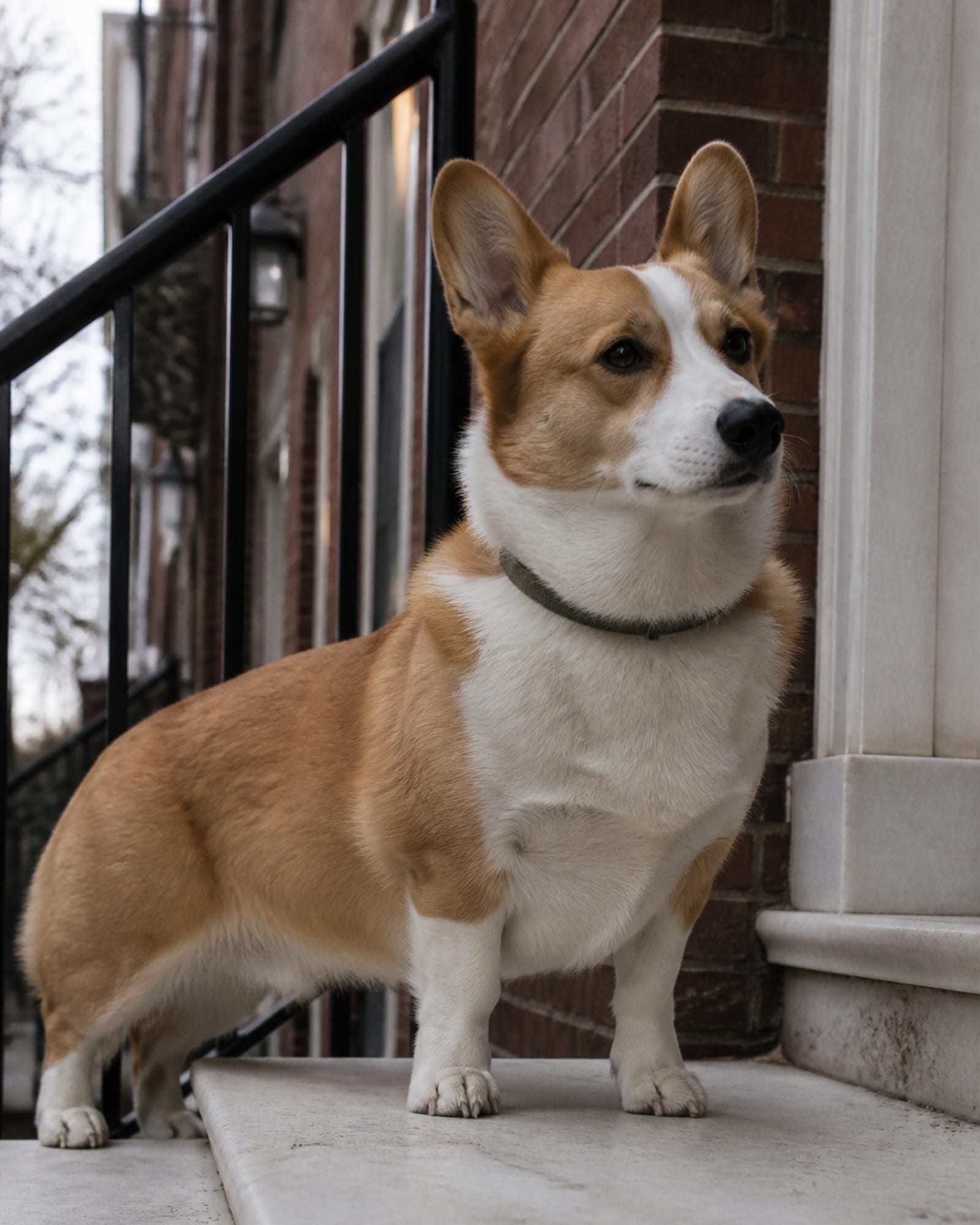
A dog standing on a low step so it fills the height of the frame, in Wheaton, MD
It is the most ordinary object on any walk and almost nobody trains it.
Most dogs learn something about curbs by accident. They learn that the handler slows down, and that after a pause there is more walking. What they have not learned is a behavior: stop at the edge, stay there while traffic passes, cross only on a word, and do not drift into the road when a bus goes by.
Wheaton makes the gap matter more than most places. 52,150 people in 6.9 square miles, 16,932 households averaging 3.11 people, the largest household size on my list. Metro trains, Ride On and Metrobus services, delivery traffic, street vendors and turning vehicles all converge around Georgia Avenue, Veirs Mill Road and University Boulevard. The center is being redeveloped with transit-oriented apartments and mixed-use buildings, so pedestrian routes shift. And the connection toward Sligo Creek requires crossing Arcola Avenue without a light.
That crossing is not unusual. It is just the one that makes the point.
No cue. He reaches the curb and stops, every time, because that is what curbs mean. Build it on a quiet street with fifty repetitions before it ever matters.
Whichever you prefer, held while a car, a bus and a cyclist go by. The behavior is stillness, and the traffic is the distraction rather than the cue.
He goes when you say so, not when you step off. If your foot is the cue, he will step off with it on the day you flinch rather than the day you decide.
Not sniffing, not veering. A crossing is the one part of a walk that has a defined start and end, and it is worth training as a unit.
One word, dog stops where he is. This is the one you need if something goes wrong in the road, and it is separate from the curb behavior.
Quiet hour first, then busier. Arcola Avenue on a Saturday morning is a different exercise from Arcola Avenue at five on a weekday.
Owners describe it as needing to be brave. It is much more about who is making the decisions.
At a light, the decision is made for you. You wait, the signal changes, you cross, and the dog's behavior barely matters because the timing is external. At an unsignalled crossing you are choosing the gap, which means you are watching the traffic rather than the dog, which means for those few seconds the dog is unsupervised at the edge of a road.
That is why the curb behavior has to be automatic rather than cued. If you have to remember to tell him, you will be remembering it at exactly the moment your attention is on a bus. A behavior that only works when you are paying attention is not much use at the one moment you cannot.
The second thing that goes wrong is the false start. A dog who has learned to cross when the handler's body moves will step off during any small movement, including the one you make when you decide it is not safe after all and shift your weight back. That is why the release has to be a word.
The third is the middle of the road. A dog who stops to sniff halfway across a crossing has turned a four second exposure into a twelve second one. Training the crossing as a single continuous unit, rather than as a stop followed by a walk, is what prevents it.
None of this requires a bold dog. A nervous dog with a trained crossing routine is considerably safer than a confident one improvising, because the routine is doing the thinking.
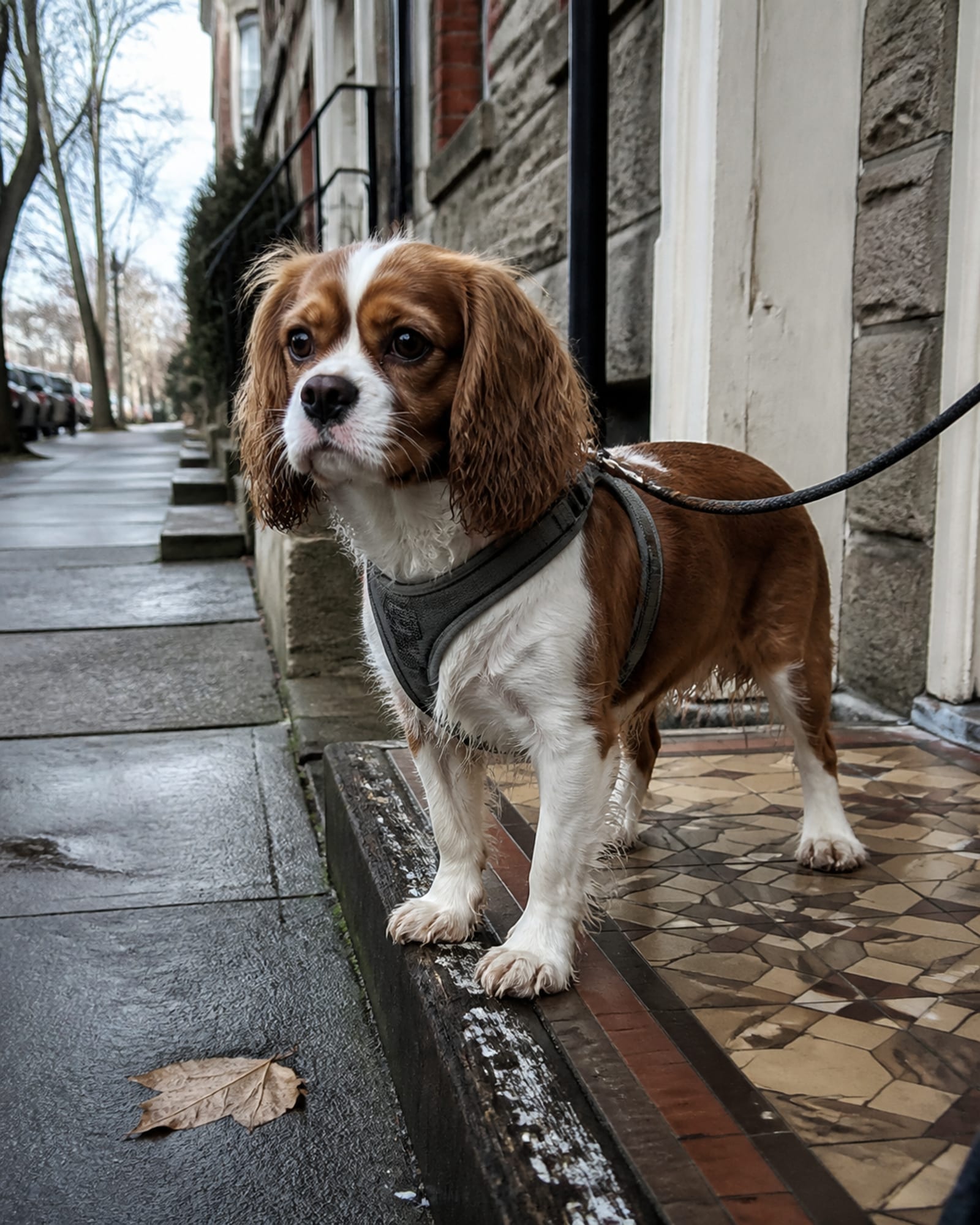
A dog standing on a sidewalk with the street receding behind it, in Wheaton, MD
A dense community built around transit with a very large regional park attached to it.
01
The work above. It is the most useful hour of training available in a place with this much turning traffic and this many pedestrians.
02
Metro trains, Ride On and Metrobus, and vehicles turning across the sidewalk around Georgia Avenue, Veirs Mill and University Boulevard.
03
The center holds transit-oriented apartments, older garden apartments and mixed-use buildings, so many dogs meet their first stranger of the day indoors.
04
Narrow walks beside moving traffic mean distance disappears fast, and the answer is a fast automatic response rather than a considered one.
05
Wheaton Regional Park's 538 acres include riding stables, so a dog can meet a horse, bicycles, athletic crowds and waterfowl at Pine Lake near one trail junction.
06
Trails east of the dog park include steep sections, and Northwest Branch and the park woods add deer and soft ground after rain.
Wheaton Regional Park is a genuine asset and it is also the single easiest place locally to ask too much at once.
Within a short distance of one junction a dog can encounter horses from the stables, bicycles, athletic crowds, playground noise, waterfowl at Pine Lake, the miniature train, the carousel and other dogs. Any one of those is a reasonable session. All of them together is not training, it is an endurance test, and dogs do not learn well from those.
So pick one and go for it. Park at the entrance nearest the thing you want, work at a distance the dog can handle, and leave before anything else gets added. Brookside Gardens and the Nature Center end is quieter than the Sports Pavilion and Ice Arena end, and the Glenallan and Orebaugh entrances put you in different parts of the site.
Horses deserve a specific word because they are the least familiar item on that list for most dogs and the one with the highest consequences if it goes wrong. A dog meeting a horse for the first time should be on a long line, well back, and doing nothing at all except watching. If he cannot take food, you are too close.
The route toward Sligo Creek is worth planning rather than taking by default, because of the Arcola Avenue crossing and because the trails east of the dog park include steep grades. Neither is a reason to avoid it; both are reasons to do it on purpose on a good day rather than at the end of a long one.
For the ordinary daily walk, Wheaton Veterans Urban Park, the library and community recreation center grounds and the Marian Fryer Town Plaza give you smaller, more controllable environments close to the center. Use those to build behavior and the regional park to prove it.
One more reason to plan the route rather than default to it: the sector plan concentrates redevelopment on roughly 484 acres of the central business district while leaving the surrounding residential streets alone. That means a dog can go from a settled neighborhood block to active construction, hoarding and rerouted pedestrians in a couple of turns, and the boundary between the two moves as the work progresses. Checking the first two hundred yards of a walk before setting off is worth more here than anywhere else on my list.
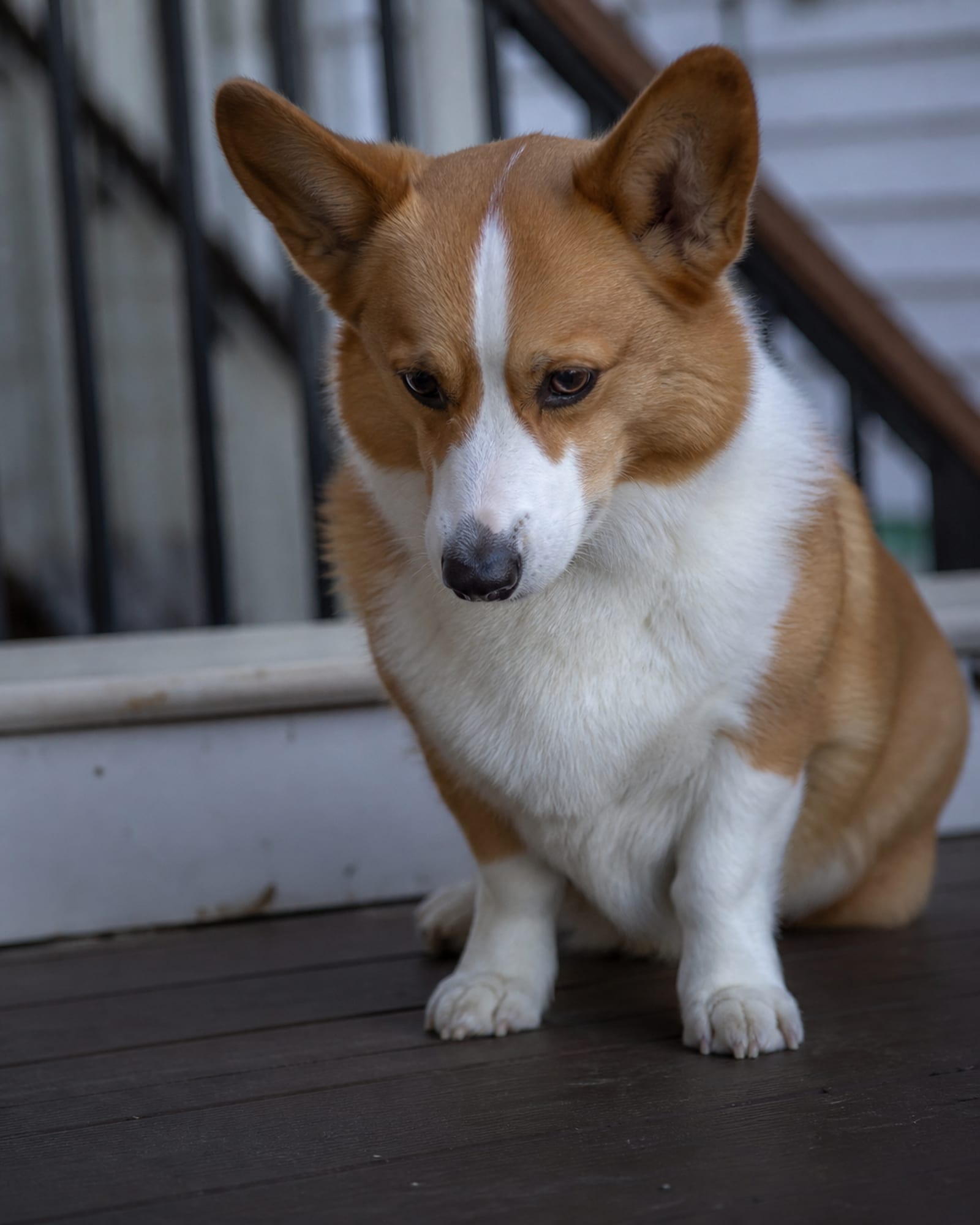
A dog sitting with its head lowered a fraction, watching hands out of frame, in Wheaton, MD
Phone (443) 429-0445, seven days a week from 6 AM to 7 PM. Tell me which crossing you use and what he does when you reach it.