01
The doorway that has no buffer
The work above. First on the list for anyone in the cooperative courts, because it is the moment every walk starts badly or well.


Old Greenbelt was planned so that front doors open onto shared walkways and garden courts rather than onto private yards. Your dog's first ten seconds outside happen in public, every time, with no transition. That single design decision shapes most of what I am called about here.
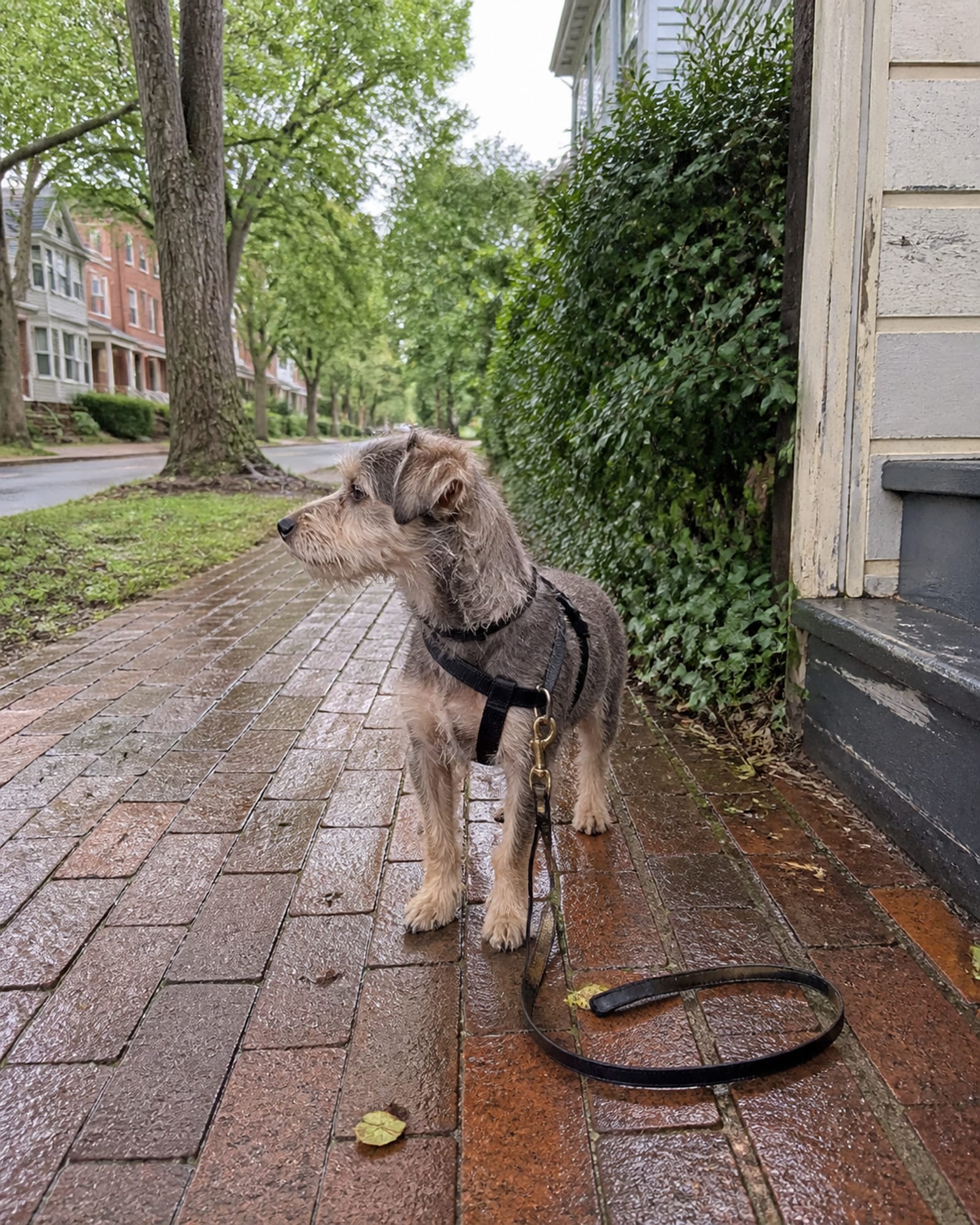
A dog in a stand stay with its lead slack on the ground beside it, in Greenbelt, MD
In most houses a dog gets a buffer. Front door, path, gate, then the world. Ten or fifteen seconds in which nothing is asked of him and the handler gets organized.
In a Greenbelt cooperative court there is no buffer. The door opens and he is already on shared ground: a common walkway, a garden court, other people's front doors a few feet away, and a neighbor who may be arriving from a direction neither of you can see, because the courts are laid out for pedestrians rather than for sight lines.
This is not an accident of the housing. It is a New Deal plan working exactly as designed, and it is why Old Greenbelt is worth living in. But it means the threshold and the walk are the same moment, and a dog who needs a few seconds to gather himself does not get them. Across the city's 10,351 households the pattern repeats in different forms: cooperative rowhouses and garden courts in the old core, townhouses, condominiums and apartments in Greenbelt East, newer mixed-use housing in Greenbelt West and at Greenbelt Station.
Everything I would normally teach in two stages has to be taught as one.
Ordinarily I build door manners indoors, where it is quiet and I control everything, and only then take the dog out to meet real arrivals. Here the door IS the arrival. There is no version of practising it privately, so the work has to start from the assumption that the first repetition is a live one.
That changes the order. The settle and the position come first, indoors, well before the door is opened at all, so the dog has something he already knows how to do before he is asked to do it in front of an audience. Households often want to start at the door because that is where the problem is. Starting at the door is exactly what has not been working.
The second consequence is that other people are part of the exercise whether they agreed to be or not. A neighbor walking past at the wrong moment is not an interruption to your training session; on a shared walkway, they are the session. That means picking your hour deliberately for the first fortnight, early or late, rather than taking whatever six o'clock delivers.
The third is that an association has an opinion. Cooperative, condominium and rental rules here govern common areas and animals, and they are usually stricter than any county rule. Reading yours before you build a routine on the shared green is worth an evening, because the routine is much harder to change once the dog has learned it.
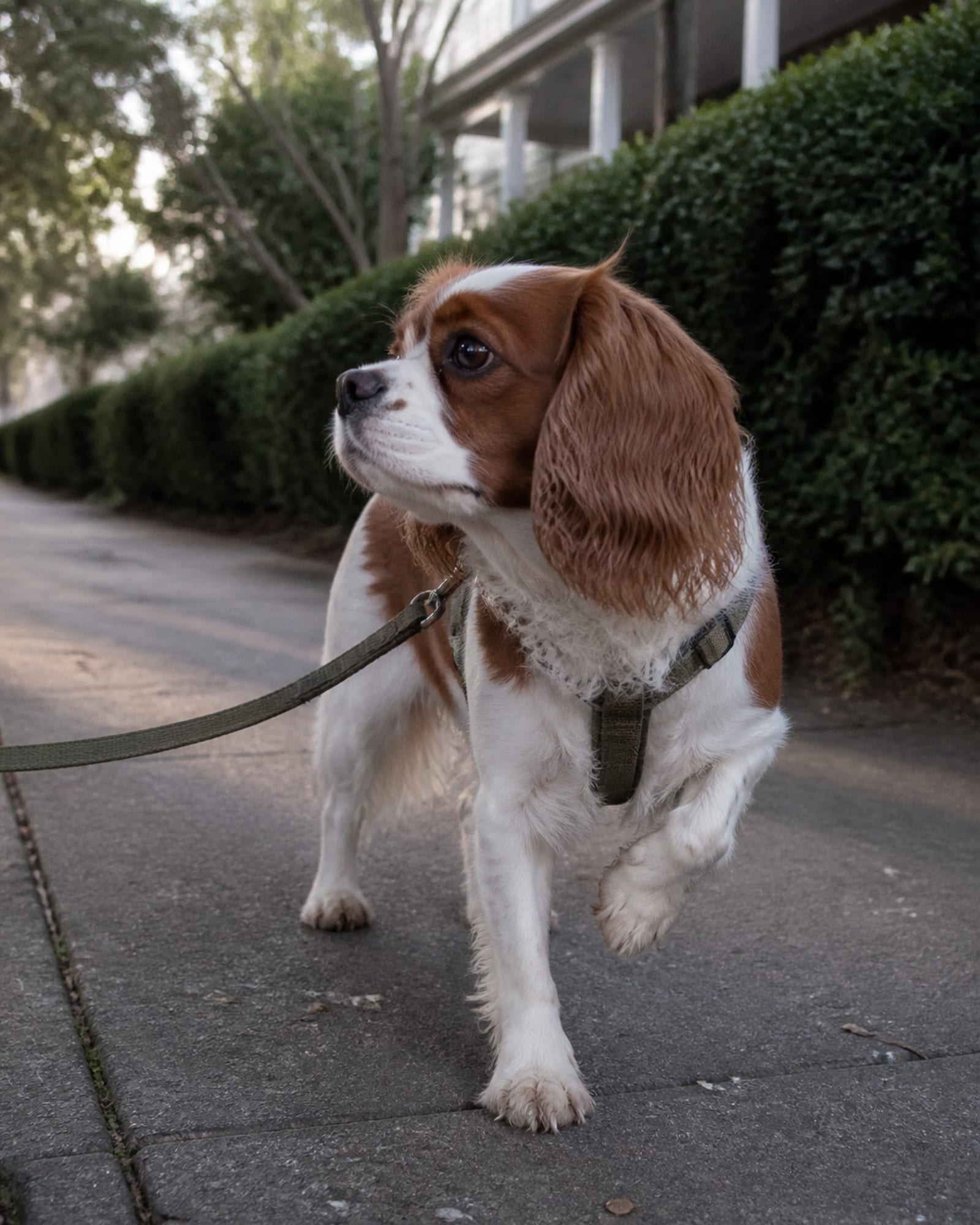
A dog pausing mid stride on a pavement, one paw lifted, in Greenbelt, MD
A planned city with four distinct housing eras and a national park on its edge.
01
The work above. First on the list for anyone in the cooperative courts, because it is the moment every walk starts badly or well.
02
The pedestrian layout means people appear at close range from directions neither of you can see. That is a management problem before it is a training one.
03
Compact rowhouses and garden courts put front doors, windows and walkways very close together, so barking is a shared experience whether anyone wants it to be.
04
Buddy Attick Park and Greenbelt Lake concentrate runners and other dogs on one loop, which makes it excellent for planned work and poor for a first outing.
05
The national park trails include steep sections, sharp turns, cross slopes and fallen trees, with deer, foxes, ticks, mud and washouts through the woods.
06
I-495 and I-95, the Baltimore-Washington Parkway, Greenbelt Road, Metro, MARC and NASA traffic. Most dogs file it as background; some need it worked properly.
A sit or a settle he can hold for thirty seconds while you move around. This is the thing he will be asked for at the threshold, so he needs to own it first.
Same behavior, harder location, door still shut. Most dogs lose it here, which is useful: it means the position was not as solid as it looked.
Touch the handle, he holds. Open an inch, he holds. Close it. Fifteen repetitions of this beat one repetition of the real thing.
Pick your hour. Early morning, nobody about. Door open, dog holds, cue, out into position beside you. Boring is the goal.
Ask a neighbor. Somebody walking past who knows the plan and will not stop to greet is worth a fortnight of accidental encounters.
By this point he has a behavior to fall back on rather than a hope. If it falls apart, go back one step rather than repeating the hardest one.
Everything above is about the door. The wider point is about what a dog needs when there is no private outdoor space at all.
A dog with a yard gets to be off duty outdoors. He can potter, sniff, lie in the sun and ignore everybody. A dog whose only outdoor time is on shared ground is on duty every time he leaves the building, and that is genuinely tiring for him in a way owners rarely account for. It shows up as a dog who cannot settle in the evening, and the usual conclusion is that he needs more exercise. Frequently he needs less stimulation and more off-duty time.
So the indoor settle matters more here than almost anywhere. A dog who can properly switch off indoors is being given the rest that the housing does not provide outdoors. That is not a consolation prize, it is the actual fix.
The other half is choosing where the decompression happens. Greenbelt is unusually well supplied: Buddy Attick Park and the lake, Schrom Hills Park, and the national park's perimeter, Azalea, Dogwood and Blueberry trails, plus the campground and picnic areas. A quiet trail at a quiet hour, on a long line, doing nothing in particular, does more for most dogs than another loop of the busy path.
One thing to plan around rather than meet by surprise. The trail conditions are real trail conditions, with steep sections, cross slopes, roots and fallen trees, and they change after rain. A long line is the right tool there and it needs managing on that ground; it is not the place to test a recall for the first time, with deer and foxes in the woods and a busy road system on every side.
There is a second reason the quiet hour matters in this particular city. Roosevelt Center, the Community Center, the library and the New Deal Cafe put a good deal of pedestrian life through the old core on foot rather than by car, which is pleasant to live in and busy to train in. The same walkway at eight in the morning and at six in the evening are two completely different exercises, and only one of them is a place to teach something new.
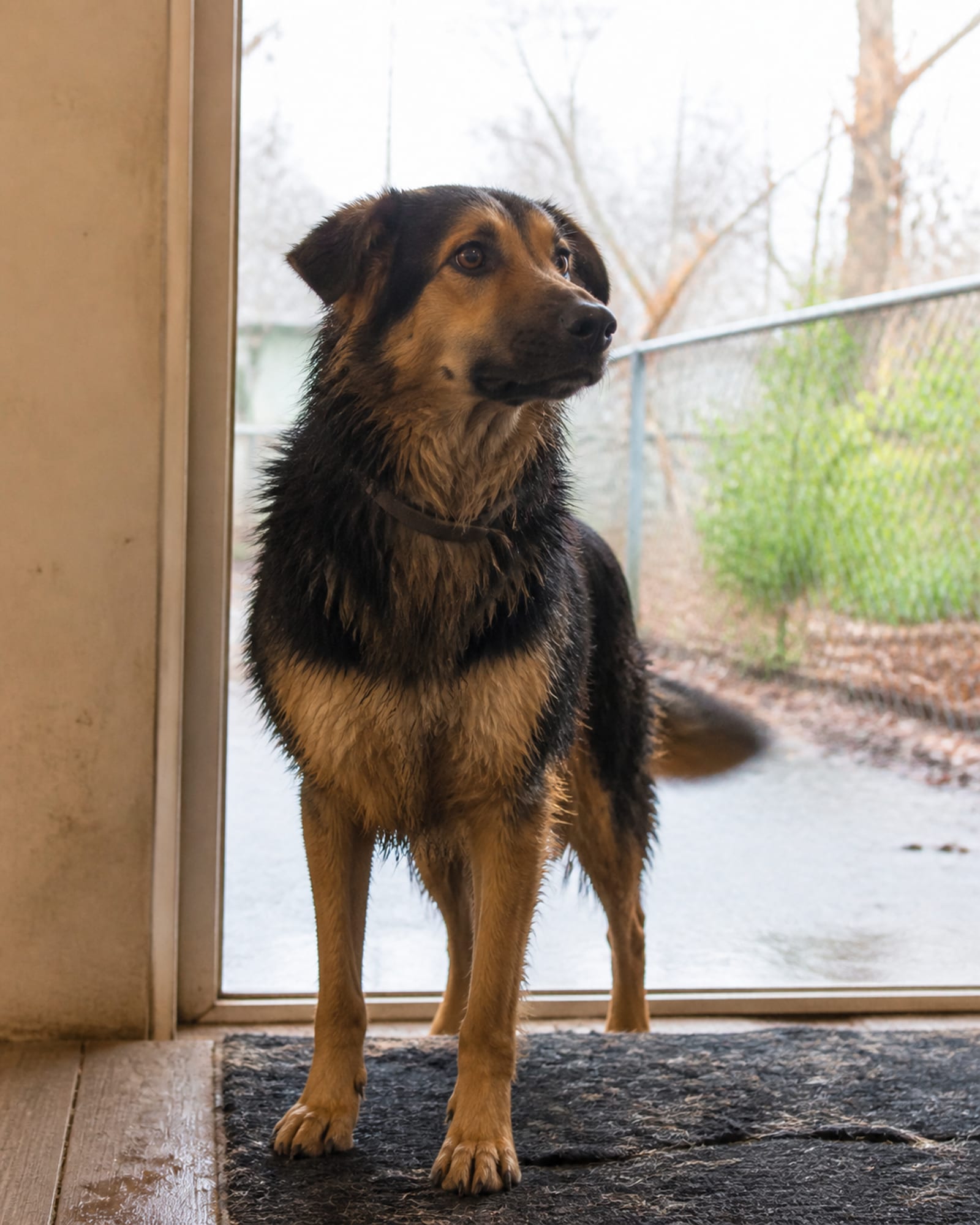
A dog watching intently off camera, head tilted a fraction, in Greenbelt, MD
Phone (443) 429-0445, seven days a week from 6 AM to 7 PM. Tell me what happens in the first ten seconds after your door opens, and who is usually out there.