01
The Carrie Dorsey underpass
It links the pond and stream side to Millard Cooper Park. Enclosed, echoing, and the most useful single training location in the town.
Carrie Dorsey Park connects to Millard Cooper Park through an underpass. Main Street runs downhill to a railroad corridor between buildings that sit right at the sidewalk. Sykesville is full of places a dog has to go forward through, and forward is the one direction most training never prepares him for.
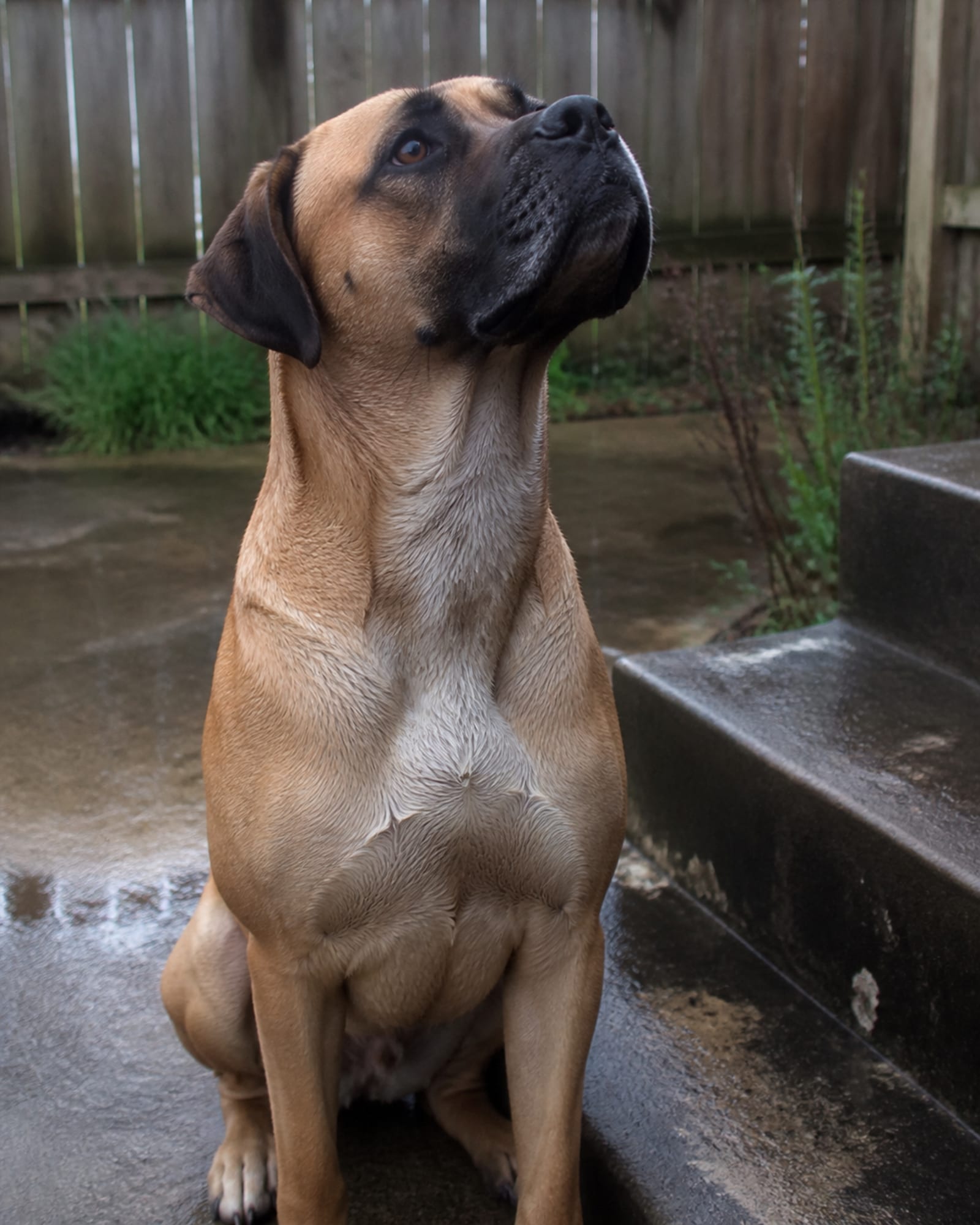
A dog sitting at the foot of steps, looking up out of frame, in Sykesville, MD
Dark, echoing, narrower than it looks from the outside, with the sound of your own footsteps coming back at you.
Almost everything I teach an anxious or reactive dog depends on being able to make space. Move away, cross over, turn around, wait for the thing to pass. Distance is the tool, and in most places you can find some.
An underpass takes it away. So does a bridge, so does a narrow historic sidewalk with a wall on one side and traffic on the other, and so does a stretch of trail with a bank above and a stream below. The town of Sykesville is small, only 4,316 people at the last count in 1,446 households, and it packs a startling number of these into a short walk. Main Street descends toward the South Branch Patapsco and an active railroad corridor, the historic district holds 85 contributing buildings on close setbacks, and the Patapsco Regional Greenway threads dense forest, stream crossings and ruins between downtown and Freedom Park.
A dog who can only cope by retreating has no plan in any of them.
It is not bravery and it is not obedience. It is a specific thing to teach, and it is usually skipped.
When a dog meets something he is unsure about in the open, he has options, and a well trained dog takes the one you give him. Turn, move off, sit at a distance. All of that is genuinely good training and none of it works in a corridor, because there is nowhere to turn to and turning around means giving up on getting where you were going.
So a dog whose whole coping strategy is space arrives at an underpass and does one of three things. He stops dead, which is the safest and the most workable. He rushes it, which looks like confidence and is not. Or he comes apart at the entrance, which is the one that frightens owners into never trying again.
What you want instead is a dog who has a job for these places. Position beside you, eyes forward, moving at a steady pace, with the handler being predictable rather than encouraging. Encouragement makes it worse, because a dog who hears an anxious upward tone concludes something is genuinely happening. Boredom is the message you want to send.
The other half of it is that the handler has to have made the decision before entering. Once you are in a confined stretch you are committed, so the choice about whether the dog can cope is made at the mouth of it, not halfway through. That is a change in how somebody walks their dog, and it is the part that takes longest to install in the person.
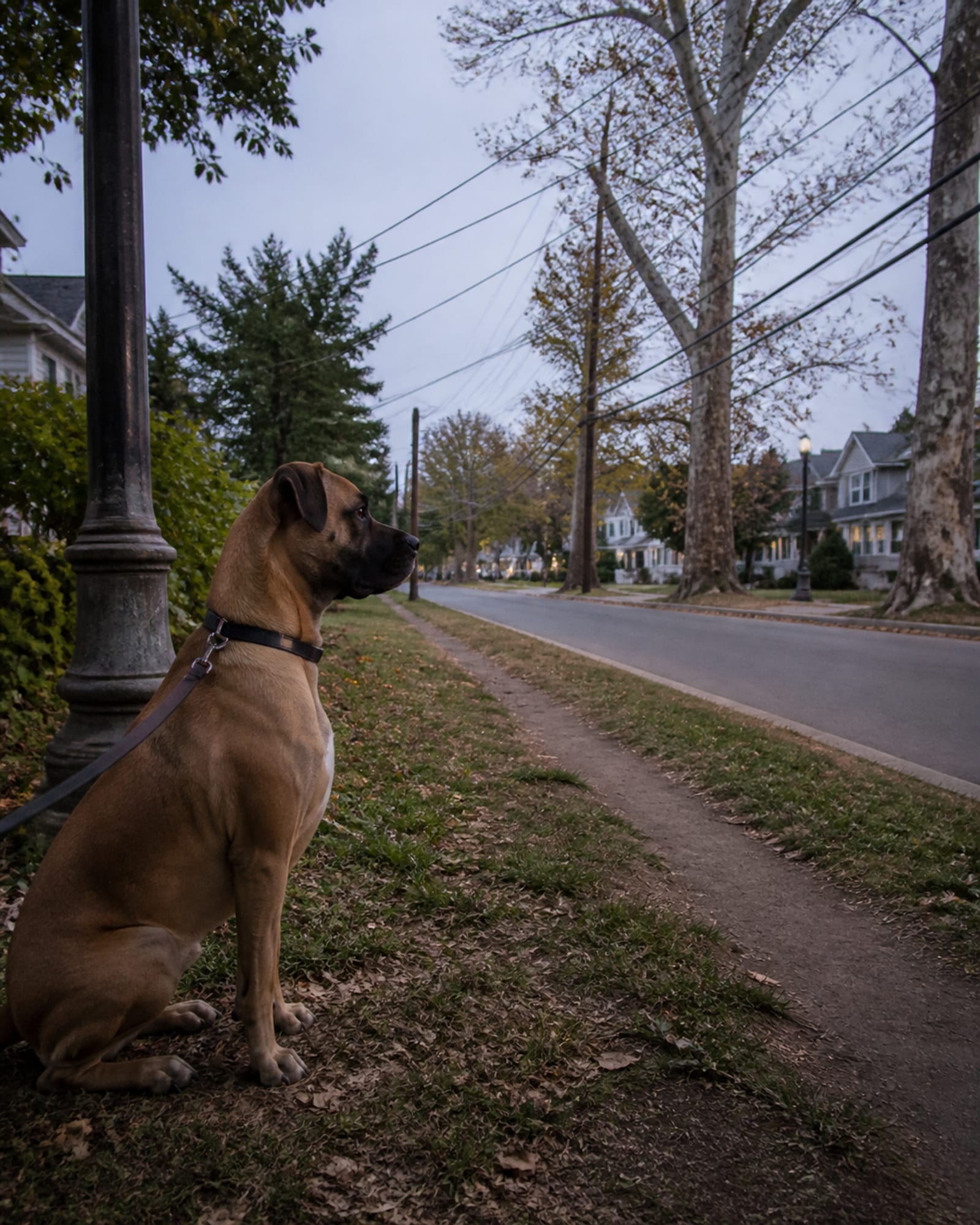
A dog sitting square beside a lamp post, in Sykesville, MD
Each one is a different version of the same problem, so each one is worth working separately.
01
It links the pond and stream side to Millard Cooper Park. Enclosed, echoing, and the most useful single training location in the town.
02
Historic buildings at close setback, traffic beside you, and no room to step aside when somebody comes the other way with a dog.
03
South Branch Park sits across the bridge, and low river ground floods. Water below and rails beside is a lot of information at once.
04
An active line runs beside the bottom of town. Sound arrives suddenly, is enormous, and stops. Trainable precisely because it is predictable.
05
Dense forest, stream crossings and ruins between downtown and Freedom Park, with bicycles arriving from behind on a path that does not widen.
06
Let Freedom Ring on July 4, the cinema evenings at Millard Cooper, the egg hunt. Street closures turn familiar routes into unfamiliar ones.
Beside you, matching your pace, no sniffing, no drifting. A dog who cannot hold that on an empty sidewalk certainly cannot hold it in a tunnel.
Between the car and the garage wall, through a gate, along the side of the house. Same behavior, in three feet of width, with nothing frightening about it.
Walk toward the underpass, stop twenty yards short, pay him, and leave. Several times. You are removing the meaning before you ask for anything.
Early morning, nobody about, steady pace, no talking. Straight in, straight out, no fuss at either end. Repeat until it is dull.
Somebody else at the far end. A bicycle. A wet floor. Never two, and always at a moment you chose rather than one that arrived.
The same position, the same pace, on a sidewalk with traffic on one side. This is where the skill becomes useful rather than impressive.
Two practical constraints that shape when this work can happen here.
The ground moves with the weather. Low river land floods, the slopes down from Main Street become slick, wet leaves sit over uneven trail surfaces in the fall, and freeze and thaw cycles do the rest in winter. A dog who is already uncertain in a confined space and is also slipping is being asked for too much, so the surface is part of the plan rather than an afterthought. Dry days, level ground, and the harder stuff later.
The town's calendar matters more here than in a bigger place, because the population is small enough that an event changes everything. A parade, a cinema evening in the park, a street closure, or activity around the miniature railway can turn a route you know into one you do not. That is worth checking rather than being surprised by, particularly with a sound sensitive dog.
Both of those are also opportunities. A predictable event on a known date is exactly the sort of thing you can work from a distance on purpose, and a small town gives you a perimeter to work from. Watching a parade from three hundred yards away is a legitimate and rather good training session.
The town's own layout helps more than its size suggests. Millard Cooper Park, Carrie Dorsey Park, the Linear Trail, Harold Burkett, Bloomfield, Jones and Beach Park are all within a short distance of each other, which means you can pick an environment rather than take whatever your street offers. That is a genuine advantage when you are working a dog who needs the difficulty raised in small steps, because the steps are all within a few minutes of one another and you are not committing to an afternoon every time you want twenty minutes of practice.
One thing worth knowing about the geography, since Sykesville addresses reach well beyond the town. The incorporated town is compact, and the 21784 postal area covers a much larger stretch of Carroll County, including Piney Run Park and its lake, which sits outside the town proper. If your address says Sykesville, the walk from your own door may be a rural lane rather than a historic street, and that changes what to work on first.
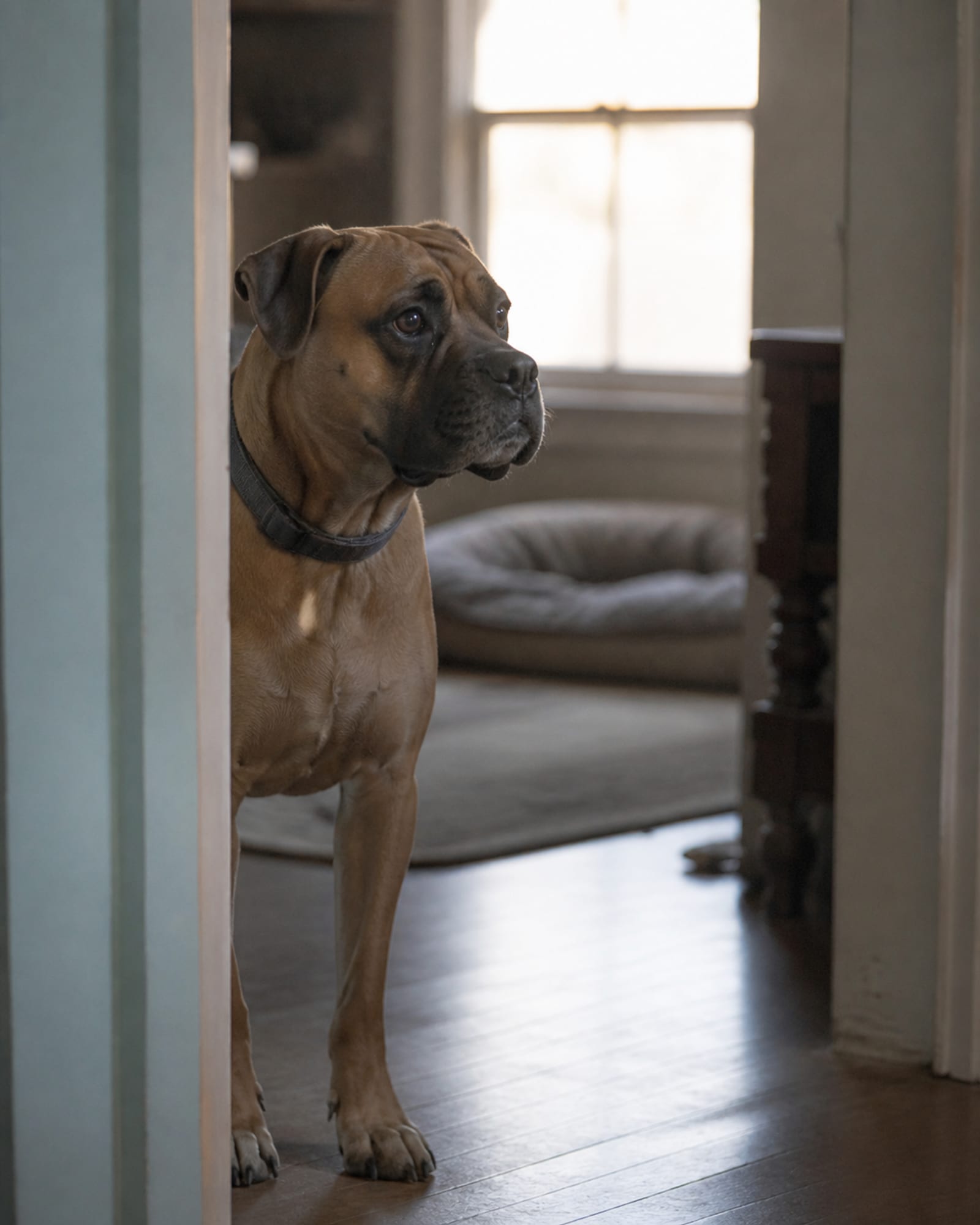
A dog's head framed in a doorway, body out of focus behind, in Sykesville, MD
Phone (443) 429-0445, seven days a week from 6 AM to 7 PM. Tell me which stretch of your walk you have started avoiding, and we will begin twenty yards short of it.