01
Go out with the dog
Not put out, go out. If you open a door and wait inside, you do not know whether anything happened, and you cannot reward it if it did. Two weeks of going out with your dog is worth two months of hoping.


Puppies, adult dogs that have started having accidents, and dogs that were clean for years and are not now. Almost every house training problem I see is a scheduling problem or a medical one, and telling those apart is the whole job.
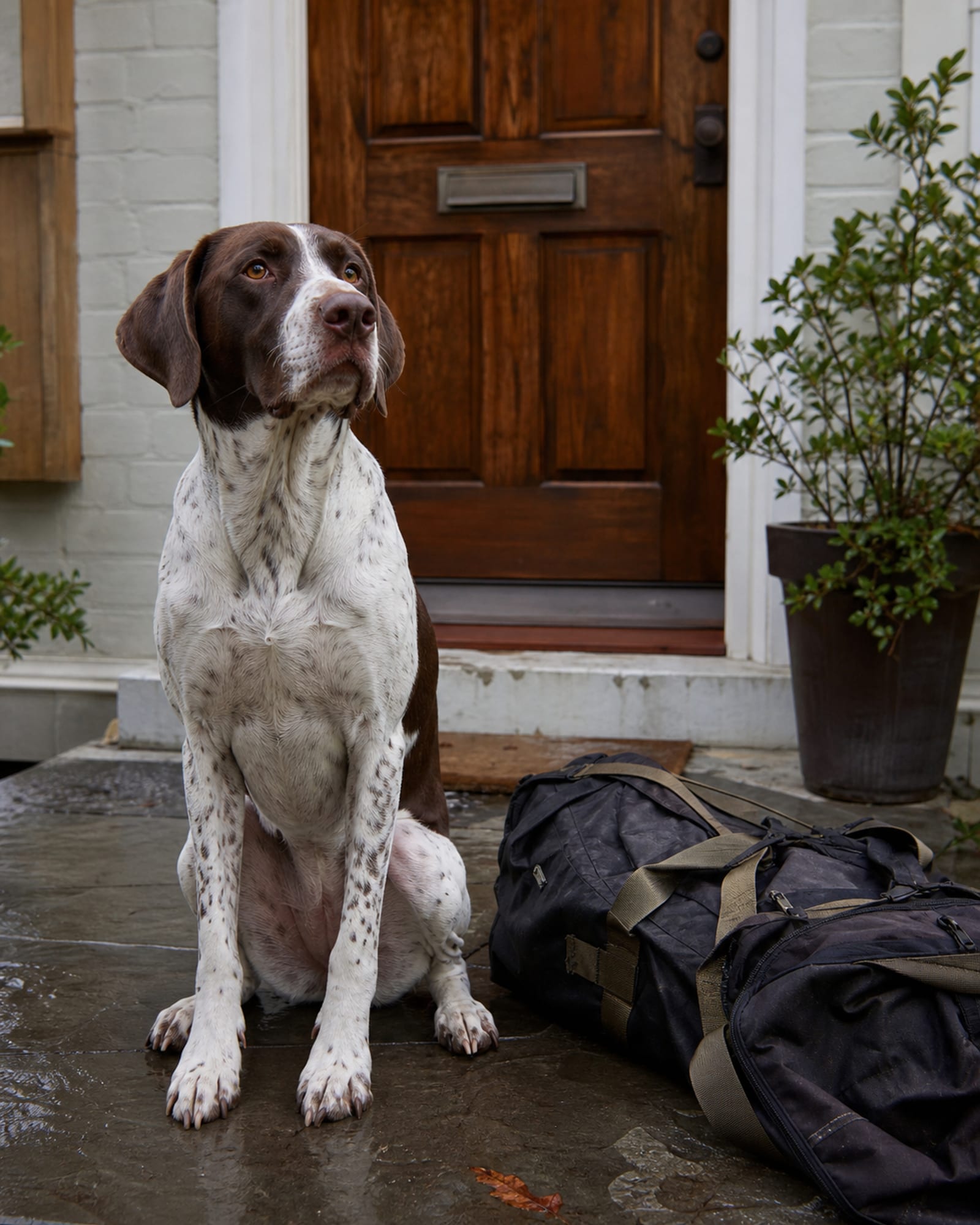
A dog sitting beside a packed kit bag by a front door
House training is the most mechanical thing I teach, which is why it responds so quickly when the mechanics are right and so badly when they are not.
A young puppy needs the opportunity to go outside at least every two to four hours, and after every change of activity: waking up, eating, drinking, playing, chewing, coming out of the crate, and last thing at night. Younger puppies need more than that. Almost every failing house training plan I look at has one thing wrong with it, and it is that the dog was not given enough chances.
That matters because it changes who the problem belongs to. A nine-week-old that wets the kitchen floor did not make a decision. It did not get outside in time, which is a scheduling failure and therefore yours rather than the dog's. Owners find that reframe uncomfortable for about a minute and then useful for months, because a scheduling problem is something you can fix today.
The second thing that goes wrong is freedom. A puppy with the run of the house will find somewhere quiet to go, and quiet corners are exactly where you will not see it happen. Limited space until the record is genuinely good is not a punishment, it is how you engineer success.
This is a specialty rather than a stand-alone service, so it is delivered through in-home private lessons, Kick Start, or board and train.
A dog lying in a patch of sun on floorboards, dust in the light
None of this is clever. It is consistency in six specific places.
01
Not put out, go out. If you open a door and wait inside, you do not know whether anything happened, and you cannot reward it if it did. Two weeks of going out with your dog is worth two months of hoping.
02
The reinforcement has to land within a couple of seconds of the dog finishing, outside, in the right place. Praising it when it comes back in teaches the dog that coming back in is the good bit.
03
Food down at set times rather than available all day. A predictable input produces a predictable output, and it lets you anticipate rather than react. It also tells you quickly when something is off.
04
An enzyme cleaner rather than anything with ammonia in it. A spot that still smells of urine to a dog is a sign saying use here, and ordinary cleaners leave that message perfectly readable.
05
A crate is management for when you cannot supervise, sized so the dog can stand and turn but not use one end as a toilet. It is never punishment, and never for longer than the dog can physically hold.
06
Times out, times of accidents, times fed. Nearly everyone who tells me house training is not working turns out to be guessing, and a week of notes usually shows the gap immediately.
This is the one piece of old advice that does the most harm, and a surprising number of people are still told to do it.
A dog cannot connect being told off now with something it did twenty minutes ago. What it connects is you, that spot, and being in trouble. So the dog learns that people plus urine equals danger, which produces two predictable results, both worse than the original problem.
The first is a dog that hides to go. Behind the sofa, in the spare room, upstairs. You have not reduced the accidents, you have moved them somewhere you will find later.
The second is the guilty look, which is the most misread expression in dog ownership. That flattened, sidling, whites-of-the-eyes face is not guilt about the carpet. It is appeasement in response to your body language, and it appears just as reliably when the dog did nothing and you are simply cross. People read it as proof the dog knew, which convinces them the telling off is working, which is how the cycle keeps going.
If you catch a dog mid-flow, interrupt gently, get outside, and reward finishing there. If you find it afterwards, clean it up and write down the time, because that time is data about your schedule.
A dog standing on a back step looking into the yard
An adult dog that was reliable and is not any more is a different problem, and the first stop is your veterinarian rather than me.
Urinary tract infections, bladder stones, kidney and liver disease, diabetes, and cognitive decline in older dogs all show up as house soiling, often before anything else is noticeable. So does anything painful enough to make stairs or a dog flap unappealing. Training a dog through a medical problem does not work and is unkind, and I would rather you spend a consultation fee finding that out than a training fee not finding out.
Once that is clear, the behavioral causes are worth separating. Marking is different from emptying: small amounts, vertical surfaces, often after a change such as a new dog, a visitor, or new furniture. Submissive or excitement urination happens during greetings and is not a house training failure at all; telling a dog off for it makes it considerably worse. And soiling that happens only when the dog is left alone often belongs with separation distress rather than here.
Moving house, a new baby, a change of schedule and a bereavement can all produce a temporary regression in a dog that knows perfectly well what it is doing. Those usually resolve with a short return to the puppy schedule rather than with anything elaborate.
A dog sitting beside a water bowl on a tiled floor
House training a puppy on the third floor is a different job from house training one with a back door, and most advice quietly assumes the back door.
The problem is time. A puppy that signals it needs to go has a very short window, and between the leash, the door, the hallway, the elevator and the lobby you may not make it. That is not a training failure, it is arithmetic, and it means going earlier rather than waiting for a signal. Set an alarm and go on the schedule rather than on request.
Carry a small puppy through the shared parts of the building if you can. It removes several minutes of temptation and stops accidents happening in a hallway you share with other people, which is its own problem.
Puppy pads are a legitimate compromise here, and I say that as somebody who would rather you did not need them. If the choice is a pad by the door or a puddle in the elevator every day, take the pad and accept that you will spend some extra weeks later moving the behavior outside. Put them in one fixed place, never scattered, and move them toward the door as the dog gets reliable.
And pick one outdoor spot and use it every time. In a building with no yard, the surface and the location are doing a lot of the work of telling your dog what this trip is for.
If you have a puppy that is not getting it, or a grown dog that has started having accidents, call me at (443) 429-0445. I answer 6 AM to 7 PM, seven days a week. Tell me the times your dog goes out and the times the accidents happen, and I will usually spot the gap on the phone.