01
Surfaces and street furniture
Grates, plates, tree pits and vents. The most common thing suburban owners have never had to think about, and among the quickest to resolve.


Cross the District line and the rules change, the housing changes, and the ground your dog walks on changes. Nearly nine in ten homes here are attached or multifamily.
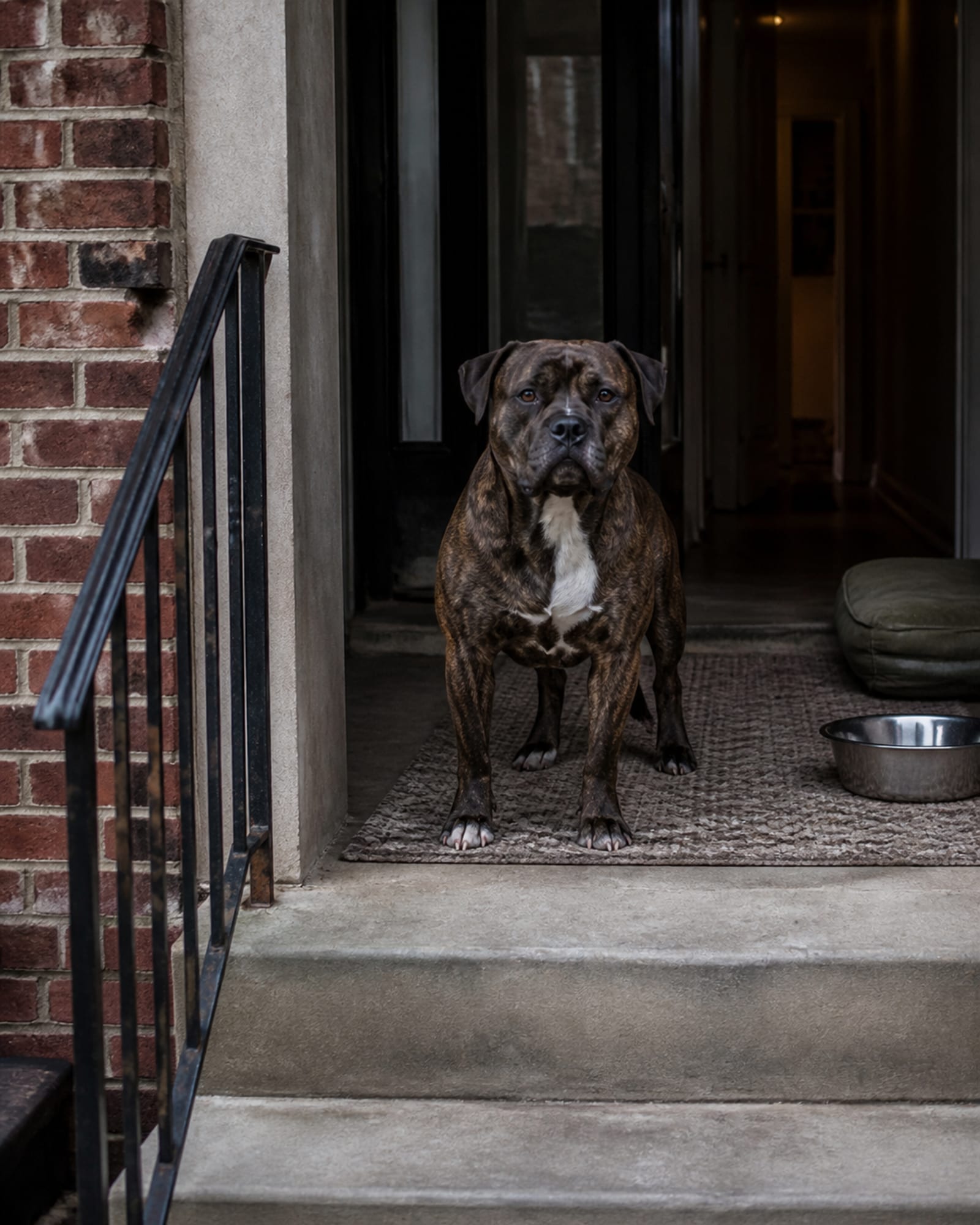
A dog standing square and settled, seen full body from the front, head up, in Washington DC, DC
The District is the far end of the corridor I cover, and it is the only place on my list that is not Maryland. That matters in two practical ways.
The first is administrative and it is yours rather than mine: licensing, animal control and the rules that govern dogs in public are the District's own, not Montgomery County's and not Maryland's. If you have moved in from the suburbs, check what applies to you now rather than assuming it carried across.
The second is physical and it is the part I am actually useful for. The Office of Planning reports about 40% of homes in buildings of twenty or more units, nearly 27% in buildings of two to nineteen, and only 11% detached. Add tree pits, metal grates, construction plates, scooters, buses and echoing underpasses, and a dog raised on suburban sidewalks meets a genuinely different set of surfaces and sounds the day it moves here.
This is the thing suburban owners are least prepared for, and it is the easiest to fix once somebody names it.
Dogs read surfaces through their feet, and they are far more particular about it than people expect. A metal grate that flexes slightly, a construction plate that rings, a tree pit with loose fill, a sidewalk vent breathing warm air: any of those can stop a dog dead. Owners usually read that as stubbornness and pull, which teaches the dog that the surface predicts an argument, and by the third week it will not go near one.
Washington is also not flat, whatever the postcard suggests. The Potomac and Anacostia lowlands, the Rock Creek ravine and the higher ridges in Northwest and Southeast give you steep sidewalks, bridges, underpasses and flood-prone edges. Dense development adds compacted ground, urban fill and pavement that holds summer heat hard enough to matter for a dog's feet.
None of that is difficult to train. It just has to be trained deliberately rather than encountered. Short sessions, the surface at a distance the dog can think at, food for approaching rather than pressure for refusing, and most dogs stop caring within a couple of weeks. What does not work is dragging a dog across a grate to prove there is nothing to worry about.

A dog walking at heel beside a handler's lower legs, both cropped at the knee, in Washington DC, DC
Shaped by attached housing, shared buildings and a dense street.
01
Grates, plates, tree pits and vents. The most common thing suburban owners have never had to think about, and among the quickest to resolve.
02
Federal and Victorian rowhouses put your door a few feet from strangers, with no yard and no buffer, exactly like a threshold exercise nobody signed up for.
03
Steep interior stairs and a separate lower entrance change how a dog moves through its own home and where it meets arrivals.
04
Encounters at a fence line with no line of sight, several times a day, which is how a fence-line habit builds without anyone deciding to.
05
Deer in the park and geese along the river. A dog that has successfully chased once is a longer job than one that has only watched.
06
Fast, quiet or loud, and often arriving from behind. Sound and movement sensitivity shows here faster than anywhere else I work.
The District has 689,545 residents across eight wards with genuinely different housing and transport realities, and a page that treats it as one affluent downtown would be describing somewhere else.
Owner-occupancy is only 41.5%, so most of the people who call me are renting and working inside what a building allows. The city is also economically varied in a way the national shorthand misses: 17.3% of residents live below the poverty line, and that sits alongside some of the most expensive housing in the country, often within a few blocks of each other.
Typical settings run from Federal and Victorian rowhouses and porch-front houses through apartment blocks, garden apartments, co-ops, converted townhouses and public housing to new glass condominium towers. Practically that means buzzers, package rooms, roof decks, courtyards, service elevators and front steps rather than a driveway and a yard, and a plan built on suburban assumptions misses most of it.
Advisory Neighborhood Commissions handle very local matters and civic and tenant associations organize at block or building level, which is worth knowing if a dog issue ever becomes a neighbor issue. The event calendar runs from Adams Morgan Day to Cherry Blossom, Emancipation Day, Capital Pride and July Fourth, all of which bring road closures, amplified sound, security activity and dense crowds. Those become training environments only once a dog can already work at a distance, and never as a way of claiming a reactive dog has been socialized.

A close vertical of a dog blinking slowly, relaxed, in Washington DC, DC
Residential stays draw from about a one hour drive, because the dog rides that road at the start and end of two or three weeks. The District is well outside it, and stretching that would not be fair on the dog.
An evaluation plus four one hour sessions across about two months, with lifetime phone support once the face to face work is done. I do the driving.
Five consecutive daily sessions in your home, your building and your neighborhood, then a lesson for you and a two week follow up. Equipment included.
In your home, and it rolls into the training fee. For a building I want to see the entrance, the stairs and the walk out to the street.
If your dog needs daily repetition nobody at home can supply, a trainer closer to you who boards is the better answer, and I will say so rather than sell you a plan I do not believe in.
Phone (443) 429-0445, 6 AM to 7 PM, seven days a week, and I will tell you honestly whether I am the right person for it.