01
A dog that ignores one person
Nearly always the person whose cue was never taught, or who repeats it. It is a signal problem long before it is a respect problem, and it is fixed in a session.

44.7% of Clarksville residents over the age of five speak a language other than English at home, and two thirds of the houses have nine rooms or more. Your dog is being given instructions by several people, in more than one language, from three rooms away. He is not being stubborn.
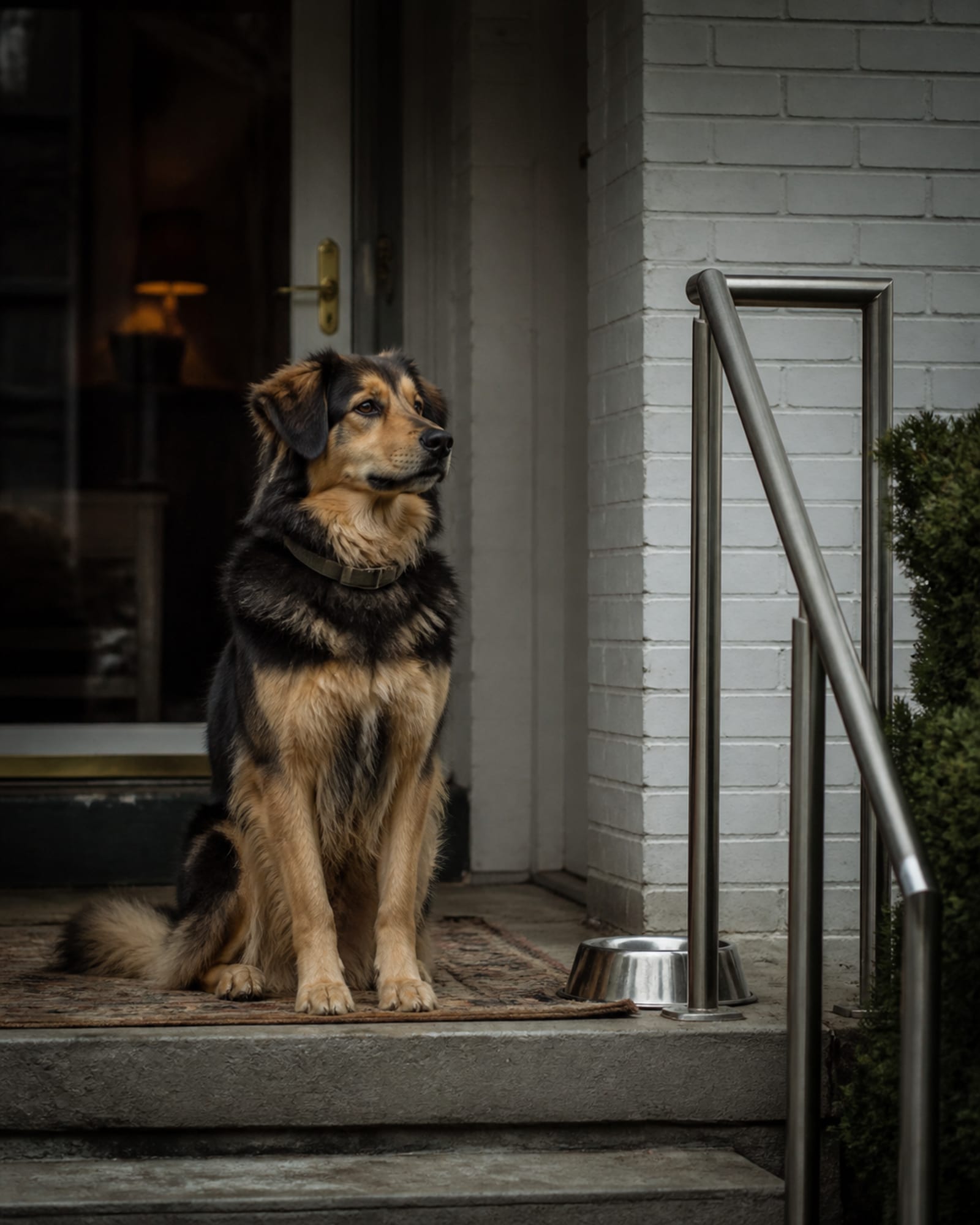
A dog sitting upright and attentive, shoulders square to camera
"Down." "Lie down." "Get down." "Down, boy, down."
Four sounds, four people, one dog, and in a good number of Clarksville houses at least one of those is in a different language entirely. Across the 21029 area 30.7% of residents were born outside the United States and 44.7% of people over five speak another language at home, and the households are larger than most, averaging 3.34 people in owner occupied homes.
Here is the part that surprises people. The second language is not the problem. Dogs learn sounds, and a dog can hold a dozen separate cues without difficulty. He will happily learn a sit in English from you and the same sit in Korean, Mandarin, Telugu or Spanish from a grandparent, and use both correctly. What he cannot do is work out which of four similar English phrases is the actual cue, said in four different tones, by people who each think they are saying the same thing.
A cue is not an instruction. It is a sound the dog has been paid for responding to, and everything else about it is decoration.
A dog does not parse a sentence. He hears a pattern and produces the behavior that has previously been worth producing when that pattern occurred. That is why "down" and "get down" are two separate sounds to him, and why "down" said sharply from the kitchen doorway and "down" said gently from the sofa can be two more. The variation people add for emphasis is the exact thing that blurs the signal.
So the rule in a multi adult house is not one language. It is one sound per behavior, per person, and everyone agrees the list. If the grandparents use their own word, write that word down and teach it deliberately as a second cue, the same way you taught the first. Ten minutes each and the dog has both. The failure mode is never bilingualism, it is an undocumented free for all where each adult improvises.
The second rule is that the word and the hand have to agree. Most people gesture without noticing, and dogs read the gesture far more readily than the sound. A household where three people use three different hand movements has taught three cues while believing it taught one. When I sit down with a family here, the first thing I do is write the list, words and hands together, and put it on the refrigerator.
The third is tone. A cue given once, calmly, and then followed through is a cue. A cue repeated five times with rising volume teaches the dog that the first four instances mean nothing, which is precisely what he then does with them. This is the single most common thing I correct in every house I go into, and in a busy household it multiplies by however many adults there are.
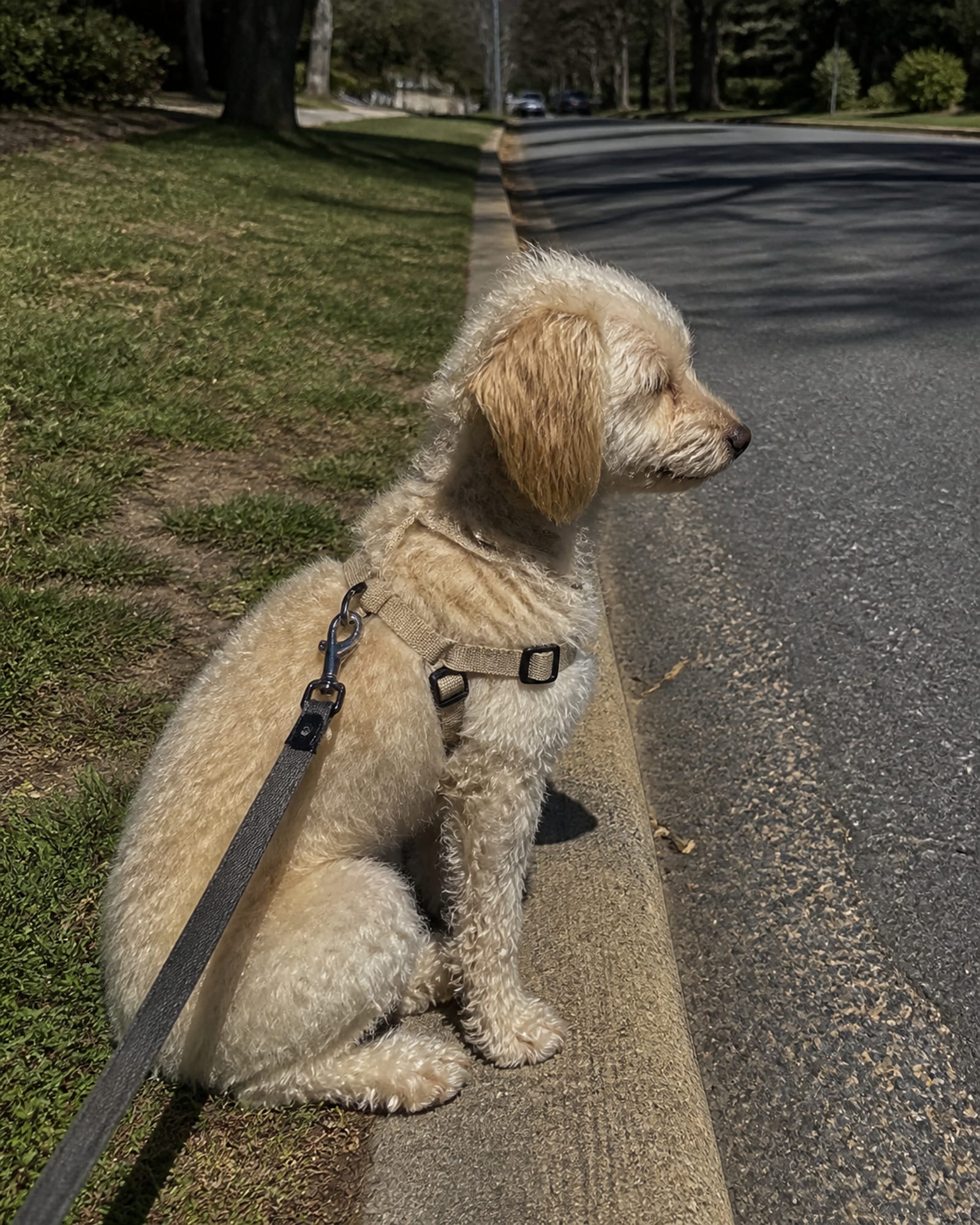
A dog sitting at a curb edge waiting to cross
Large houses, large households, and a lot of ground behind them.
01
Nearly always the person whose cue was never taught, or who repeats it. It is a signal problem long before it is a respect problem, and it is fixed in a session.
02
Two thirds of homes here have nine rooms or more and many are open plan. A cue that works at four feet may have never been tested at forty, and the dog is often out of sight when you use it.
03
Custom houses on wooded and former rural parcels have driveways that reach the road out of sight of the house. A dog loose in that space is not contained, he is simply not visible yet.
04
With no interior doors to work with, the settle has to be taught as a place rather than as a room. Almost every large house here needs this and few have it.
05
Clarksville Commons and the River Hill Village Center bring carts, food, children and other dogs into a small area, and the producer only farmers market concentrates all of it.
06
More than a thousand protected acres reached from Trotter Road, with deer, uneven ground and wet stream valleys. Excellent training ground and a poor place for an untested recall.
Space is comfortable for the household and it is neutral for the dog. Sometimes it works against you.
In a small house a dog is never more than a few feet from a person, so a hundred tiny corrections happen without anyone deciding to make them. He learns the household's shape by proximity. In a house with nine or more rooms none of that happens automatically. The dog can be entirely out of the loop for hours and still be indoors, and the behaviors you assumed he was absorbing were never actually taught.
The same is true outside. 89.7% of homes here are detached and most sit on real land, much of it wooded or backing onto former farm ground. A dog with that much space exercises himself and answers to nobody, which produces a fit dog with no recall. The fix is not less space. It is ten deliberate minutes inside it, twice a day, before the free time starts.
The interior version of the fix is a place command, taught to a specific bed or mat that can move with you. In an open plan house it is the only reliable way to say where the dog should be, because there is no door to close and no room to send him to. A dog that will hold a mat for twenty minutes while people cook, eat and come and go has solved most of what large households call me about.
One local note on the rules, since it comes up. Howard County requires licensing and current rabies vaccination, dogs under control off your own property, and it takes nuisance barking seriously. River Hill and the other associations here have their own covenants on top of that, and those are usually the ones that generate a letter. Worth reading yours before you solve a problem by building something.
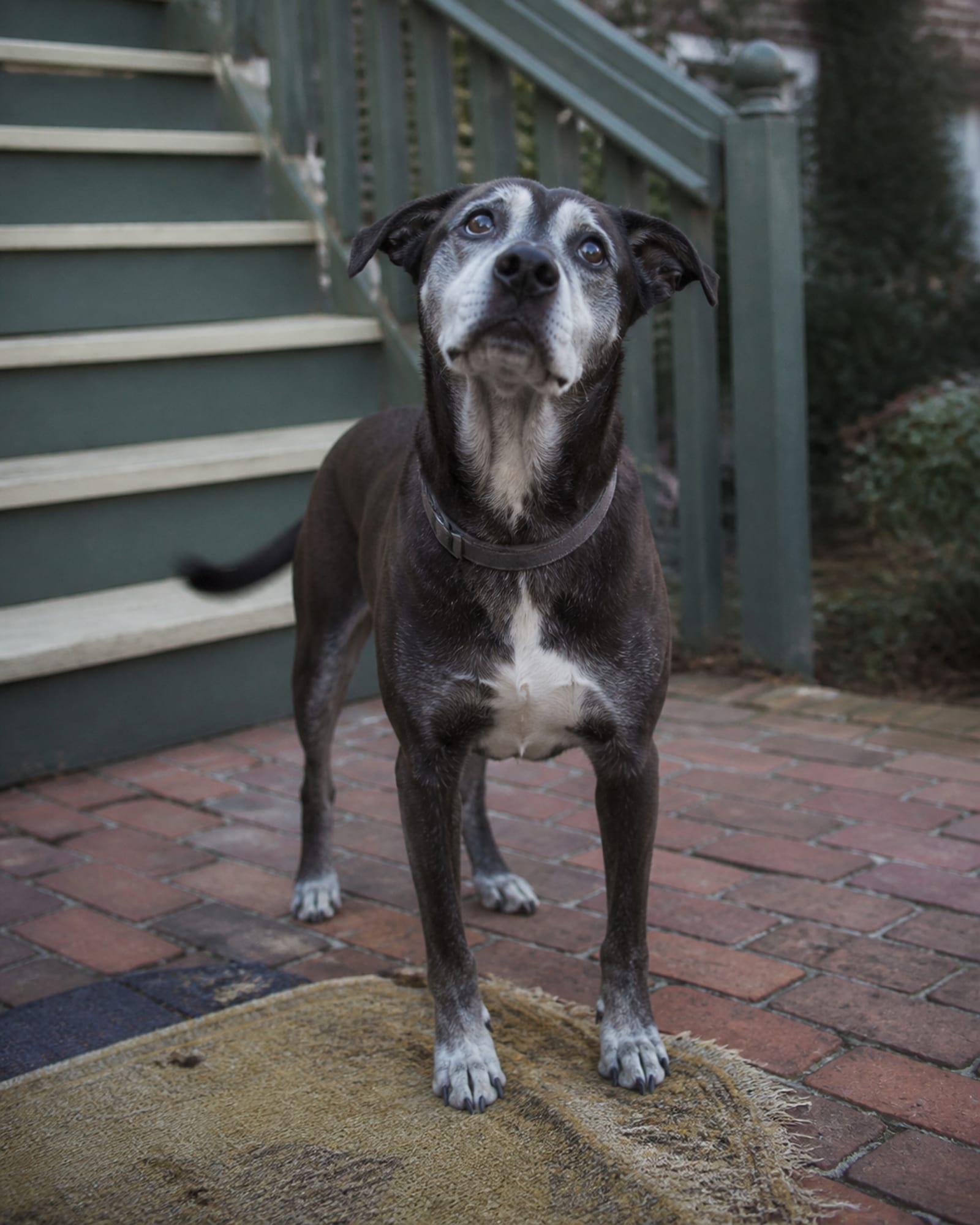
A dog looking up from a down, chin low, eyes raised
Every adult, every child, every word, in whichever language they use it. The list is always longer than anyone expects and that is the finding.
Not per household. Per person. If a grandparent's cue is in another language, that is fine and it stays, as long as it is fixed and taught rather than improvised.
One gesture per behavior, agreed and copied. Dogs read hands first, so an unmatched hand quietly overrides an agreed word.
One cue, then wait, then help the dog do it if he does not. Never a second repetition. This single rule changes more in a household than any technique I teach.
Ten minutes, new word, same behavior, paid the same way. A dog picks up a parallel cue in a couple of days and then has both for life.
Down the hall, from another room, from the far end of the yard. A cue that only works at arm's length in a house this size is not finished.
Phone (443) 429-0445, seven days a week from 6 AM to 7 PM. Tell me how many adults live with the dog and what each of them says when they want him to lie down.