01
A place, taught properly
A mat he can be sent to from across the room and hold for twenty minutes. It is the portable equivalent of a closed door and it works in a rental too.


In most towns the first advice for a difficult dog involves changing something: a fence, a gate, a screen. In Takoma Park's historic district a gate or a fence is an exterior alteration that may need a Historic Area Work Permit, so a training plan that depends on building something is not a plan at all.
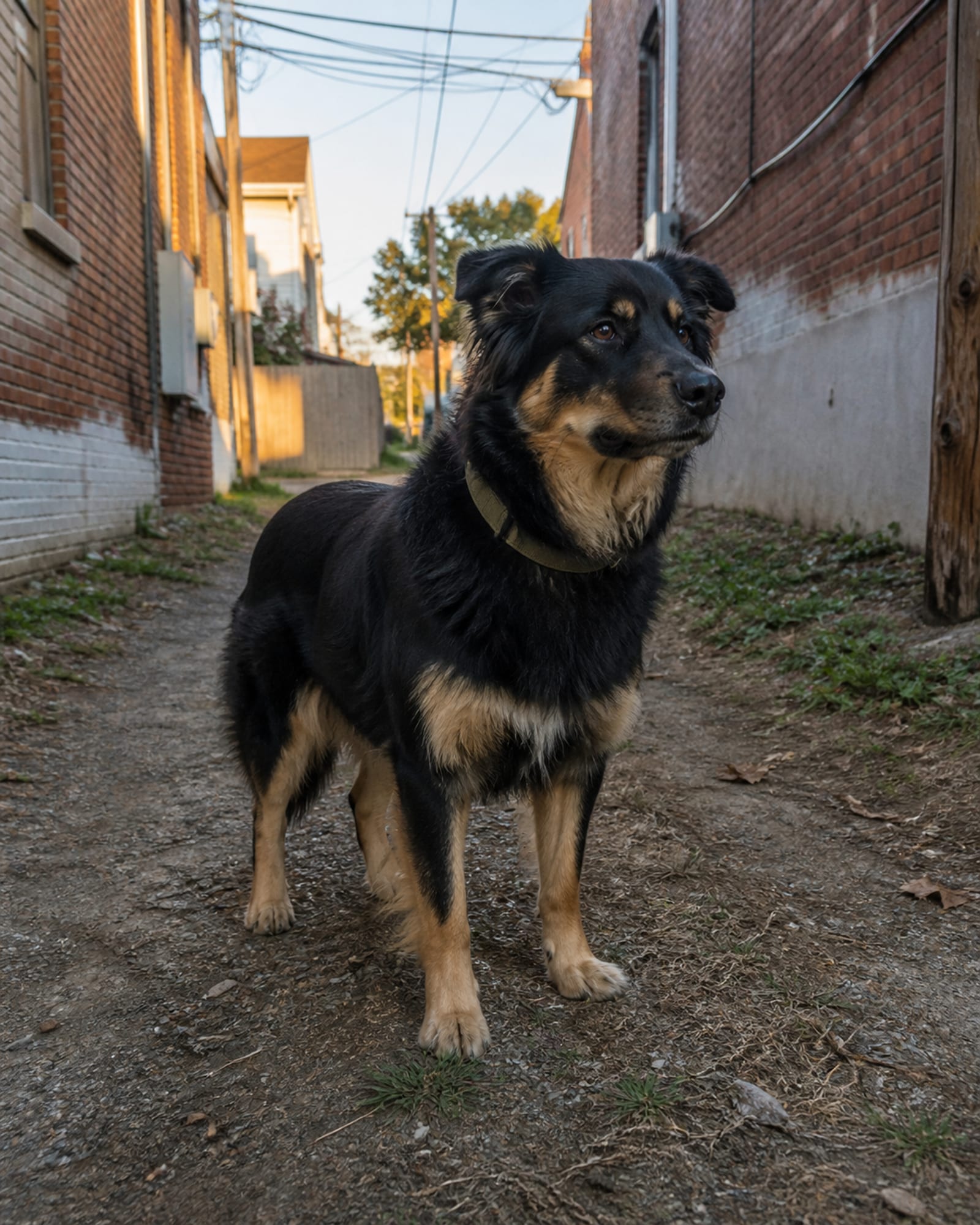
A dog standing alert with its weight even, tail neutral, in Takoma Park, MD
"Could we not just put a fence across there?"
Usually the answer is yes and it solves half the problem in an afternoon. Here it is often no, or not quickly, because the city's large historic district covers a great deal of the housing and exterior changes within it can require a Historic Area Work Permit. A fence is not a training accessory you pick up at the weekend. It is an application.
So the work has to be built out of behavior and layout rather than hardware, and that is a genuinely different discipline. It is also, for what it is worth, better training. Every problem solved by building something is a problem the dog never learned anything about.
Takoma Park packs 17,629 residents into 2.09 square miles, across 6,926 households at 54.2% owner occupancy. The historic district holds Victorian, Queen Anne, Craftsman, bungalow, Colonial Revival and vernacular houses; elsewhere there are apartment buildings, duplexes, small detached homes and garden apartments along New Hampshire Avenue and Flower Avenue. Small fenced yards, narrow porches, shared entries and steep basement stairs are the normal constraints, and windows sit close to neighbors.
Six things that do the job a fence or a gate would have done, without altering anything.
01
A mat he can be sent to from across the room and hold for twenty minutes. It is the portable equivalent of a closed door and it works in a rental too.
02
Six feet of line trailing on the floor for a few weeks. It is not a punishment, it is a way to reach a dog without lunging at him, and it replaces a stair gate.
03
A sofa turned, a bookcase moved, a rug that marks an edge. Rearranging is not an exterior alteration and it changes a dog's map of the house immediately.
04
Frosting the lower half of a pane removes the sight line without touching the exterior. It is the single most effective thing in a house where neighbors are close.
05
The dog waits at a doorway on cue. It costs nothing, needs no permission, and does the work of the gate you cannot install.
06
Which way you turn out of the door decides what he meets. On a street grid this tight, route selection is a real tool rather than an evasion.
This is presented as making the best of a constraint. It is actually the stronger approach and it is worth saying so.
Hardware contains a dog; it does not teach him anything. A gate at the top of the stairs stops him going up and leaves him exactly as inclined to go up as he was before. The day the gate is left open, or you are in a house that does not have one, you find out that nothing was ever learned.
Behavior travels. A dog who waits at a threshold on cue does it at your door, at your mother's door, at the vet's, and in the next house you live in. In a city where 45.8% of households rent and people move, that portability is not a small thing.
There is also a quieter benefit. A dog managed entirely by barriers spends his life being prevented, which is frustrating for him and produces a dog who tests every edge. A dog who has been taught what to do instead has a job, and dogs are noticeably more settled with a job than with a rule they keep bumping into.
None of which is an argument against equipment where it is available and appropriate. A crate, a leash and a well fitted collar are tools I use constantly. The distinction is between equipment that helps you teach something and construction that substitutes for teaching it.
In practice the households here who do best are the ones who accept the constraint early rather than spending three months trying to get around it. Once the answer to "can we build something" is settled as no, the plan gets built properly instead of provisionally.
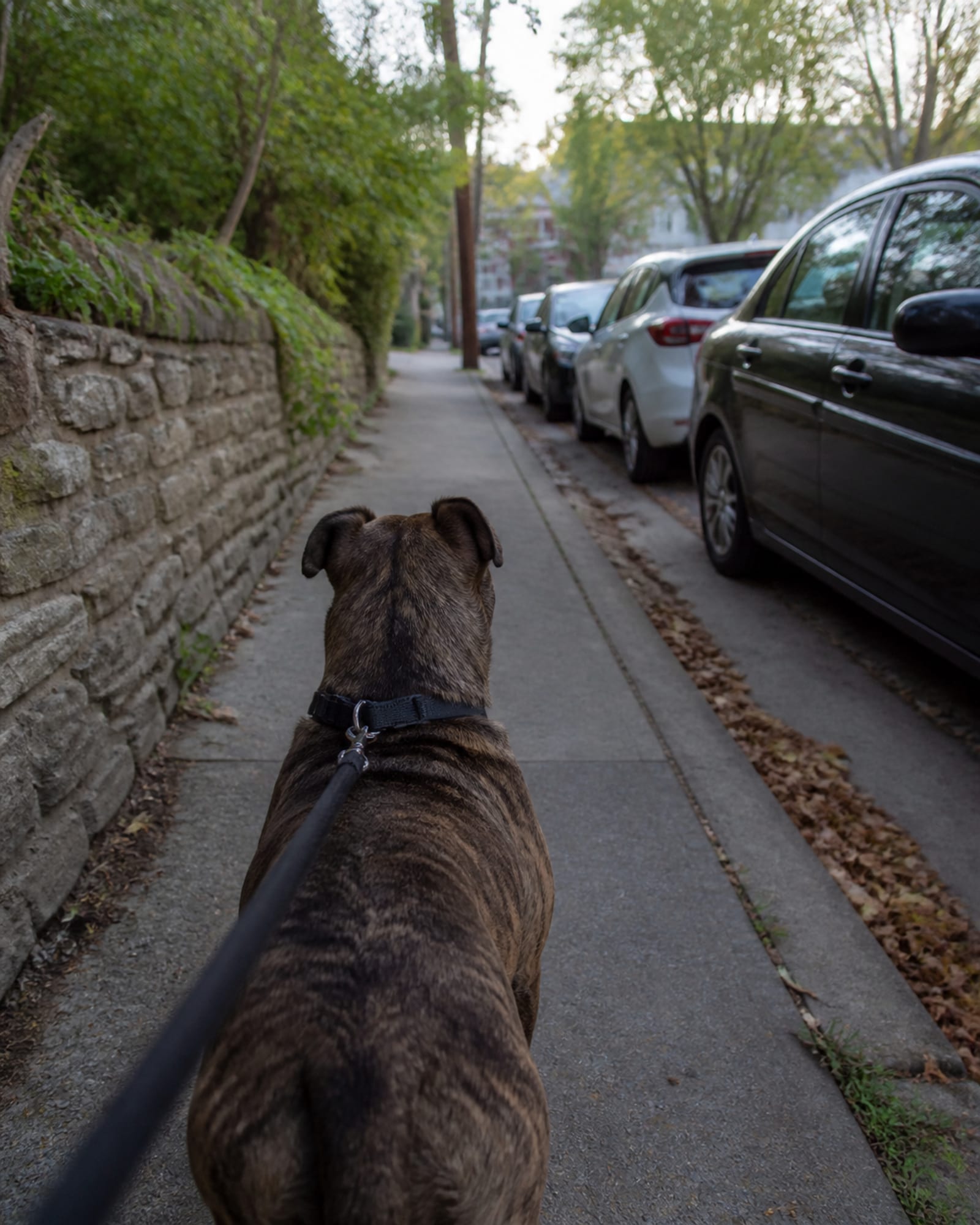
A dog walking away from camera down a pavement, seen from behind, in Takoma Park, MD
Dense, green, old and busy, with everything close together.
The street grid is tight, with on-street parking, alleys, buses, bicycles and limited sight distance under mature trees. That combination produces short-notice encounters at close range, which is the opposite problem from open ground and needs a fast, automatic response rather than a considered one.
The terrain rolls and is cut by Sligo Creek, Long Branch tributaries and small stormwater channels. Sligo Creek Trail is the main green corridor and it supplies deer, geese, mud, runners and sudden dog encounters, often around a bend. It is the best local training ground and it is not a beginner's environment.
New Hampshire Avenue, Piney Branch Road and University Boulevard add faster traffic directly beside dense housing, and Metro and CSX sound reaches the western edge. Takoma Junction and the Old Takoma businesses on Carroll Avenue concentrate pedestrians into a small area at predictable times.
One practical note that catches people out: the Flower Avenue green-street plantings and the roundabout bioretention areas are working drainage features rather than patches of grass, and they are not places to let a dog into. They look like the obvious spot to stop and they are not.
Quieter alternatives for real training work exist and are worth knowing: Takoma-Piney Branch Local Park, Spring Park, Forest Park, Belle Ziegler Park and Heffner Park, plus the Community Center grounds. Those give you somewhere to build a behavior before proving it on Carroll Avenue.
Timing matters as much as place in a city this compact. Old Takoma and the Junction fill and empty on a predictable rhythm, the Metro station feeds people through at commuting hours, and Washington Adventist University and the Montgomery College campus just outside the city add their own cycles. The same two hundred yards of Carroll Avenue is an easy walk at nine in the morning and a hard one at six, and choosing the hour is the cheapest training decision available to you.

A dog panting lightly after work, mouth open, eyes bright, in Takoma Park, MD
Where he goes, what he can see, which doors matter, where the neighbors' windows are. On a small lot the layout is doing more work than anyone realizes.
It is free, immediate, needs nobody's permission, and it frequently removes the trigger altogether. Do this before any training is attempted.
Not a token version. Sent from a distance, held while people come and go, with real duration. This is the load-bearing behavior in a house you cannot modify.
One doorway, taught as a hard boundary. Then a second. A dog with two reliable thresholds needs far fewer physical barriers than anyone expects.
Work out which direction from your door gives the calmest first two hundred yards, and use it for the first month. Every walk that starts well is a repetition in your favor.
Old Takoma and the Junction are the proving ground rather than the classroom. Go when it is quiet first, and go for ten minutes rather than an hour.
Phone (443) 429-0445, seven days a week from 6 AM to 7 PM. Tell me what you would build if you were allowed to, and I will tell you what replaces it.