01
No sight line
Garages and fences on both sides mean whatever is coming appears at ten feet rather than fifty. There is no distance to work with, so the dog reacts before you can.


Kentlands and Lakelands were laid out so the front of the house faces a street and the cars go behind. Which means the door your dog actually uses, ten times a day, is the back one, onto a shared lane. Almost nobody trains that door.
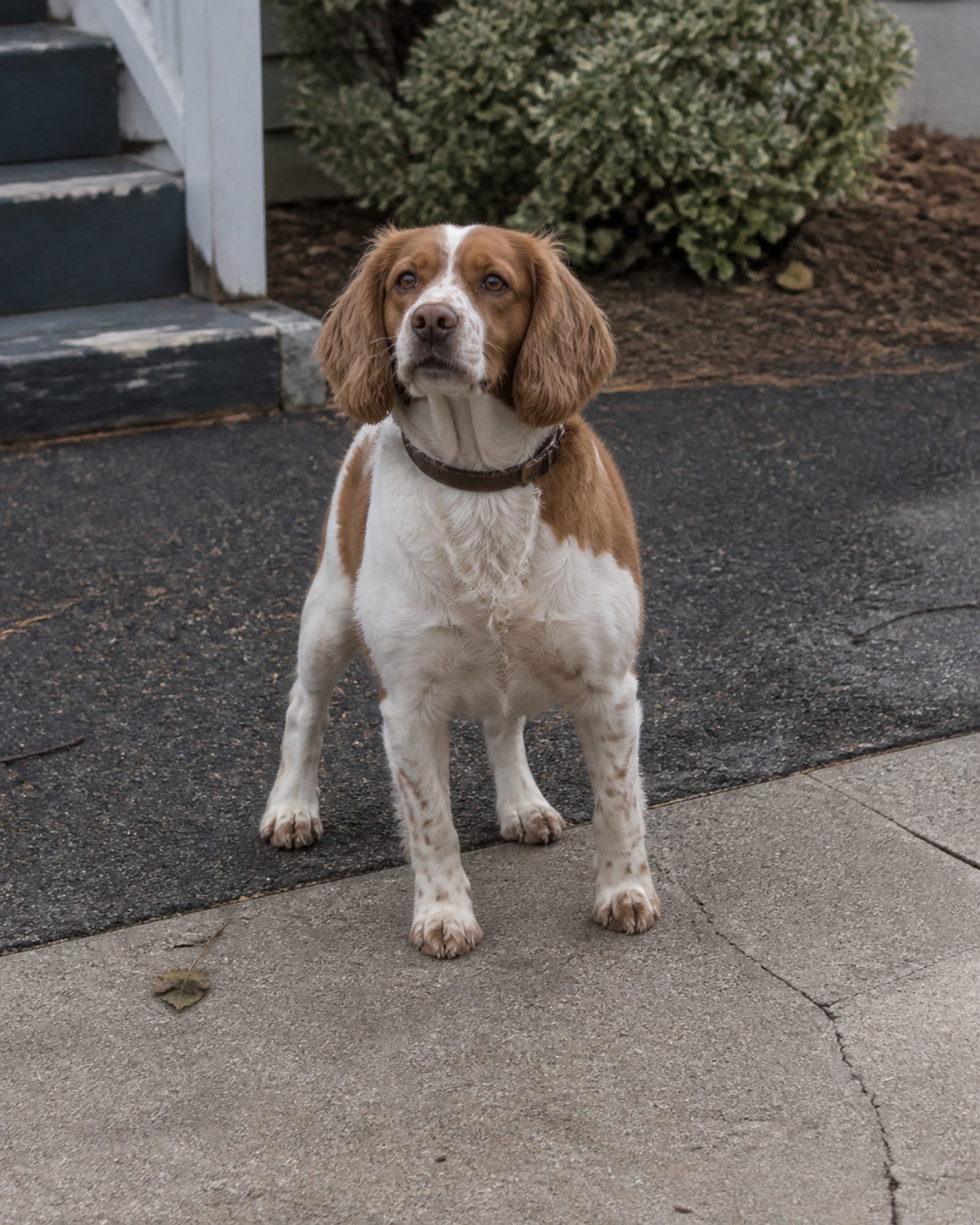
A dog standing square and settled, seen full body from the front, head up, in Gaithersburg, MD
The front door is the formal one. It has the porch, the number, the visitors and, if the dog has been trained anywhere, the training.
The back gate is the real one. It opens onto an alley with garages, bins, parked cars, neighbors' gates a few feet away, delivery vans reversing and children on bicycles using the lane as a shortcut. It is narrow, it has poor sight lines, and things appear in it without warning. That is where your dog goes out to the car, out to the bins, and out for most walks.
Gaithersburg is dense, at 6,749 residents per square mile across 25,772 households, and traditional-neighborhood design is a real part of how it is built. Kentlands and Lakelands mix detached homes, townhouses, apartments, shops and small greens around exactly this arrangement, and the city's housing planning also takes in duplexes, triplexes, quadplexes, stacked townhouses and bungalow courts. In a good share of those, the alley is the front door in everything but name.
Six things, and they arrive together rather than one at a time.
01
Garages and fences on both sides mean whatever is coming appears at ten feet rather than fifty. There is no distance to work with, so the dog reacts before you can.
02
On a sidewalk you can cross. In a lane you can flatten against a garage door. That is the whole of your options and the dog knows it.
03
A car reversing out of a garage is slow, quiet and unpredictable, which dogs find harder than fast traffic on a main road.
04
Another dog can be on the other side of a gate at nose height with no warning at all. That is a fence-line meeting in a corridor.
05
The single most reliable reason a dog pulls in an alley, and the easiest one to fix once anybody names it as the cause.
06
Bicycles, scooters and children move through lanes faster than through streets, because there is nothing to slow them down.
Households train the door that visitors use, because that is where the embarrassment happens. The dog's behavior is built at the other one.
Frequency decides habits. A dog goes out of the back door perhaps a dozen times a day and out of the front two or three times a week. Whatever happens at the back is therefore the rehearsed behavior, and whatever happens at the front is the occasional one. If he barges through the back gate, drags to the bins and lunges at the neighbor's gate every single day, that is his trained response to leaving the house, and the polite sit he does at the front door has nothing to do with it.
It is also where the risk is. A dog who shoots out of a front door lands on a lawn. A dog who shoots out of a back gate lands in a lane where a car may be reversing. That is worth more attention than the tidiness of his manners for guests.
The good news is that it is one of the fastest things to fix, precisely because you do it so often. A dozen repetitions a day of the right sequence changes a dog inside a fortnight, where the same behavior at the front door would take two months to get the same number of reps.
The sequence is not complicated: dog waits, leash on, gate opens, dog holds, cue, dog steps out into position beside you, gate shut. Same order every time, in both directions. The discipline is doing it when you are carrying something and running late, because that is the version the dog is actually learning from.
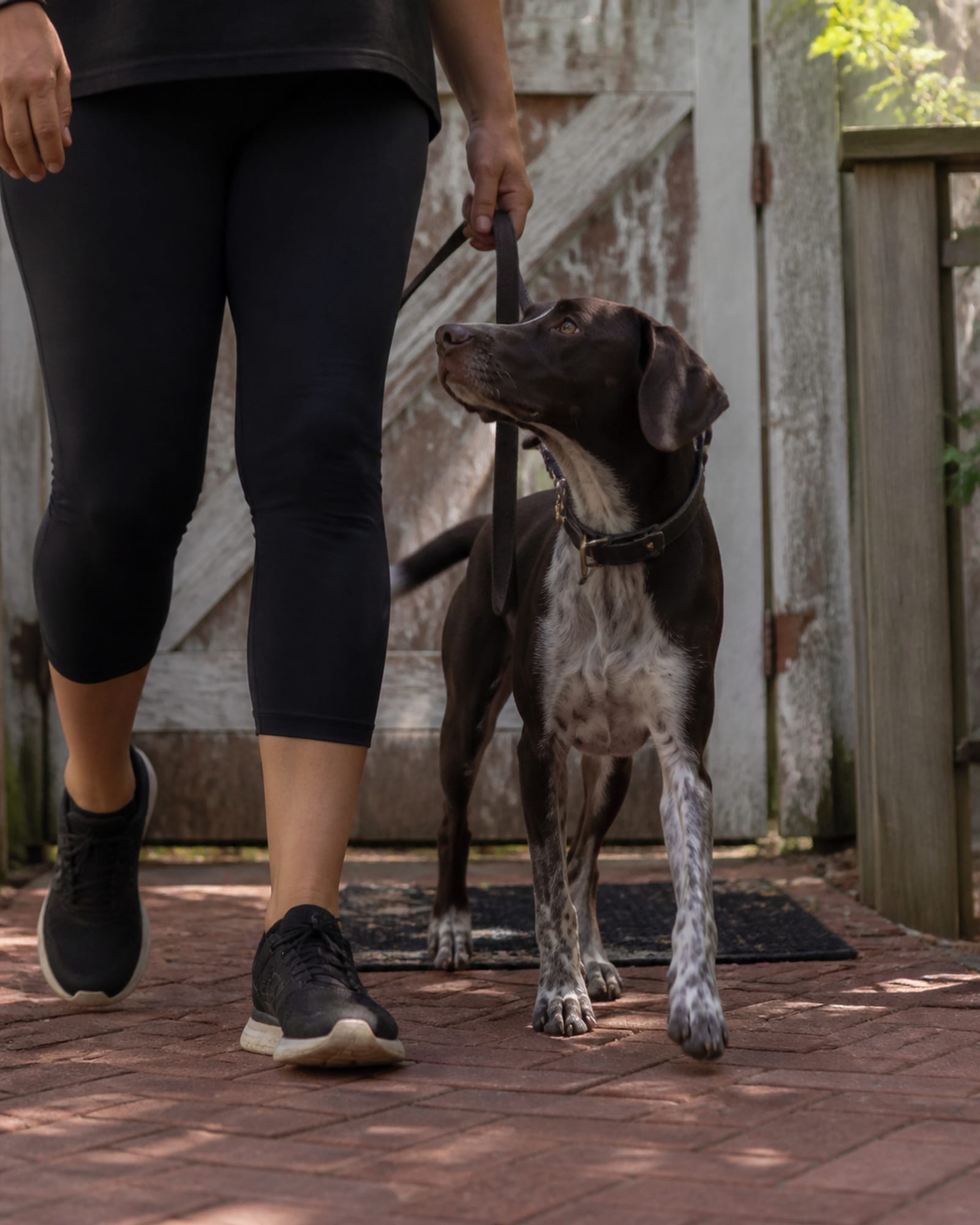
A dog walking at heel beside a handler's lower legs, both cropped at the knee, in Gaithersburg, MD
Fifteen times over a weekend, opening the gate and shutting it again without leaving. He learns that the gate opening is not a start gun.
Every time, no exceptions, including when it is thirty seconds to the car. This one change removes most of the actual danger.
One word, dog stops where he is. In a lane you cannot rely on recall, because there may not be room to come back through.
Early morning, empty, both directions, several times. He needs a version of that space in his head that is boring before he meets a busy one.
Walk past them, pay him for ignoring them, repeat. Treating the food smell as an ordinary trained distraction beats hoping he grows out of it.
The neighbor's dog behind the fence is the last thing you add, at whatever distance he can still think at, and it is worth arranging rather than waiting for.
The lane is the local specialty. It is not the whole picture, and the city changes character quickly.
Olde Towne and the historic districts around Brookes, Russell, Walker and Chestnut hold older houses on tighter streets with roughly ninety designated resources between them. Washingtonian Center and the newer mixed-use districts put homes over and beside shops, which means a dog can live above a business and meet retail foot traffic every time he goes out. The communities around Lakeforest bring garden apartments, condominiums and postwar subdivisions. Those are four genuinely different training environments inside one city, and a plan built for one of them does not transfer.
The ground is developed headwaters, with tributaries of Lower Great Seneca Creek, Muddy Branch and local ponds running between the roads. The city's own watershed study describes older areas built before modern stormwater controls, so after heavy rain the trails and pond edges add rushing water, mud, geese and displaced wildlife to a walk that was quiet the week before.
Then there is the mechanical layer: I-270, the MARC line carrying both freight and passengers, NIST security activity, Frederick Avenue traffic and the Lakeforest redevelopment. Those produce sudden noise and, more awkwardly for dogs, changing pedestrian routes. A dog who has settled into a walk can find the walk itself has moved.
All of which argues for the same approach rather than a longer list of things to worry about: work one variable at a time, in a place you have chosen, at a distance the dog can still think at. A dog who is steady beside a pond may still come apart at rail vibration or a construction fence, and that is not a setback. It is just the next thing on the list.
If you want one place to do the unhurried work, Bohrer Park and the ground around Seneca Creek State Park at the city edge give you space and a choice of distance, which is exactly what a lane cannot offer. Green Park, Kelley Park and Constitution Gardens are the smaller local versions. Use those to build the behavior and the alley to prove it, rather than the other way round, which is what most households end up doing by accident.
A dog's head and chest filling the frame, collar just visible, in Gaithersburg, MD
Phone (443) 429-0445, seven days a week from 6 AM to 7 PM. Tell me which door he really uses and what happens in the first ten feet after it opens.