01
Pulling, and the fall risk
On a grade this stops being a manners problem and becomes a safety one, especially for older handlers. It is treated accordingly.


Towson is built on a slope. Your dog pulls harder going down than coming back up, and on wet leaves in November that stops being an annoyance and becomes the reason people fall.
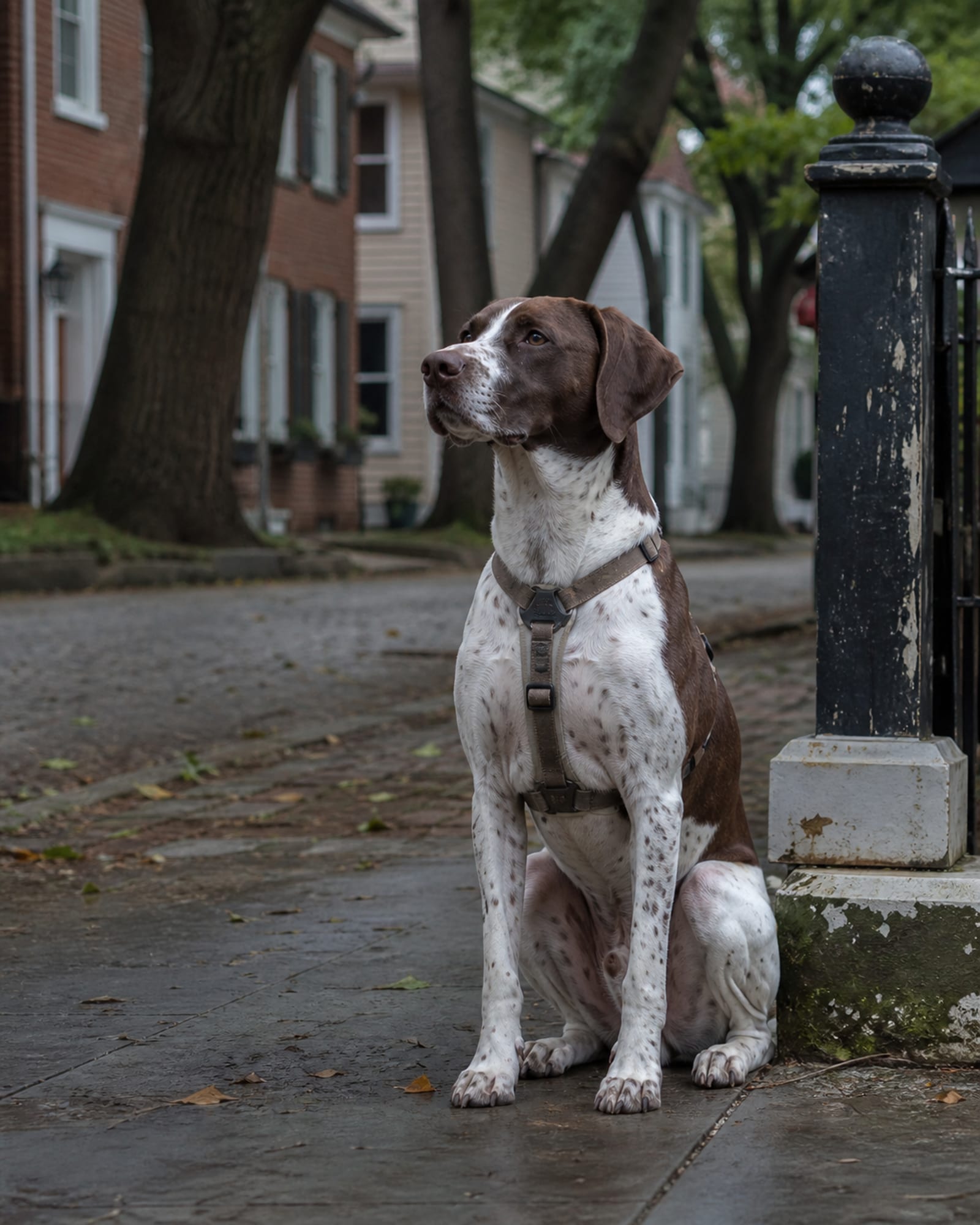
A dog sitting beside a gatepost, upright and calm, in Towson, MD
Ask someone in Towson where their walk gets difficult and they will usually describe a direction rather than a place. Going out is fine. Coming back down the hill, the dog is ahead, the leash is tight, and they are braking with their heels.
There is a reason, and it is not that the dog is being difficult on the way home. Gravity is helping it and working against you. A dog leaning into a harness on a grade has its whole weight behind the pull, while you have less grip and less braking than you do on the flat. Add wet leaves in autumn, a drainage grate the dog balks at, and the frost that sits on a north-facing sidewalk into mid-morning, and an ordinary pulling problem becomes a fall risk.
This is a Towson problem specifically. The town sits on rolling Piedmont ground, and USGS records Baltimore Gneiss exposures along Towson Run and Bellona Avenue toward Towsontown Boulevard. The hills are not incidental here. They are the terrain.
Most of the gear I see in Towson is the wrong size, the wrong type, or sitting on the wrong part of the dog. Ten minutes here is often worth more than a whole session, and it is where I start.
The dog has to know what position beside you means somewhere easy. Asking for it first on a hill guarantees a failure and teaches the dog that the cue is optional.
Going up, the grade is already slowing the dog down and doing some of the work for you. It is the gentlest place to add the slope as a variable.
Very short stretches at first, with frequent stops, so the dog rehearses moving down a slope at your pace. This is the actual exercise and it is the one everybody skips.
Wet leaves, a grate, a slick patch. If your dog has never met those under control, the first time will be the day it matters.
Almost 60,000 people live across Towson's 14 square miles, and the housing changes so sharply that what your neighbor was told may be wrong for you.
Downtown has apartment towers and newer mixed-use buildings, where the problems are quiet doorway manners, shared corridors and a dog that has learned an elevator means outside. Rodgers Forge is compact brick rowhouse blocks, where fence-line behavior is noticeable because your neighbor is six feet away. West Towson, Wiltondale, Southland Hills, Hampton and Ruxton have varied detached homes, mature yards and older street patterns, where the problem becomes recall and a boundary the dog cannot see.
Owner-occupancy sits at about 56%, so a good share of my clients are renting, and the age mix is genuinely wide: 17.8% under 18 and 18.0% over 65 in the same town. That is a different set of households than the university-town shorthand suggests, and it changes what a plan has to be realistic about.
So I would rather not tell you what Towson dogs need. I would rather see which Towson you live in. A dog with a perfect recall on a Ruxton acre may be hopeless in a downtown lobby, and neither of those owners has done anything wrong.
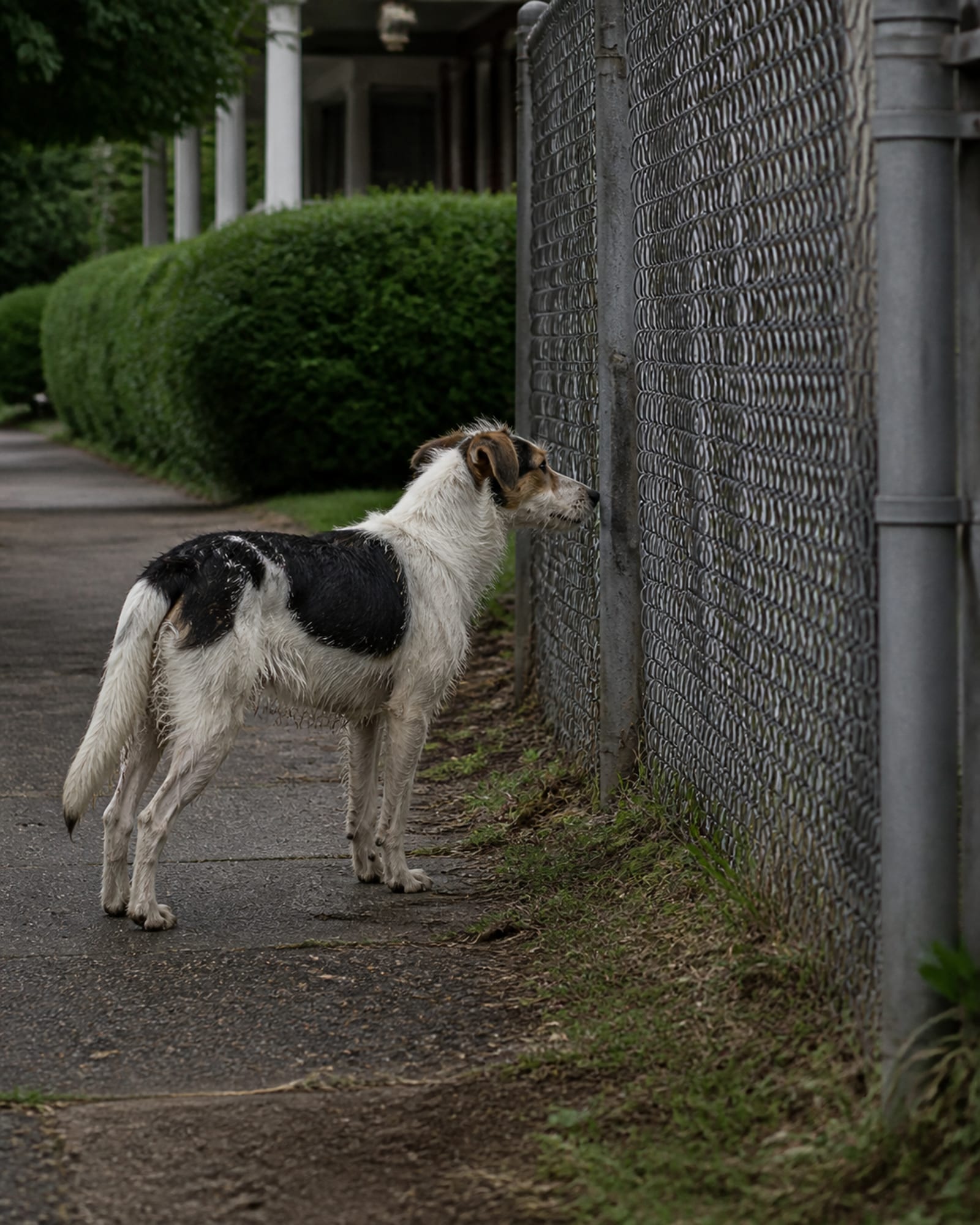
A dog standing beside a fence line, nose to a gap, in Towson, MD
The local pattern.
01
On a grade this stops being a manners problem and becomes a safety one, especially for older handlers. It is treated accordingly.
02
Sloped sidewalks funnel water, so there are more grates here than most people notice. A dog that plants its feet is easy to fix and miserable to live with.
03
Towson Run and the wooded corridors bring deer and smaller animals close to ordinary walks. A dog that has chased something once will try again.
04
Farmers markets, university events and seasonal street gatherings put strollers, bicycles, food and unfamiliar dogs in one place. Advanced practice, never a first outing.
05
Two dogs either side of a close boundary, rehearsing the same argument daily and never finishing it. It escalates rather than resolving.
06
Clay-rich, compacted yard soil drains slowly, so autumn brings mud indoors. Not a behavior issue, but a doorway routine fixes most of it.
Towson is just north of the city and well inside every range I work to, so nothing here is out of reach.
In-home private lessons at $700 cover an evaluation plus four one hour sessions across about two months. For a leash and handling problem this is often exactly right, because the hills we need to work on are the ones outside your door and you get two weeks between sessions to practice on them.
Kick Start at $1,600 runs five consecutive daily sessions in your home and neighborhood, then a lesson for you and a two week follow up, with equipment included. It suits a dog that needs momentum, and it suits a household that would rather do the work in one concentrated push than spread it over two months.
Board and train is available here too, and it earns its place where the underlying obedience is missing rather than just untidy. Your dog stays in my home rather than a kennel run. The programs are set out on the board and train page. What I will add is that a hill problem has to come home to your hill, so the handover lesson is where that value actually lands.
Whichever you pick, the useful thing about Towson is that the range of difficulty is short. A quiet residential street, a sloped stretch, a wooded stream corridor and a busy downtown block all sit within a few minutes of each other. That makes staged training genuinely practical here: you can build a behavior somewhere easy and test it somewhere hard without getting in the car, which is the single biggest reason owners actually keep up the practice between sessions.
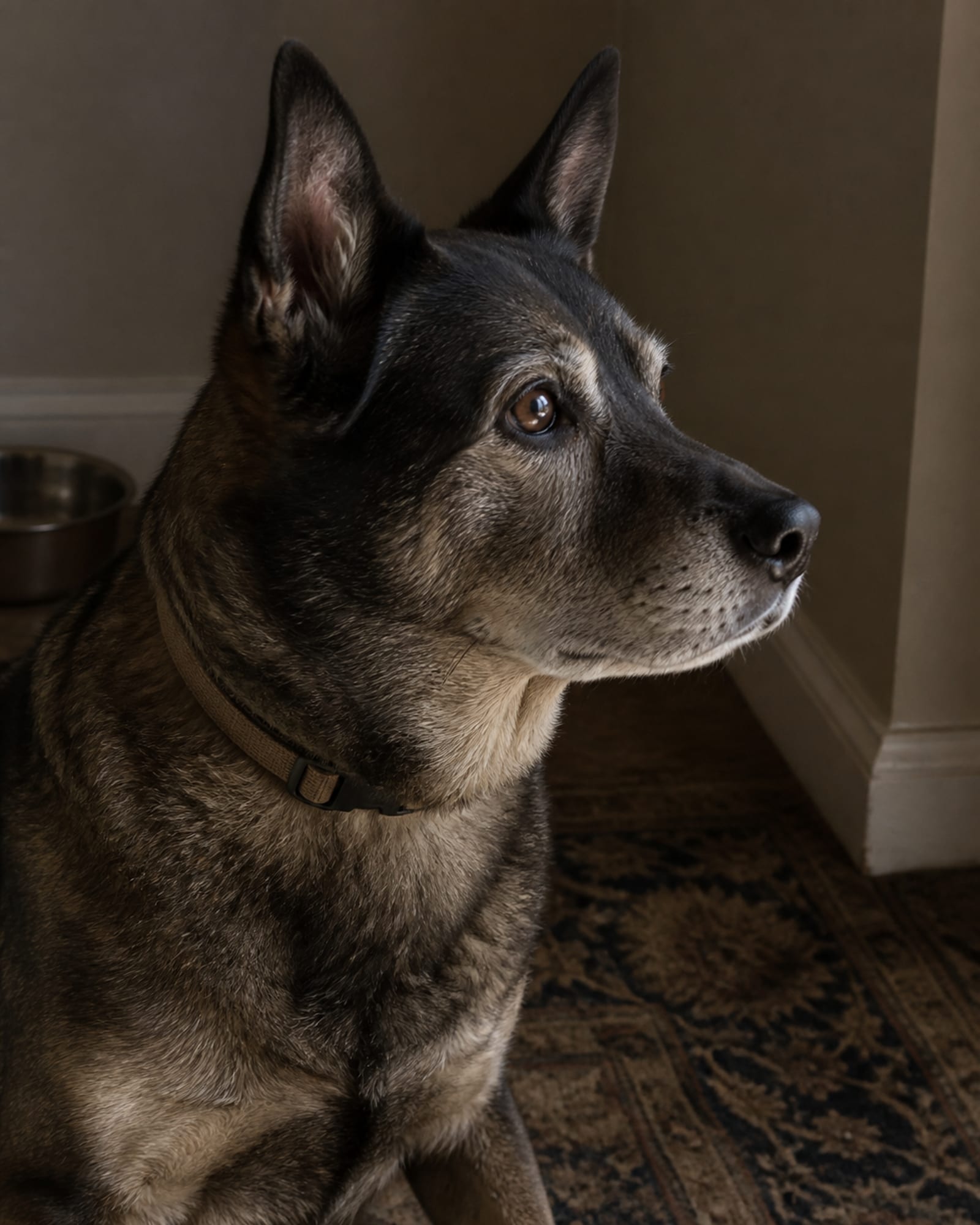
A dog's ears pricked mid alert, head and neck filling the frame, in Towson, MD
Phone (443) 429-0445, 6 AM to 7 PM, seven days a week, and describe the walk rather than the diagnosis.