01
People who come in and are not guests
The work above. It needs a different routine from the one you use for friends, and most households only have the one.


A lot of Potomac households have people coming into the house most days: a contractor, a delivery, someone for the grounds, someone for the pool, someone who is here every Tuesday. None of them is a visitor exactly, and your dog has no category for any of them.
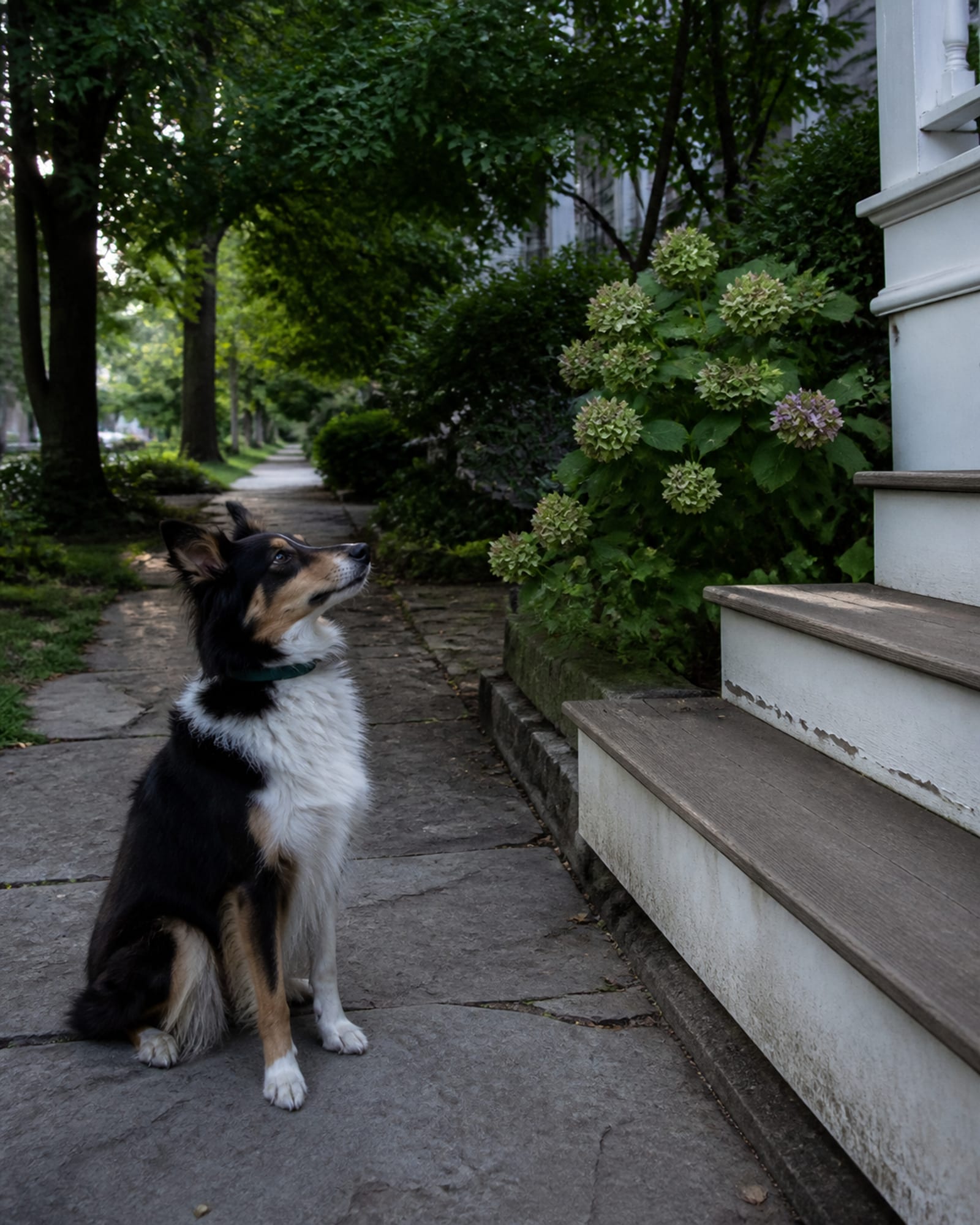
A dog sitting at the foot of steps, looking up out of frame, in Potomac, MD
A guest is easy. A guest arrives, is greeted, sits down and stays put. Dogs work guests out quickly because guests behave in a predictable shape.
The people who actually come into a Potomac house mostly do none of that. They arrive at odd hours, they do not greet the dog, they walk around carrying things, they go into rooms nobody normally goes into, they come and go through side doors, and then they leave without saying goodbye. From a dog's point of view that is not a visit at all. It is a series of unexplained intrusions by people who behave as though they live here and are not part of the household.
Potomac's 16,316 households sit at 84.8% owner occupancy on properties that run from mid-century ramblers and split levels through colonials and contemporary houses to equestrian parcels, gated estates and planned townhouses. Carderock Springs has modernist homes on wooded slopes; Avenel combines detached houses, townhouses and association-managed common land. A good number of those properties come with long private drives, separate entrances and more than one way in.
Large properties, a lot of arrivals, and a recreation corridor at the bottom of the hill.
01
The work above. It needs a different routine from the one you use for friends, and most households only have the one.
02
A front door, a side entrance, a garage, sometimes a separate staff door. Each is a threshold and the dog has usually only been trained at one of them.
03
Long private drives mean a vehicle is on the property well before anyone is at the door, so the dog has a minute of anticipation to work with.
04
Big open foyers and connected ground floors mean there is nowhere to put a dog without teaching a place first.
05
Narrow shoulders, high speeds, cyclists and private drive entrances all on the same stretch. Not a road to be casual on.
06
Mather Gorge, the C&O Canal, Cabin John Creek and Watts Branch bring rock ledges, fast water and heavy scent. Pets are not permitted on Billy Goat Section A.
One place, the same place every time, away from the route people carry things along. Not a different room depending on who it is.
He goes there on a word, from a distance, and stays. If you have to take his collar, it will fail on the day your hands are full, which is the day it matters.
On a long drive the anticipation starts when the car turns in. That is where the routine should start too, or you are always a minute behind him.
Something genuinely good, every time, for going to the spot while somebody comes in. You are buying a habit that has to outlast your attention.
"Please ignore him, he is training." Most people are relieved to be told. A regular who greets him every week is training the opposite of what you are.
Same routine at the side door, the garage and the main door. A dog trained at one threshold has not generalized to the others and will treat them as unrelated.
Space is not the advantage people assume it is, and in this particular respect it works against you.
On a small property the dog is near the door and near you, so a hundred small corrections happen without anyone deciding to make them, and the household's expectations get absorbed. On a large one he can be three rooms away doing something entirely of his own devising, and the first anyone knows about it is when it becomes a problem.
The arrivals compound that. A dog who barks at somebody coming in, and who then watches that person leave two hours later, has had the behavior confirmed on a slow but perfectly clear schedule. Repeat across several trades a week and you have a genuinely well practiced routine that nobody set out to teach.
The other thing that space hides is that the dog is often not being asked for anything at all. A dog with a lot of ground gets plenty of exercise and very little instruction, which produces a fit, confident, entirely self-directed animal. That is a harder starting point than a bored dog in a flat, and it surprises people.
None of this is an argument for less space. It is an argument for ten deliberate minutes a day inside it, and for a single routine that covers every arrival rather than a judgment call each time.
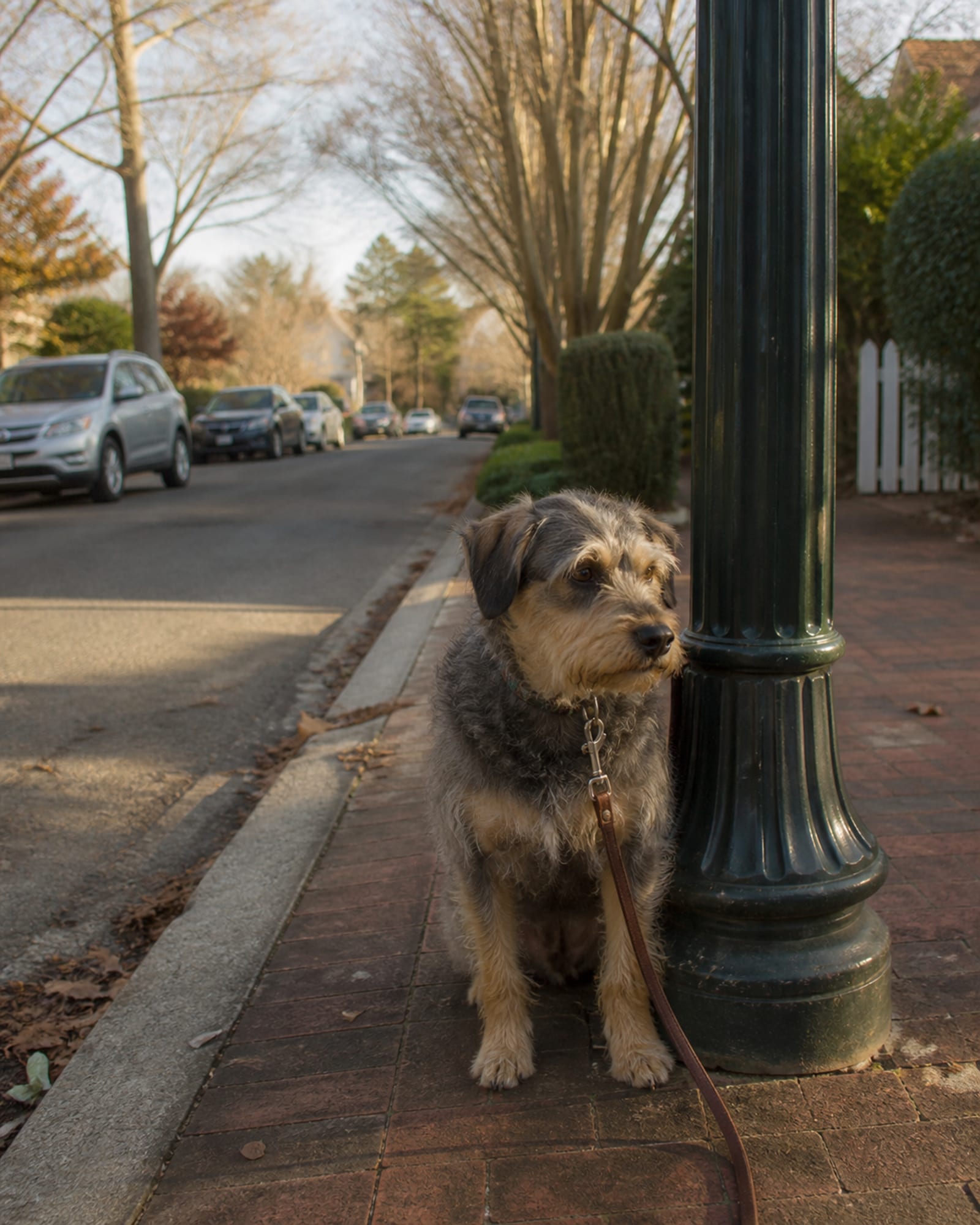
A dog sitting square beside a lamp post, in Potomac, MD
The property and the gorge are minutes apart and they ask opposite things of a dog.
At home he is expected to be relaxed, self-managing and largely unsupervised across a lot of ground. Fifteen minutes later he can be at Great Falls, Carderock or the towpath, where the ground is rock ledge and fast water, the parking surges on a fair weekend, and there are cyclists, runners and other dogs on a narrow path. Those are opposite skill sets and a dog who has only ever been asked for the first will not have the second.
The mistake I see is skipping the middle. Households go straight from a quiet property to a busy recreation corridor because both are places the family goes, and there is nothing in between. The dog has had no intermediate exposure at all, so his first experience of crowds and close passes happens on a ledge above moving water.
So the intermediate steps have to be manufactured: Potomac Village at a quiet hour, the Potomac Community Center surroundings, Cabin John Regional Park, Blockhouse Point. Somewhere with people and room to move away from them, worked before anywhere with people and no room.
And a plain safety line, which I would rather state than imply. I do not test recall beside cliffs, canal water or River Road, and neither should anyone else. A recall gets proofed somewhere it can safely fail. If it has never failed anywhere, it has not been tested, and the gorge is not the place to find out.
One last thing about the middle ground, because it is where the work actually gets done. Potomac Village at the Falls and River roads junction, the Potomac Community Center, the library and the school approaches all give you people and room to move away from them at the same time. That combination is exactly what a dog needs while a behavior is forming, and it is the thing the property does not offer and the gorge does not either.
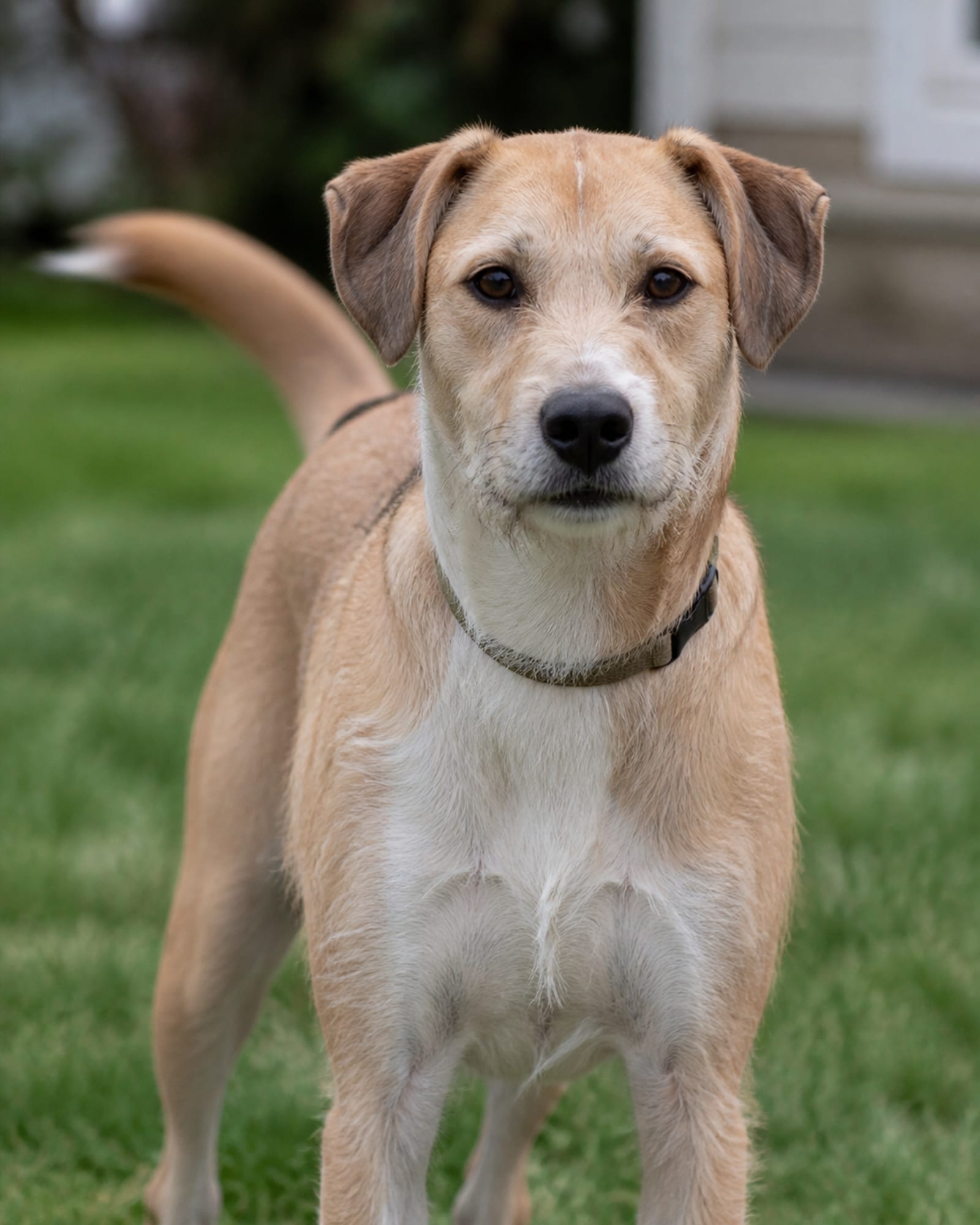
A dog's head and chest filling the frame, collar just visible, in Potomac, MD
Phone (443) 429-0445, seven days a week from 6 AM to 7 PM. Tell me who comes in during a normal week, which door they use, and what he does about it.