01
Livestock manners
A dog that can stand at a fence and look at a horse without fixating. It is a specific trained behavior and it is not the same thing as general obedience.
Kinder Farm Park runs 288 acres with a working farm, livestock and 4-H animals at the middle of it, and a paved trail 2.4 miles around the outside. A great many Millersville dogs will meet a goat, a sheep or a horse this year, and almost none of them have ever been taught what to do about it.
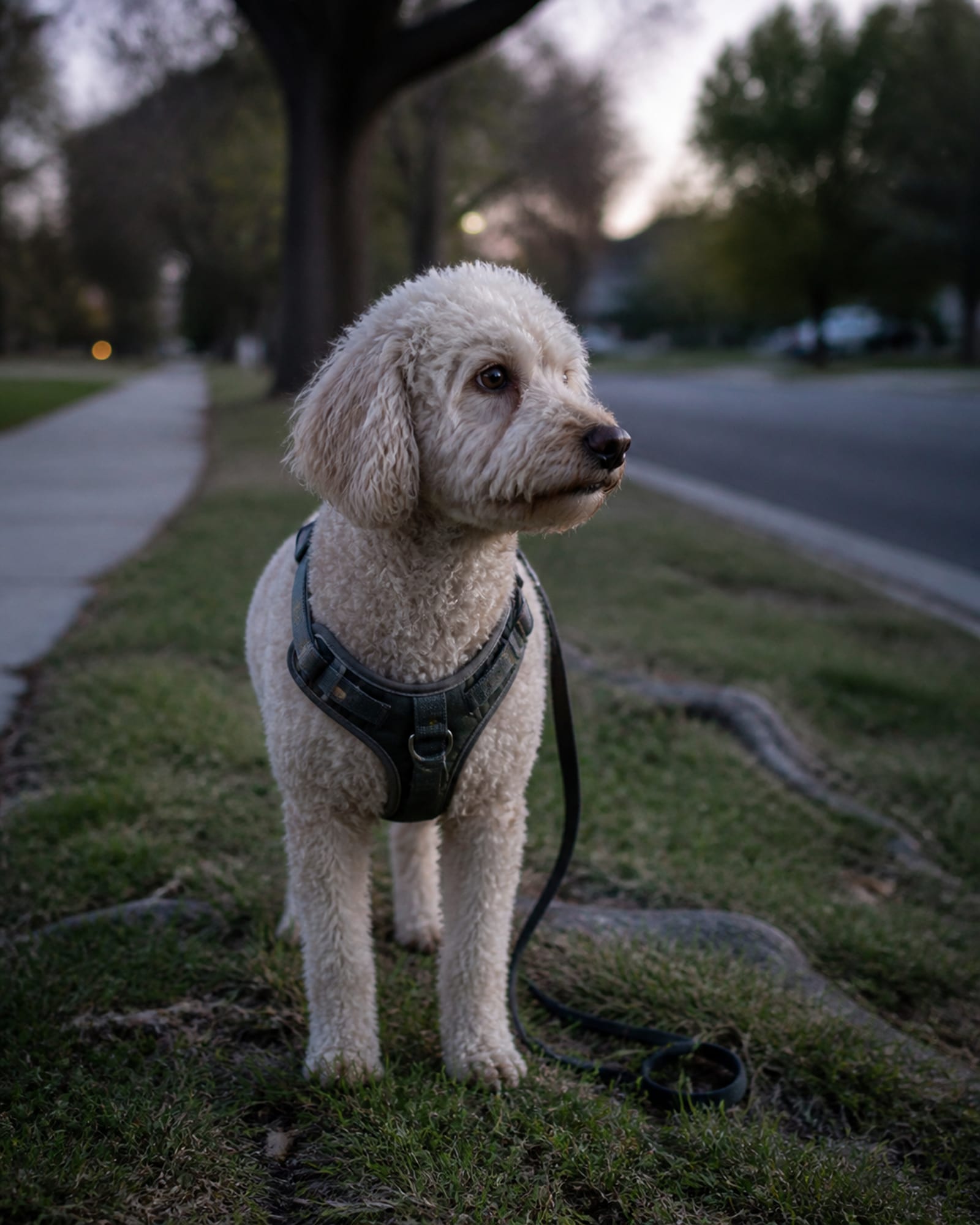
A dog in a stand stay with its lead slack on the ground beside it, in Millersville, MD
A dog can be perfectly civilized about people, cars, bicycles and other dogs, and completely unprepared for the first time a large animal turns and looks at him through a fence.
It is not aggression and it is usually not fear either. It is the oldest set of instincts he has, arriving all at once, in a body that has spent its life on a sidewalk. Some dogs freeze. Some bark in a tone you have never heard from them. Some go quiet and lock on, which is the one to take seriously.
Millersville puts that meeting within reach of almost every household here. Kinder Farm Park's 288 acres hold a farm museum, livestock and 4-H programs, with a paved perimeter trail of 2.4 miles and natural trails inside it. The South Shore Trail runs on the old WB&A railroad alignment. Beyond the subdivisions the ground is still open in places. A dog raised in a 1970s or 1980s split level on Benfield Road can be nose to nose with a sheep in fifteen minutes.
A settled, heavily owner occupied community with real farm ground inside it.
01
A dog that can stand at a fence and look at a horse without fixating. It is a specific trained behavior and it is not the same thing as general obedience.
02
The still, silent, staring version. This is the one I most want to see early, because it is the pattern that precedes chasing and it does not resolve on its own.
03
With 88.5% homeownership and 76.0% detached houses, most dogs here have space. Space plus wildlife plus livestock is exactly where a partly built recall fails.
04
County plans call for safety work and wider shoulders on Millersville Road and Generals Highway. Until then a lot of local walking happens on a verge.
05
The county facility on Maxwell Frye Road means dogs arriving, dogs barking and a good deal of arousal in one place. Worth working at distance rather than walking straight past.
06
The new park on Millersville Road is being built with fields, courts, trails and stormwater work. Noise, machinery and closed routes for a while yet.
People treat it as one more distraction. It is not, and treating it as one is how dogs get into serious trouble.
A squirrel that gets chased runs up a tree. A horse that gets chased runs, and a running horse is an emergency for the horse, for whoever is on it, and for your dog. Sheep and goats can be injured or killed by a dog that had no intention of hurting anything and was simply doing what the movement made him want to do. The consequences are entirely different from every other distraction on a walk, and they arrive faster.
That is why I do not train livestock as an exposure exercise where the dog gets closer and closer until he is fine. I train it as a boundary. There is a distance at which the dog can look, think and respond to you, and the whole of the work happens at or beyond that distance. Getting closer is not the goal. A dog who can walk past a paddock with his head up and his brain on is finished, whether that happens at ten feet or at fifty.
The second reason it is its own category is that the instinct varies enormously by dog and by breed group, and it does not correlate with how well behaved a dog is otherwise. I have seen impeccable family dogs come apart at a fence line and difficult, reactive dogs be entirely indifferent to a cow. You do not find out which you have by reasoning about it. You find out by taking the dog somewhere with a long line on him and watching.
The third is the phrase I hear most, which is that he would never actually do anything. He might not. Neither of us knows, and the test is expensive to get wrong. A dog off leash near livestock is a decision you are making on the animal's behalf and on the owner's, and I would rather be blunt about that than polite.
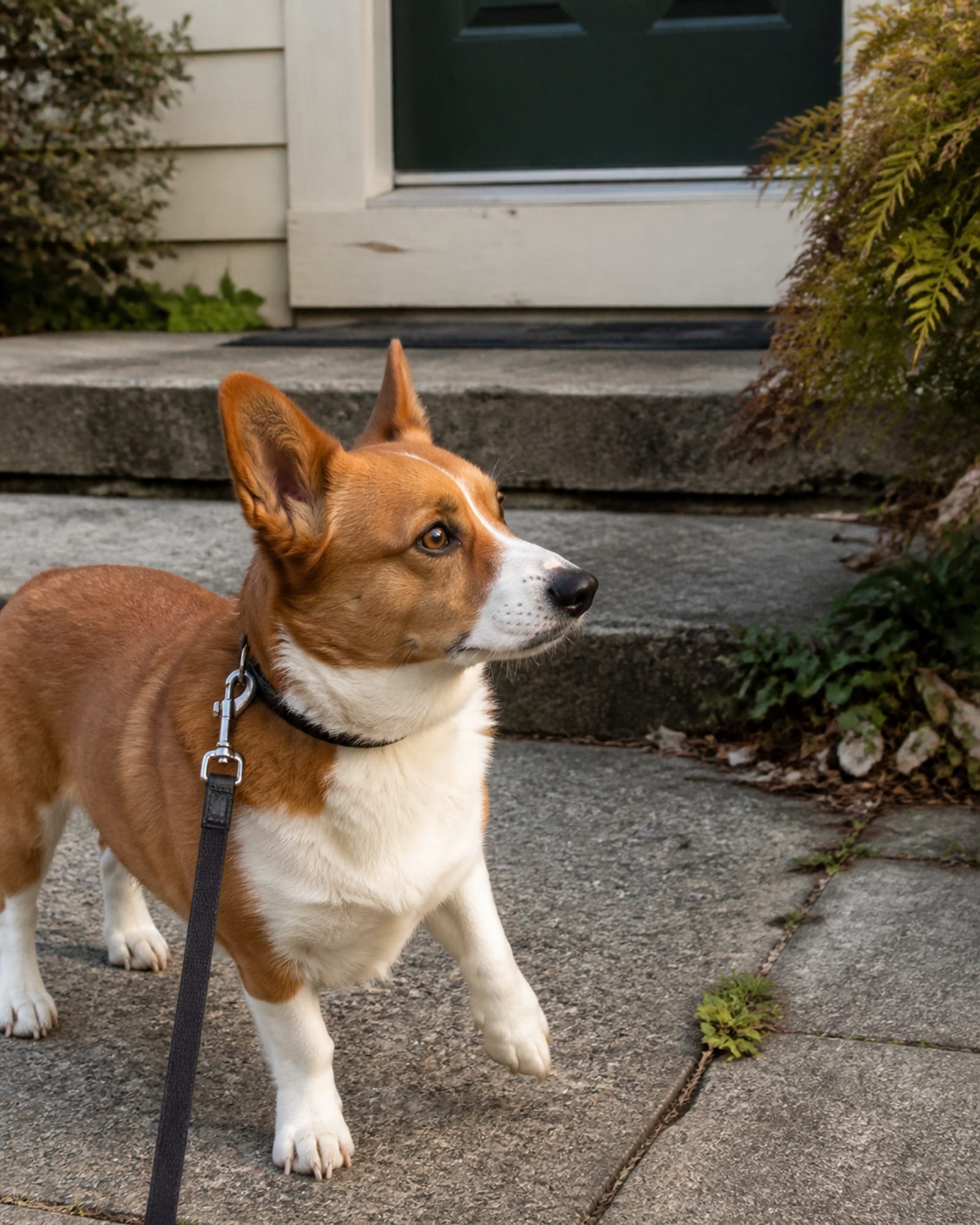
A dog pausing mid stride on a pavement, one paw lifted, in Millersville, MD
Kinder Farm Park is one of the better training resources in the county if you use it deliberately.
The layout does most of the work. The paved perimeter runs 2.4 miles with the farm at the middle, so you can choose your distance from the animals almost continuously rather than in the jumps a smaller park forces on you. Start far out on the loop, work at whatever distance the dog can handle, and cut inward over weeks rather than in an afternoon.
It also gives you everything else in one place: bicycles and runners on the paved trail, children, other dogs at distance, farm smells that a suburban dog has never met, and natural paths with real footing. Very few places let you rehearse that many things without having to drive to five of them.
Two practical notes. Check what is running before you go, because livestock programs, camps and group events change how busy it is by an order of magnitude, and an unprepared dog does not need a 4-H day as his introduction. And keep the leash on. Recognizing a place as good training ground is not the same as it being somewhere your dog may be loose, and the rules there exist because of the animals.
The Millersville area has one gap worth planning around. There is no library branch of its own, and people use Severna Park, Odenton or Crofton, which means a fair amount of local life happens in a car. That is relevant to dog training more than it sounds, because a dog who only ever goes out by car needs the car itself to be an ordinary, calm place rather than the thing that predicts excitement.
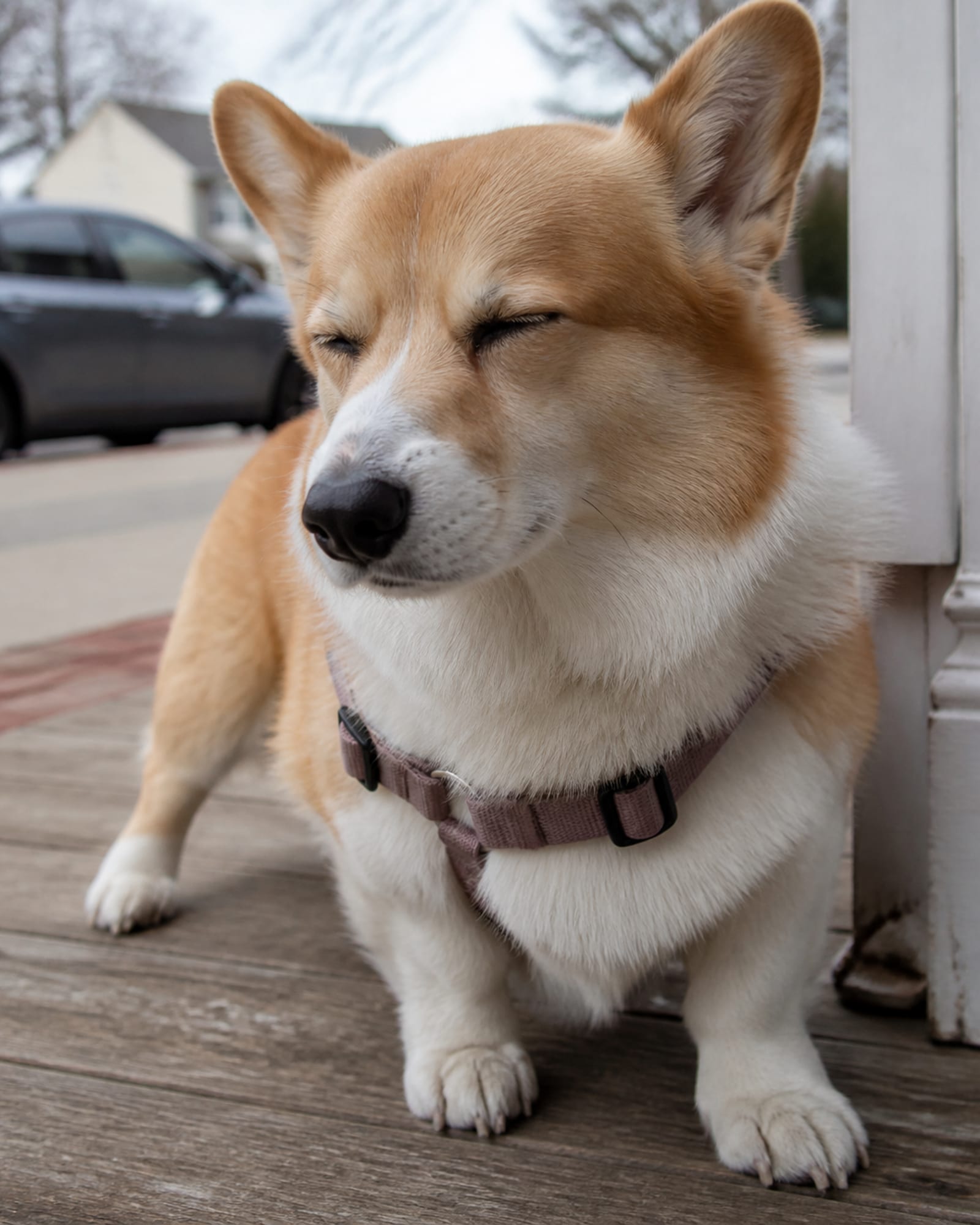
A close vertical of a dog blinking slowly, relaxed, in Millersville, MD
Long line, wide distance, and watch. Curious, worried, indifferent, or locked on. That answer sets everything that follows and it takes one session to get.
The distance where he can look at the animals and still hear you and still take food. That is your training line. Anything nearer is management, not learning.
Look at the horse, look at me, get paid. Repeated until the sequence is automatic, so that seeing an animal becomes the cue to check in rather than the cue to fixate.
Animals that are standing still are the easy version. A horse moving, a goat running at a fence, is the real test and it has to be met at your working distance first.
The behavior that matters is coming away from something interesting, not coming when nothing is happening. Long line stays on for all of it.
Boredom is the target. If he is still fascinated at forty feet, thirty feet is not a reward for progress, it is a way to lose what you have built.
Phone (443) 429-0445, seven days a week from 6 AM to 7 PM. Tell me what he does when he sees something large and unfamiliar, and how much room you have to work in.