01
The long approach
The work above. It is the local specialty and it changes how every other exercise on this list has to be run.


Kent Island runs from sea level to about twenty feet. The ground is flat, the yards are open and the trails run straight, which means your dog sees what is coming a very long way off. Most training advice is written for the opposite problem.
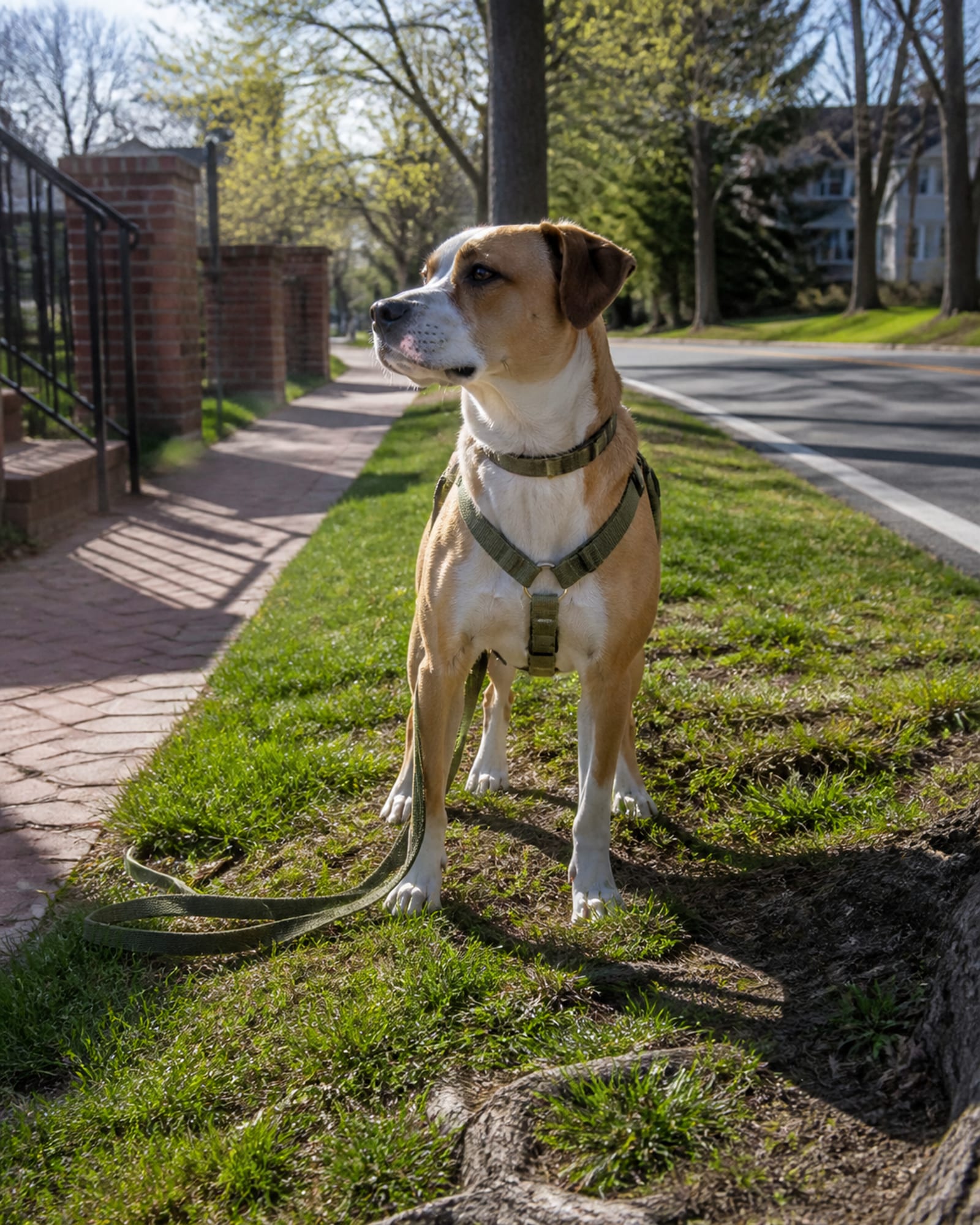
A dog in a stand stay with its lead slack on the ground beside it, in Stevensville, MD
You are on the Cross Island Trail and there is a dog three hundred yards away.
On a wooded path you would not see it until sixty yards, and neither would your dog, and you would both deal with it in a few seconds. Here you have three hundred yards of approach, and so does he. He locks on at two hundred and fifty. By a hundred he is up on his toes. By fifty he has been staring at that dog for a full minute and a half, and whatever happens next was decided long before either of you got there.
That is the local training problem, and it is the exact inverse of the one most advice is written for. Everything you read is about surprise: dogs appearing round corners, no time to react, nowhere to make space. Stevensville gives you all the time and all the space in the world. What it does not give you is any way to prevent your dog spending ninety seconds rehearsing before the thing arrives.
It is a small community, 7,442 people in 3,318 households, up from 6,803 in 2010, with 77.8% owning their homes and a mean commute of 27.2 minutes.
Owners assume seeing it early is an advantage. For a reactive or excitable dog it is usually the opposite.
Arousal builds. A dog who spots something at distance and stares at it is not calmly assessing, he is winding up, and the longer he does it the higher he gets. By the time the other dog is close he is at the top of a slope he has been climbing for a minute and a half, and no cue you own is going to reach him up there.
Compare that with the wooded version. A dog rounds a bend, meets another dog at forty yards, and reacts for perhaps four seconds before you can move away. Four seconds of arousal is recoverable. Ninety seconds is a different animal.
This is why owners here often tell me their dog is worse on open ground than in town, which sounds backwards until you think about the timing. It is not the openness. It is the staring, and the staring is only possible because there is something to stare at for that long.
The other half of it is that you can see it coming too, and most people respond by tensing up, shortening the leash and going quiet. Every one of those is information to the dog, and it confirms that something worth worrying about is on its way. On a long approach your own behavior has ninety seconds to leak, and it does.
So the work here is almost entirely about the first ten seconds after the sighting rather than about the meeting itself. If you can interrupt the stare early, the rest of the approach is ordinary. If you cannot, no amount of skill at close range is going to save it.
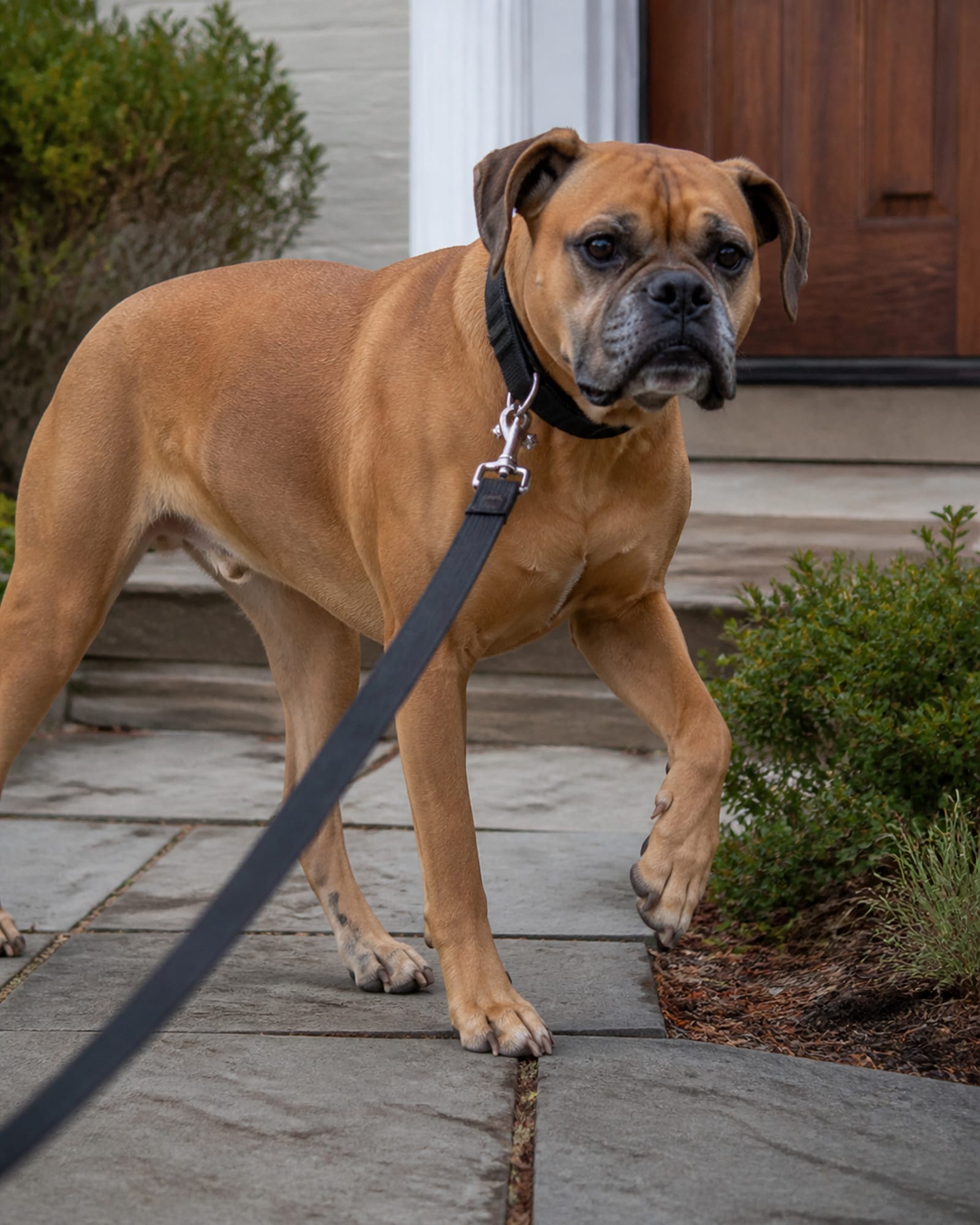
A dog pausing mid stride on a pavement, one paw lifted, in Stevensville, MD
The same open ground that causes the problem is the best training resource on the island, and for the same reason.
On a wooded path you cannot choose your distance. Whatever appears, appears, at whatever range the corner decides. Here you can work at literally any distance you like, which is precisely what a reactive dog needs and almost nowhere offers. That is a genuine advantage and it is worth understanding before writing the openness off as a problem.
So the routine is to see it first and act immediately: change direction, step off the path, put yourself between, or ask for something he knows, while the other dog is still far enough away that he can hear you. Not when it gets close. The whole skill is in acting at two hundred yards rather than at fifty.
Terrapin Nature Park and the Cross Island Trail are the obvious places to practice, and Old Love Point Park, Mowbray Park and the Matapeake ground give you alternatives at different levels of busyness. Thompson Creek Landing and the beaches add water, boats and anglers when you want them, and let you avoid all three when you do not.
One caution about the trail specifically. It is used by bicycles as well as walkers, and a bicycle at distance on a straight path closes much faster than a dog does, so the ninety seconds you have with an approaching dog can be fifteen with a bike. Those are two different exercises and it is worth training the fast one separately.
The other thing the island supplies in quantity is birds. Waterfowl on the water at Terrapin, Matapeake and around Thompson Creek are a completely different kind of trigger from another dog, because they move suddenly and in numbers, and a recall built against a distant dog has not been tested against a flock lifting off.
A close vertical of a dog's profile, muzzle to chest, in Stevensville, MD
Scan ahead deliberately rather than watching your dog. On open ground the handler who sees it first has the whole advantage, and it is a habit rather than a skill.
A name, a turn, a treat to the nose, anything, as long as it happens immediately. Three seconds of staring is nothing. Thirty is a decision he has already made.
Not as a retreat. Turn, walk twenty yards the other way, turn back. It resets the approach and it costs you nothing on ground this open.
Walk toward something at a controlled pace and note where he stops being able to take food. That number is your working range and it is usually further out than owners expect.
Parallel, not head on. Two hundred yards apart is a legitimate training session on a flat trail, and it is where the improvement actually comes from.
Shortening the leash and going silent at two hundred yards tells him something is wrong before he has decided anything. Keep the leash the length it was and keep talking normally.
Few places this size compress so many different stimuli into six square miles.
01
The work above. It is the local specialty and it changes how every other exercise on this list has to be run.
02
US 50 and US 301 carry heavy and sometimes rerouted volume, and MD 8 divides north island movement from south. Fast, loud and close to housing.
03
Bay Bridge Airport puts aircraft over the island at low altitude. Most dogs file it as background; the ones who do not need it worked deliberately.
04
Some neighborhoods have none at all, so roadside position and a hard stop matter more than anything decorative.
05
Wet ditches, storm surge, saltwater edges and flood detours come with ground that runs from sea level to about twenty feet. Routes close after weather.
06
A compact historic core of late-1800s frame houses, foursquares and bungalows on small lots, and postwar waterfront subdivisions and newer development outside it.
Phone (443) 429-0445, seven days a week from 6 AM to 7 PM. Tell me how far away he is when he first locks on, and what you usually do at that moment.