01
The transition walk
A quiet block, then Main Street traffic, then courthouse activity, then a narrow historic sidewalk, then the rail trail. That whole sequence fits inside one ordinary walk here.

Bel Air averages 2.06 people per household, the smallest figure of any town I cover. A great many dogs here are managed by one person, and almost every piece of training advice you will read assumes there are two of you.
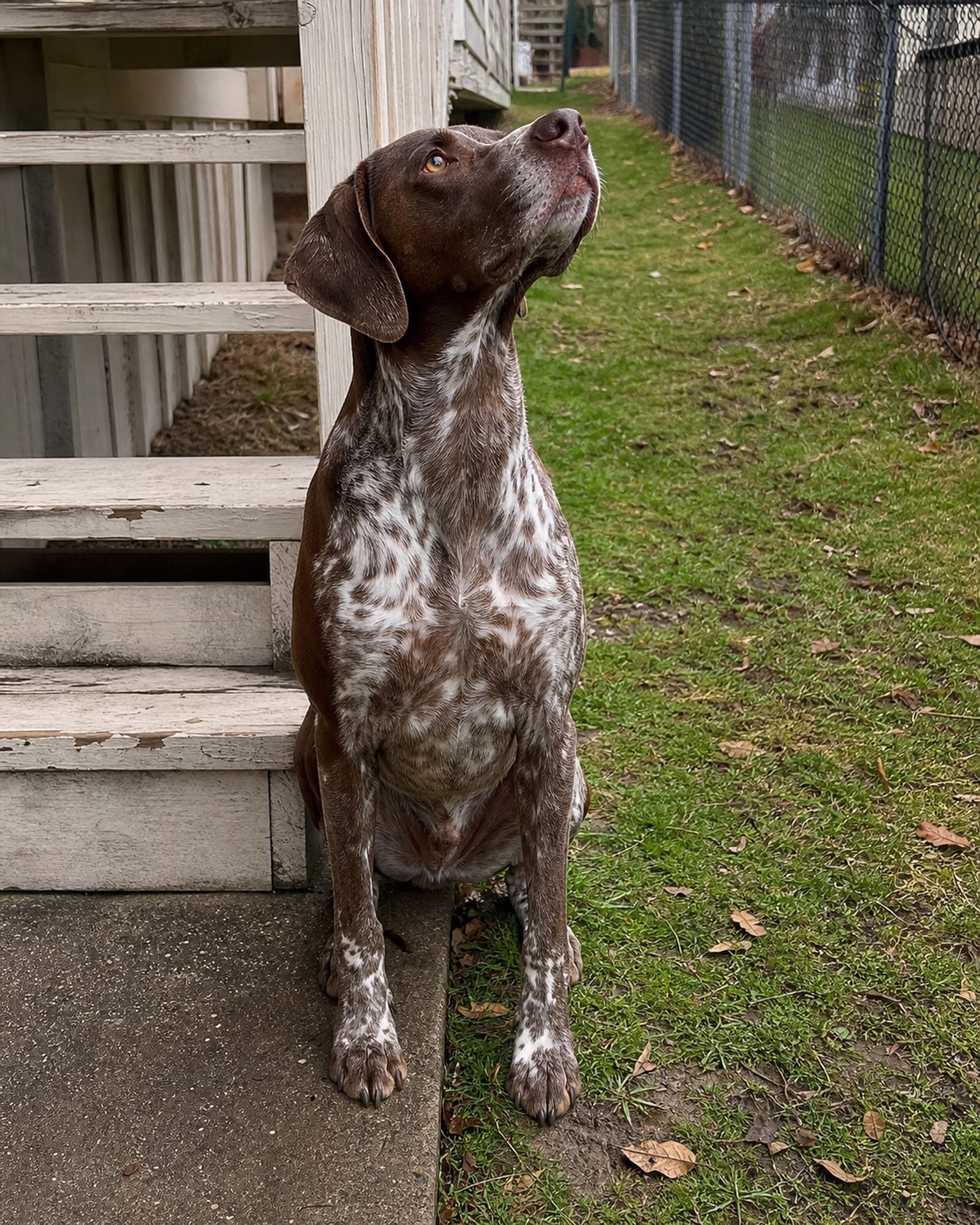
A dog sitting at the foot of steps, looking up out of frame
One leash. One door. One dog going through it. One person holding the mail, the keys and the leash at the same time.
Across the town's 5,042 households the average is 2.06 people, and 21.8% of residents are 65 or older against 15.8% under 18. That is a town of couples, of people living alone, and of households where one adult is realistically the only person who will ever run the training. It is a different problem from a busy family house, and it is not a smaller one.
The good news arrives first. A one person household has the thing I most often cannot get anywhere else, which is perfect consistency. Nobody is quietly letting the dog on the sofa when you are out. Every rule the dog meets is the same rule. That advantage is real and it is large. What you do not have is a second pair of hands, and about a third of standard training exercises assume one.
Nobody tells you which ones. You find out halfway through, standing in your hallway holding a leash and a door handle.
Door manners is the obvious one. The usual method has somebody outside knocking while somebody inside works the dog. On your own you have a dog, a door and a delivery driver who is already leaving. The fix is to separate the two jobs in time rather than between people. You rehearse the behavior against a recorded knock or a rap on the wall for a week until it is solid, and only then let it meet a real visitor, ideally one you invited.
Recall with a distraction is the second. Standard practice has a helper hold the dog while you walk away, or a helper produce the distraction on cue. Alone, you use a tie back point and a long line for the first job, and you use the environment rather than a person for the second. Bel Air makes that easy. There is a reliable supply of distraction on the Ma and Pa Trail, at the Williams Street trailhead and around the Armory Marketplace, and it comes at a distance you choose rather than one a helper guesses.
The third is the car. Loading and unloading a dog on your own, on a street, with traffic on Churchville Road or Rock Spring Road, is where a lot of dogs slip a collar. That gets trained as a specific sequence with the door and the leash in a fixed order, so that there is never a moment where the dog is loose and your hands are full.
None of these need another person. They need a different order of operations, and that is most of what I set up in a one adult house.
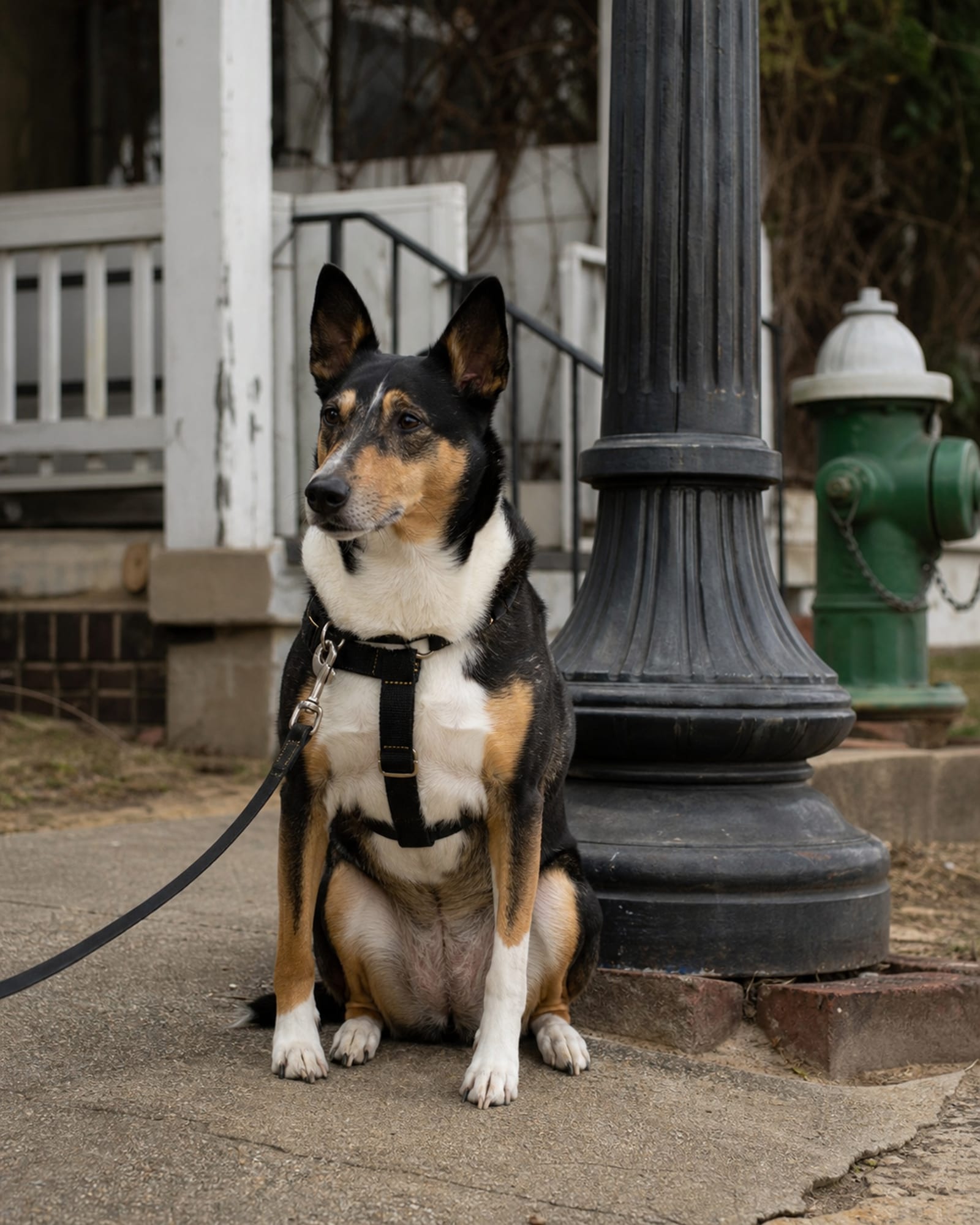
A dog sitting square beside a lamp post
I would rather train a dog for one consistent person than for four inconsistent ones, and it is not close.
The largest single reason training fails is that the household does not agree. One person feeds from the table, one lets the dog up at the door, one enforces the settle and one does not. The dog is not confused, he is doing exactly what the evidence tells him, which is that the rule depends on who is in the room. Undoing that takes longer than teaching the behavior did.
A single handler removes the entire problem. Every repetition points the same way. Dogs in these households often learn faster than the ones in bigger houses, and the improvement holds because there is nobody undoing it between sessions.
The trade is that the dog can become extremely attached to one person and unhelpful with everybody else, which shows up when you need a friend to feed him or when he goes anywhere without you. That is worth working on deliberately rather than finding out the hard way. It usually takes a handful of arranged sessions with other people, done on purpose, early.
The other trade is the one nobody likes to say. If you are the only handler, there is no relief. That is a genuine argument for a residential stay, where the dog does the intensive part of the learning with me and comes back with the behavior already installed, and you learn to run it rather than to build it. Bel Air is well inside the range for that.
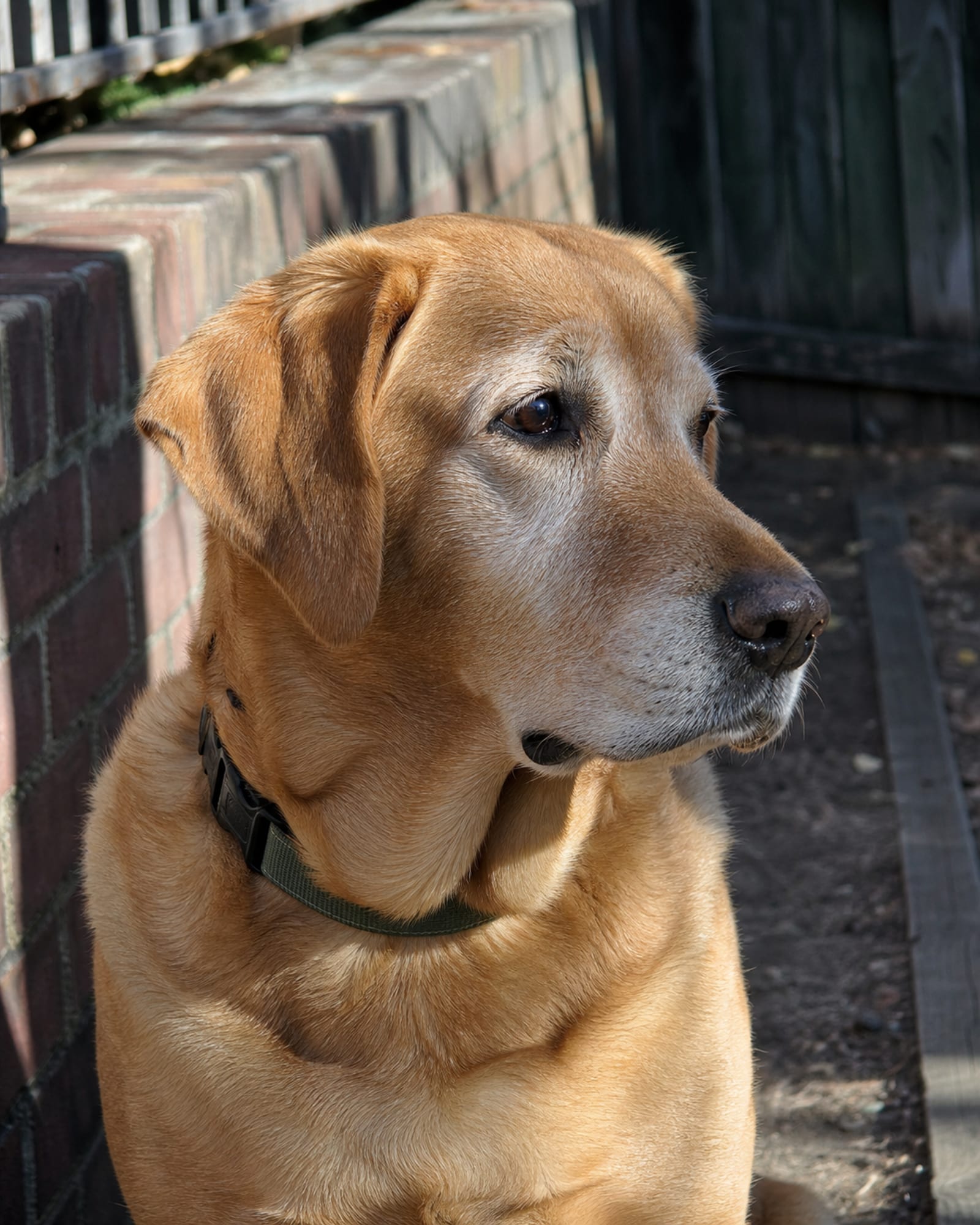
A dog's head and chest filling the frame, collar just visible
Dogs learn better in short blocks and a single person is far more likely to actually do ten minutes twice than half an hour once.
A fixed anchor in the yard or the hall where the dog can be secured for thirty seconds while your hands are busy. It replaces the second person in about half the exercises I teach.
Position, then duration, then a knock on the wall, then a real knock, then a real visitor. Weeks apart, in that order. Skipping to the visitor is why it never works.
The Main Street sidewalks, Frederick Ward Park and the trail give you people, bicycles and dogs at whatever distance you choose. Sit on a bench at the edge and let them come to you.
Leash on, door open, cue, in, door shut, in that order every time. Reverse it on the way out. This is the routine that stops a dog loose on Main Street.
Once a fortnight, somebody else handles the dog for ten minutes while you watch. It is the one thing a single handler household reliably skips and it is the one that matters when you are unwell.
Three square miles, 3,517 people per square mile, and a lot of change packed into a short walk.
01
A quiet block, then Main Street traffic, then courthouse activity, then a narrow historic sidewalk, then the rail trail. That whole sequence fits inside one ordinary walk here.
02
Many homes date from the mid-1800s to the early 1900s, with wraparound porches and narrow entries. A dog on a porch is effectively on the street, which changes what barking means.
03
At 59.2% owner occupancy there is a substantial rental presence, so apartment halls and shared stairs are part of the daily route for a good number of dogs here.
04
The Festival for the Arts, summer concerts, Garden Mart and the Armory events change the street on a schedule. Useful for planned work at distance, poor for a surprise.
05
Worth knowing before you plan a session there. Frederick Ward, Rockfield, Homestead and Plumtree are the ones to use, and the Tollgate trailhead is the busier end.
06
Winters Run and Bynum Run frame the town with wetland, steep ground and deer. A recall that works on Main Street has not yet been tested there.
Phone (443) 429-0445, seven days a week from 6 AM to 7 PM. Tell me who is in the house and what the dog does when you are on your own with him.