01
Settling in a crowd
Not walking through one. Actually lying down and switching off while people move past a few feet away. It is the behavior that makes a dog welcome anywhere in this city.


Forty thousand people live here and several times a year the streets fill with strangers. Your dog's own block becomes a different place on a schedule, and most dogs are never prepared for it.
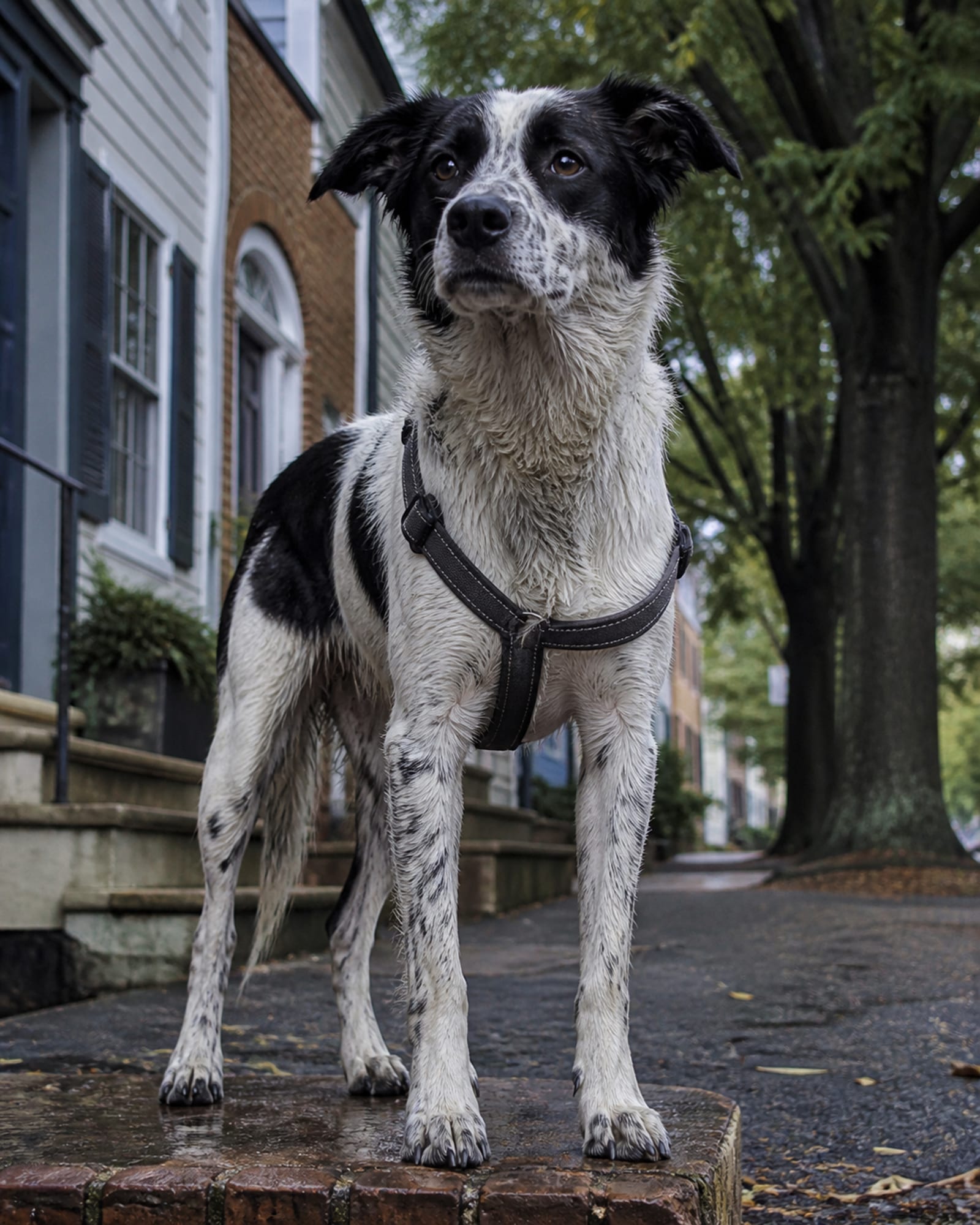
A dog standing on a low step so it fills the height of the frame, in Annapolis, MD
Annapolis is a compact city, about seven square miles and roughly 41,000 residents, with an event calendar that would suit somewhere five times the size. The approved 2026 calendar runs to the Running Festival, the Film Festival, First Sunday Arts, parades, the Annapolis Cup and recurring run clubs. Boat shows bring thousands downtown and reconfigure streets and docks outright.
For a dog, that is not a busier version of a normal week. It is the same walk with the ground rules changed. The brick sidewalk your dog knows now has a crowd standing on it, food at nose height, a barricade where the corner used to be, and a stream of people who are all looking at something other than your dog.
The dogs I get called about in Annapolis are usually fine for ten months of the year. The call comes after a weekend when the city filled up and the dog could not cope.
Shaped by crowds that arrive on a timetable and a city built on the water.
01
Not walking through one. Actually lying down and switching off while people move past a few feet away. It is the behavior that makes a dog welcome anywhere in this city.
02
Brick walks, marine decking, gravel and wet grass in one short walk. Uneven and slick surfaces are a bigger part of daily life here than most owners register.
03
About 80% of the city drains toward the Severn, with Spa Creek and Back Creek the largest sub-watersheds. Water is rarely more than a few streets away.
04
Constant, close, and prone to sudden movement. A strong leave-it matters more here than a long list of obedience commands.
05
Tight front doors, shared walks, small yards and steps straight onto the street in the Historic District.
06
Low ground floods tidally and familiar paths become unusable. A dog that only knows one route copes badly when the route is gone.
A dog that can genuinely relax on a mat with you in the room. Nothing else on this list works before this does, and most owners skip it.
The same mat, the same behavior, on your own steps or a quiet corner. Same picture for the dog, one variable changed.
A normal Tuesday on a normal street. Enough people to be real, few enough that the dog can still think and take food.
Brick, decking, a bulkhead edge. Doing footing and crowds at the same time is two problems at once and the dog fails both.
The far end of the street, not the middle of it, and leaving early while the dog is still doing well. That is the exam, and it comes after everything else.
Annapolis packs more variety into seven square miles than most towns manage in thirty, and the training implications change with it.
The Historic District has 18th and 19th century Georgian, Federal, Victorian and vernacular buildings, often on narrow lots with brick walks, steps, small yards and closely spaced or attached walls. Eastport mixes older worker cottages and compact homes near the marinas with newer infill. Murray Hill, West Annapolis, Wardour, Homewood, Admiral Heights and Germantown add bungalows, Cape Cods, Colonials, midcentury houses, townhouses, condominiums and apartments.
Owner-occupancy is about 62%, and 20.4% of residents are 65 or older, which is a meaningful share in a city with brick sidewalks and steps. The city is also more varied than its waterfront image suggests: 14.8% of residents identify as Hispanic or Latino, 20.3% as Black alone, and 16.8% of people over five speak another language at home.
That mix is why I want to see the actual address. A plan for a Historic District house with a door onto the street is not the plan for an Admiral Heights house with a driveway, even though both owners describe the same behavior on the phone.
Terrain is worth a word too, because it is not the flat waterfront people picture. Annapolis sits on the Atlantic Coastal Plain over layered sand, silt and clay, and the ground moves between brick, marine decking, compacted gravel, wet grass and muddy shoreline inside a single walk. Higher ravines and stream banks erode, and low ground floods on the tide rather than only after rain. A dog that has only ever walked on dry pavement has not been asked to do anything difficult with its feet, and that shows up the first time it meets a wet bulkhead.
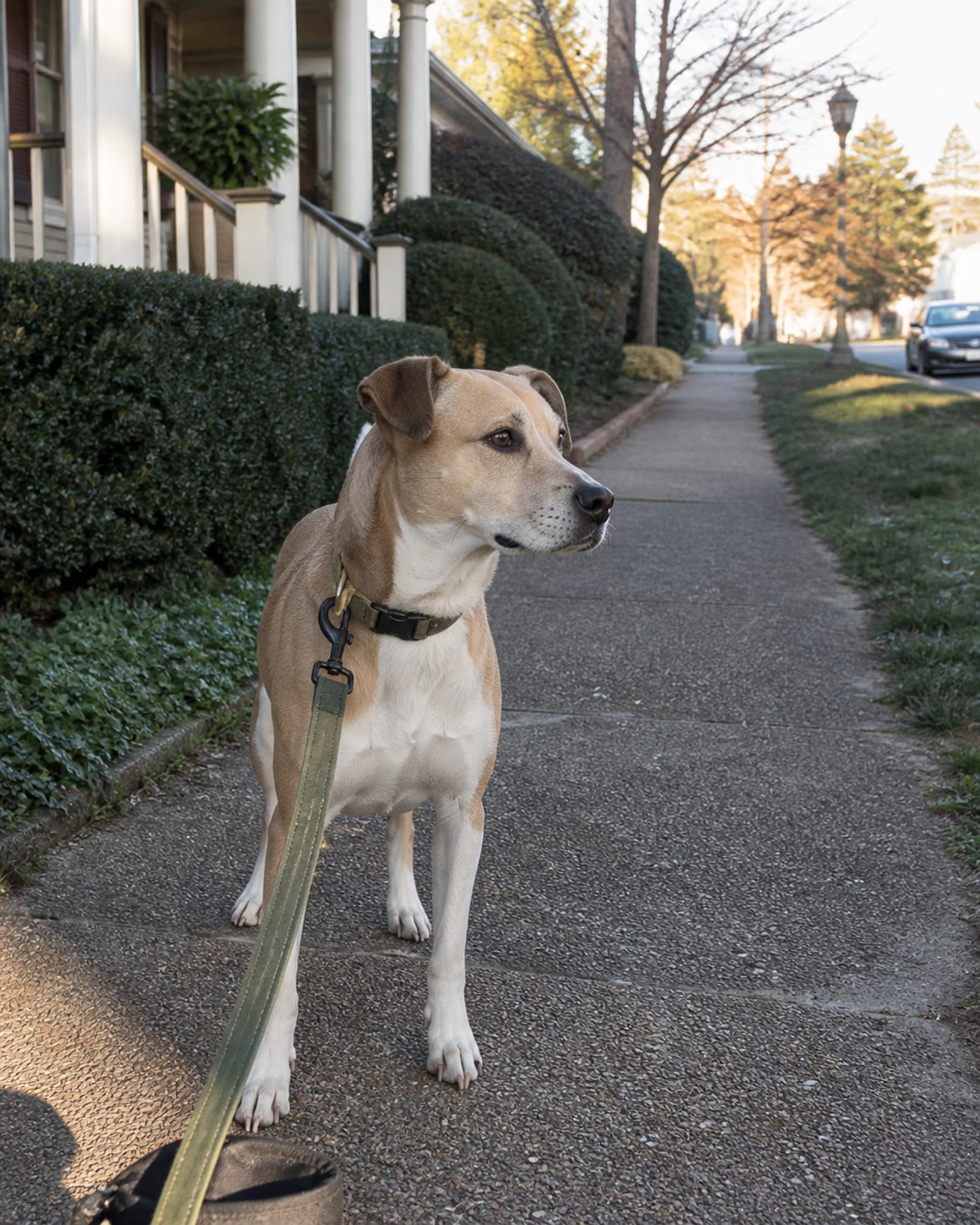
A dog standing on a sidewalk with the street receding behind it, in Annapolis, MD
Annapolis is on the bay side of the service area and inside the range for everything, including a residential stay.
In-home private lessons at $700 cover an evaluation plus four one hour sessions over about two months, with lifetime phone support afterward. For crowd and surface work I often prefer this, because the brick, the dock and the street are all at your address and the practice between sessions is what does the work.
Kick Start at $1,600 gives five consecutive daily sessions in your home and neighborhood plus an owner lesson and a two week follow up. It suits a dog that needs consecutive days rather than a session two weeks apart, and it works well scheduled before a season you know is coming.
Board and train draws from within about a one hour drive because your dog comes to stay in my home, not a kennel, and Annapolis sits inside that. It is the right answer when the underlying obedience is missing rather than untidy: a settle in a crowd is hard to build on a dog that has never reliably settled anywhere. The programs are set out on the board and train page.

A close vertical of a dog's face turned slightly, ears forward, in Annapolis, MD
Phone (443) 429-0445, 6 AM to 7 PM, any day of the week.