01
Passing another dog on a narrow walk
There is no crossing the road when both sides are parked solid. The dog needs a behavior it can perform while a stranger passes within touching distance, and that is a specific skill, not general obedience.
Parkville packs 7,424 people into every square mile. Your dog meets more strangers before breakfast than a country dog meets in a week, and that is the whole training problem here.
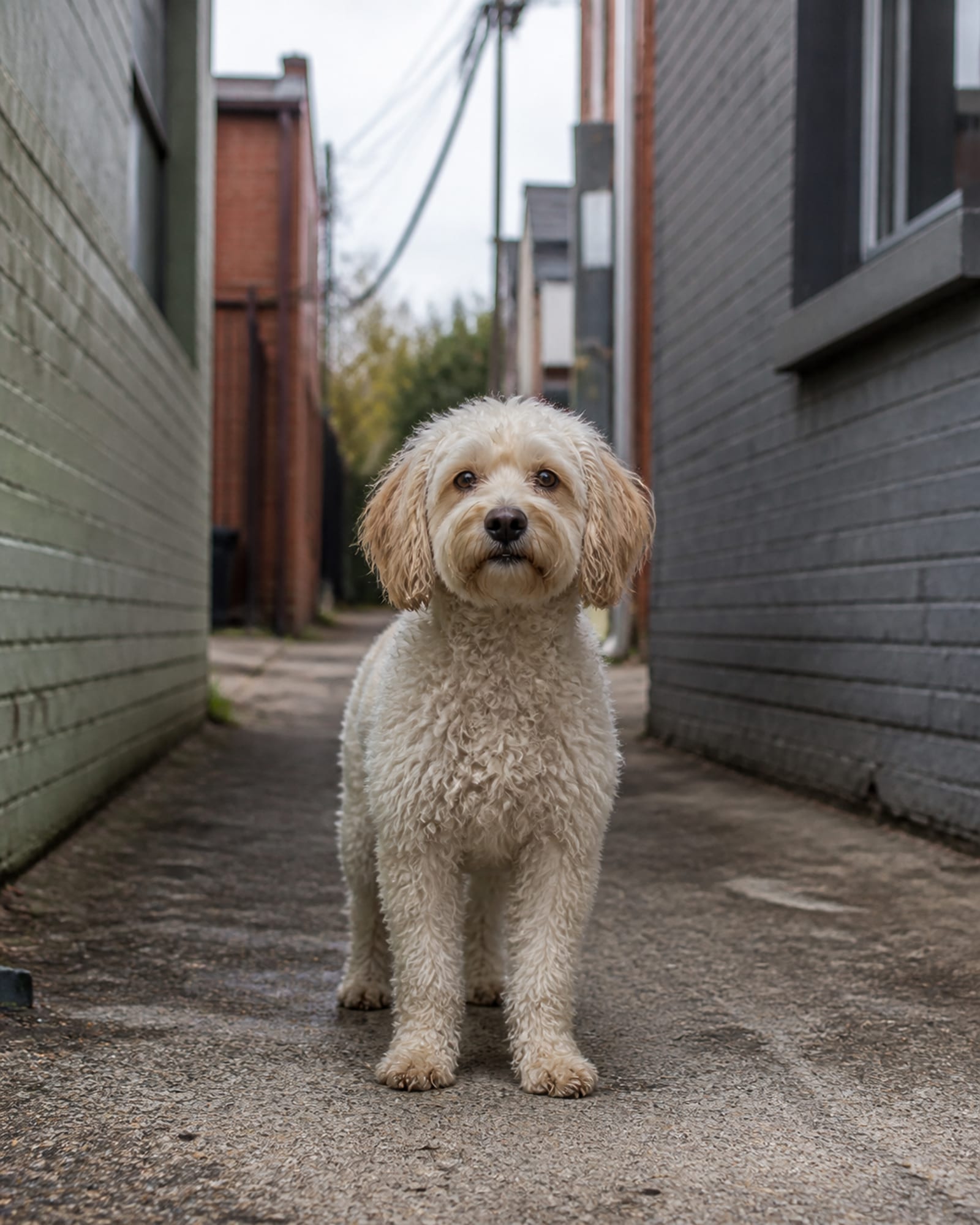
A dog standing square and settled, seen full body from the front, head up, in Parkville, MD
Parkville fits nearly 32,000 people into 4.29 square miles. On the ground that means short front setbacks, street parking on both sides, sidewalks that run within a few feet of living room windows, and a walk where you cannot get more than about forty feet without passing a person, a parked car with someone in it, or another dog coming the other way.
A dog with a mild problem in a spacious suburb has a serious problem here, because the thing it struggles with happens twenty times a walk instead of twice. That is also the good news. Twenty repetitions a walk is twenty chances to practice the right behavior, once the dog knows what the right behavior is. Density cuts both ways, and my job is to flip which way it is cutting for you.
In order of how often Parkville owners raise them with me.
01
There is no crossing the road when both sides are parked solid. The dog needs a behavior it can perform while a stranger passes within touching distance, and that is a specific skill, not general obedience.
02
Short setbacks put the sidewalk inside your dog's territory. Every passer-by is an intruder who then leaves, which the dog reads as a win. My excessive barking page covers how to break that loop.
03
Street parking means people appear suddenly at close range from between vehicles. Dogs that are fine with a person walking toward them from distance often are not fine with one materializing at three feet.
04
Loose leash walking matters more in Parkville than almost anywhere in the county, because you cannot manage a pulling dog by simply giving it space. There is no space.
05
Duplexes, garden apartments and older attached houses put your dog and a neighbor at the same door at the same moment, often around 6 PM every day.
06
A short walk from curb to door means the driver is at the threshold in seconds, with no approach for the dog to process. This is a very common bite context and it deserves a real plan.
38.5% of Parkville's homes were built in the 1950s, another 19.2% in the 1960s and 15.1% in the 1940s. Nearly half of everything here has three bedrooms.
Roughly 43% of the housing is detached, but 30% is attached and another 18% sits in buildings of five to nineteen units. So the picture is brick rowhouses and duplexes as much as it is compact detached homes, with basements, porches and small yards throughout. Mid-century construction also carries footsteps and voices between units in a way modern building does not.
This is why I ask what time of day the behavior happens before I ask anything else. A dog that barks at 7:20 AM and 5:40 PM is not barking at nothing, it is barking at a neighbor's routine that it can hear and you have tuned out. Once you know the trigger has a schedule, you can get ahead of it instead of reacting to it, and getting ahead of it is most of the work.
The other consequence is the yard. A small yard with a fence close to the neighbor's fence is not a place a dog burns off energy. It is a place two dogs practice a confrontation through a barrier every day, and that rehearsal transfers straight onto your walks. Fixing the walk sometimes starts with changing what happens in the yard.
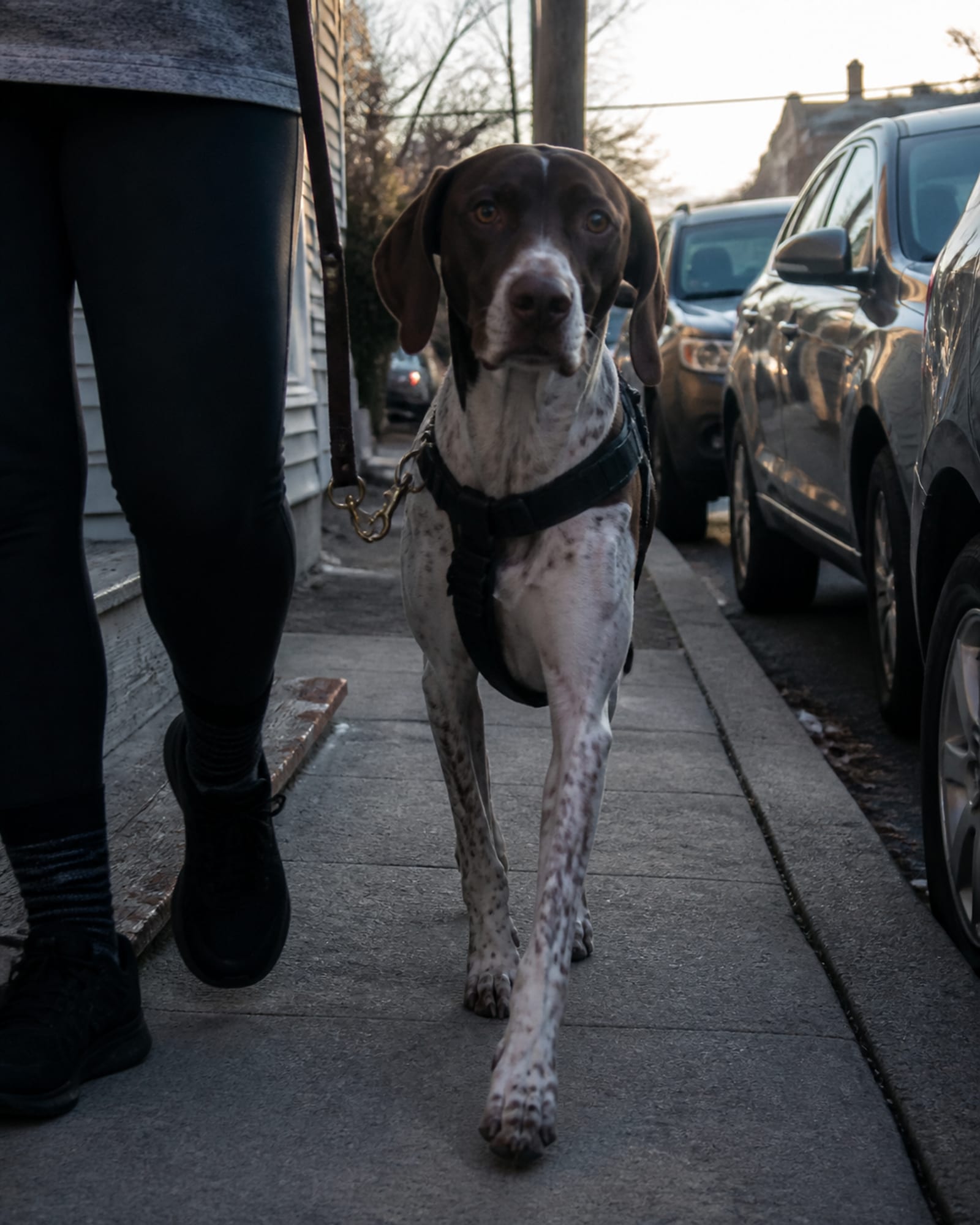
A dog walking at heel beside a handler's lower legs, both cropped at the knee, in Parkville, MD
Parkville gives you a useful range of difficulty within a very short drive, which is exactly what staged training needs.
Harford Road, Maryland Route 147, is the main north to south commercial spine, with Joppa Road, Taylor Avenue, Putty Hill Avenue, Old Harford Road and Satyr Hill Road feeding it, and I-695 crossing the community near Perring Parkway. That is the hard end: multilane traffic, interchange noise and hot pavement in summer.
Double Rock Park, 107.7 acres on Glen Road, is the softer end, with fields, playgrounds, pavilions, a community garden, wooded trails and Stemmer's Run. The county's own trail map marks the wooded terrain and stream crossings where footing needs care after heavy rain. Cromwell Valley Park carries a Parkville postal address at the northwestern edge and is a step further out again.
Between those two extremes sit the residential streets where you actually live, and that is where most sessions happen. I am not interested in a dog that behaves beautifully in a park and cannot manage its own block. We work the block.
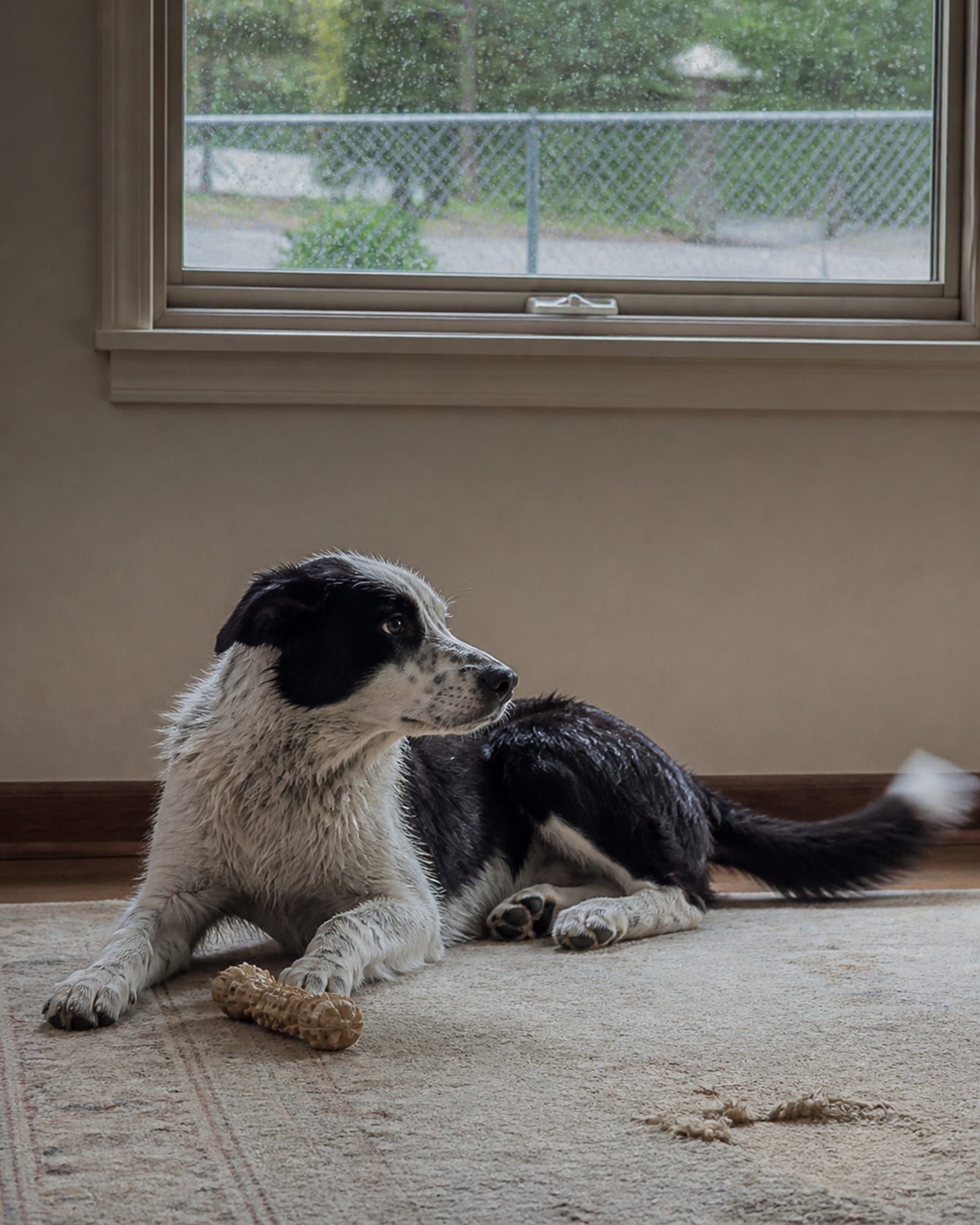
A dog lying on a rug with a window above it, in Parkville, MD
What the dog does, at what time, and at what distance it starts. Distance is the number I most want, because it tells me where we can begin without setting the dog off.
In your home. I want to stand on your step, look down your sidewalk and see the walk you take. It rolls into the training fee if you go ahead.
Usually indoors, then a quiet street at an hour when Parkville is not busy. The dog has to know the behavior cold before we ask for it under pressure.
One difficulty at a time: first distance, then movement, then another dog, then Harford Road. If the dog fails we made the jump too big, and we go back one.
You do it, with me watching, on your own street. Then lifetime phone support once the face to face work is done, because behavior drifts and it is easier to fix early.
All three are available here, and the choice is genuinely about your household rather than about the dog's diagnosis.
In-home private lessons at $700 cover an evaluation plus four one hour sessions spread across about two months. That spacing is deliberate: you get two weeks to practice between sessions, which is when learning actually happens. For a dog with one clear problem and an owner with time, this is usually the right answer.
Kick Start at $1,600 runs five daily one hour sessions in your home, your street and local parks, then a lesson for you and a two week follow up, with equipment included. It suits a dog that needs momentum, and a household that would rather do something intensively than stretch it out.
Board and train suits the cases where daily repetition is the whole medicine and your week cannot supply it. Parkville is comfortably inside the range for it. The programs and what each covers are set out on the board and train page, so I will not repeat them here. What I will say is that the dog comes home to the same dense street it left, so the transfer lesson is where the value either lands or does not.
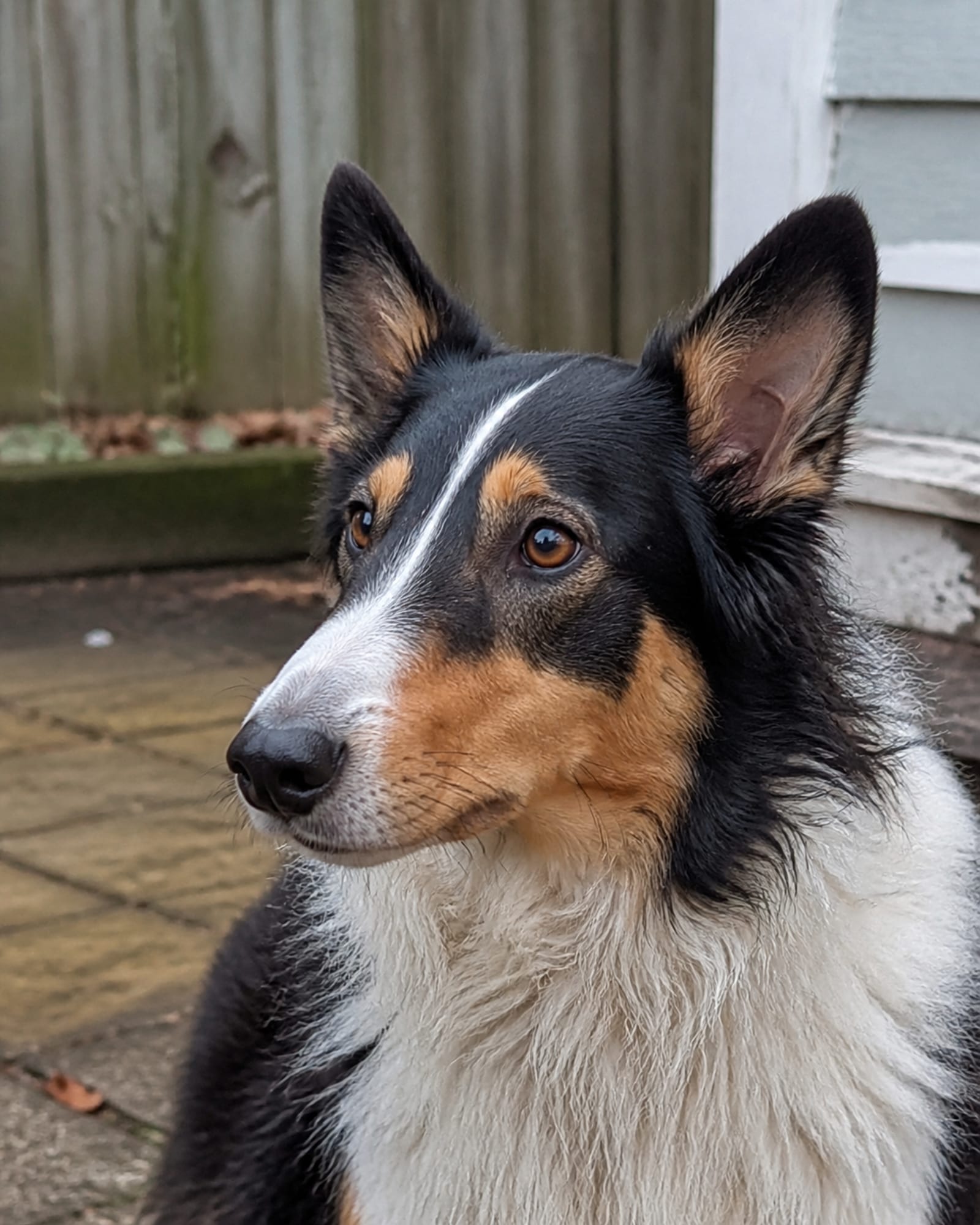
A tight portrait of a dog's head and shoulders, eyes soft and attentive, in Parkville, MD
Phone (443) 429-0445, 6 AM to 7 PM, any day. Tell me how close another dog can get before yours reacts, and we can start from there.