01
The door at arrival time
A dog who holds a position while the door opens. It is the highest value behavior in the community and it takes about three weeks.

Pasadena is a set of peninsulas hanging off one long road. A dog who gets out of a yard here has water on three sides and Mountain Road on the fourth, and that geometry is why door and gate training matters more in this community than anywhere else I work.
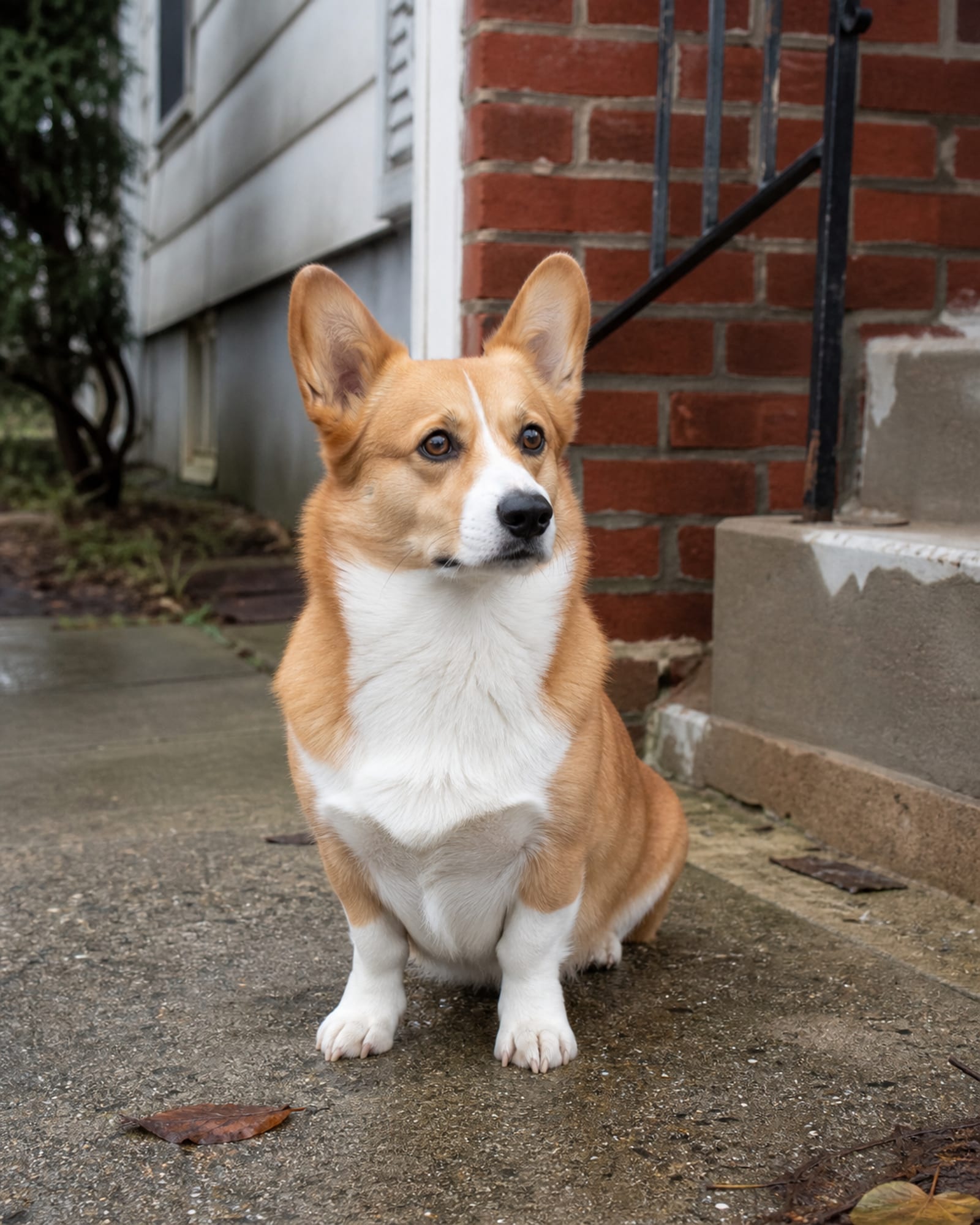
A dog sitting upright and attentive, shoulders square to camera, in Pasadena, MD
Look at how the neighborhoods sit. Lake Shore, Riviera Beach, Green Haven, Chesterfield, Bayside Beach, Rock Creek, Bodkin. Each one runs out toward water, and nearly all of them reach the rest of the world through Mountain Road.
Anne Arundel's Region 4, which takes in Pasadena, holds about 200 miles of shoreline across the Magothy, the Severn, Bodkin Creek and the tidal Patapsco. That is the good part of living here and it is also the reason a loose dog is a genuinely serious afternoon. He is not going to wander two blocks and be brought back by a neighbor. He is going to run in whatever direction he was already pointed, and on a peninsula the choices are water, woods, or a road carrying everybody's traffic because there is no alternative route.
So in this community I put containment and door manners ahead of almost everything else, and I do not apologize for it being unglamorous.
It is almost never the dramatic version. Four ordinary situations account for most of it.
The front door during an arrival. Somebody comes in, hands are full, the dog is excited, and there is a two second window with nobody in position. This is the most common of the four by a distance and it is the most trainable.
The gate. A gardener, a delivery, a child, a gate that swings and does not latch reliably. Around 30.4% of Pasadena's housing went up between 2010 and 2019, alongside established shoreline communities dating back decades, so fencing here ranges from new to very old. A latch that needs a knack is a latch that will fail.
The car, which I have written about at length for the households that drive everywhere, and which matters here too because a dog loose in a lot on a peninsula road has nowhere sensible to go.
And the leash coming off, or the collar coming over the head, at exactly the wrong moment. That is an equipment question rather than a training one and it gets checked at the evaluation, because no amount of obedience helps a dog who is no longer attached to anything.
What all four have in common is that they happen in a hurry, in the middle of something else, when nobody has decided in advance what is supposed to happen. That is why I train them as fixed routines rather than as good intentions. A routine survives being tired, being late and having your hands full. An intention does not, and the dog only needs it to fail once.
There is a Pasadena specific reason to take the yard half seriously as well. The community here runs from established shoreline neighborhoods dating back decades to construction from the last fifteen years, so fence lines, grades and gates vary enormously between one property and the next. Steep banks, erosion and a fence that has settled leave gaps that are obvious to a dog and invisible from a kitchen window. Walking your own boundary properly once, looking at it the way a dog would, is an hour well spent.
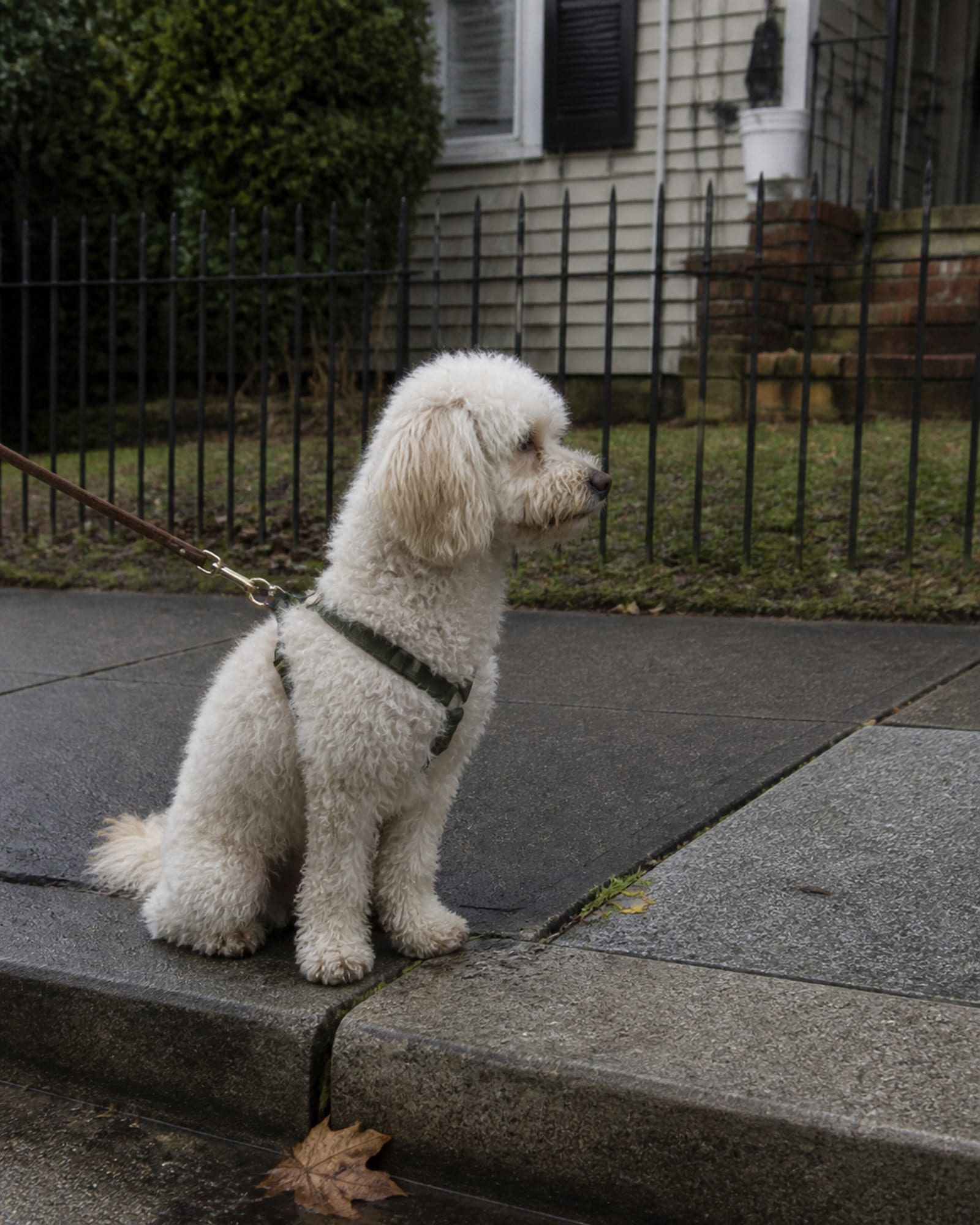
A dog sitting at a curb edge waiting to cross, in Pasadena, MD
A big, family weighted, mostly owner occupied community strung along the water.
01
A dog who holds a position while the door opens. It is the highest value behavior in the community and it takes about three weeks.
02
83.7% ownership means most people can change their own fencing. A self closing latch is cheaper than an afternoon looking for a dog.
03
A dog who has committed to a shoreline is not stopping partway. The recall has to work before he goes, which means it is built on a long line first.
04
Peninsula routes limit walking space and the traffic has nowhere else to be. Position and a hard stop matter more than anything decorative.
05
The county notes that many local sites were developed before modern stormwater practices, so yards, banks and paths vary a great deal from one parcel to the next.
06
A lot of these neighborhoods have community beaches, piers and private roads with their own rules. Worth knowing yours before a dog is loose on them.
Worth reading before you need it, because every instinct you have in that moment is wrong.
Do not chase. A person running at a dog produces a dog who runs away, and on a peninsula that can mean straight toward Mountain Road. It is the single most common way a recoverable situation becomes a bad one.
Instead, get low, turn side on, and move away from him while making a happy noise. A dog who is loose and excited is far more likely to follow something moving away than to be caught by something moving toward him. It feels absurd and it works far more often than the alternative.
Have something that always means food. A specific bag, a specific sound, used only in the house and never wasted. A dog who has been conditioned to a particular rattle for months will turn for it in a way he will not turn for his name, because his name has been shouted at him in every context including angry ones.
Know your own ground in advance as well. Where does your street run to, which direction is the water, where is the nearest fenced area, and which neighbors have dogs of their own who would help rather than hinder. Two minutes of thinking about that on a calm evening is worth an hour of panic later, and in these neighborhoods the answers are quite specific: the peninsulas funnel a running dog in a predictable direction, and knowing which one saves you searching the wrong half of a mile.
And when he does come back, be pleased. Every owner's instinct is to tell the dog off for running, and every time somebody does that they teach the dog that coming back is punished. That single mistake is behind an enormous number of the recall problems I am called about. Whatever he did, the coming back is the part you are paying for.
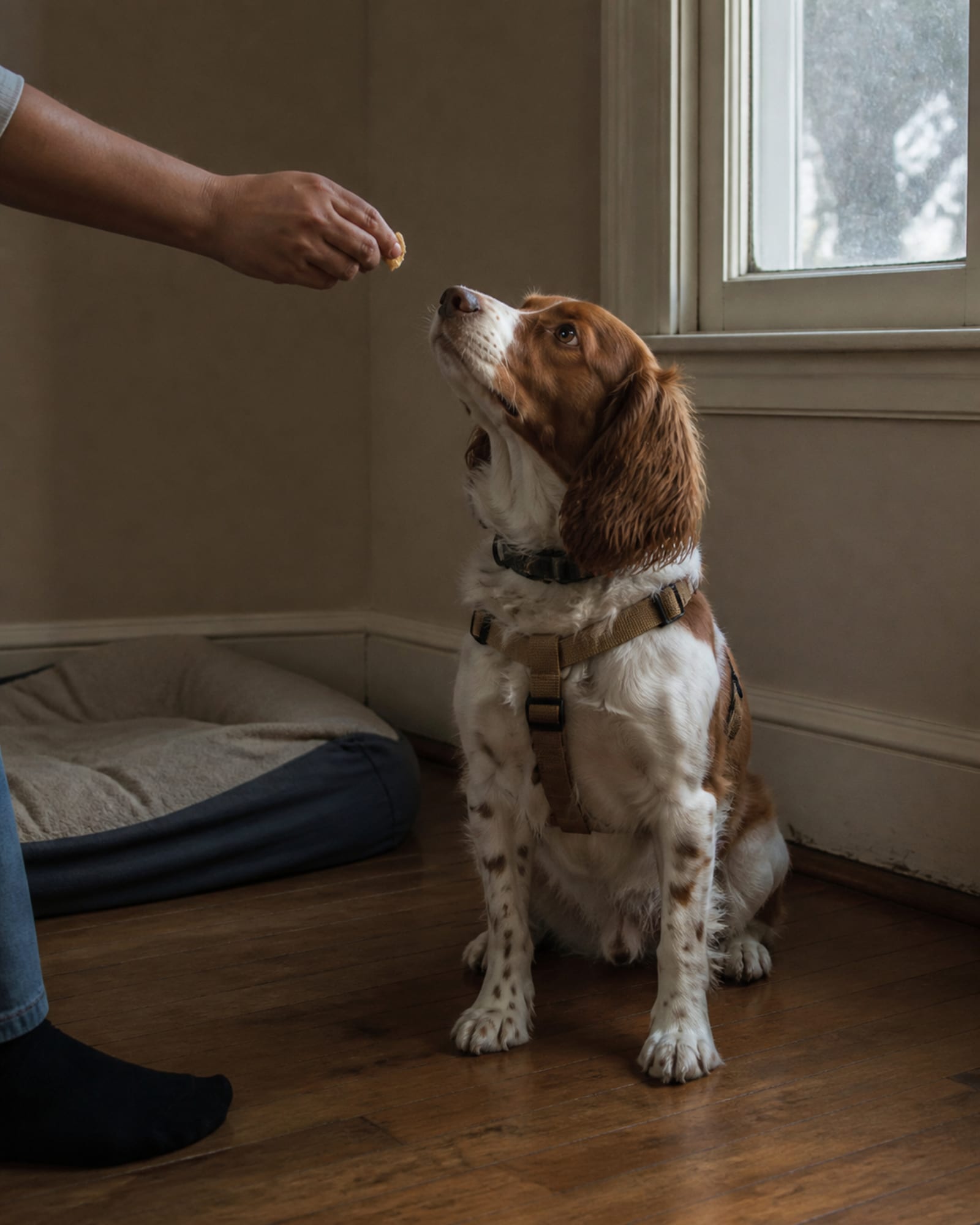
A dog holding a sit while a hand offers a treat at nose height, cropped at the wrist, in Pasadena, MD
A mat or a specific rug, far enough from the door that an opening does not put him in reach of it. The location never changes.
With nothing happening at the door. He should be able to send himself there before you touch a handle.
Each one separately, several sessions each. If he breaks at any stage you have moved too fast and you go back one step, not back to the beginning.
Somebody who knows the plan and will wait. This is where most households find out that their real problem is the visitor rather than the dog.
Shopping bags, children, everybody talking at once. The version that goes wrong is never the calm one, so the calm one is not the version to practice with.
Self closing gate, a latch that works without a knack, identification tags and microchip details up to date. Training and hardware do different jobs and you want both.
Phone (443) 429-0445, seven days a week from 6 AM to 7 PM. Tell me how he behaves when somebody arrives, and whether he has ever been out on his own.