01
Jumping on visitors
Same behavior as the school run, different trigger, and it transfers once one of them is solid. Usually the second thing we fix rather than the first.


The dog is fine until the children get home. Then the door goes, three people arrive at once, and everything you have taught it stops working for about twenty minutes.
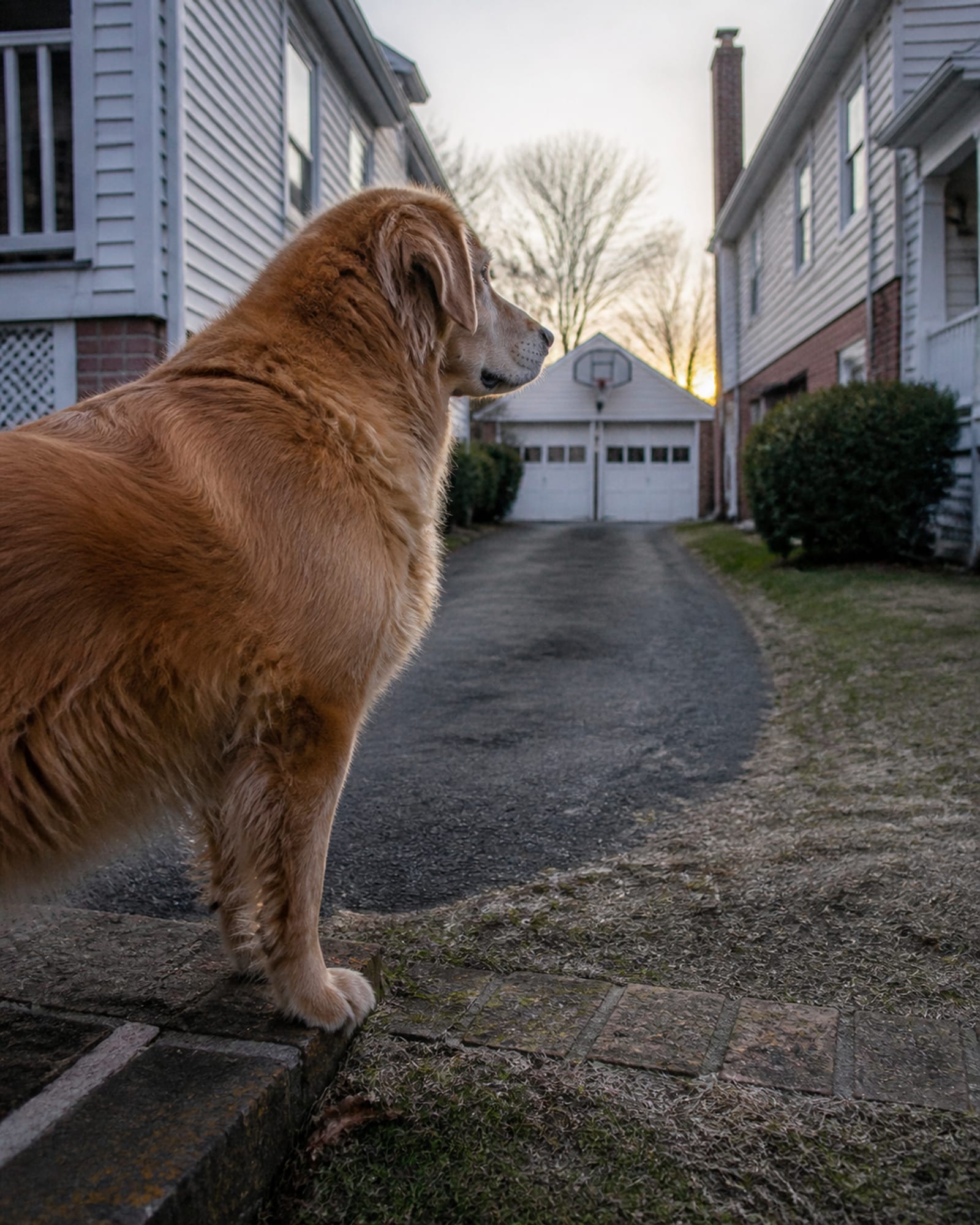
A dog standing on a low step so it fills the height of the frame, in Perry Hall, MD
Perry Hall is a family community. 21.5% of residents are under 18, 76.5% of homes are owner-occupied, and the housing runs to three and four bedrooms more than anything else. Most of the dogs I am called about here live with children, and most of the trouble happens at the points in the day when the household changes state.
School arrival and dismissal, the after-school return, dinner, and the doorbell going at the same time as everything else. A dog that is perfectly pleasant at ten in the morning can be genuinely difficult at half past three, and owners often describe this as the dog being unpredictable. It is not unpredictable at all. It happens at the same times every weekday. The predictability is what makes it fixable.
It is worth being precise here, because the common explanations lead people to the wrong fix.
A dog that jumps, mouths, spins, grabs sleeves or barks when children arrive is usually not being aggressive and is usually not being dominant over anybody. It is over-aroused. Something exciting has happened suddenly, the dog has no idea what to do with that, and it does all the things at once. The behavior looks alarming and it is genuinely a problem, particularly with a small child in the middle of it, but the emotion underneath it is closer to a party than a threat.
That distinction matters because arousal responds to structure and to teaching the dog a specific alternative, while punishing it usually just adds tension to a moment that already has too much. A dog that gets told off for jumping at children can start associating the children themselves with trouble, which is the one outcome nobody wants.
The fix is unexciting and it works. The dog learns a place to be when the door goes and gets paid well for going there. The arrival gets rehearsed at a boring hour, deliberately, dozens of times, with nobody actually arriving. And the children get given a job, because a child who knows what to do is a child the dog can predict. If your dog has ever put its teeth on a child, even in play, that is a different conversation and it should be part of the first phone call rather than mentioned later.
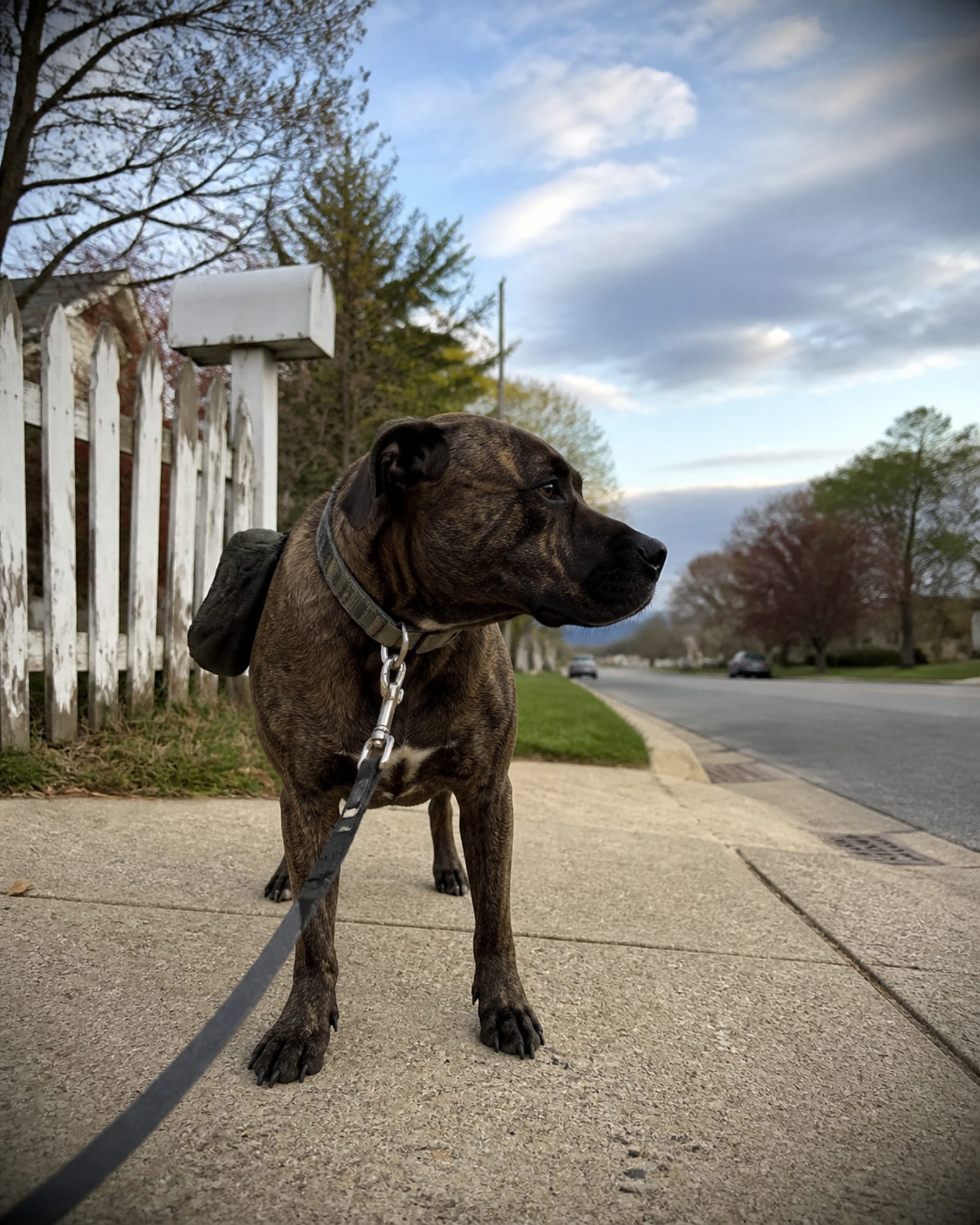
A dog standing on a sidewalk with the street receding behind it, in Perry Hall, MD
A bed or a mat, somewhere the dog can see the door but is not in the path of it. Telling a dog not to jump gives it nothing to do instead, which is why that instruction never holds.
Fifty repetitions in a quiet house before the door is ever involved. The behavior has to be automatic before it meets any excitement, or the excitement wins.
You go out and come back in. Nobody speaks to the dog. Repeat until it is genuinely dull, which takes longer than people expect and is the step most often skipped.
Briefed in advance, walking not running, no greeting until the dog is settled. Then two children. Then the real half past three, which is the exam.
Everyone who lives there has to run it the same way, children included. A dog that gets a different rule from each person has no rule at all, and this is the single most common reason family training stalls.
What else comes up here, in roughly the order it arrives.
01
Same behavior as the school run, different trigger, and it transfers once one of them is solid. Usually the second thing we fix rather than the first.
02
Common in young dogs, taken seriously here, and worth addressing early rather than waiting to see whether the dog grows out of it.
03
US Route 1 is the community's main road and it is fast. Automatic sitting at a curb is worth more here than a long list of tricks.
04
Children, scooters, other dogs and cars in a compressed twenty minutes. Excellent training ground once the dog is ready and a poor place to start.
05
Newer subdivisions have close neighbors and small yards despite the space around them, so fence line habits form quickly.
06
Fields, stream corridors and paths that go muddy after heavy rain. A recall built only in a fenced yard does not survive here.
Perry Hall is really two housing stories, and which one you live in changes the practical detail.
The county community plan describes brick ranchers and Colonial-style houses near Belair and Ebenezer roads from the 1950s and 1960s, then townhouses, garden apartments, condominiums and detached subdivisions built during the later growth, with the Honeygo area to the northeast as the newest part. Around 40.5% of homes have three bedrooms and 24.5% have four.
In the older streets you get mature trees, established fence lines and neighbors who have been there for decades, which means longstanding dog-to-dog relationships across boundaries, for better or worse. In the newer areas you get closer siting, homeowner association common space, and a lot of dogs that all arrived within a few years of each other and are still working out the neighborhood.
The community itself is unusually organized. The Perry Hall Improvement Association has run since 1945 and its calendar includes the annual Town Fair outside Perry Hall High School on Ebenezer Road and the community tree lighting, alongside the recreation council, the library and school programs. Every one of those is a genuinely useful training environment and none of them is a first outing for a dog that cannot yet cope with the doorbell.
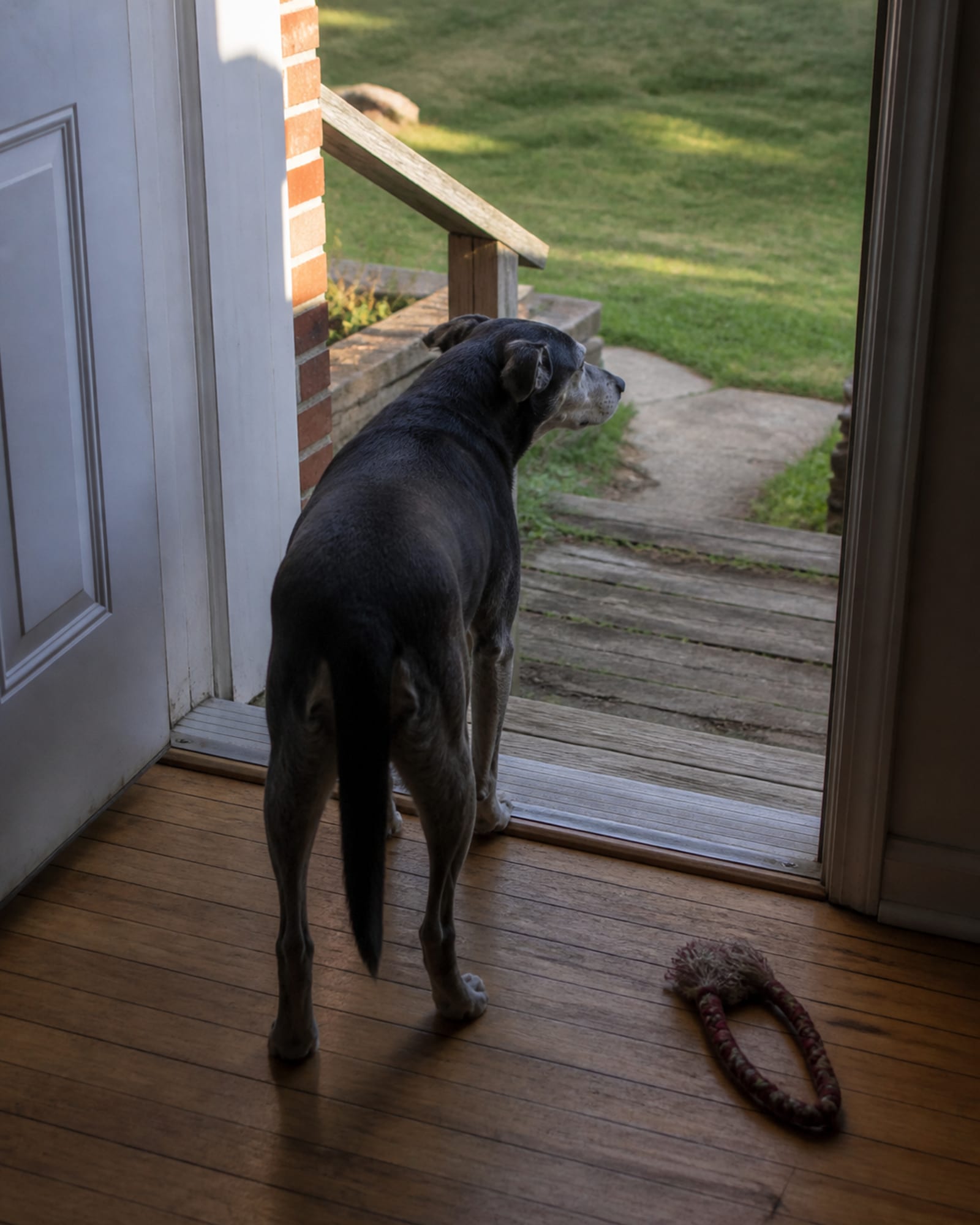
A dog waiting at a threshold, not crossing, interior looking out, in Perry Hall, MD
The honest answer here depends less on the dog than on how many people live in the house.
In-home private lessons at $700 cover an evaluation plus four one hour sessions across about two months, and for a family this is often the right choice, because everybody can be present and everybody learns the same handling. A dog trained by one parent while the rest of the household does something different will not hold.
Kick Start at $1,600 runs five consecutive daily sessions in your home and neighborhood, then a lesson for the owners and a two week follow up, with equipment included. It suits a household that would rather do one intensive push than spread it out, and it works well over a school holiday when the children are actually around to be part of it.
Board and train suits the case where the behavior needs daily work that a family week genuinely cannot supply. Perry Hall is comfortably inside the range. The programs are set out on the board and train page. What I will add here is that the handover matters more in a family home than anywhere else, because the dog has to perform for four or five people rather than one.
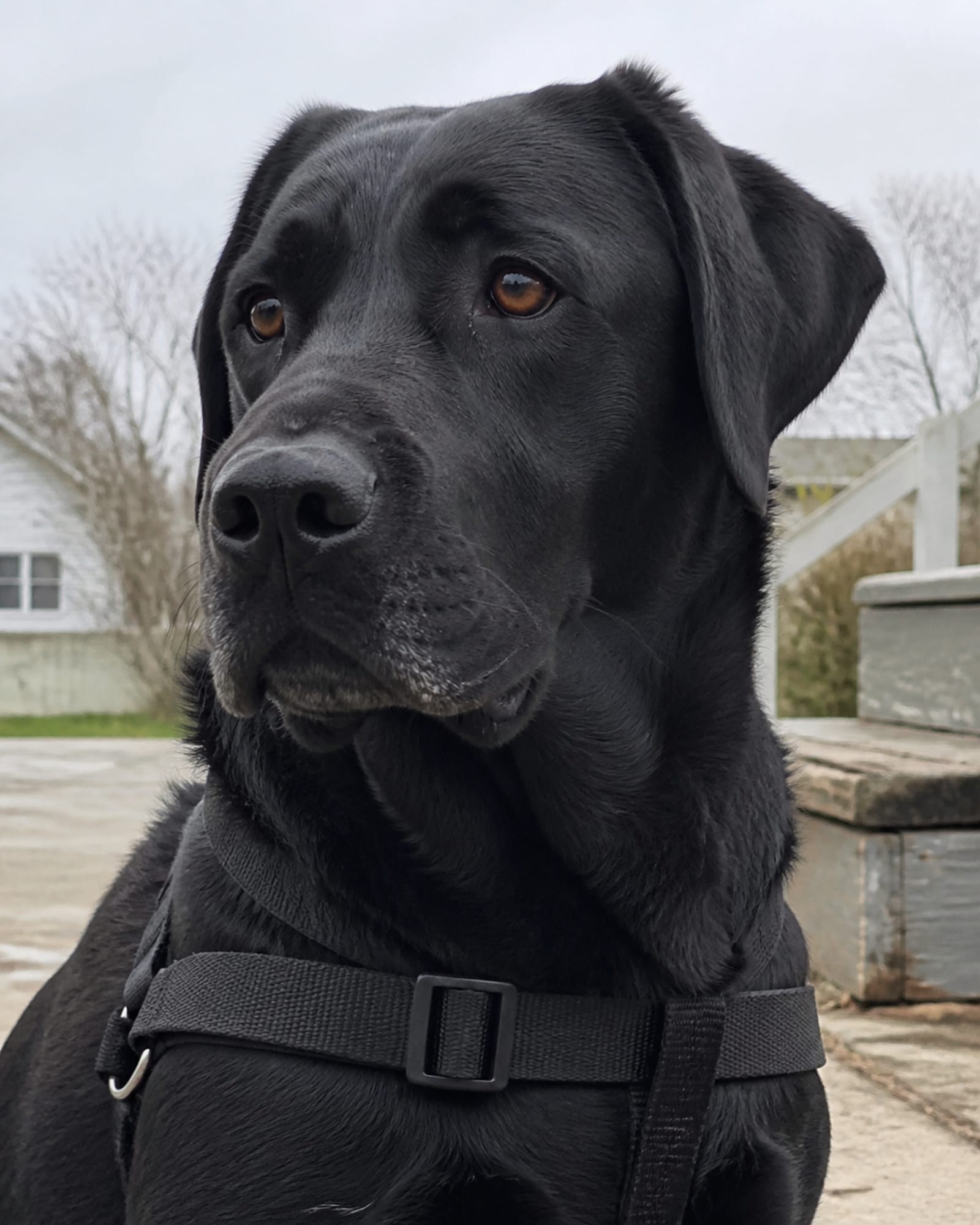
A close vertical of a dog's face turned slightly, ears forward, in Perry Hall, MD
Phone (443) 429-0445, seven days a week from 6 AM to 7 PM. Tell me who is in the house, how old they are, and what the dog does when they walk in.