01
The road edge
Where the lawn meets the street. This is the one that has to be automatic, and it is worth more than every other behavior on this page combined.

Almost 70% of Arnold homes are detached and a great many of them sit on peninsula lots where the property simply stops, at a creek, at a slope, at a road. Your dog cannot see where your land ends. He has to be taught it, and that is a behavior rather than a place.
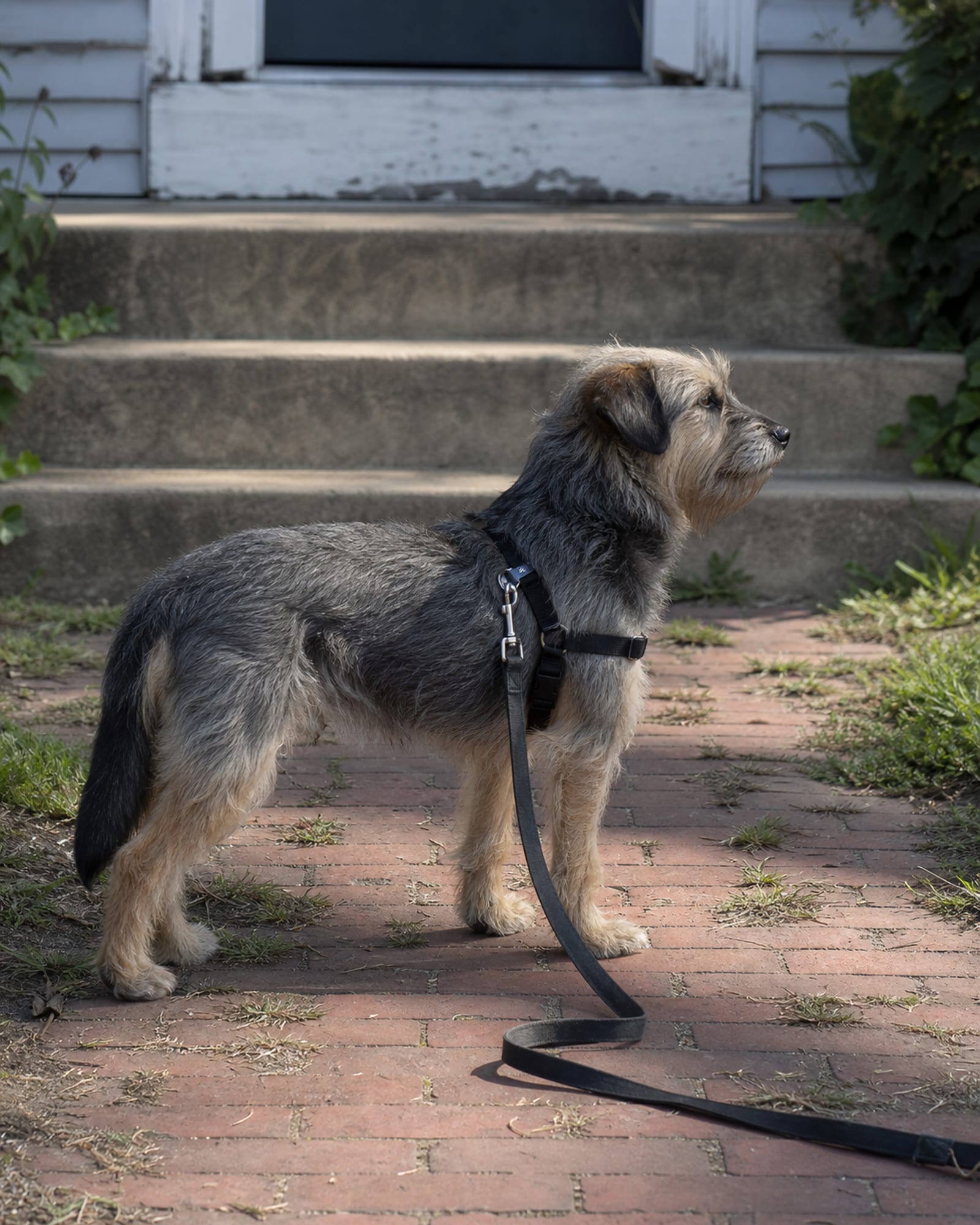
A dog in a stand stay with its lead slack on the ground beside it
Stand at the top of a driveway in Ulmstead Estates or Pines on the Severn and try to point at the edge of the property. You probably can, roughly, because you have the deed and you know which tree it runs past. Your dog has none of that. To him the lawn continues into the next lawn, the driveway continues into the road, and the ground continues down to the water without interruption.
Arnold sits on the Broadneck peninsula with the Severn River to the west and south and the Magothy to the north, and a large number of streets here end near a creek rather than at another street. Lots are wooded, sloped, open to the water, and often not fenced, because fencing a waterfront lot is frequently impractical and sometimes not permitted by the community association.
So the boundary has to live in the dog rather than in the ground. That is completely trainable, and it is the single most useful thing to build in a house like this.
Four different lines, each taught separately, because a dog does not generalize one to the others.
01
Where the lawn meets the street. This is the one that has to be automatic, and it is worth more than every other behavior on this page combined.
02
A dog that stops at the top of the drive when a car pulls in has a genuinely useful habit. Many of these driveways are long, sloped and blind at the road end.
03
Steep banks, docks and drainage ditches. A shoreline is not a fence, and a dog that goes in after something has to be able to be called off before he goes, not after.
04
The indoor version of the same skill, and the one you can practice a dozen times a day without leaving the kitchen.
05
Many neighborhoods here have association owned piers, beaches and access points with their own rules. Your dog treating them as an extension of your yard is a neighbor problem waiting to happen.
06
The B&A Trail and the Broadneck Peninsula Trail along College Parkway put runners, bicycles and other dogs into a narrow corridor. Staying on your side of it is a boundary too.
A fence works because it is not a decision. Everything else on this page is a decision, made by a dog, in the presence of something interesting.
A gate does not need the dog's cooperation and it does not degrade when he is excited. That is its whole value. Every alternative to it, including the good ones, asks the dog to make a choice at the exact moment his brain is least available for choosing. That is why boundary work has to be built to a much higher standard than a party trick, and why it is worth doing properly.
The build is not complicated. You mark the line clearly for the dog while he is calm, you reward him heavily for being on the correct side of it, and then you deliberately introduce the things that would normally pull him across. A person walking past, a ball, another dog, a squirrel. He is on a line during all of this, so the answer is never allowed to be the wrong one.
The part people skip is the last one. A boundary that has only ever been tested by a person walking past is not a boundary, because nothing interesting has ever crossed it. On a wooded peninsula lot the real tests are wildlife and water, and the training has to include them or it is decorative.
The other thing worth saying plainly is that no boundary training makes an unfenced lot safe for a dog left out alone. It makes a supervised dog reliable and it makes a moment of inattention less likely to end badly. Those are both worth having. Neither is a fence, and I would rather tell you that than sell you a system.
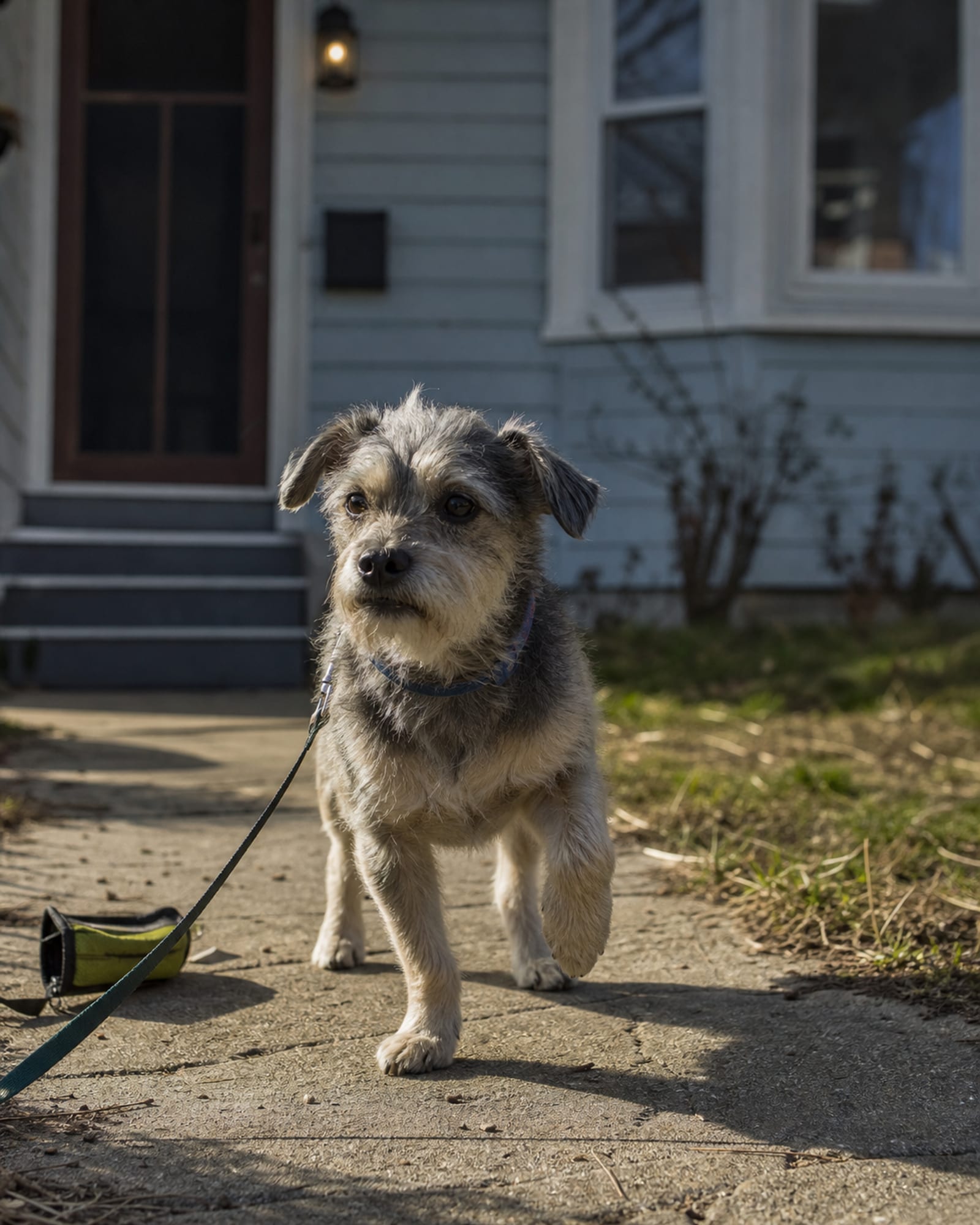
A dog pausing mid stride on a pavement, one paw lifted
The edge of the driveway apron, a change in surface, a specific tree. If you cannot tell instantly whether the dog is over it, you will be inconsistent and he will learn nothing.
The dog learns to hold a spot on the correct side, on cue, with you standing beside him. This is a settle with a location attached, and it is the foundation for everything after.
You cross the line, he does not. This is where most dogs break first, and it is the version you will need when you are carrying something to the car.
Someone walking past, then jogging past, then with a dog. Thirty feet of line means his answer is never up for negotiation.
Deer scent, waterfowl, a ball rolling downhill toward a creek. If the boundary survives those it is real, and if it has not met them it is untested.
On a sloped, wooded lot a voice does not travel and the dog is often out of sight. This is where e-collar work earns its place, as a way to reach the dog at distance rather than as a correction.
Boundary work is the local specialty. It is not the only thing people call about.
The housing here is heavily weighted to the 1970s and 1980s, with 28.0% of homes built in that first decade and 26.2% in the second, and nearly four in ten have four bedrooms. That means split levels and interior stairs, decks, and family houses with a lot of comings and goings. A quarter of Arnold residents are under 18, so the door is busy and the dog usually has an audience.
It also means a fair number of attached homes, at 23.5% of the stock, where a party wall is close enough that barking becomes somebody else's problem. That is a different conversation from the one above and it usually starts with what the dog is barking at rather than with the barking.
Then there is the traffic in the shared spaces. Anne Arundel Community College on College Parkway, Broadneck High School, Broadneck Library on Green Holly Drive and the trails between them put bicycles, runners, children and unfamiliar dogs into predictable places at predictable times. That predictability is useful. You can pick your distance in advance rather than being surprised.
On licensing, the county rules are the ordinary ones. Dogs six months and older are licensed, rabies vaccination is kept current, dogs are under control once they leave your property, and waste gets picked up. If your community association has its own rules about animals or fences, those sit on top of the county's and they are usually the stricter of the two.
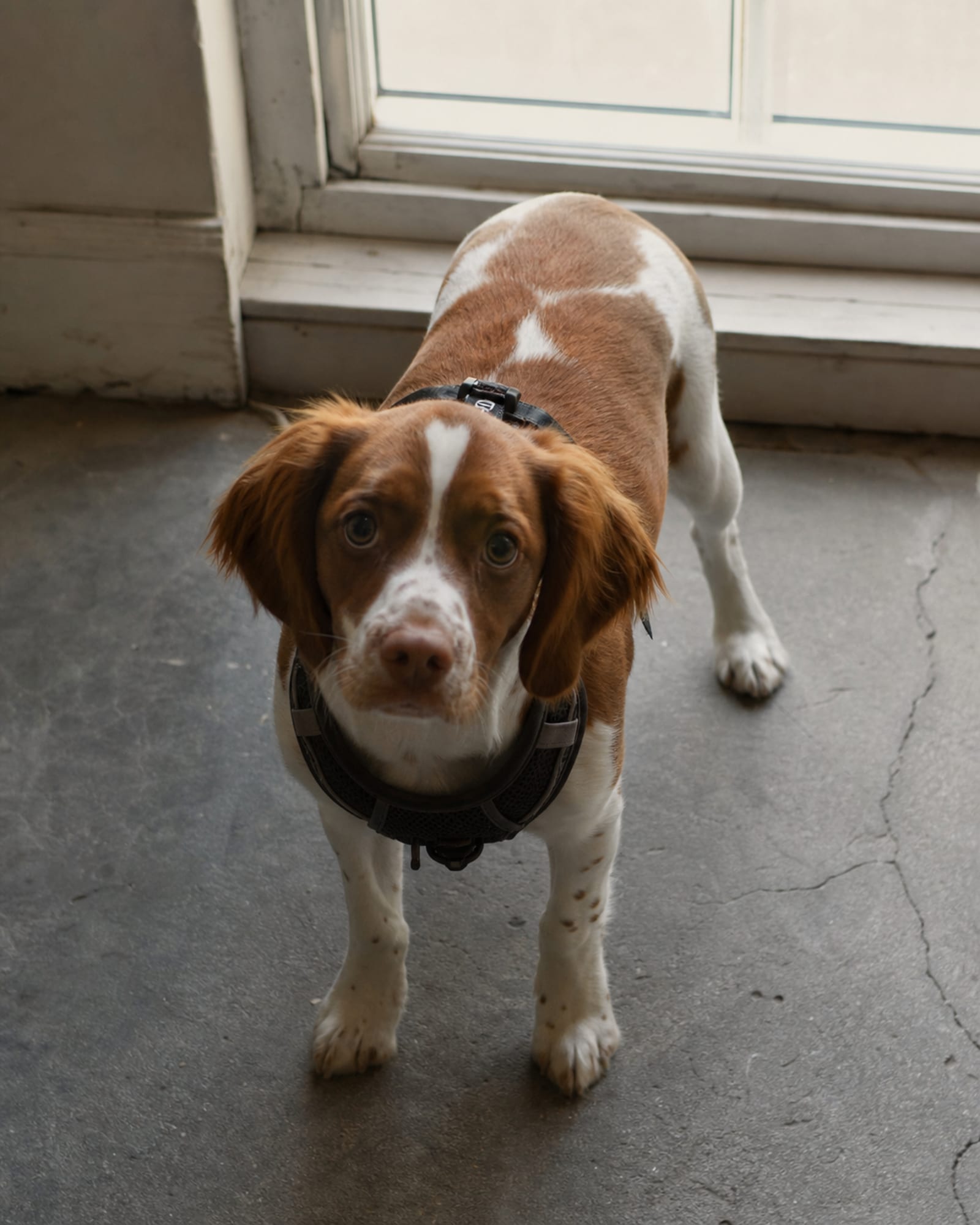
A dog looking up and holding eye contact, shot from just above
Phone (443) 429-0445, seven days a week from 6 AM to 7 PM. Tell me what your lot backs onto and where he goes when he goes, and I will tell you what to build first.