01
The house next door's dog
At 54.6% detached and 13.5% attached with small 1950s lots, the nearest dog is often twenty feet away and behind a fence. He is on the list every single day.


72,590 people and no single center. Nobody's dog experiences Glen Burnie. He experiences about four hundred yards of it, twice a day, and that is the piece worth training properly.
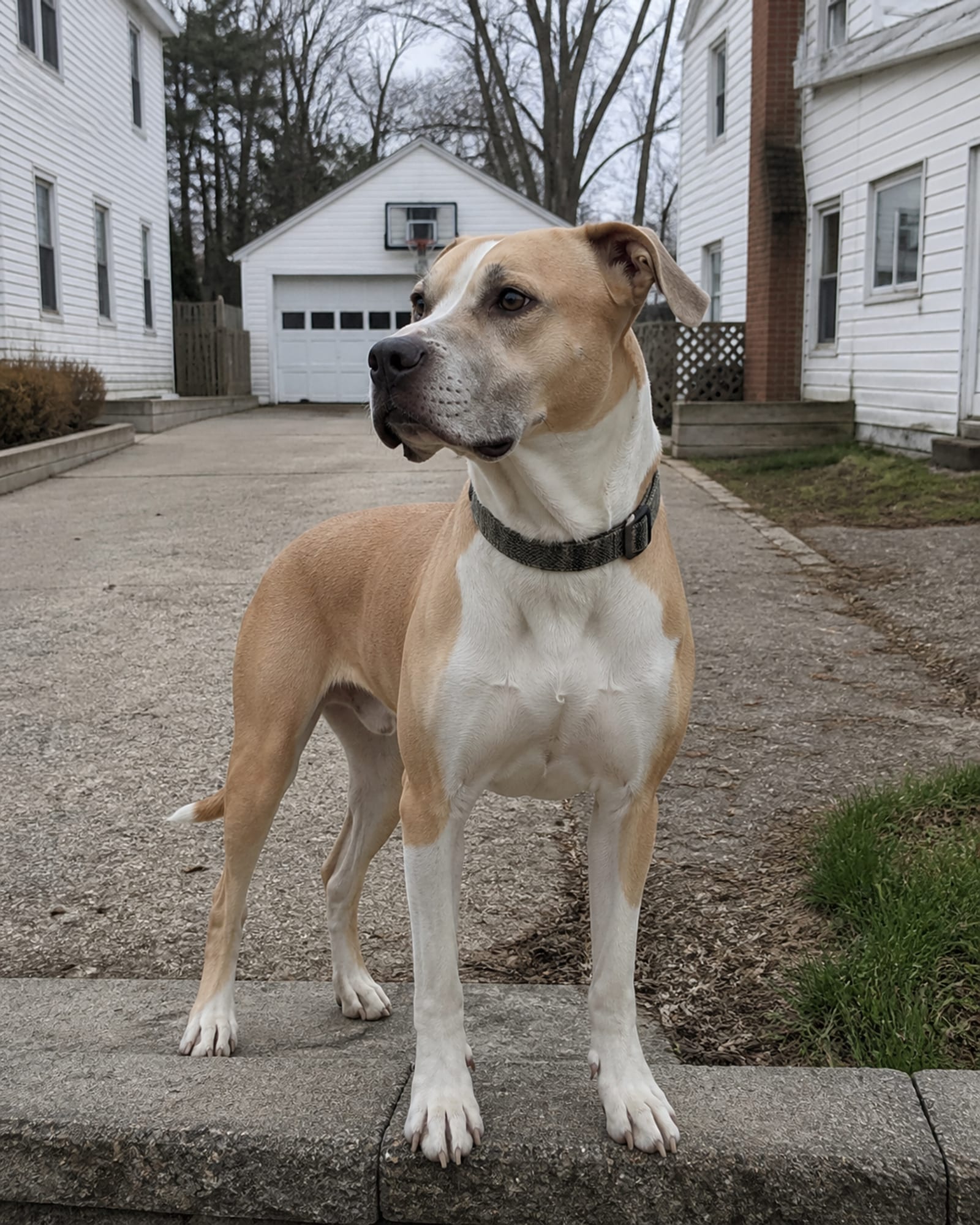
A dog standing on a low step so it fills the height of the frame, in Glen Burnie, MD
It is the standard line and it sounds generous. Get him out, let him meet everything, expose him to as much as possible.
In a place this size that advice falls apart. Glen Burnie holds 72,590 residents across 29,089 households, and it is not one town so much as a dozen neighborhoods that share a name. Harundale and Glen Burnie Park have a 1950s street grid and small yards. The southern side has townhouse and condominium communities from the 1980s and 1990s. Tanyard Springs is newer again. There is a light rail station, a hospital, a shopping plaza, a skate park, and an ice rink on Crain Highway. No dog is going to be socialized to all of that, and chasing it produces an overwhelmed dog and a discouraged owner.
What every dog can be trained for is his own route. The specific streets, the specific corner, the specific three dogs and the specific delivery van. That list is short, it is knowable, and it is where the whole of his real life happens.
Write your own version of this list. It is usually six to eight items and it is never as long as people fear.
01
At 54.6% detached and 13.5% attached with small 1950s lots, the nearest dog is often twenty feet away and behind a fence. He is on the list every single day.
02
Most routes here touch one arterial. Crain Highway, Ritchie, Baltimore Annapolis Boulevard. One crossing, trained properly, covers ninety percent of a dog's traffic exposure.
03
18.9% of homes here sit in buildings of ten to nineteen units, so for a lot of dogs the walk begins in a corridor and continues across asphalt.
04
The same vans at roughly the same times. Predictable enough to train against rather than react to.
05
One resident in five is under 18. Bicycles, scooters and groups of children on foot are part of the daily picture, not an occasional event.
06
Sawmill Creek Park, the library grounds on Eastway, or the aquatic center's surroundings. Whichever one you actually use is the only one that matters.
This is not lowering the bar. It is putting the effort where it produces something.
A dog has a limited number of good repetitions in him each week. Spend them on a broad tour of unfamiliar places and each one gets a single exposure, which is not enough to change anything. Spend them on the six items above and each gets ten or fifteen, which is more than enough. The same effort, concentrated, produces a completely different dog.
It also protects the dog from the failure mode nobody warns about. A young or nervous dog dragged through a lot of novelty does not become bold, he becomes worried, and a dog who has learned that outings are unpredictable is harder to fix than one who has seen very little. Quality of exposure beats quantity, and it is not close.
The other advantage is that a short list can be finished. Owners lose heart because socialization sounds infinite and there is no point at which anyone says it is done. Six items with a plan for each is a job with an end, and reaching the end is what keeps a household training for the eight weeks it actually takes.
None of this means the dog stops going places. It means the going places is recreation once the list is handled, rather than being mistaken for the training. Those are two different activities and blurring them is why so many dogs get a great deal of walking and very little learning.
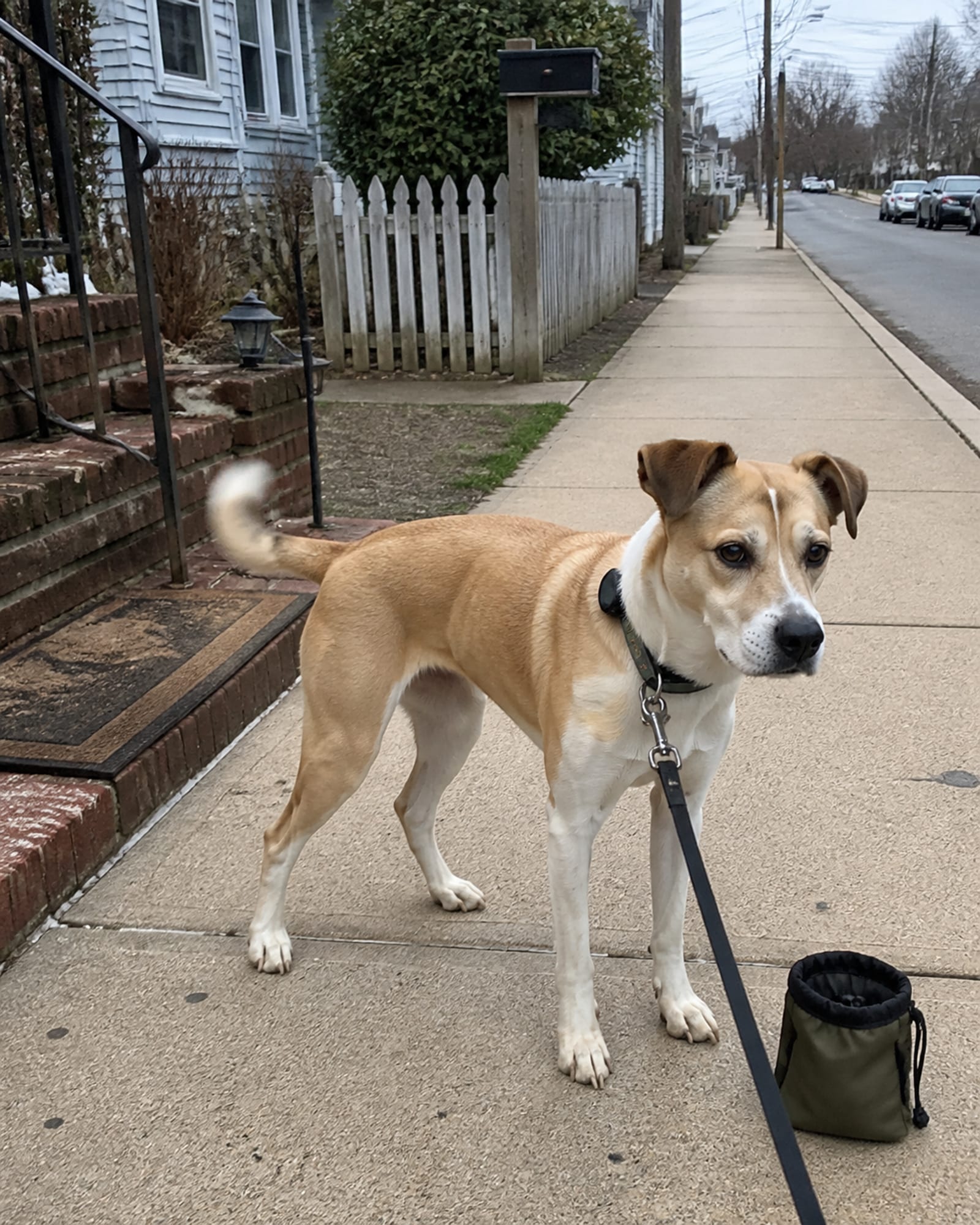
A dog standing on a sidewalk with the street receding behind it, in Glen Burnie, MD
A few things here are common enough that they land on almost every route audit I do in this community.
Noise from several sources at once. Aircraft overhead, highway traffic, the light rail, and the sheer density of the road network mean a fairly loud baseline. Most dogs file that as background within a week or two of moving in. The ones that do not need graded work, meaning you start at a distance where the dog notices and can still take food, and close the gap over days rather than in an afternoon.
Shared entries. For the substantial share of households in apartment and townhouse communities, the first stranger of the day is met before the dog reaches the sidewalk. That is a threshold problem rather than a temperament problem and it trains quickly once it is treated as its own skill.
Small yards. The 1950s stock in the older neighborhoods gives a lot of dogs a yard just big enough to patrol and not big enough to run in. Patrolling a small yard along a fence line is a habit that gets stronger every day it is practiced, and it is worth interrupting early rather than accepting.
Ground conditions after rain. The low corridors around Sawmill Creek and the older drainage in the established neighborhoods hold water, so footing changes with the weather and hot asphalt in July is a real constraint on when you can work. Both are reasons to have an indoor plan as well as an outdoor one.
Construction and change. The library on Eastway is being replaced with a much larger building, the town center rink is scheduled to return in November 2026 after a closure, and growth around Tanyard continues. For most dogs none of that registers. For a sound sensitive one it means the route he had settled into keeps producing something new, and the answer is to work the new thing at distance deliberately rather than to walk past it every day and hope. A dog who has been shown that unfamiliar noise predicts nothing in particular copes far better with the next one than a dog who has simply endured a series of them.
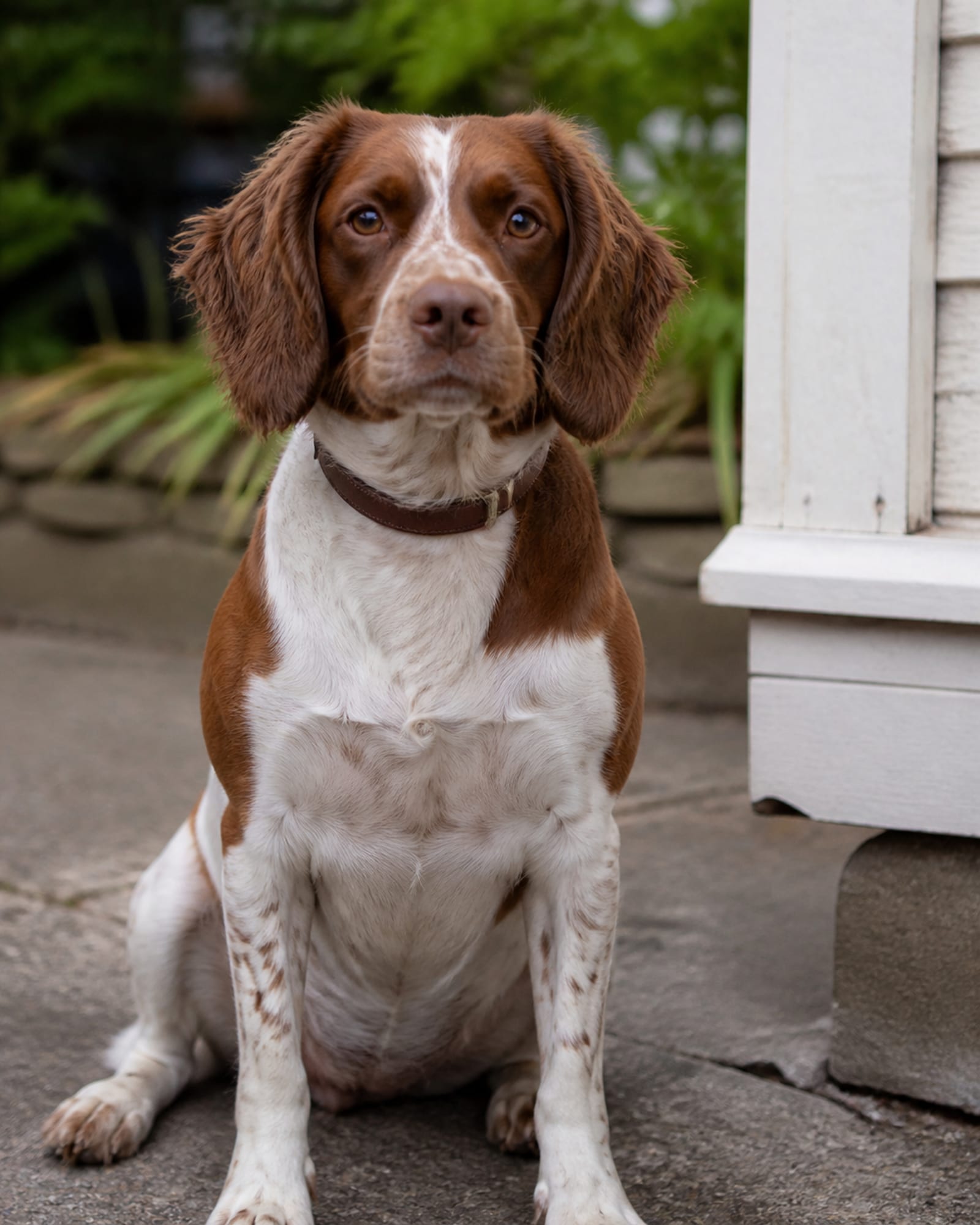
A tight vertical of a dog sitting, front legs straight, chest square, in Glen Burnie, MD
You will see three times as much. Write down every fixed feature and every recurring event, with the time it happens.
The point where the head comes up, not the point where he reacts. That gap is usually forty or fifty yards and it is where the training has to happen.
The fence dog you pass twice a day outranks the ice rink you visit twice a year. Frequency decides the order, not how dramatic the reaction looks.
Stand at a workable distance and stay there until it is dull. That is the whole exercise. It is not a walk and you are not trying to get anywhere.
Five yards at a time, and back off the moment the dog stops being able to think. Distance is the dial and it is the one most people refuse to use.
Not before. Two half trained items is a worse position than one finished one, and finishing something is what convinces a household to keep going.
Phone (443) 429-0445, seven days a week from 6 AM to 7 PM. Describe your usual route and where on it things go wrong, and I will tell you which item to work first.