01
MD 2/4
Sustained truck and commuter noise through the middle of everything, and the main road most local walks eventually have to acknowledge.


Prince Frederick is the furthest south I come and one of the smallest places on my list, around 3,000 residents in roughly 1,267 households. When a trainer drives that far, it is fair to ask what actually happens when the car pulls in. So this page answers that.
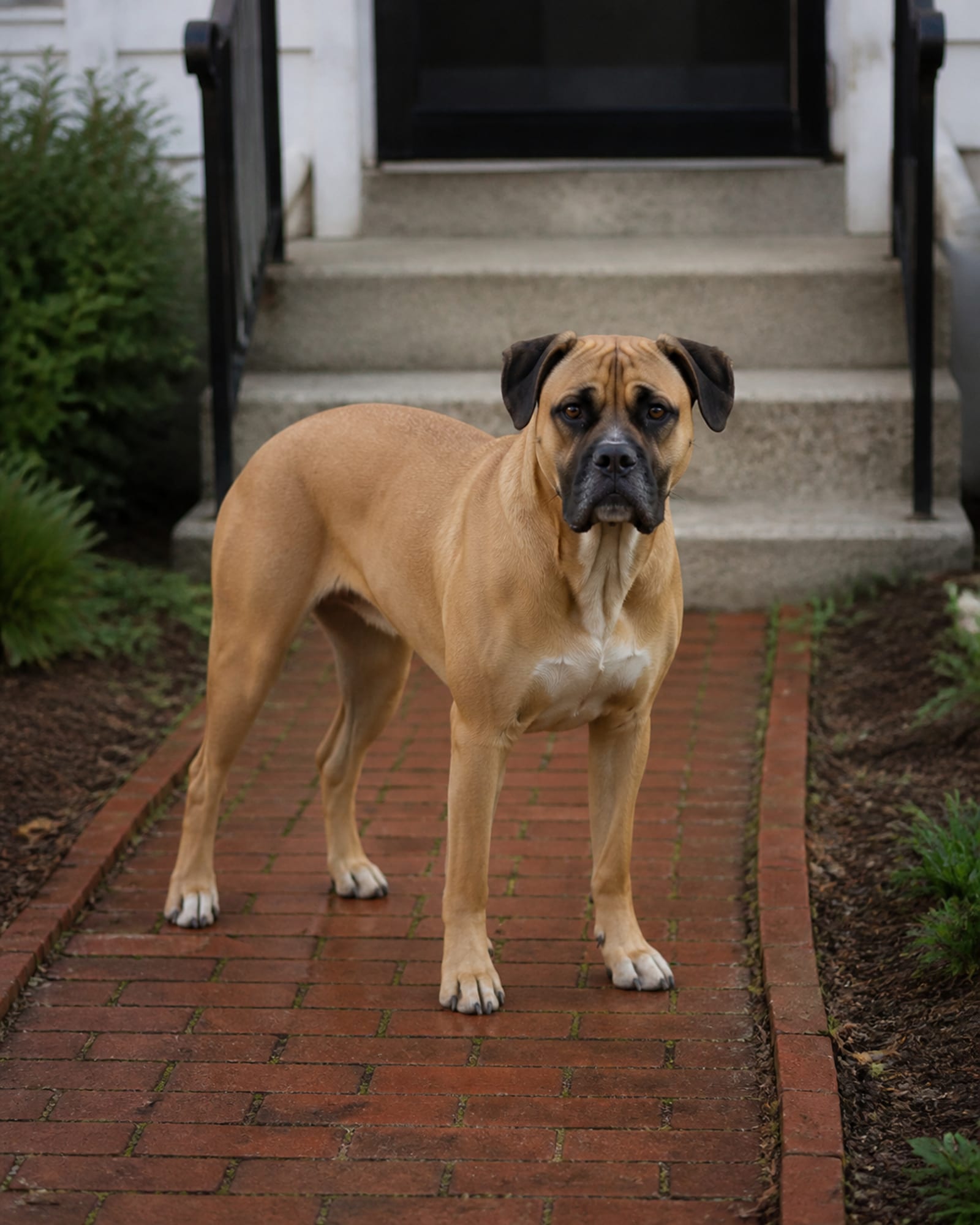
A dog standing alert with its weight even, tail neutral, in Prince Frederick, MD
I work in two ranges and they are the opposite way round from what most people guess.
Board and train draws from a tighter ring, roughly an hour's drive of Baltimore, because a dog staying in my home means the household has to be reachable. The overall service area is the wider one, about two hours, because in-home lessons mean I come to you and the distance is mine to cover. Prince Frederick is inside the second and outside the first. So a residential stay is not available here, and everything else is, and I would rather say that on the first screen than bury it.
What that leaves is the thing I do most of anyway: I turn up at your house, with your dog, in the rooms where the problem actually happens. For a place this far out that is worth explaining properly, because a two hour round trip is a real commitment on both sides and you should know what you are getting for it.
It is $100, it happens in your home, it rolls into the training fee if you go ahead, and there is no obligation to go ahead.
The first thing I do is watch. Not the dog performing, the dog being ordinary: how he greets me at the door, whether he settles once I sit down, what he does when somebody stands up, where he goes when he is not being looked at. Most of what I need is visible in the first fifteen minutes and none of it survives a phone call.
Then I ask you to show me the problem rather than describe it. Descriptions are filtered, in good faith, by what people think matters. A household will tell me a dog pulls, and I will watch them leave the house and see that the whole thing went wrong at the door thirty seconds earlier. That is the sort of thing the visit is for.
Then we look at the actual rooms. Where he sleeps, what he can see from the window, which door people really use, where the bins are, what the first two hundred yards of the walk look like. A plan built without that is a generic plan, and generic plans are what people have usually already tried.
And then I tell you what I think it is, what order to work on it in, roughly how long it should take, and what should have changed by the time we are two weeks in so you can tell early whether it is working. If I think you can handle it yourself, I will say so. If I think it needs a veterinary behaviorist rather than a trainer, I will say that too.
You get that whether or not you book anything, which is the point of it rolling into the fee only if you continue. It is a diagnosis rather than a sales visit, and at this distance it needs to be.
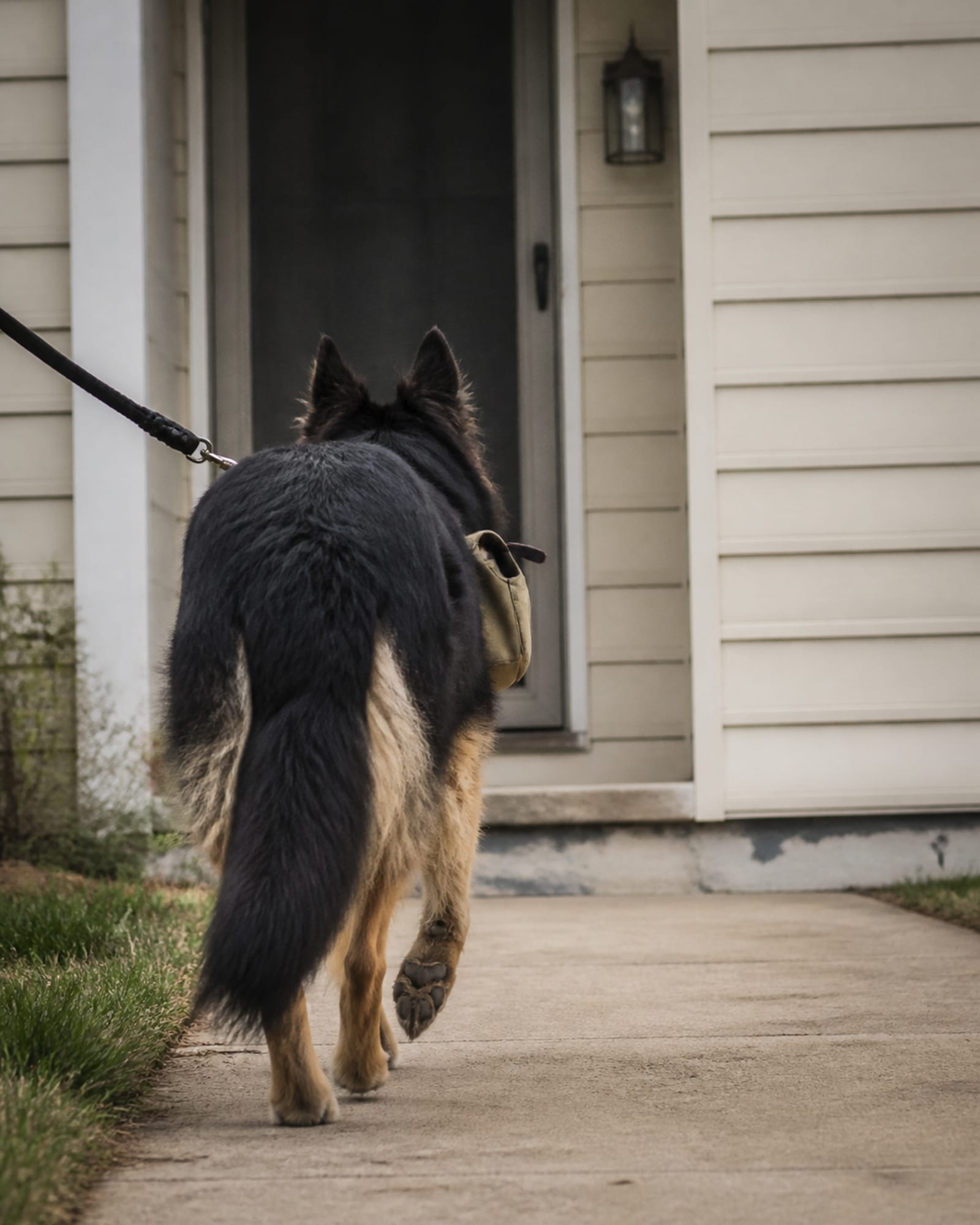
A dog walking away from camera down a pavement, seen from behind, in Prince Frederick, MD
Board and train is not available here, and for a good number of these problems it would not be the first choice anyway.
The great majority of what I am called about is not a dog problem in isolation, it is a dog problem in a house. Barking at a specific window, charging a specific door, pulling on a specific route, guarding a specific chair. A dog can be taught to be immaculate in somebody else's home and still come back to the same window, the same door and the same chair, with the household doing exactly what it did before.
In-home work fixes the arrangement rather than only the dog. That means the people learn it too, which is slower in the first fortnight and considerably more durable after that. Households that have watched their own dog do the thing, in their own hallway, with somebody explaining what just happened, do not forget it.
It also means the plan is built for the actual property. Long unfenced driveways, a townhouse court, an apartment stairwell, HOA common land, or a historic front setback close to public activity are all realistic here, and each of those changes what to teach first. Prince Frederick genuinely contains all of them, from the Main Street buildings and the older streets through garden apartments, townhouses, detached subdivisions and senior housing out to rural homes beyond the Town Center.
The honest limitation is intensity. A residential program puts a dog through a great many repetitions a day with somebody who does this for a living, and in-home work cannot match that rate. What it can do is put the right repetitions in the right place with the people who will be doing them for the next ten years, and for most household problems that is the better trade.
Where it is genuinely not the better trade, and a dog would be better served by a residential program he cannot access from here, I will tell you that rather than sell you the thing I happen to offer.

A dog in a down with its chin resting on its paws, shot from the front, in Prince Frederick, MD
A small county seat on the dissected western shore, with real countryside a few minutes out.
01
Sustained truck and commuter noise through the middle of everything, and the main road most local walks eventually have to acknowledge.
02
Stream valleys draining toward Parkers Creek and Battle Creek give clayey mud, roots, wet bridges, ticks and heavy wildlife scent on wooded routes.
03
Common outside the Town Center, and a dog loose on one is not contained, he is simply still in sight for the moment.
04
The bald cypress swamp on Grays Road adds boardwalk, water and birds, which is a genuinely unusual surface and a good place to find out about a dog.
05
Armory Road work and Town Center redevelopment can take away a familiar sidewalk or parking area without notice.
06
Courthouses, the county administration building, the hospital and the college concentrate ambulances, shoppers and foot traffic into a small area.
People often walk the dog for an hour so he will be calm for me. I need to see the dog you actually live with, not a tired version of him.
Everyone who feeds, walks or lets him out. It is the single biggest factor in whether the plan survives past week two.
Time, place, what happened before, what you did. Three days of notes turn a vague description into something I can work from immediately.
Genuinely. Where the bins are, where his bed has drifted to, what is on the window sill. That is data and it disappears when a room gets rearranged.
If the problem is outdoors, we go outdoors. The first two hundred yards from your own door tells me more than anything you can say indoors.
What it costs, how long, what happens if it does not work, whether this is even a training problem. All fair, and easier answered face to face.
Phone (443) 429-0445, seven days a week from 6 AM to 7 PM. Tell me what he does, where in the house he does it, and who is usually there when he does.