01
An elevator that opens on another dog
The most requested one by a distance. Your dog learns a turn away and a wait, and you learn that taking the next car is a competent choice rather than a defeat. Nobody has to force a close pass inside a box.


A shared building removes the thing most dog training quietly depends on: private ground between your front door and everybody else. This is training for the corridor, the elevator, the lobby and the shared relief route, where every mistake happens in front of a neighbor.
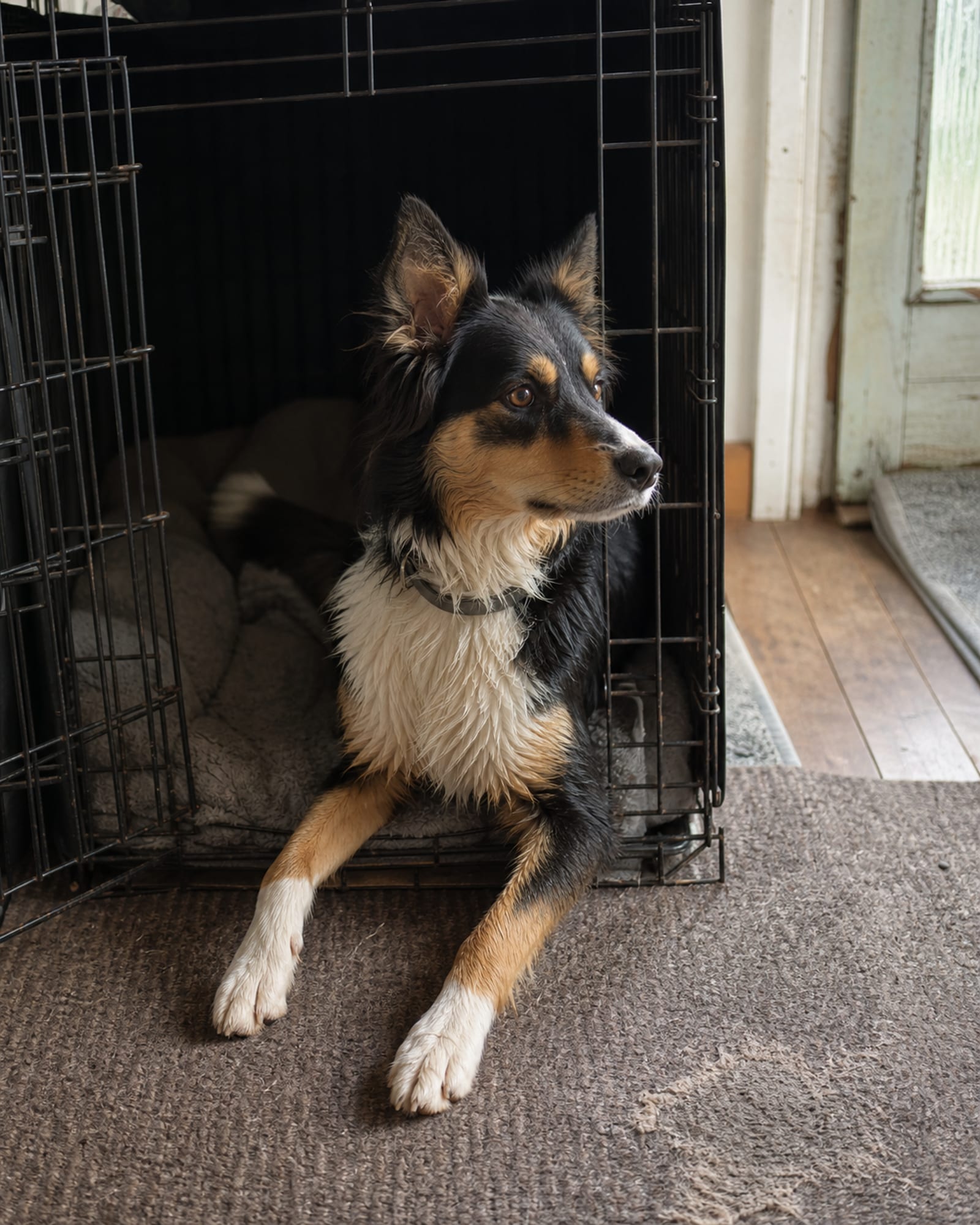
A dog settled in an open crate with bedding, half in and half out
Apartment and condo manners is training for the route between your unit door and the street, and for how your dog behaves inside a building it shares with other people. It covers waiting at the threshold instead of pushing through it, passing another dog in a corridor with no room to step aside, standing back from an elevator that opens on somebody, crossing a lobby, settling while carts and deliveries move past your door, and toileting on ground that belongs to everyone. It is a specialty I deliver through one of my programs, and it starts with a $100 evaluation in your own building.
The reason it needs its own name is that owners in buildings keep being told they have an obedience problem, when what they actually have is a geography problem.
I work this across the Baltimore, MD area, in the building itself rather than in a training hall, because a corridor cannot be simulated anywhere else.
A still life of a flat collar, a harness and training treats on a wooden surface, no dog
In a house, your dog gets a transition. There is a yard, a driveway, a path, a quiet stretch of sidewalk. By the time it meets anything, it has been outside for a minute and it has somewhere to go if it wants space.
A building deletes all of that. Your dog steps from your living room into a public corridor in one movement. The first stranger it meets that day is met indoors, at close range, often coming around a corner it could not see. If an elevator opens and there is a dog inside, there is no crossing the road and no wide arc. There is a metal box and about four feet.
So a dog with a perfectly reliable sit at home can still be a problem in a building, and the owner gets told the answer is more obedience. More obedience is not the answer to a place with no room to retreat. What your dog needs is a plan for the exact moments the building creates, worked through in the building itself.
Party walls and floors supply the other half of it. Your dog hears footsteps, voices, doors, elevators and deliveries all day, at a volume it would never meet in a detached house, and it can never go and look at any of it.
A lead coiled on a hook by a door, no dog in frame
What happens when the door opens. Most building problems start here, with a dog that arrives in the corridor already moving and already ahead of you. I want to see whether your dog can wait while you look at what is out there.
How wide it really is, where the corners are, which doors open outward, and how much warning you get before something appears. I measure this in feet, because the distance you have is the distance we get to work with.
Whether your dog will stand back and let a car go, ride without crowding, and step out without rushing. If your building has stairs, they are often the better route while we are building this, and I will tell you so.
Usually the busiest ground your dog crosses, often with a desk, a door somebody is holding, and the highest chance of a greeting you did not ask for. It needs its own plan, not a hurried version of the corridor plan.
Where your dog toilets, how far it is, what it passes on the way, and how crowded it gets at the times you actually go. A route that works at six in the morning can be unusable at six in the evening.
Where your dog rests relative to the front door, what it can hear from there, and what it does about it. A dog stationed three feet from the door is being asked to ignore something it is sitting on top of.
These are the moments that produce the phone calls. Each one gets a plan you can run without thinking, because you will be running it while holding a leash, a coffee and your keys.
01
The most requested one by a distance. Your dog learns a turn away and a wait, and you learn that taking the next car is a competent choice rather than a defeat. Nobody has to force a close pass inside a box.
02
Something appears at six feet with no warning. We drill a stop and a step back to the wall, so you both have a default that does not depend on seeing it coming.
03
A corridor too narrow to give ground, so the space has to be made another way: a doorway alcove, a pause, a change of side. Your dog learns that standing still while something goes by is the finished behavior, not a delay before the real one.
04
Moving through the busiest part of the building without stopping to meet everyone and without towing you. It is also where most unwanted greetings begin, so you get the wording to head one off before it reaches you.
05
Wheels, trolleys, tool bags, and people who arrive without warning at your own door. We work these as a category rather than one at a time, because your building will keep inventing new ones.
06
In a building your visitor is already inside before they reach you, so the greeting happens at your door with no run up. Your dog gets somewhere to be that is not the doorway.
These two get treated as one thing constantly, and they are not one thing. A dog barking at footsteps, voices and the elevator while you are sitting right there is reacting to the building. A dog that is quiet all day until you leave, then comes apart, is doing something else, and the plan for it is different.
The quickest way to tell them apart costs nothing. Set a phone up and watch what your dog actually does in the first twenty minutes after you go out. Owners are usually surprised, in both directions.
If it is the building, that is this page and we work it here. If it turns out to be absence, my anxiety and nervousness page is where that plan lives. If your dog barks at everything everywhere and the building is only the loudest version of it, my excessive barking page is the better place to start.
The same handoff applies to a dog that is genuinely reactive to other dogs rather than simply short of room. A corridor makes reactivity worse because it removes distance, but it does not create it, and my leash reactivity page describes that work properly.
Four sets of rules can apply to your dog at the same time: your lease, your condominium or association documents, local animal control rules, and federal fair housing rules. They are not the same as each other and they do not always agree.
A few practical things are worth knowing. Maryland now requires many residential rental listings and applications to disclose pet restrictions, fees, limits and vaccination requirements up front, so you should be able to see what applies before you sign rather than afterwards. An association can generally regulate the common areas and can impose fines, but normally only after giving notice and a chance to be heard. Assistance animals are not treated as pets where a valid accommodation applies, which is a separate question from behavior and gets looked at case by case.
What I will tell you plainly is what training cannot do. It cannot withdraw a warning or a complaint your building has already issued. It cannot override a rule, a fine, or a restriction on where your dog is allowed to go. What it can do is change what happens next, and give you a documented plan you can hand to a property manager who wants to see you are dealing with it, which in my experience is usually what they were asking for.
Get your own lease and association documents and read them. I am a dog trainer and not a lawyer, and none of this is legal advice.
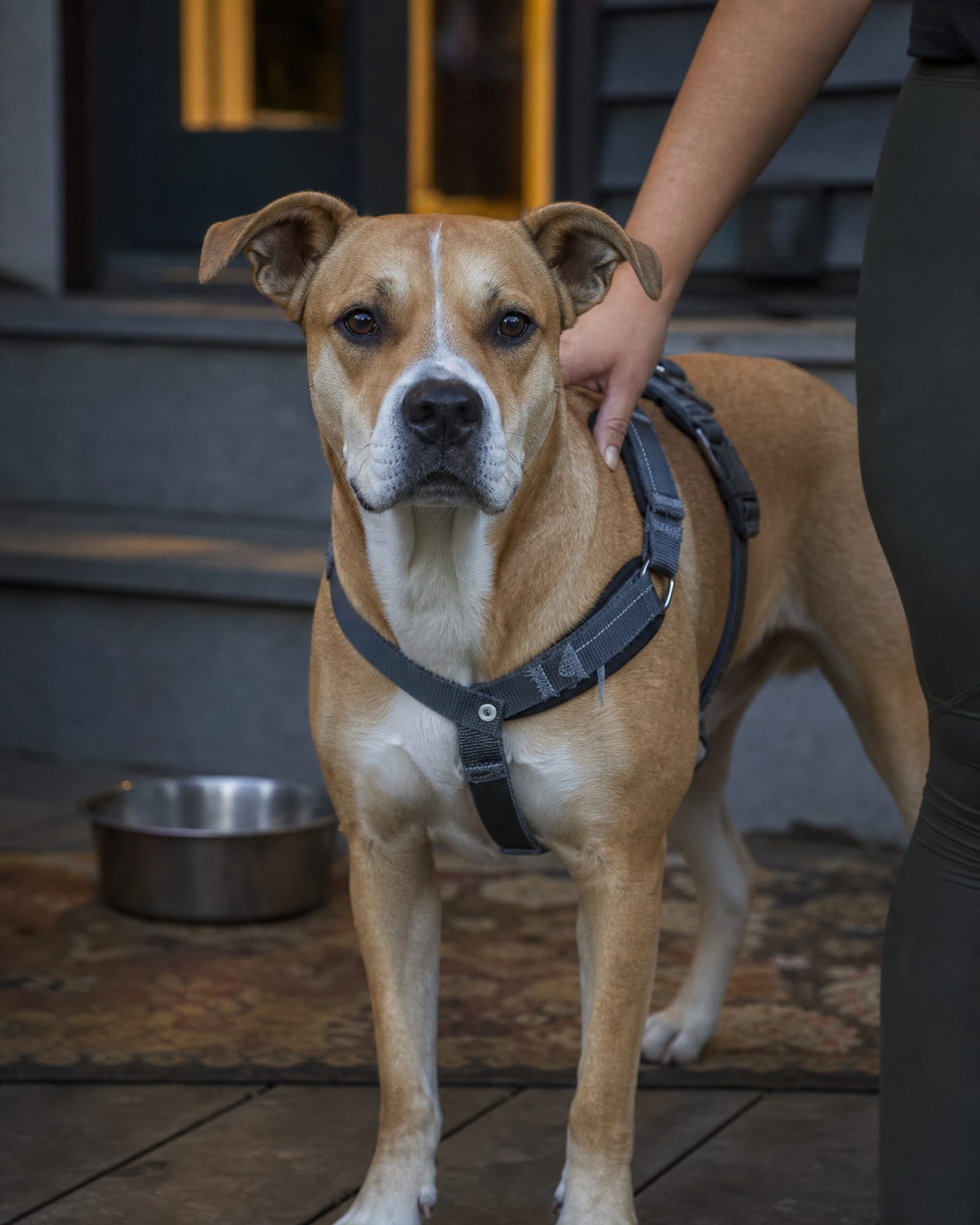
A dog standing with a handler's hand resting lightly on its shoulder, forearm only
Apartment work is never sold on its own, because the thing you are buying is a program and this is the specialty I run through it. Every dog starts with an evaluation at $100. I meet your dog, walk your route, and tell you which of the three fits. If your building is straightforward and your dog is basically sound, I will tell you that too.
In-home private lessons start at $700, and this is the usual route for building work, because the training has to happen where the problem happens and because you are the one holding the leash in that corridor every day. Kick Start starts at $1,600 and front loads the work with daily sessions, which suits a dog with ground to make up quickly, or an owner working to a deadline their building has set. Board and train starts at $3,600 and builds the foundation in my home; the transfer into your own corridor, elevator and lobby still has to happen afterwards, and I build that in rather than pretending the foundation on its own is enough.
How long it takes depends on where your dog is starting, how busy your building is, what access you have for practice, and how much you do between visits. Anyone quoting you a fixed number of weeks for a building they have not walked is guessing.
If your dog is difficult in the corridor, impossible in the elevator, or barking at everything that passes your door, call me at (443) 429-0445. I answer 6 AM to 7 PM, seven days a week. Tell me what floor you are on, what your dog does and where it does it, and I will tell you honestly what I would do about it and what it would cost.