01
The three points on the walk
The rehearsed reaction described above. The most common single call I take from this community and the most satisfying to fix.


Crofton was laid out in 1964 around a parkway that loops back on itself, and most of the community walks some version of that same circuit. Your dog has walked it perhaps eight hundred times. He knows exactly where the trouble is, and so, if you think about it, do you.
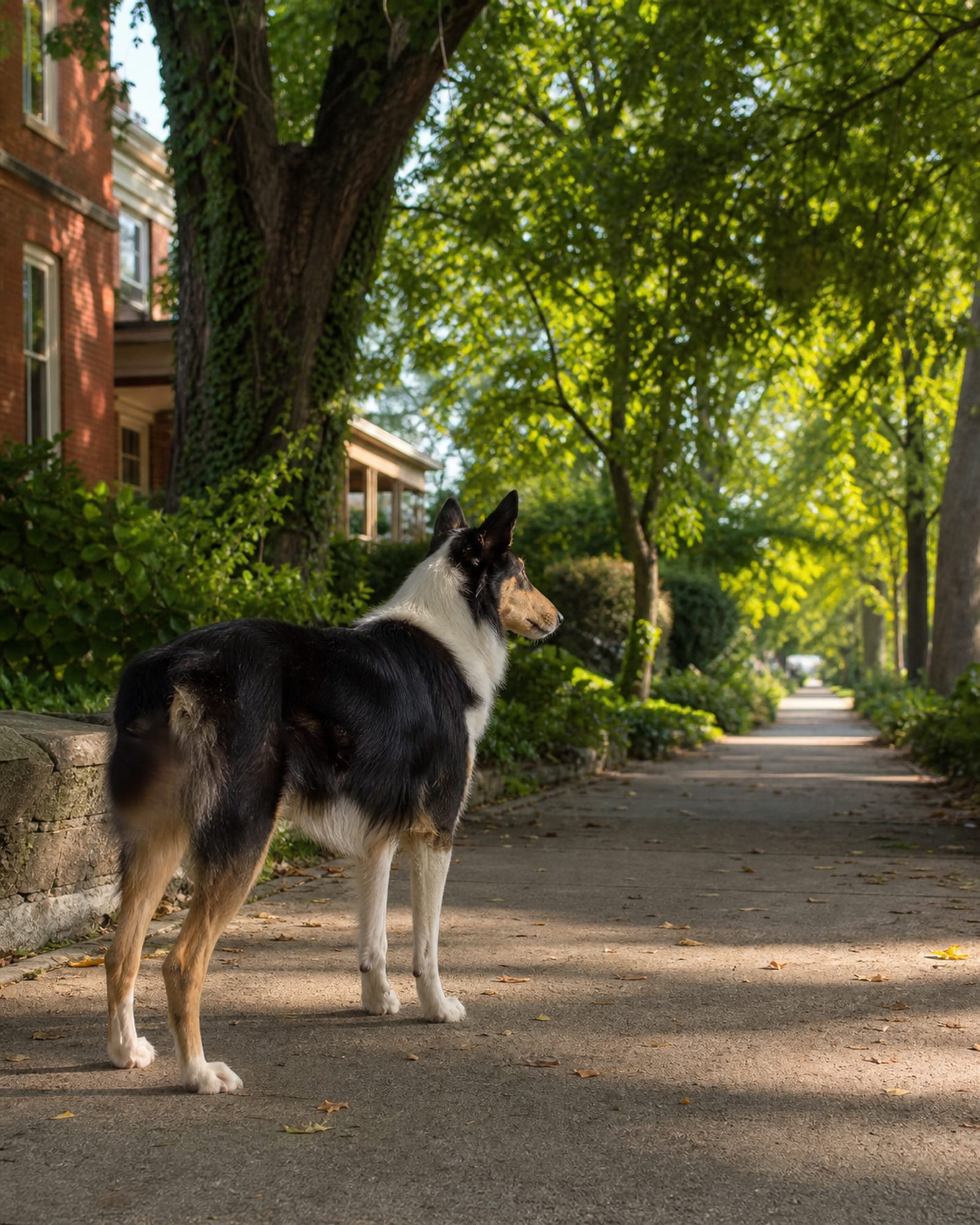
A dog standing alert with its weight even, tail neutral
Draw the walk you did last night. Out of the door, left, along the parkway, around, back. Now mark the three places where you tighten the leash without thinking about it. The corner where the two dogs live. The stretch by the school where the fence has gaps in it. The point near the Village Green where somebody is usually coming the other way.
Almost every Crofton owner can mark those three points in about ten seconds, which tells you how well established they are. A planned community built around a loop produces something unusual: a whole town walking a shared circuit, at roughly the same times, past the same houses, meeting the same dogs. With 10,528 households, 29.1% of residents under 18 and an even split between detached and attached homes at 45.8% and 45.9%, that circuit is busy.
And repetition is how dogs learn. Which means a route walked twice a day for four years has not just revealed your dog's problems. It has been practicing them.
Not forever. You cannot retrain a behavior while the dog is rehearsing it daily, and two weeks off the loop is the cheapest intervention available to you.
Write down where it happens, at what distance, and what you do. Most owners find the reaction starts fifty yards earlier than they thought, which is the useful part.
Crofton Park, Bell Branch Park or a street on the far side of the community. The dog learns what to do instead, in a place with no history attached to it.
Same route, seven in the morning or after dark. Same ground, none of the traffic. The dog gets to walk past the corner with nothing happening at it, which is a repetition in your favor for once.
Walk the loop the other way. The cues arrive in a different order and the dog's anticipation, which is half of the reaction, has nothing to hook onto.
Stand at a distance the dog can handle and stay there until it is dull. That is a session, not a walk. Trying to do it while also getting somewhere is what has not worked so far.
Owners often tell me their dog is fine everywhere except at home, and are surprised when I say that is exactly what I would expect.
A behavior gets stronger every time it is performed. If a dog lunges at a fence and the fence dog goes away, which it always does eventually because you keep walking, the lunging worked. It did not work in any sense you would recognize, but it worked in the only sense the dog cares about. Do that four hundred times over two years and you have a genuinely well trained behavior. It is just not the one you wanted.
The predictability makes it worse. On an unfamiliar street a dog is taking in information. On a route he has walked eight hundred times he is not taking in anything, he is anticipating, and by the time you reach the corner he has already started. That is why the reaction seems to arrive from nowhere and why it looks so much bigger than the trigger deserves.
It also explains the thing that frustrates people most, which is that the dog is perfectly civil on holiday, at a friend's house, or on the trail. He is not being selective. He simply has no rehearsed pattern in those places, so what you are seeing there is his actual baseline behavior. The baseline is usually fine. The route is the problem.
The upside is that this responds well and fairly quickly, because you are not fixing a temperament. You are interrupting a habit, and habits need their trigger. Take the trigger away for a fortnight, teach the alternative somewhere clean, and reintroduce it under conditions you control, and most dogs shift noticeably inside a month.
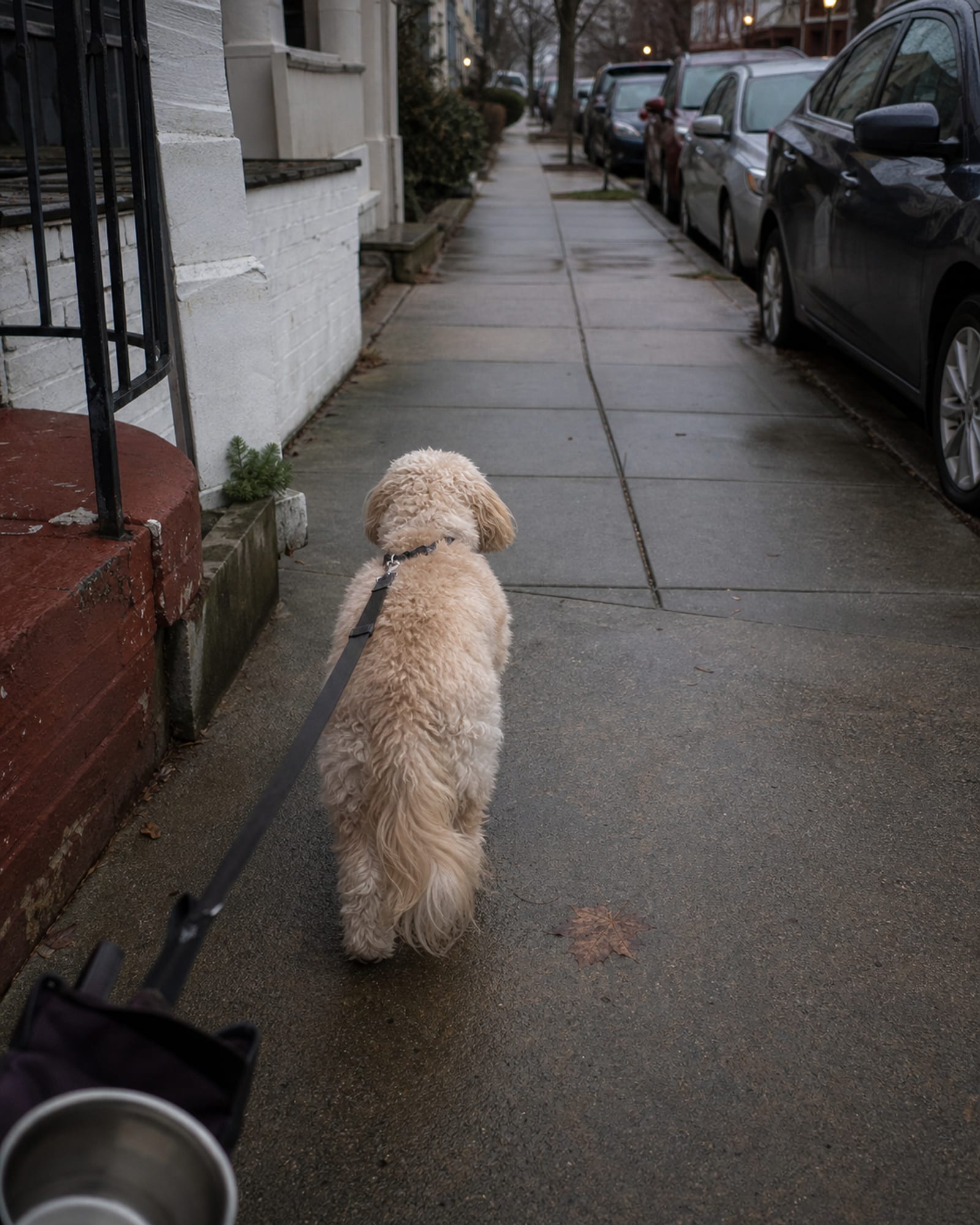
A dog walking away from camera down a pavement, seen from behind
A family heavy planned community with an even mix of detached and attached homes.
01
The rehearsed reaction described above. The most common single call I take from this community and the most satisfying to fix.
02
Nearly half the stock is attached, in Crofton Village, Walden, Chapman Farms and Crofton Meadows, so a fence line or a shared green is somebody else's yard as well as yours.
03
Crofton High School and the feeder schools produce a reliable surge of children, bicycles and cars at fixed times. Predictable enough to train against on purpose.
04
Fast traffic and the commercial edge sit right beside quiet residential streets, so a dog can go from calm to overloaded in one turn.
05
The average commute here runs over half an hour each way, which shapes when the dog is walked and by whom. Both matter more than people expect.
06
Crofton drains into the Little Patuxent, and the Anne Arundel portion of that watershed carries 181 stream miles across 21 subwatersheds. Low paths stay soft for days.
The loop is not only a liability. Used deliberately it is one of the better training resources in the county.
A predictable route means predictable exposure, and predictable exposure is exactly what a nervous or reactive dog needs. If you know that the two dogs are behind that fence, you can choose to work at eighty yards on Tuesday and seventy on Thursday. On an unfamiliar street you get whatever turns the corner, at whatever distance it chooses, which is not training, it is gambling.
The same is true of the people. A community where everyone walks the same circuit means you can arrange things. Ask a neighbor with a calm dog to walk parallel at a distance for five minutes. That single arrangement, repeated a few times, does more for a reactive dog than a month of hoping.
Distance is the tool in all of this, and it is worth being blunt about what that means in practice. If your dog can think at sixty yards and cannot think at thirty, then sixty yards is where the training happens, for as long as it takes, and thirty yards is not a target you are entitled to rush. My leash reactivity page goes into the mechanics of it.
One boundary I will name here rather than let you find out later. If the dog's reaction includes going for the leash, the handler, or another dog with real intent, that is a different piece of work and it starts with an evaluation rather than with a walking plan. Where it goes beyond training and into veterinary behavior territory, I will say so.
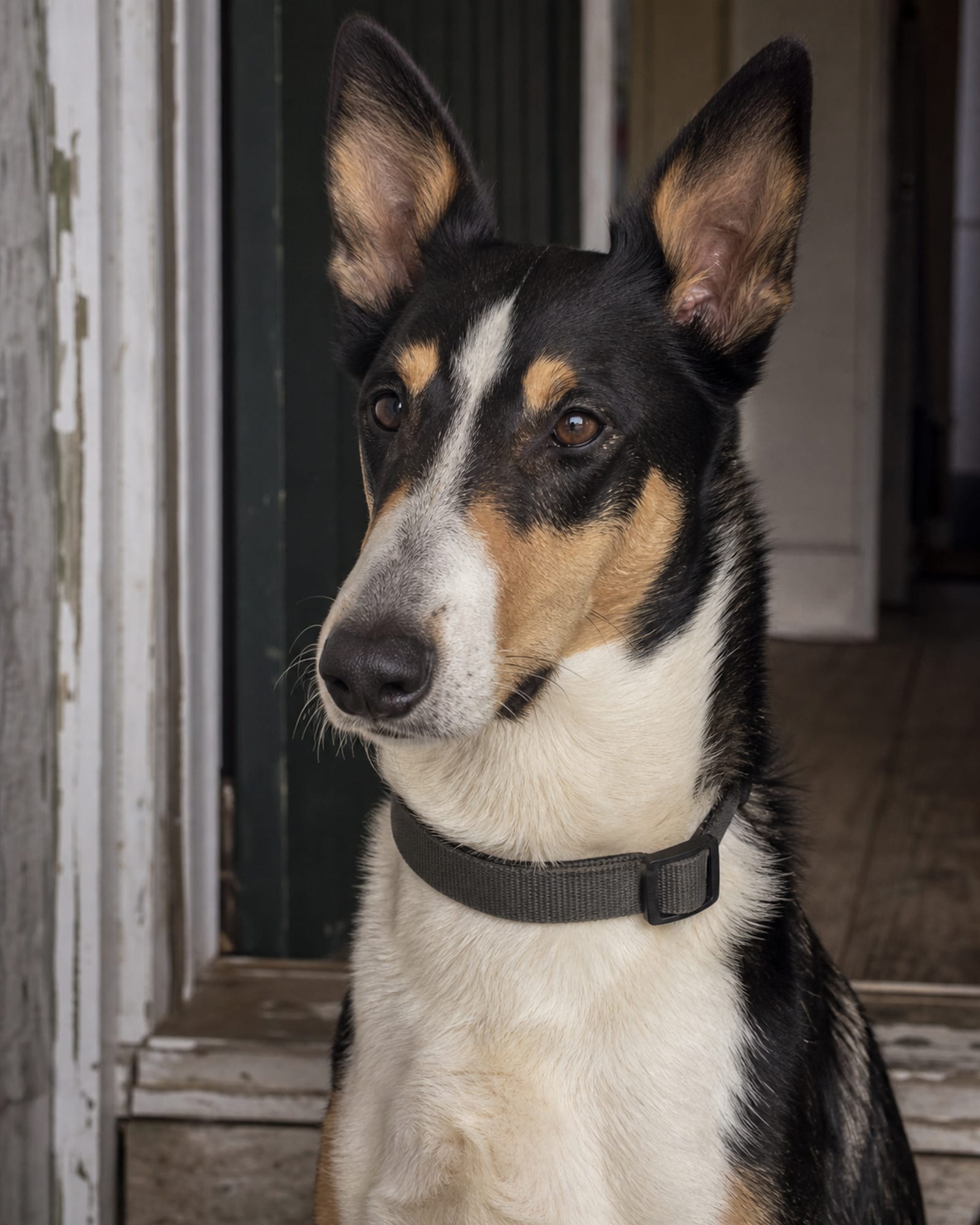
A dog's ears pricked mid alert, head and neck filling the frame
Phone (443) 429-0445, seven days a week from 6 AM to 7 PM. Tell me where on the route it happens and at what distance it starts, and I will tell you what the first fortnight looks like.