01
Indoors, with nothing happening
Where it gets taught. Easy, quiet, repeatable. Most dogs never leave this one and that is why the training does not survive the front door.

Your dog is faultless on the Maple Lawn sidewalks and useless on Hall Shop Road, a mile away. That is not inconsistency. It is the single most misunderstood thing about how dogs learn, and Fulton demonstrates it better than anywhere else I work.
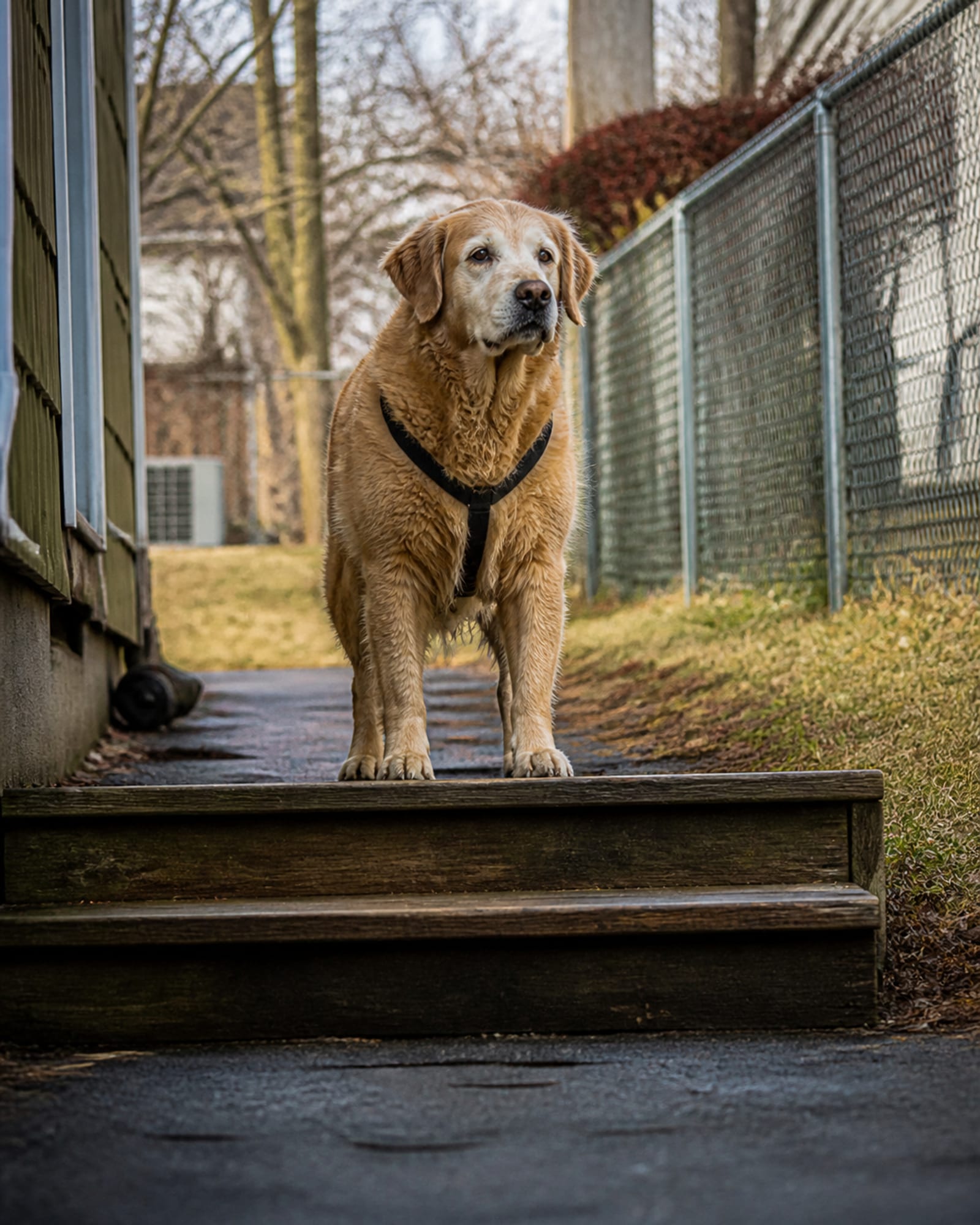
A dog standing at the top of a short flight of steps, in Fulton, MD
Two walks, one dog, one mile apart.
The first is Maple Lawn: a sidewalk grid, street trees, a business district, townhomes and condominiums, people going to the shops. Your dog is a credit to you. The second is out along Lime Kiln or Pindell School Road, where the housing thins into older properties and larger rural lots, the shoulder narrows, and there is a deer standing in a field. The same dog does not appear to know his own name.
Fulton is built to make this obvious. 64.6% of its housing went up between 2010 and 2019, the stock splits almost evenly between detached homes at 38.4% and attached at 37.3% with another 16.6% in buildings of twenty units or more, and beyond the planned community the ground goes rural quickly. So one household can be walking two completely different environments inside fifteen minutes.
And a dog does not learn behaviors. He learns behaviors in places.
This is the thing that makes owners believe their dog is being deliberately difficult, and it is the most fixable misunderstanding on this page.
When you teach a dog to sit in your kitchen, he does not learn "sit". He learns something much narrower: sit, in this kitchen, on this floor, with you standing there, in this light, with these smells. Every one of those is part of the picture as far as he is concerned. Change enough of them at once and the picture no longer matches, so the behavior does not come.
People take that personally. He knows it, he is just choosing not to. Almost always he is not. He genuinely has not worked out that the word applies out here as well as in there, and until somebody shows him, it does not.
Generalizing a behavior is a real piece of training work rather than a bonus you get for free. The rule of thumb I use is that a behavior is not portable until it has been taught in about five clearly different places. Not five variations of your living room. Five environments that look, sound and smell different from each other.
Fulton makes that unusually easy, which is the compensation for the problem. Within a couple of miles you have a sidewalk grid, a business district with foot traffic, school grounds, park land at Hammond Park and Schooley Mill, and genuinely rural lanes. That is a ready made ladder, and most households here have never used it as one.
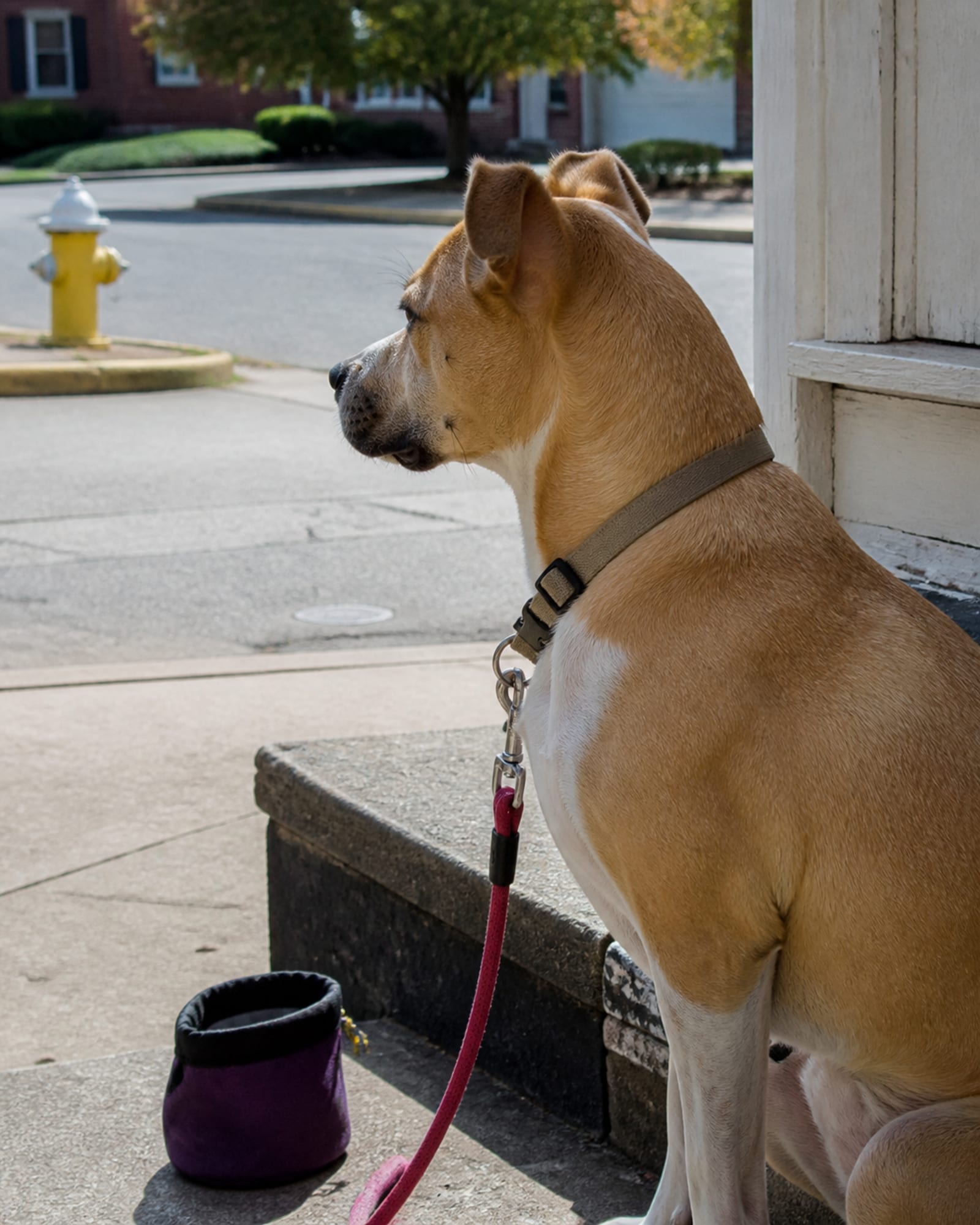
A dog sitting on a stoop watching the street, in Fulton, MD
One dog, five pictures. Each one changes the surface, the sound and the company.
01
Where it gets taught. Easy, quiet, repeatable. Most dogs never leave this one and that is why the training does not survive the front door.
02
Same house, different floor, real smells, weather. The smallest possible step up and the one most people skip because it feels too easy to bother with.
03
Maple Lawn's streets give you level pavement, other people, delivery activity and a predictable amount of noise. A controlled step, and available every day.
04
The business district, or the farmers market on the historic Maple Lawn farm site. Start at the perimeter. This is proofing, not a first attempt.
05
Hammond Park or Schooley Mill. Uneven footing, long sight lines and other dogs at distance. Behaviors often fall apart here first, which is the point of going.
06
Lime Kiln, Hall Shop, Murphy and Pindell School roads. Narrow shoulders, deer, no sidewalk, and a dog who has never been asked for anything out here.
Generalizing is not only about obedience. The two halves of Fulton fail in different ways and need different management.
In the planned part, the risks are social and mechanical. Shared greens and close pedestrian routes mean encounters at short range, elevators and corridors in the condominium buildings, deliveries, and hot pavement in summer with deicing residue on it in winter. A dog needs door manners, a settle that works in a small space, and the ability to pass another dog at three feet without an opinion.
Out on the rural side, the risks are speed and wildlife. Narrow shoulders and limited lighting, a dog that has never met a tractor, and deer on former farm ground where new landscaping drains differently from the older lots beside it. The behaviors that matter there are a hard stop, a step off the road, and a recall that survives something moving fast in a field.
A household that walks both is asking a dog to hold two quite different skill sets, and most dogs manage it perfectly well once somebody teaches both rather than assuming one covers the other. What does not work is training in whichever half you happen to prefer and hoping the other one comes along.
There is a timing point too, and it belongs to Fulton specifically. School traffic around Fulton Elementary, Lime Kiln Middle and Reservoir High arrives at fixed hours, the business district fills at lunchtime and again after work, and the rural lanes are quietest in the middle of the day when the sidewalks are busiest. So the same route offers three different levels of difficulty depending on when you leave the house, and that is a dial you can use rather than a nuisance to put up with. Households who work out their own timetable make faster progress than households who walk at whatever hour is convenient and take whatever they get.
One boundary worth stating. If the failure in the second environment is not obedience but a genuine reaction, lunging, barking, fixating on wildlife to the point where nothing reaches him, then that is a separate piece of work and it starts with an evaluation. My leash reactivity page covers the mechanics of it.
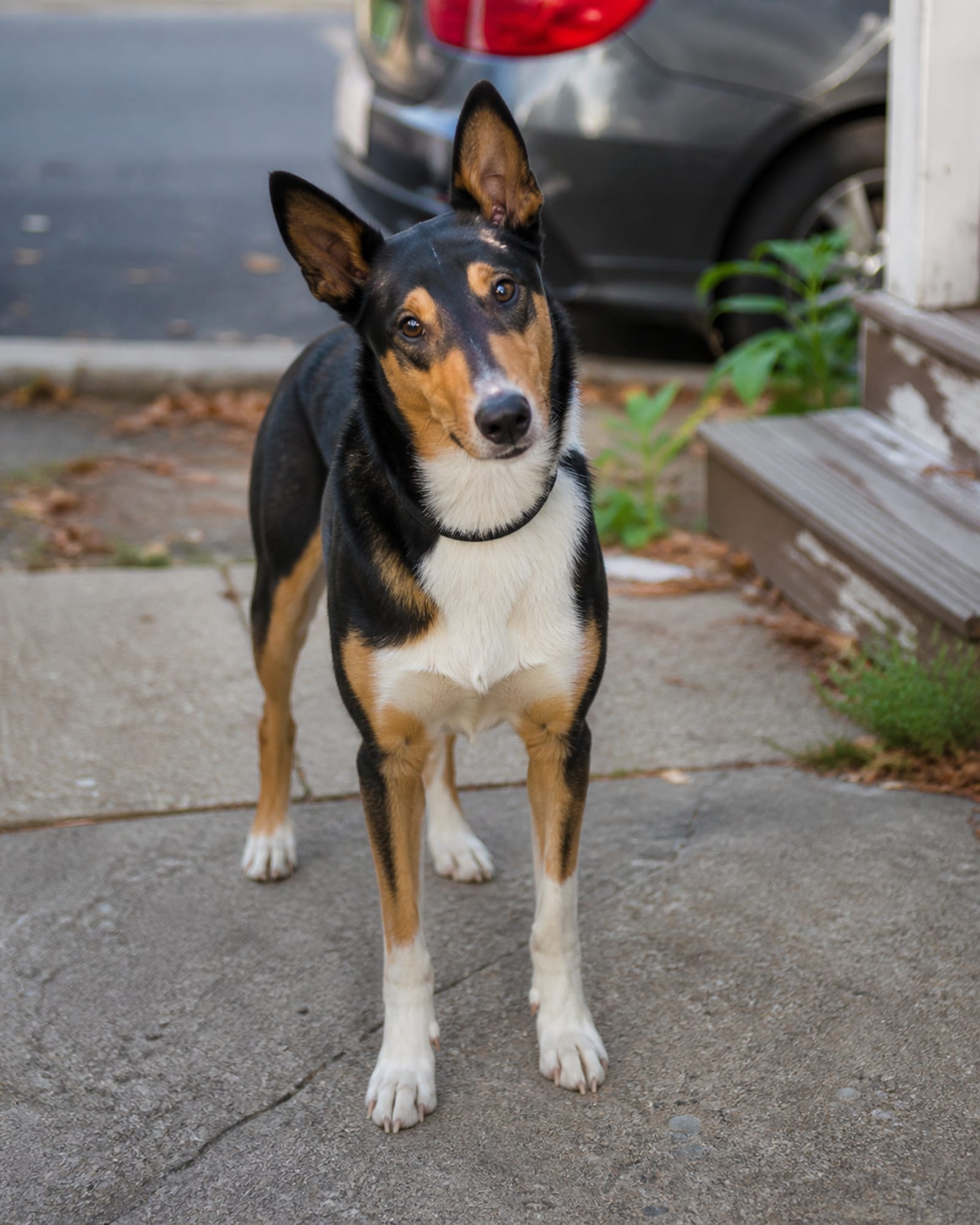
A dog looking up and holding eye contact, shot from just above, in Fulton, MD
Usually the recall or the settle. Generalizing one behavior properly is worth more than half generalizing four.
New environment means going back to short distance, no distraction, and paying well. People take a finished behavior to a hard place and are surprised when it breaks.
New place, familiar handler. Then new handler, familiar place. Changing both at once is where the wheels come off and where owners lose confidence in the plan.
Park land and rural lanes both. It is not a compromise, it is what lets the answer be right every time while the behavior is still forming.
Five genuinely different environments. Write them down and tick them off. Once a behavior has been through five, the sixth tends to come free.
Distance, duration, distraction, in that order and never two at once. This is the part that turns a behavior that works into one you can rely on.
Phone (443) 429-0445, seven days a week from 6 AM to 7 PM. Tell me where he is good and where he is not, and that comparison tells me most of what I need.