01
A recall that has never existed
The one above. Extremely common in a community where 86.7% of homes have three or four bedrooms and almost everyone has a yard.


90.6% of Abingdon homes are owner occupied and most have three or four bedrooms and a yard to match. That yard is why the dog gets enough exercise, and it is also why he has never once had to come when you called.
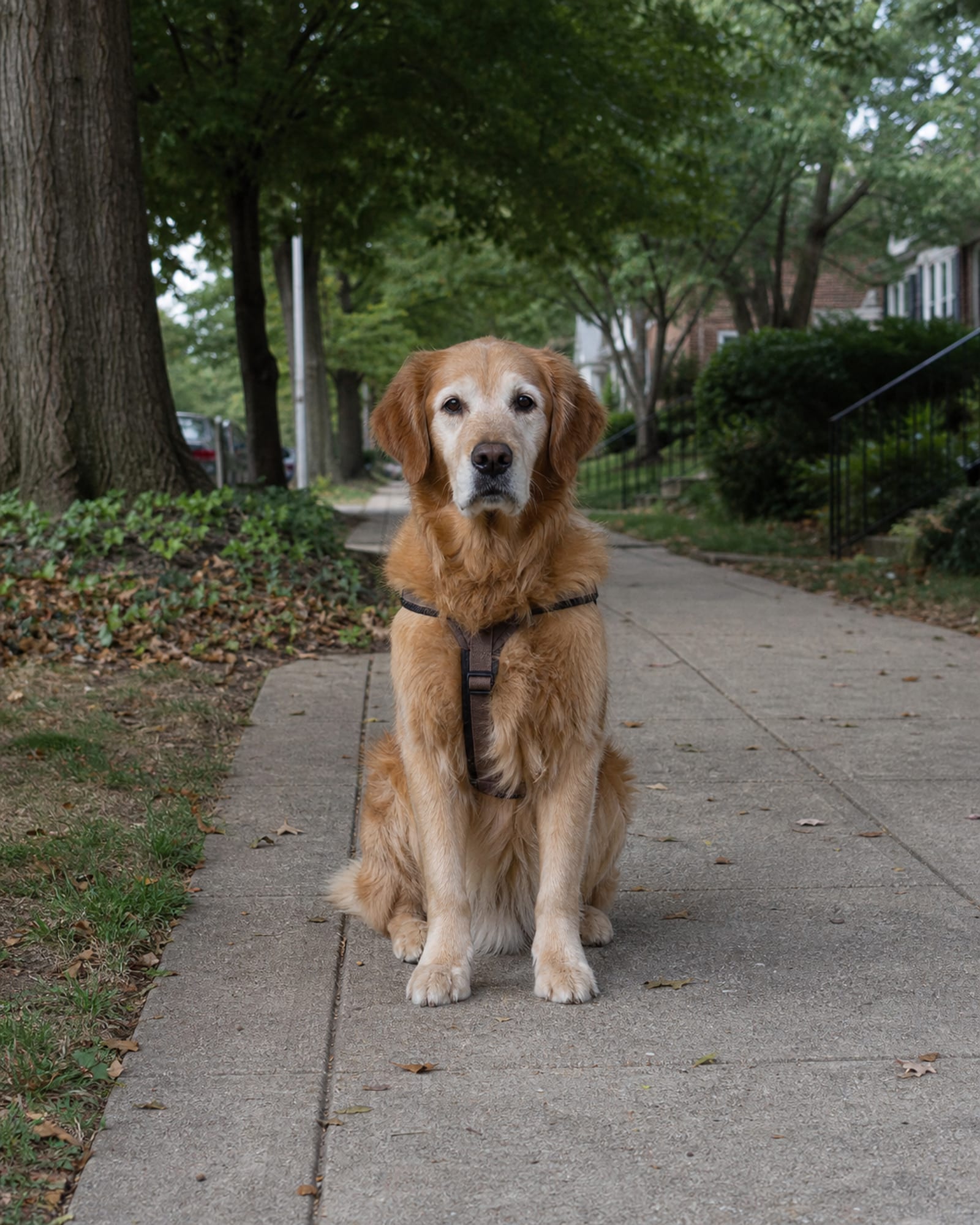
A dog sitting upright and attentive, shoulders square to camera
Open the back door, the dog goes out, the dog comes back in when he is ready. Nobody planned it that way. It is simply what a fenced yard makes easy, and in a community where nine homes in ten are owner occupied and the median house has 7.8 rooms, most people have one.
A yard is a genuinely good thing to own. What it quietly does is remove every occasion on which your dog would have had to listen to you. He is tired, so he is not destructive. He toilets outside, so housetraining looks finished. He never runs off, because a fence is doing that job. Four years later you take him somewhere without a fence and find out that he has no recall at all, not because he is stubborn, but because he has never in his life needed one.
That is the most common thing I fix in Abingdon, and it is not a behavior problem. It is a gap.
Every trainer sees this and it almost always arrives late, because nothing goes wrong until something does.
A dog learns what he practices. In a fenced yard he practices being outdoors unsupervised, following his nose, and returning to the door when he feels like it. All three are perfectly reasonable and none of them involves you. So the dog builds a real skill set over several years, and you are not in any of it.
Meanwhile the same fence hides the size of the problem. You cannot see that his recall is missing, because you have never needed it. You cannot see how he handles another dog at close range, because the fence has always been there. You cannot see what he does with a real distraction, because a squirrel on the far side of a fence is a completely different event from a squirrel he could actually reach.
Then the household changes. A gate gets left open, a visitor props a door, you take him to the Anita C. Leight Estuary Center at Otter Point Creek and the trail drops 650 feet toward the stream with waterfowl on the water, or you simply want to walk him somewhere new. Suddenly you are asking for a behavior you have never taught, in the hardest possible setting, and it does not come.
The good news is that this is one of the more satisfying jobs I do. There is nothing to undo. The dog does not have a bad habit, he has an absence, and an absence fills faster than a habit breaks.
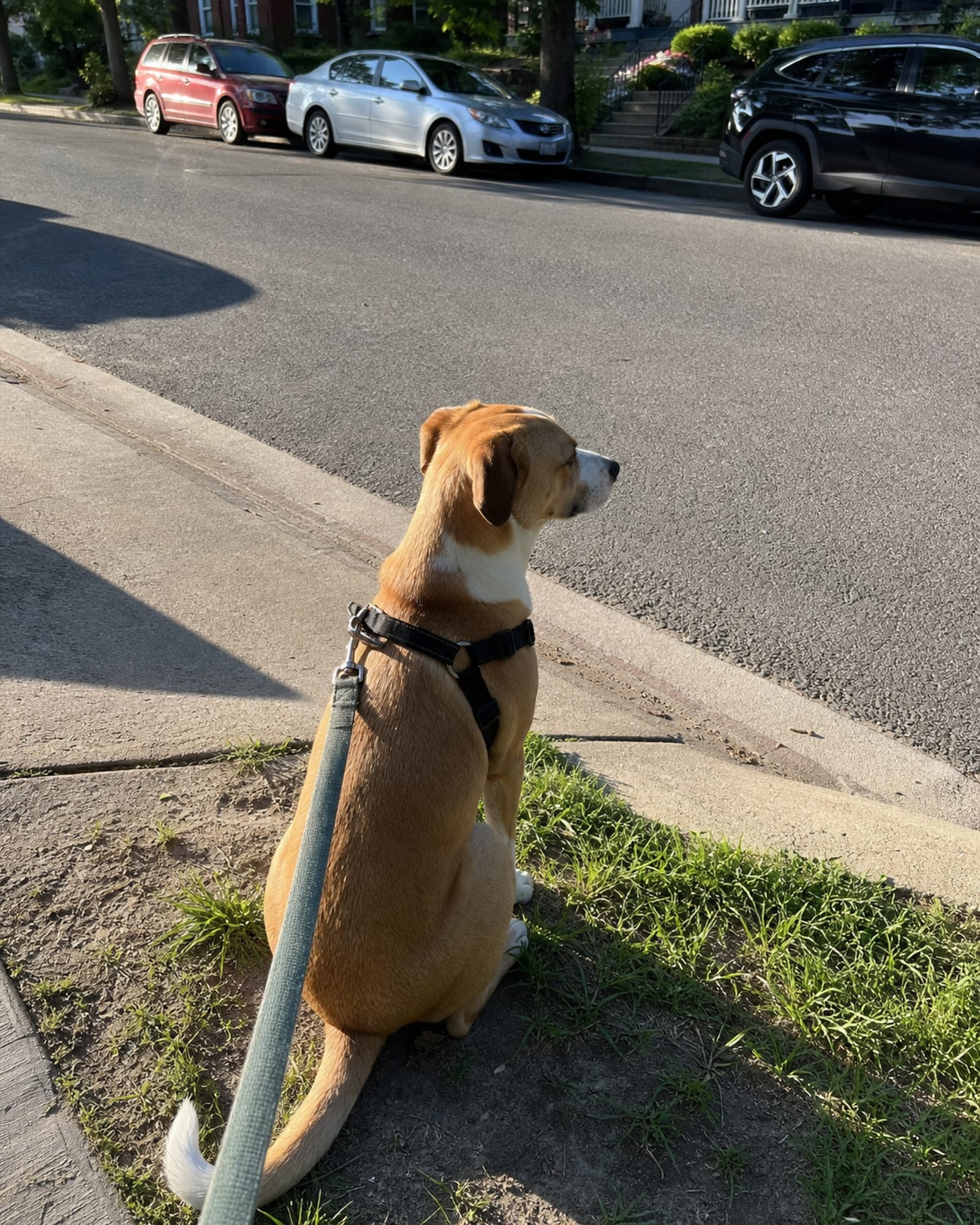
A dog sitting at a curb edge waiting to cross
For two weeks, the dog goes out with you rather than instead of you. Not forever. You are creating the occasions that the yard has been removing.
In the yard, at short distance, with nothing else going on. It should feel almost too easy. A recall built at the level where the dog cannot fail is the one that survives later.
Fifteen to thirty feet, in the yard first and then outside it. The line is not there to drag him in. It is there so that the answer to the cue is never allowed to be no.
A person, then a smell, then another dog at distance, then movement. Adding two at once is how people conclude the recall does not work when they have simply skipped a rung.
Abingdon Road Park's perimeter path is about a mile, it sits high and open with real wind, and the association open space around Constant Friendship gives you edges and cover. Work the line there before you ever consider dropping it.
If you want a recall that holds at a hundred yards with a deer moving, that is what my e-collar work is for, and it is a signal at distance rather than a correction. If you want a dog that comes in reliably from a yard and a trail, a long line will get you there.
Weighted toward established houses, settled families and dogs that have been comfortable for years.
01
The one above. Extremely common in a community where 86.7% of homes have three or four bedrooms and almost everyone has a yard.
02
Two dogs sharing a yard become a small unit with its own habits. Separating their training is usually the first move and it surprises people how much it fixes.
03
Backyards adjoin in Box Hill, Monmouth Meadows and Long Bar Harbor, and two dogs rehearsing a fence argument twice a day get better at it, not worse.
04
The estuary trails bring marsh scent, slippery ground and a hard descent. Neighborhood stormwater ponds and the Bynum Run tributaries bring deer and mud within a few streets of a townhouse.
05
The I-95 interchange work and the volume on MD 24 mean a dog that is perfect on a cul de sac can be useless at a busy crossing. Both are trainable, separately.
06
Covenants in the planned communities here cover fencing, animals and noise, and they generate the letters. Worth reading before you solve a barking problem by building something.
None of this is an argument against having one. A fenced yard is the best training space most people will ever own.
It is private, it is familiar, it has a boundary you can rely on, and it is available at six in the morning without getting in a car. That combination is worth a great deal. Almost every skill I teach starts in a yard exactly like the ones here, because the dog can succeed there before anything else is asked of him.
The change is only in how it gets used. A yard used as an exercise pen produces a tired dog with no skills. The same yard used as a training space, for ten minutes twice a day, produces a dog with a recall, a settle and a stay, and he still gets to run around in it afterward. Nothing is taken away. The ten minutes simply go in first.
The second change is that the work has to leave the yard on purpose. A behavior learned in one place is learned in that place until you prove otherwise, so a recall that is perfect at home has to be taken to the park, the trail, the library parking area on Tollgate Road, and a friend's yard before you can call it real.
One more Abingdon specific point. Because so many households here are settled, with a median age of 41.6 and families in the same home for years, the routine is usually stable and that is a real advantage. Consistency is the hardest thing to get from a household, and this is a place where it is easier than most.
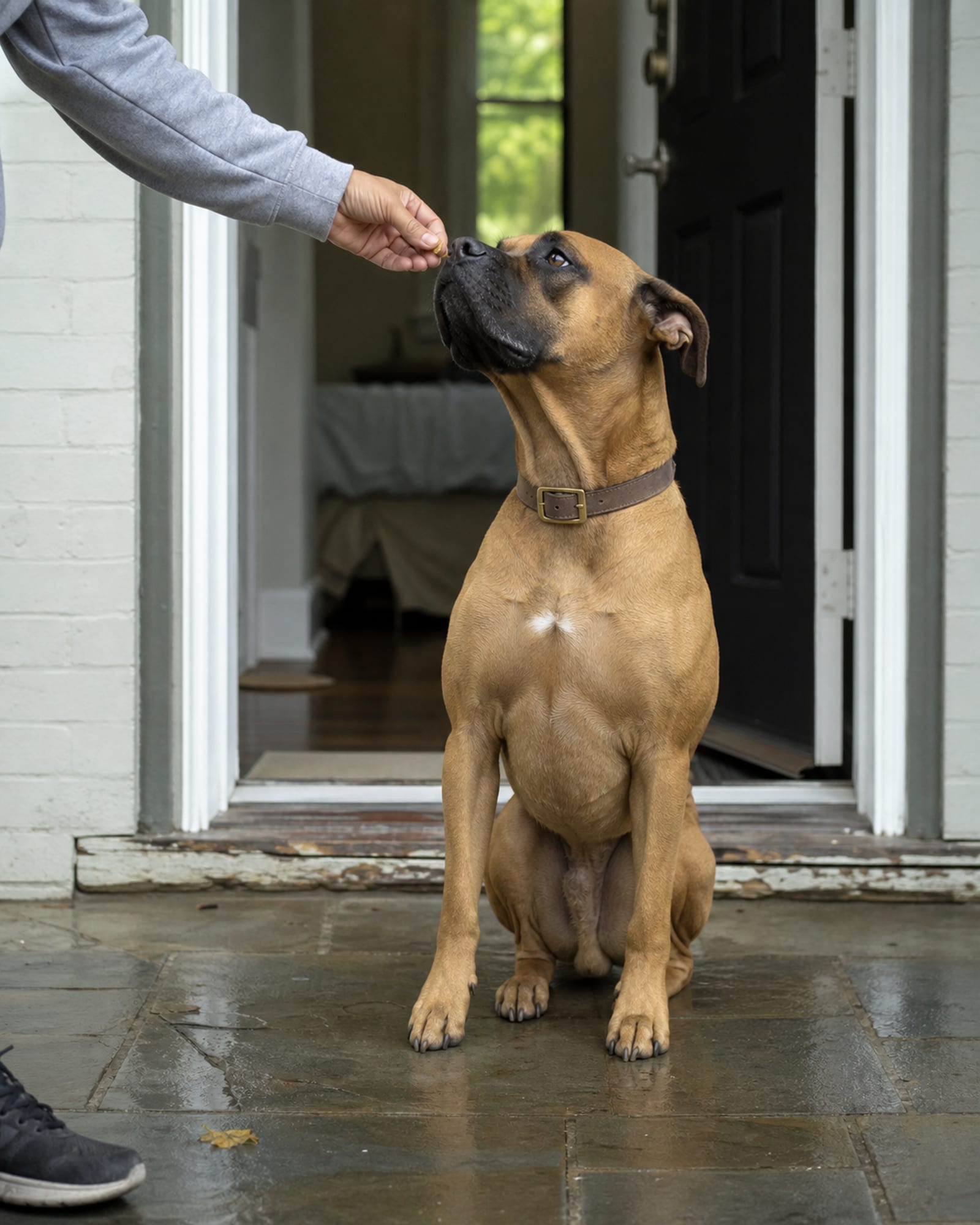
A dog holding a sit while a hand offers a treat at nose height, cropped at the wrist
Phone (443) 429-0445, seven days a week from 6 AM to 7 PM. Tell me what happens when you call him in the yard and what happens when you call him anywhere else.