01
A dog that obeys one person
Usually the one who did the training. The fix is not more training; it is the same training run by everybody else in the house.


A walker at eleven, daycare on Tuesdays, a sitter when you travel, and two adults with different ideas about the sofa. Five people, five sets of rules, and a dog that has learned to test all of them.

A dog standing alert with its weight even, tail neutral, in Bethesda, MD
Plenty of Bethesda households run genuinely busy professional schedules, and the dog's day passes through several pairs of hands because of it. A midday walker. Daycare a couple of days a week. A sitter when work travels. Family who visit and think the rules are a bit strict.
Every one of those people is doing their best and most of them are good at it. The problem is that they are doing four different things. The walker allows the dog out the door first because it is quicker. Daycare lets it jump up because everyone there does. One person feeds from the table and one does not.
A dog in that situation has not become stubborn. It has correctly worked out that the answer depends on who is holding the leash, and it now checks. That is a rational response to inconsistent information, and it is the single most common thing I am actually fixing in this town, whatever the owner called about.
This is the part that decides whether Bethesda training holds, and it is more about the household than the dog.
The first move is to pick the three or four rules that genuinely matter and let the rest go. Nobody maintains a fifteen-point charter. What almost always makes the list is what happens at the door, what happens when someone arrives, whether the dog is fed from the table, and what the recall word is. Four things, agreed once, enforced by everyone.
The second is that the people who are paid to be with your dog need the same brief. A walker who has your two-sentence version does not accidentally undo an hour of work, and in my experience they are pleased to have it, because a dog with clear rules is easier for them too. Daycare is harder, because a group setting has its own rules and the dog will draw a distinction. Knowing it will draw that distinction is most of the battle.
The third is that the handover lesson has to include whoever is actually going to be doing this. If one person learns the timing and four people do not, you have paid for a dog that performs for one person in a house of five. I would much rather run that session with everybody present, including the teenagers, than run it twice.
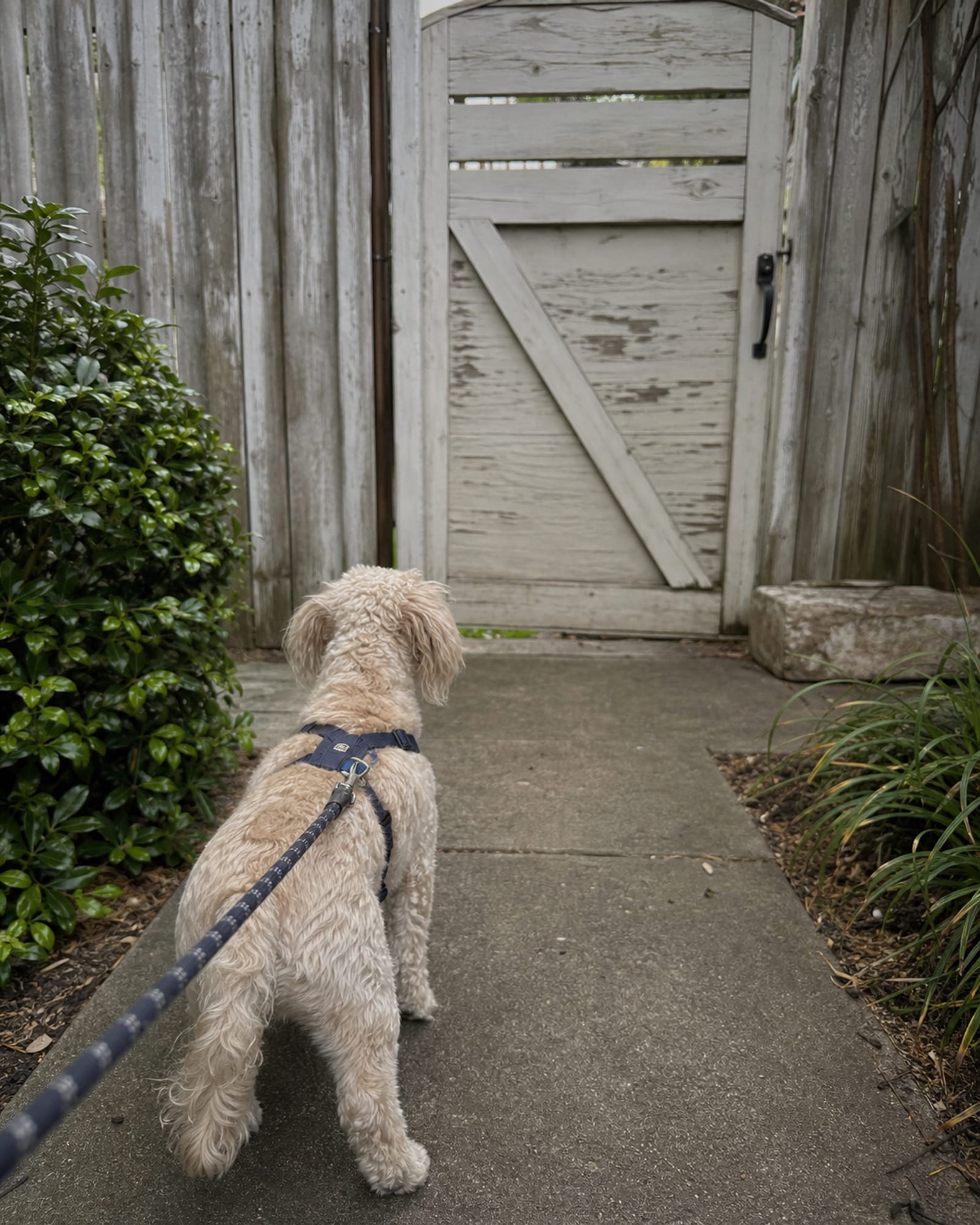
A dog walking away from camera down a pavement, seen from behind, in Bethesda, MD
The local pattern, across two very different kinds of Bethesda housing.
01
Usually the one who did the training. The fix is not more training; it is the same training run by everybody else in the house.
02
Very common here, and the reason a bolt out of the front door reaches a road with speed. A taught boundary and a real recall matter more than a fence does.
03
A dog with a full view of the street and nothing to do about it will invent a job. What the dog can see is half the treatment.
04
41.3% of units are in buildings of twenty or more. Shared corridors, loading garages, association rules and neighbors on the other side of a wall.
05
Little Falls Branch, Cabin John Creek and Rock Creek bring slopes, roots, narrow bridges, mud, wildlife scent and blind bends into the weekend walk.
06
An over-aroused dog coming home to a quiet house at six. Structure at that hour is worth more than another walk.
The housing splits almost down the middle, and the two halves need genuinely different plans.
About 51.8% of units are detached houses and 41.3% sit in buildings of at least twenty units, with roughly 62% built before 1980. Older neighborhoods hold brick Colonials, Cape Cods, ramblers, split-levels and midcentury houses, with teardown redevelopment adding large custom homes. Downtown has condominium and apartment towers around Woodmont Triangle, Battery Lane, Wisconsin Avenue and Bethesda Row.
So one client has an unfenced acre, a long driveway and a dog that watches the street through glass. The next has a twelfth floor, an elevator, a loading garage and an association with opinions. Owner-occupancy is about 64%, so more than a third of homes are rentals, and 19.0% of residents are 65 or older alongside 23.2% under 18. That is a wider range of household than the shorthand about this town suggests.
The downtown events calendar is worth knowing about: Taste of Bethesda spreads along Norfolk, St. Elmo, Cordell, Del Ray and Auburn, and there are summer concerts, outdoor movies and the Fine Arts Festival. Those are genuinely useful final exams for a prepared dog and thoroughly bad first exposures for a puppy or a fearful one.

A dog in a down with its chin resting on its paws, shot from the front, in Bethesda, MD
What the dog does, and just as importantly, who else handles it in a normal week. That second answer usually reframes the whole problem.
At your home, rolling into the training fee. I want to see the driveway, the window, the door and whichever of those the dog is actually using.
Three or four rules everyone will actually keep. Written down, not remembered, and shared with the walker and the sitter.
In-home private lessons at $700 for an evaluation plus four one hour sessions, or Kick Start at $1,600 for five consecutive daily sessions plus an owner lesson and a two week follow up.
Everyone who handles the dog, in one session, doing it themselves while I watch and correct the timing. Then phone support for the life of the dog.
Phone (443) 429-0445, 6 AM to 7 PM, any day. That one answer usually tells me more than the description of the behavior does.