01
Your own front door
The dog should not be the first thing through it. A dog that waits while the door opens is a dog you can manage everywhere else, and it is the cheapest behavior to teach relative to what it buys you.


More than half of Owings Mills lives in a building with a shared front door. Everything your dog does badly, it does in front of an audience, starting at the lobby.
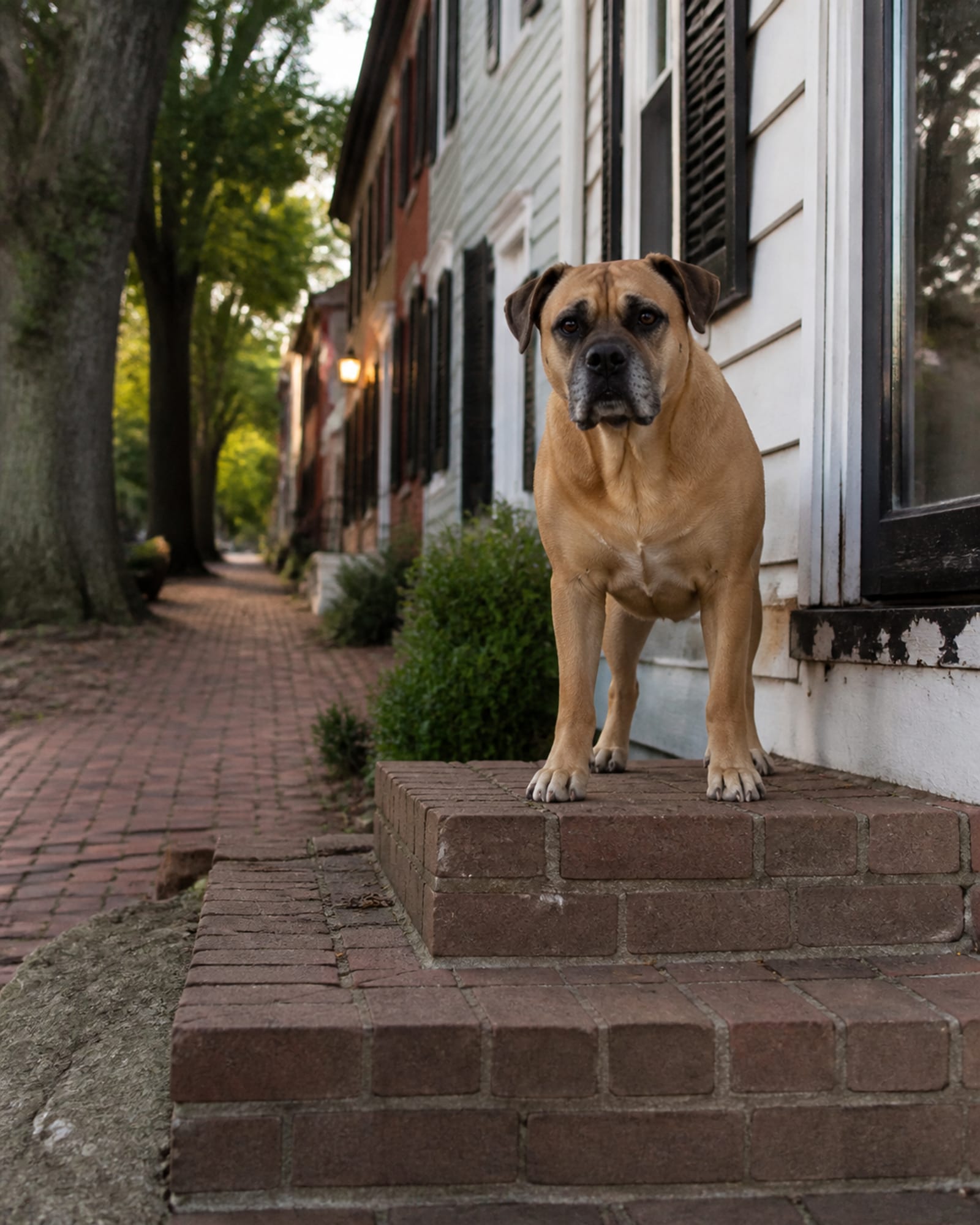
A dog standing at the top of a short flight of steps, in Owings Mills, MD
In a detached house your dog's first move of the day happens in your own hallway, where nobody is watching and nothing is at stake. Here it happens at a shared entrance, usually with someone else coming through it, often with a delivery propped against the wall and an elevator standing open on the other side.
53.4% of housing in Owings Mills is in buildings of five units or more, against 19.1% detached, and much of it went up in the 1990s and 2000s as the growth area filled in. So the first thirty seconds of your dog's day is a threshold, a stranger and a confined space, all at once. Get that thirty seconds right and the rest of the walk is straightforward. Get it wrong and you spend the whole walk recovering from it.
Almost every apartment-dog problem I am called about here happens at one of these, and each needs its own behavior.
01
The dog should not be the first thing through it. A dog that waits while the door opens is a dog you can manage everywhere else, and it is the cheapest behavior to teach relative to what it buys you.
02
Narrow, hard-floored and full of doors that open without warning. What the dog needs here is a position beside you it can hold, not a heel that looks smart for ten feet.
03
A small box that fills with strangers and then moves. A dog that will sit facing the doors, in a corner, is doing something genuinely difficult, and it is worth training deliberately rather than hoping.
04
Where a loose dog meets traffic. A dog that waits to be released from a doorway or a car is the difference between a near miss and an accident in a parking structure.
Owings Mills is not an old community that filled in. It was planned as a growth area and built out fast, and that shows in the dogs.
Nearly a third of the housing dates from the 1990s, another 22.6% from the 2000s and 14.3% from the 2010s. Only 45.3% of homes are owner-occupied, and 24.9% of residents are under 18. Read that as young households, a lot of movement in and out, and a high proportion of first dogs in first apartments.
The upside is that a lot of what I am asked to fix here is genuinely early. A twelve month old dog with bad door manners and no recall is a much easier job than a six year old with four years of practice behind the same behavior. Owners in Owings Mills tend to call sooner, partly because a shared building does not let a problem stay private for long.
The downside is that a new-build neighborhood has no established dog culture. Nobody on your floor has been walking the same route for fifteen years. The Metro terminus brings buses, garages and pedestrian crossings around Grand Central Avenue; the retail at Mill Station brings carts, doors and delivery vehicles; and Red Run's stream corridor brings wildlife in behind it all. It is a lot of novelty for a young dog, arriving all at once.
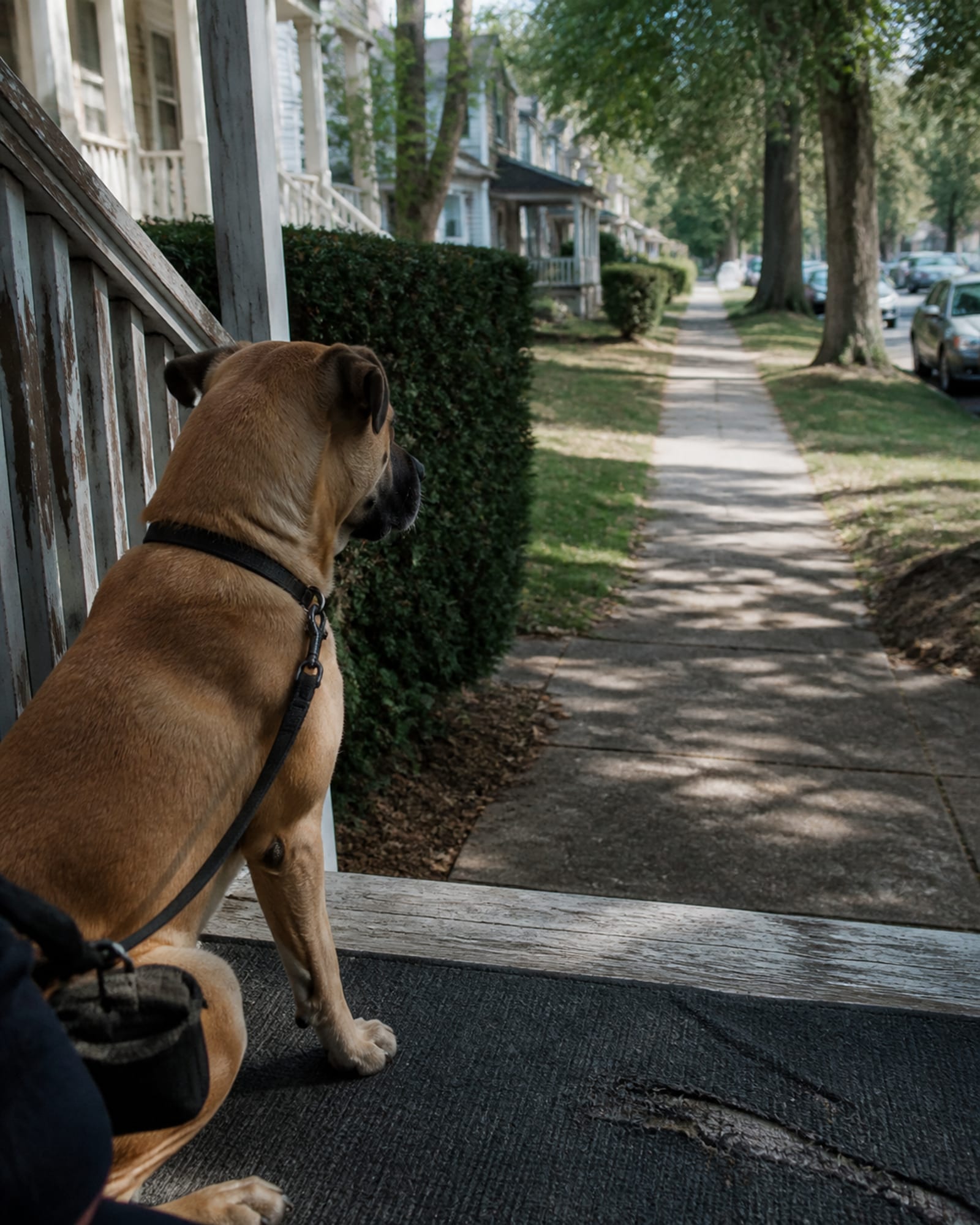
A dog sitting on a stoop watching the street, in Owings Mills, MD
The Owings Mills pattern, in roughly the order it comes up.
01
The single most common one, and the one that fixes fastest. It also happens to be the behavior that makes every other behavior easier.
02
Encounters at four feet, with no line of sight round the corner. My leash reactivity page has the method; here it runs at closer quarters than the method assumes.
03
Dogs learn very quickly that the elevator means outside. A dog that drags you to it is not being difficult, it is being consistent, and it needs a different arrangement rather than a scolding.
04
A dog alone in a flat hears every neighbor's routine through the door. In a building this becomes other people's problem quickly.
05
Stream corridor, wildlife and open ground behind a lot of the newer development. A recall that only works on a balcony is not a recall.
06
A great deal of exposure is available here and most of it is too much, too fast. Structured is better than plentiful, and my puppy training page explains why.
Apartment training has constraints that a house does not, and they are worth planning around rather than running into halfway through.
Common areas usually have rules. Some buildings do not want dogs lingering in the lobby, some want them carried through it, some have designated relief areas and some have none. That is not an obstacle to training, it is information about where the sessions happen. I would rather work within the building's rules from the first session than have you get a letter in week three.
Timing matters more here than anywhere else I work. A hallway at 2 PM on a Tuesday is a training environment. The same hallway at 6 PM is an exam. Early sessions go at the quiet hours deliberately, and we move to the busy ones as the dog earns it. Owners often assume this is avoidance. It is the same principle as not starting a nervous child on a crowded bus.
And your neighbors are part of the picture whether you involve them or not. A neighbor who knows you are working on the dog and will walk past at an agreed distance is genuinely useful, and a neighbor who has been putting up with the barking for six months without saying anything is a complaint waiting to happen. It is worth a conversation.
The last constraint is that you do not control the traffic through your own building. A house lets you decide when your dog meets a stranger. A lobby does not, and a dog that is only ever asked to cope with encounters you arranged will fall apart at the first one you did not. So once the basics hold, part of the work is deliberately practicing the unplanned version: the door that opens as you pass it, the person already in the elevator, the cart coming the other way. That is the difference between a dog that has been trained and a dog that is reliable where you live.
A young dog's head and oversized ears, close and vertical, in Owings Mills, MD
How many floors, whether there is an elevator, where the door goes, whether there is a garage. It changes the plan more than the breed of the dog does.
At your address, and it comes off the training fee. I want to see the walk from your sofa to the sidewalk, because that is the part that goes wrong.
Door, corridor, elevator, lobby, in that order. Each one has to hold before we add the next, and the whole sequence is often the entire job.
Then the transit area, the retail, the crossings and the stream paths, at whatever pace the dog can take honestly rather than the pace we would like.
You run it, in your own building, while I watch and correct the timing. Then phone support for the life of the dog, once the face to face work is finished.
Reach me on (443) 429-0445, 6 AM to 7 PM, any day. Tell me how many doors stand between your sofa and the sidewalk, and which one your dog loses its head at.