01
A dog who has learned to expect trouble
Usually after a bad run at an off leash space. It responds well and it needs distance and structure rather than more exposure.
Everyone gets told the same two things: take him to the dog park, and get him out to a festival to socialize him. Reisterstown has both, and for a good number of the dogs I am called about, both are making the problem worse rather than better.
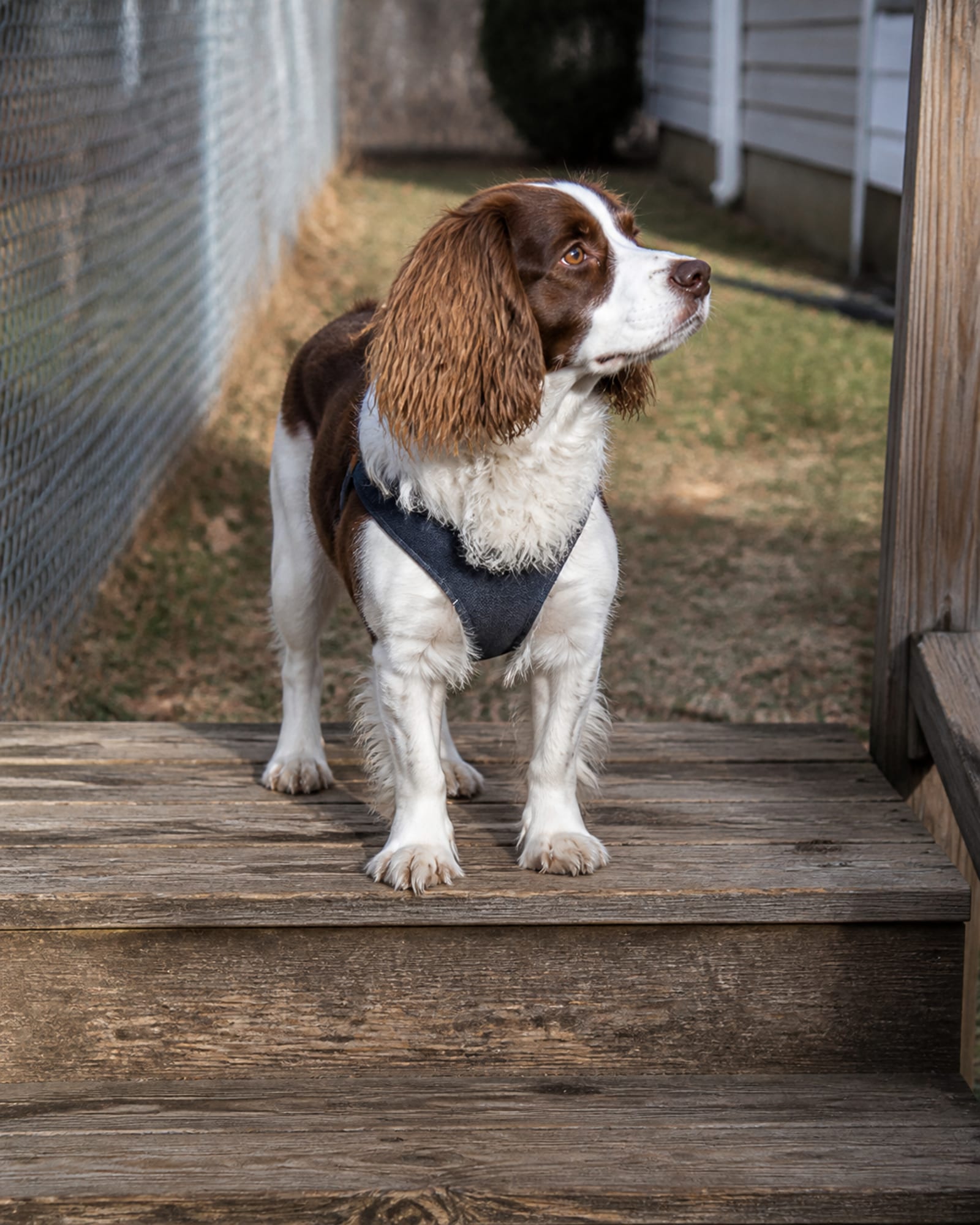
A dog standing at the top of a short flight of steps, in Reisterstown, MD
Your dog is difficult with other dogs, so somebody suggests the dog park. The logic seems obvious. More dogs, more practice, problem solved.
The logic is wrong, and it is wrong in a way that costs people months. A fenced enclosure full of unfamiliar dogs, off leash, with no structure, no screening and no way to control distance is the single hardest environment a struggling dog can be put in. It is the equivalent of treating someone's fear of public speaking by pushing them onto a stage.
Reisterstown has a real community life. The Improvement Association runs Music on Main, Bloomin' ArtFest, the farmers market, BOOtacular and Holidays on Main, the festival brings a parade, and there are volunteer maintained woodland trails and a good regional park. All of that is genuinely useful for a dog. Used at the wrong point, in the wrong way, it is the fastest route to a dog who is worse than he was in March.
I am not against them. I am against them being prescribed as treatment.
A dog park suits a specific dog: adult, socially skilled, physically confident, with a reliable recall and an owner who is watching rather than looking at a phone. For that dog it is recreation, and recreation is a perfectly good thing to want. Nobody needed to fix anything.
For a dog who is nervous, reactive, adolescent, under socialized, or simply unsure, it is the opposite of useful. The encounters are unpredictable, the other owners cannot be relied upon, there is no way to increase distance because the fence decides that, and the dog cannot leave. Everything that makes a dog park convenient makes it a bad training environment.
There is also the rehearsal problem. A dog who has three tense encounters in there learns something specific: that dogs come at him fast and there is nothing he can do. That is a lesson, it is well taught, and it takes far longer to undo than it took to install. The Hannah More dog park is an option in this community, not an obligation, and for a dog with a problem it is optional in the sense of best avoided for now.
What actually builds dog to dog skill is boring by comparison. Controlled distance, parallel walking, one calm known dog rather than eight unknown ones, and gradual reduction of the space between them over weeks. It is slower to describe and considerably faster to work.
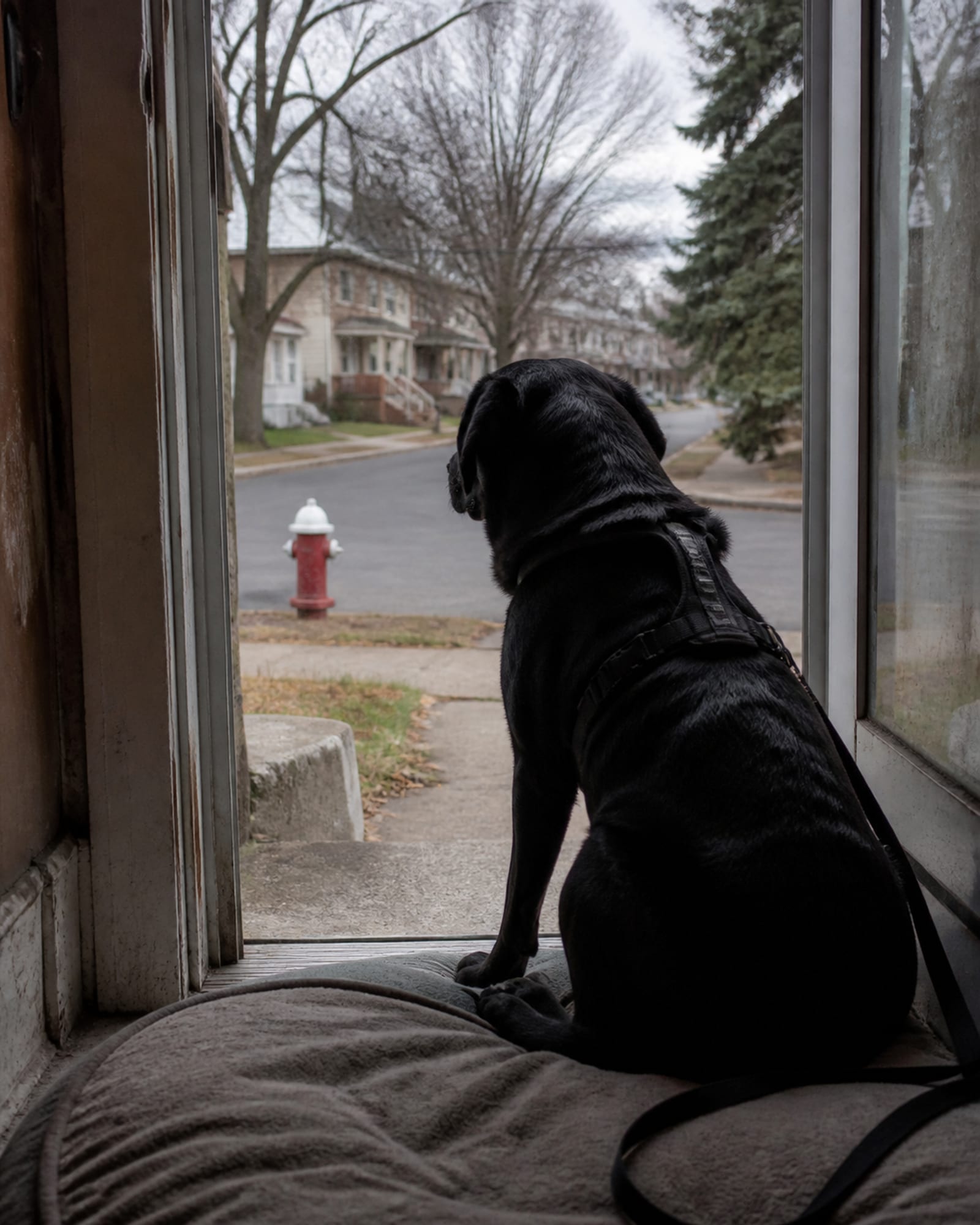
A dog sitting on a stoop watching the street, in Reisterstown, MD
Socialization does not mean exposure. It means good experiences, and the difference is the whole thing.
Main Street here produces genuine crowds several times a year, with food, children, carts, bands and close foot traffic. For a settled dog that is a pleasant afternoon and a decent bit of proofing. For an unsettled one it is a wall of things he cannot get away from, and he will spend the whole time being told he is fine by people who are not him.
The useful version of the same event is to work the edge of it. Sit two hundred yards back where he can see people and still take food, stay there for twenty minutes, and go home. That is a training session. Walking him through the middle is not a training session, it is an endurance test, and dogs do not learn anything good from enduring.
The community actually makes the graded version easy, because the same streets are quiet on an ordinary Tuesday. Main Street has three distinct stretches, there is an art trail with murals and sculpture along it, and the Welcome Center sits at 234 Main Street. Walking the exact route with nothing happening, then again on a market morning at a distance, then closer, is a proper ladder rather than a leap.
It is worth being clear about what socialization is supposed to produce, because the word has drifted. The goal is not a dog who greets everybody. It is a dog who can be near people and other dogs without needing anything to happen. Neutrality, in other words, rather than sociability. A dog who walks past three dogs on Main Street without a flicker is a socialized dog, whether or not he ever plays with any of them, and aiming for neutrality instead of friendliness makes the work far more achievable for the dogs who need it most.
One more note about the woodland trails. They are volunteer maintained, they cross small bridges and a creek, and they run through the Upper Gwynns Falls drainage, so the footing changes with the weather. Wet leaves over roots and soft ground after rain are worth planning around, particularly with an older dog or an older handler.
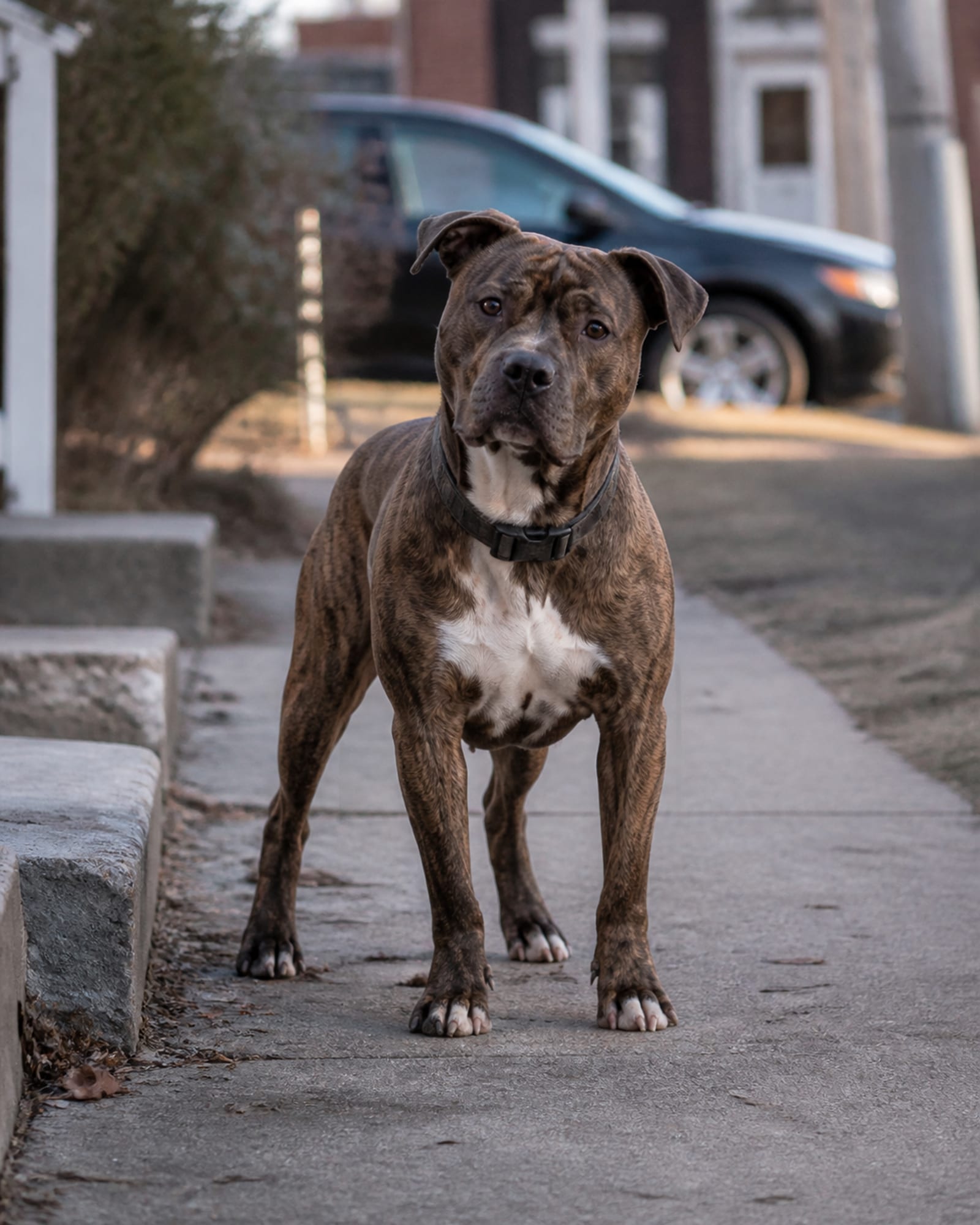
A dog watching intently off camera, head tilted a fraction, in Reisterstown, MD
A varied community, with housing and circumstances that change street by street.
01
Usually after a bad run at an off leash space. It responds well and it needs distance and structure rather than more exposure.
02
46.8% detached, 23.4% attached and around 28% in multifamily buildings, so a dog's first stranger of the day might be in a hallway or across a fence.
03
Close sidewalks, storefronts and traffic. A completely different walk from the subdivisions two minutes away, and worth training separately.
04
One household in three rents and a real share of the community is stretched. If money is the constraint, say so and we will sequence it rather than pretending the constraint is not there.
05
Roots, small bridges, creek mud and clay ground that stays soft. Fine for a sure footed dog, harder for a stiff one.
06
Baltimore County treats a property with more than three dogs as needing a holding facility or kennel license, and directs you to check zoning first. Worth knowing before a fourth arrives.
The range where he can see another dog and still respond to you. That number is your starting point and it is usually further than owners want it to be.
Two dogs walking the same direction at a distance, never approaching. Head on greetings are the hardest thing you can ask and everybody starts there.
A neighbor's steady older dog is worth more than a whole park. Same dog, several sessions, so the picture is predictable while the skill forms.
And go back out the moment he stops being able to think. The reduction is the reward for progress, not the method for producing it.
Boredom is the target at every stage. A dog who is still interested is not ready for more difficulty.
The park perimeter, the quiet end of Main Street, a market morning at a distance. If your dog is genuinely sociable at the end of this, the dog park becomes an option again.
Phone (443) 429-0445, seven days a week from 6 AM to 7 PM. Tell me what happens when he sees another dog and at what distance it starts.