01
The weekday and weekend dog
The work above. It usually presents as "he is fine at weekends" or "he is impossible on Sundays", and both are the same pattern.


Waldorf has a mean commute of 41.1 minutes, the longest of any town I cover. That produces a particular kind of dog: one who gets almost nothing from Monday to Friday and then everything at once on Saturday, and who is worse on Sunday evening than he was on Friday.
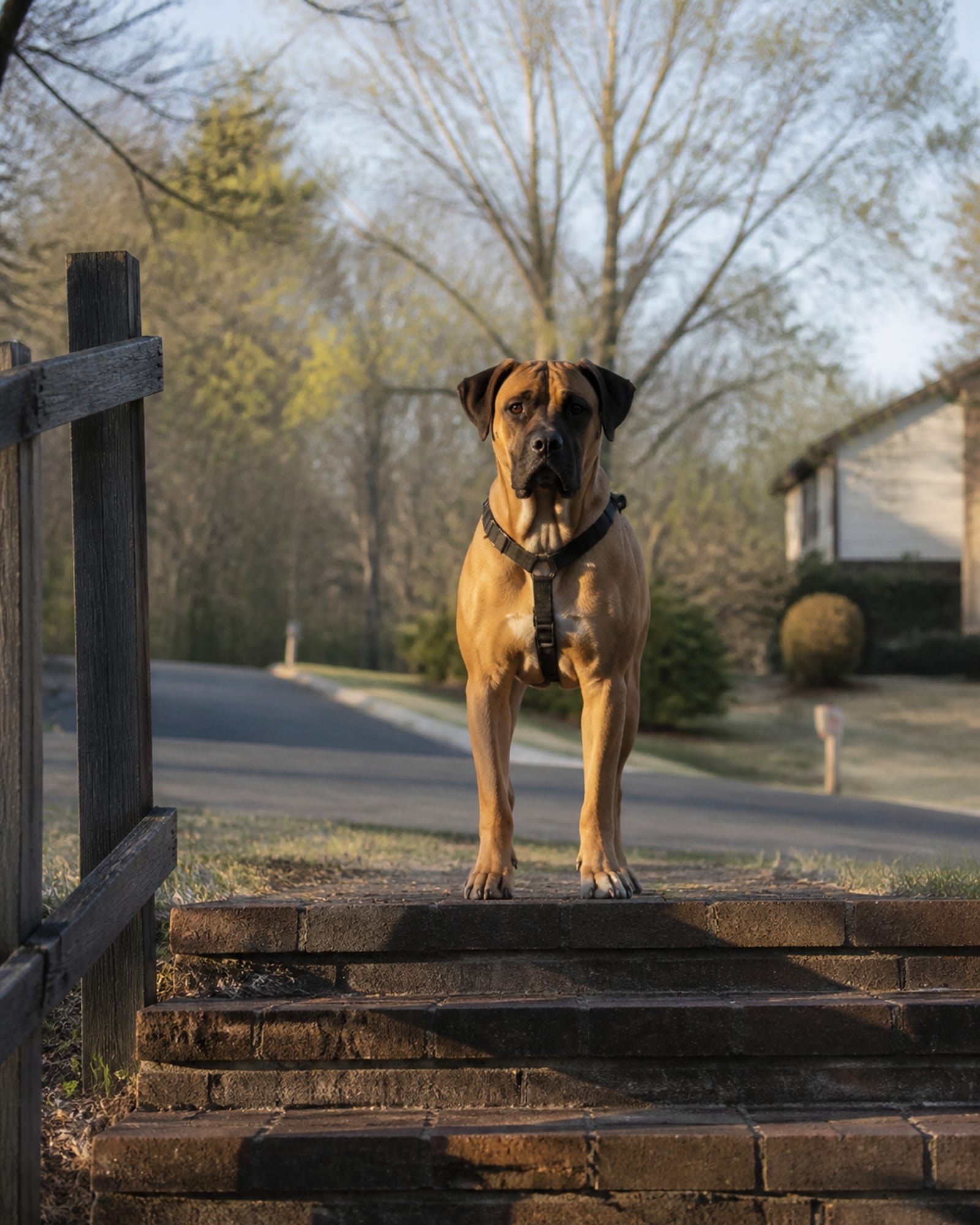
A dog standing at the top of a short flight of steps, in Waldorf, MD
Monday to Friday he is let out, fed, walked briefly, and left. Somebody comes home tired and he gets a fuss and an evening on the sofa.
Saturday he gets a two hour walk, a trip somewhere, visitors, and more attention in one day than the previous five combined. Sunday is similar. Then Monday arrives and it all stops again.
Households do this because they are decent people trying to make up for the week, and it is the most understandable pattern in dog ownership. It is also, from the dog's side, two completely different lives in rotation, and it produces exactly the behavior people then ring me about: a dog who cannot settle at weekends because he is overstimulated, and cannot settle in the week because nothing is happening, and who has learned that Monday means the good version is being taken away.
Waldorf is large, 81,410 people across 36.24 square miles in 30,404 households averaging 2.72 residents, with 74.9% owning their homes and a quarter of residents under 18. The St. Charles villages, the older Waldorf corridor, apartments and townhouses all sit inside that same commuting pattern.
This is the counterintuitive one and it does most of the work. A shorter Saturday is what makes Monday survivable, because the gap is what he is reacting to.
Mental work tires a dog far more efficiently than distance, and ten minutes is achievable after a 41 minute commute in a way that an hour is not.
If the day's shape depends on who walks through the door and when, it changes daily. Meals happen regardless, so build the routine around those.
In, coat off, dog stays on his mat, greeting after a few minutes. A homecoming treated as an event teaches him that the day is a countdown to it.
Hand fed for behavior instead of poured in a bowl. Costs no extra time, uses food you were giving him anyway, and turns the dullest part of the day into work.
Same rules, same settle, same routine, just more of it. A dog whose weekend has no rules learns that rules are a weekday thing and tests them accordingly.
A big, family weighted, mostly owner occupied community built around a long commute.
01
The work above. It usually presents as "he is fine at weekends" or "he is impossible on Sundays", and both are the same pattern.
02
With a 41.1 minute commute each way the absence is long before anybody has done anything wrong. How the leaving is handled matters more than the length.
03
At 2.72 people per household and a quarter of residents under 18, most dogs here take instruction from three or four people on different schedules.
04
St. Charles organized neighborhoods around village centers, with shared greens and common land where HOA rules govern what happens outdoors.
05
Fenced yards, shared walls, garages, narrow townhouse entries, open-plan family rooms and apartment corridors, sometimes on the same street.
06
Flat Coastal Plain drainage, clay-rich soils and fast stormwater mean muddy lawns, and summer humidity plus hot asphalt shortens what is safe outdoors.
It is the single most common well-intentioned mistake I see, and it is worth understanding rather than just being told to stop.
Dogs run on prediction. What settles a dog is not the total amount of activity in a week, it is knowing roughly what is coming. A week where Monday to Friday is empty and Saturday is enormous is unpredictable by design, and an unpredictable week produces a dog who is permanently on standby waiting to find out which kind of day this is.
The Sunday evening problem follows from that. He has had two days of high stimulation and constant company, and then it is withdrawn. That is a genuine change of state, and the pacing, whining and restlessness people notice on Sunday night is exactly what you would expect from it.
There is a physical layer too. A dog who does very little for five days and then a hard two hour walk is an unconditioned athlete having a hard weekend, which is not kind to joints and is not how fitness works in dogs any more than in people.
And there is a training cost. The weekend is usually when the rules relax, because everybody is home and it feels mean to enforce them. So the dog learns that the rules depend on the day, which is the same lesson a household with four inconsistent adults teaches, arriving by a different route.
The fix is not to do less for the dog. It is to move some of the weekend into the week in a form that fits a working evening, and to accept that a shorter Saturday is a fair price for a dog who is settled on Sunday night and on Wednesday afternoon.
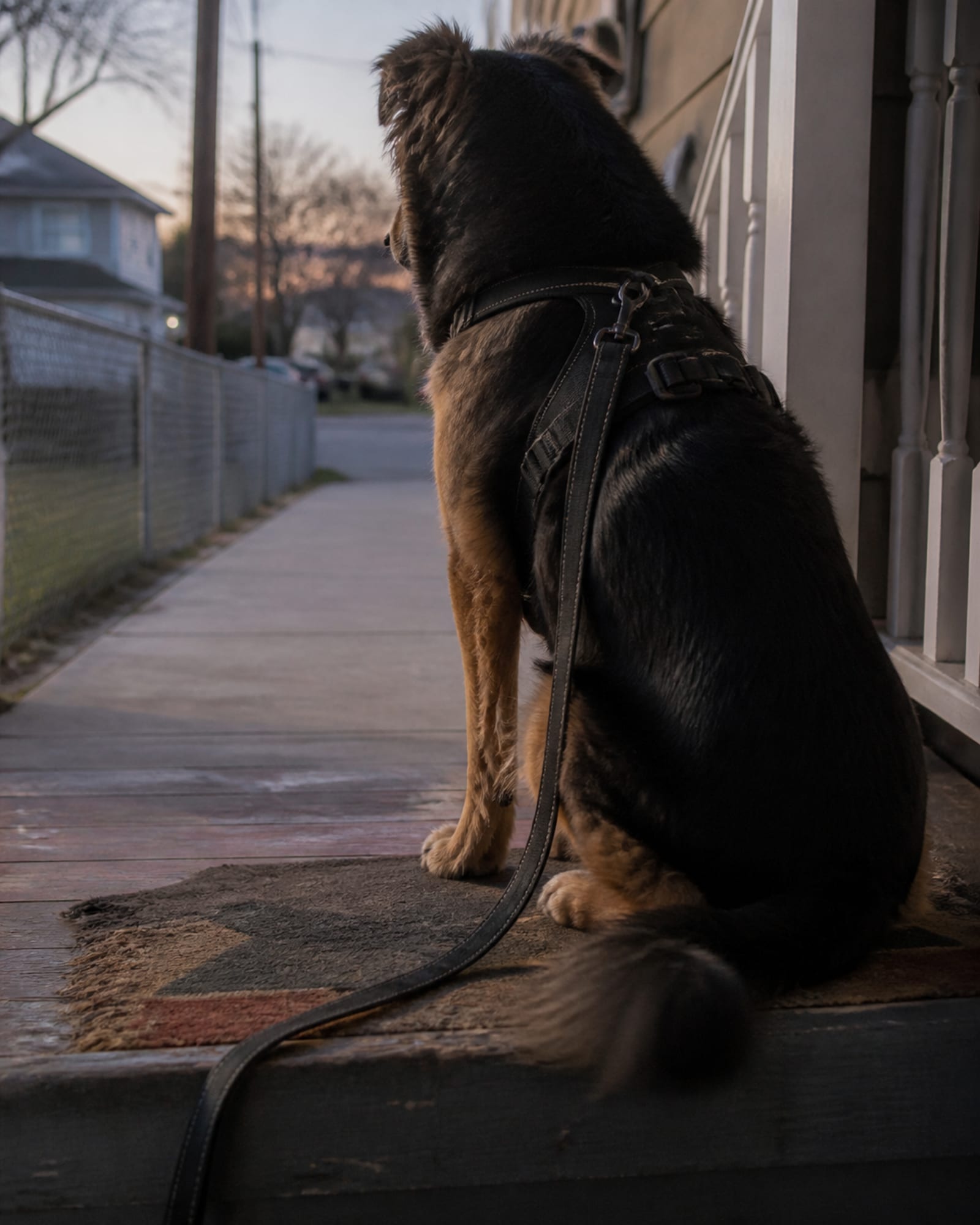
A dog sitting on a stoop watching the street, in Waldorf, MD
The hours are what they are. What can change is what they feel like from his side.
Most dogs cope with a long day perfectly well if the departure is calm, there is something to do in the first hour, and the house is small enough that he cannot get into trouble. The first hour is the one that matters: a dog who settles in the first hour usually sleeps through most of the rest, and a dog who spends it working himself up is unlikely to recover.
So the leaving routine is worth more attention than the coming home. Mat, something worth chewing, keys, door, no farewell. Practiced a dozen times without actually going anywhere, so that the sequence stops predicting a long absence and starts predicting nothing in particular.
Where it goes beyond that, into destruction focused on doors and windows, vocalizing that starts within minutes and does not stop, house soiling from a clean dog, or injury to himself, that is separation distress rather than boredom and it does not respond to a better routine on its own. My anxiety and nervousness page sets out what that work involves, and it is a longer road than most households expect.
Two other things are worth planning rather than improvising. A midday visit from somebody, if it is available, is far more useful than a longer evening walk. And a dog who is comfortable being handled by a stranger, easy on a leash, and settled in a crate is a dog a neighbor or a sitter can actually help with, which turns an impossible schedule into a manageable one.
For the outdoor half, the local geography is straightforward rather than demanding. Flat ground, wet lawns after rain, hot asphalt in summer. White Plains Regional Park and the Indian Head Rail Trail give you distance when there is time for it, and St. Charles Towne Center, the library and the recreation center areas give you graduated exposure closer to home. Start at a quiet edge, confirm he can still listen, and move closer only if he can.

A dog looking straight down the lens, shoulders square and low, in Waldorf, MD
Phone (443) 429-0445, seven days a week from 6 AM to 7 PM. Tell me what a weekday looks like for him and what a Saturday looks like, and the gap between the two will tell us both a lot.