01
Leash work with no sidewalk
Position, stop and step off. The most common piece of work I do out here and the one that most changes how a household feels about walking the dog.
Turn off MD 26 onto Pine Knob or Bollinger Mill and the sidewalk simply stops. Carroll County's own pedestrian planning lists the connections that are missing here. Walking a dog on a road with no edge is a specific skill, and almost nobody is taught it.
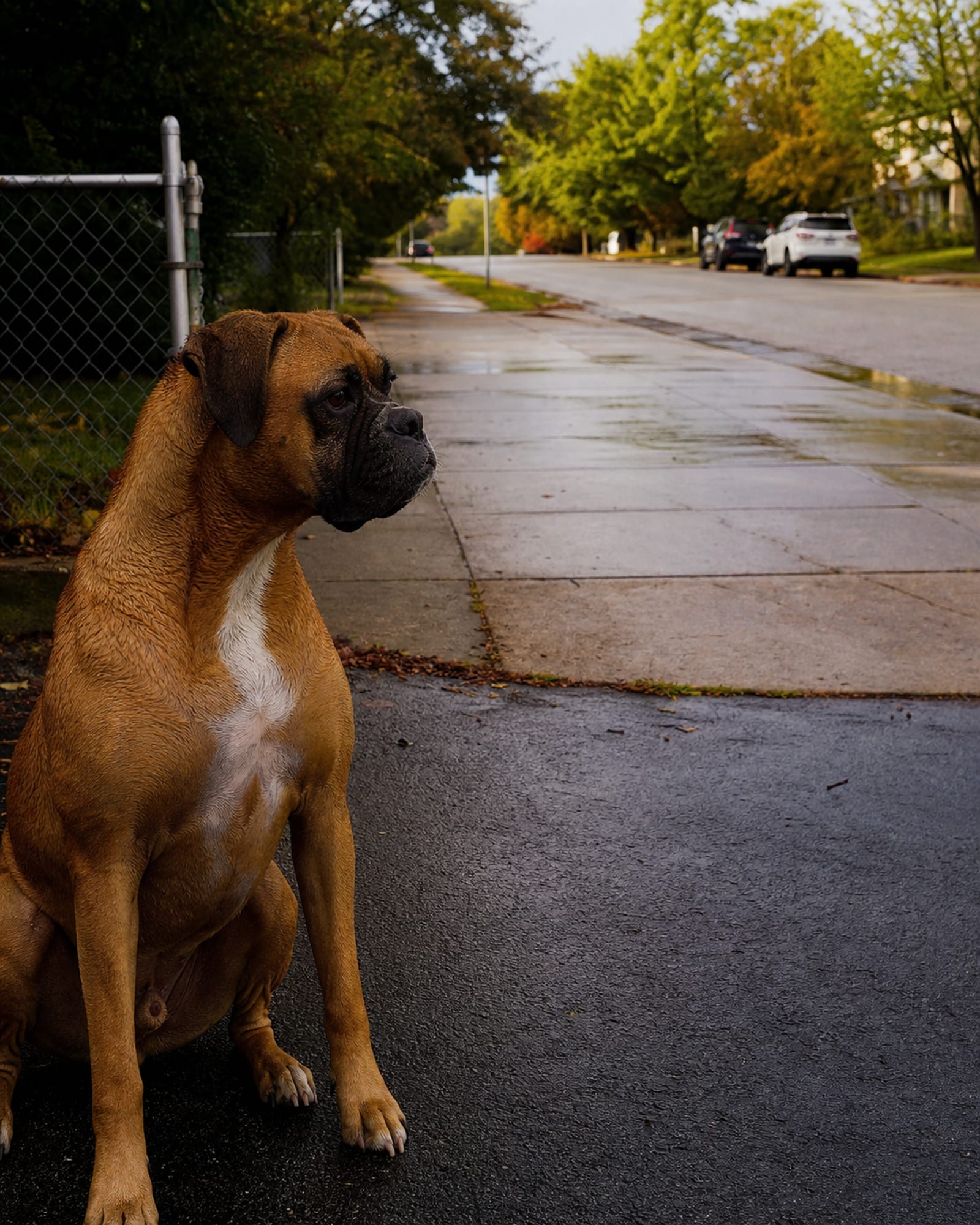
A dog sitting upright and attentive, shoulders square to camera
Where exactly do you put the dog?
On a street with a sidewalk that question never comes up. Here it comes up within two minutes of leaving the house. The Freedom commercial core has arterial traffic on MD 26 and MD 32, and a few hundred yards off it the roads narrow to two lanes with a strip of gravel, a ditch, and cars that are not expecting to meet anybody on foot. County pedestrian plans name Becket Road, Georgetown, Londontown, Bonnie Brae and Monroe among the connections residents want and do not yet have.
Eldersburg is a settled place, with 32,582 residents, 88.0% homeownership and 93.6% of people in the same house a year earlier. It is also a place where a great many dogs are walked on roads that were built for cars alone. That is not a reason to stay indoors. It is a reason to train the roadside as its own skill, deliberately, rather than to improvise it every evening in the dark.
Four separate behaviors, and most dogs have none of them because nobody ever asked.
The first is a fixed position. The dog walks on one specific side of you and stays there, which is the whole point rather than a stylistic preference. On a shoulderless road you want your body between the dog and the traffic, so the dog is on the side away from the road and he does not swap. A dog that drifts across in front of you is a dog that will one day drift at the wrong moment.
The second is a stop that works instantly, without a treat, without a repeat. Not a sit, not a stay, just a hard stop where he is. This is the behavior that buys you the two seconds you need when a car comes over a rise faster than you expected.
The third is a step off. On cue the dog moves off the road surface with you, onto grass or gravel, and stands still while something passes. Dogs find this genuinely difficult at first because the footing changes, the ditch is often wet, and the vehicle is close. It has to be practiced on quiet lanes long before it is needed on a busy one.
The fourth is the one everybody forgets, which is that the dog must be visible. A dark dog at the roadside at seven in the evening in November is invisible from a car until the last moment, and no amount of obedience fixes that. Lit collar, reflective leash, high visibility on you as well. It is not training, it is the thing that makes the training survivable.
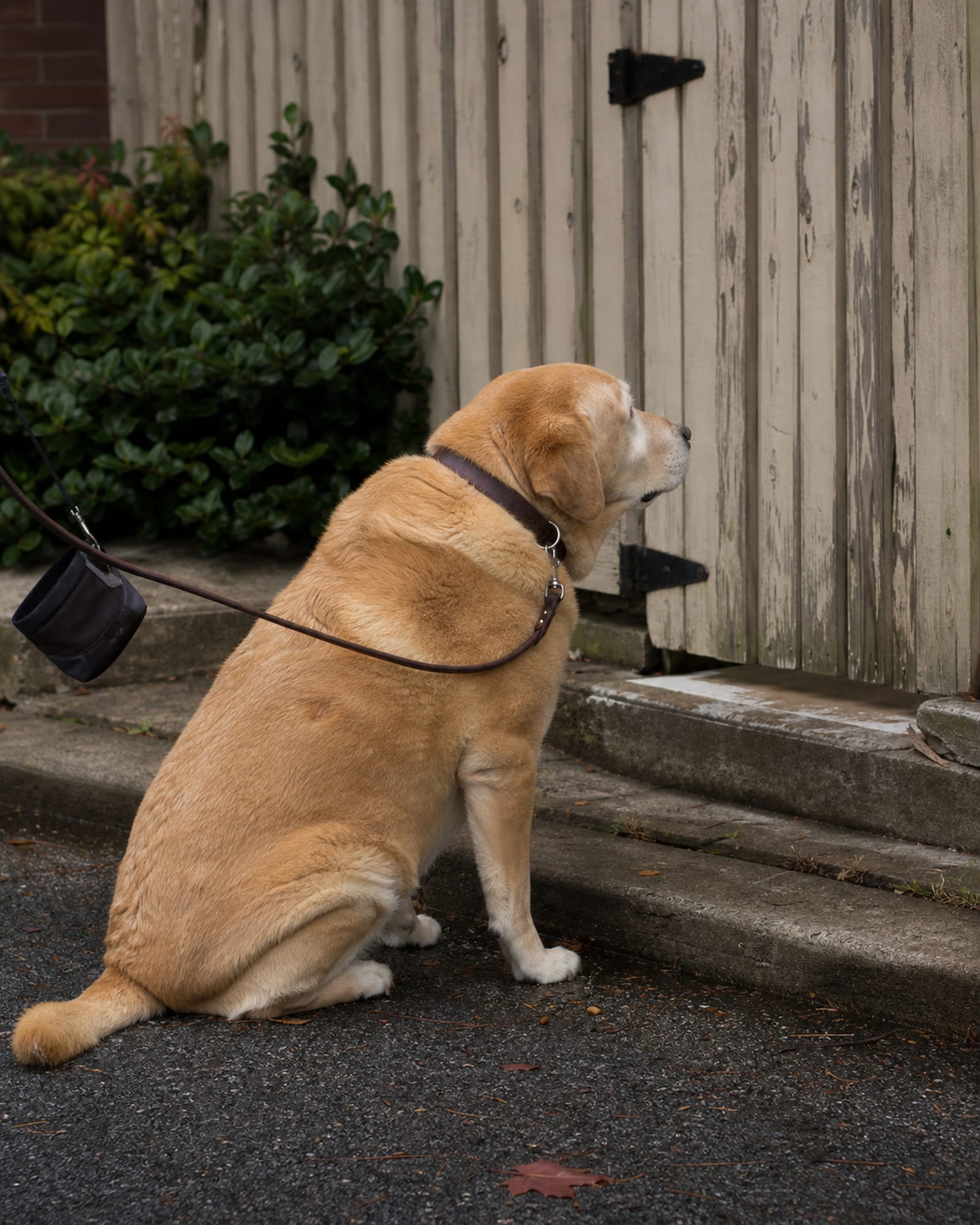
A dog sitting at a curb edge waiting to cross
The dog learns which side he lives on with nothing else going on. Ten minutes twice a day. If he cannot hold the position on your drive he certainly will not hold it on Mineral Hill Road.
One word, dog stops, no negotiation. Build it standing still, then walking, then at speed, then with something moving in the distance.
Wet grass, gravel, the edge of a ditch. Carroll County ground stays soft for days after rain, and a dog that refuses the verge will stay on the tarmac when it matters.
The residential streets around Carrolltowne and Freedom Forest give you low traffic and a real shoulder. Get it boring there before you take it anywhere with volume.
One car, then a truck, then a farm vehicle, then a school bus. Same behavior each time. The dog learns that a passing vehicle predicts standing still rather than anything interesting.
Lit up, on the same route, with the same behaviors. This is the walk most people actually do, and it should be the last one you attempt rather than the first.
The roads are only half of it. Eldersburg sits where suburban ground runs out, and the dog notices before you do.
The Liberty Reservoir woods, the tributaries running down to it, and the stormwater ponds at Eldersburg Estates and Elderwood Village put deer, waterfowl and small animal scent within a few yards of ordinary streets. Sight lines change completely between summer and winter, so a route the dog handled in August can produce a completely different dog in February when he can suddenly see two hundred yards into the trees.
That is why the recall has to be built to a higher standard here than in a town with continuous sidewalks. A dog that breaks toward a deer on a lane with no shoulder is not a training problem for later, and I work the recall on a long line for longer with these households than with almost any others. Where an owner wants that recall reliable at real distance, the e-collar work is about giving the signal reach rather than about correction, and my page on it sets out how that is introduced.
The footing deserves a mention of its own. Clay ground and mowed verges hold water, wet leaves sit over uneven surfaces in the fall, and freeze and thaw cycles make the gravel edges treacherous. A dog pulling on a slick verge is how owners get hurt, and it is a large part of why I care so much about the loose leash on these roads specifically.
One more local point, since Eldersburg sits at the edge of my range and people ask. I work to two distances. The overall service area is about a two hour drive, which is why I come out here for in home work. Board and train draws from a tighter ring of roughly one hour, because a boarded dog needs me to be able to reach the household. Eldersburg is inside both, so every program is genuinely available here, including a residential stay.
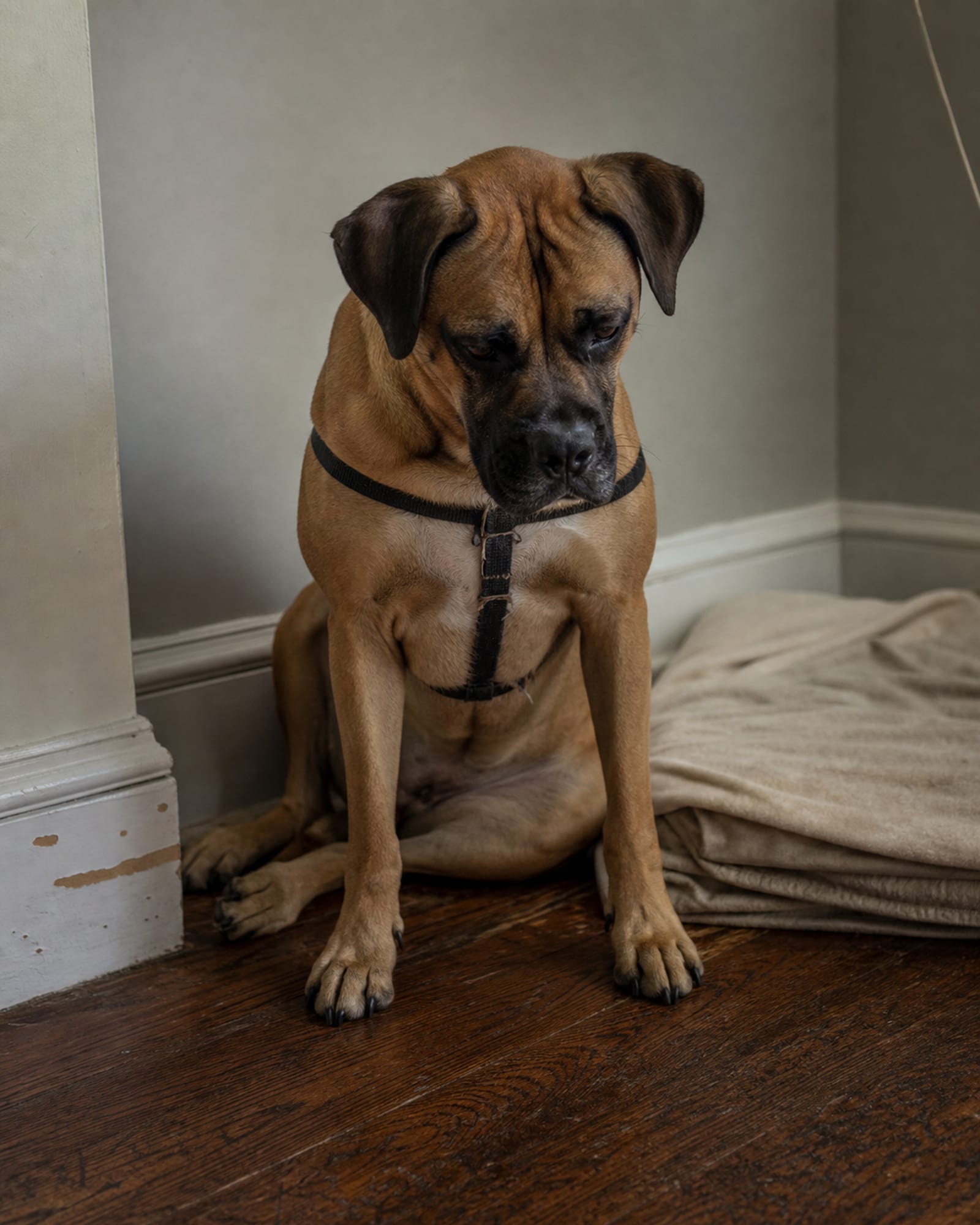
A dog sitting with its head lowered a fraction, watching hands out of frame
A settled, family weighted community that runs out of pavement fast.
01
Position, stop and step off. The most common piece of work I do out here and the one that most changes how a household feels about walking the dog.
02
Deer and waterfowl within yards of the house. A recall that has never been tested against something moving is not a recall yet.
03
MD 26 traffic and the Freedom retail area, then a narrow lane, inside one walk. A dog can go from overloaded to under stimulated in half a mile.
04
At 2.82 people per household and 24.3% of residents under 18, most dogs here take instructions from three or four people. Agreement matters more than technique.
05
Liberty High School and the elementary schools produce predictable surges of cars, buses and children. Predictable is useful. You can plan around it.
06
Gravel verges, ice at the ditch edge and wet leaves. Worth adjusting the route for rather than pushing through, especially with an older dog or an older handler.
Phone (443) 429-0445, seven days a week from 6 AM to 7 PM. Tell me what road you live on and where the pavement ends, and we will start there.