

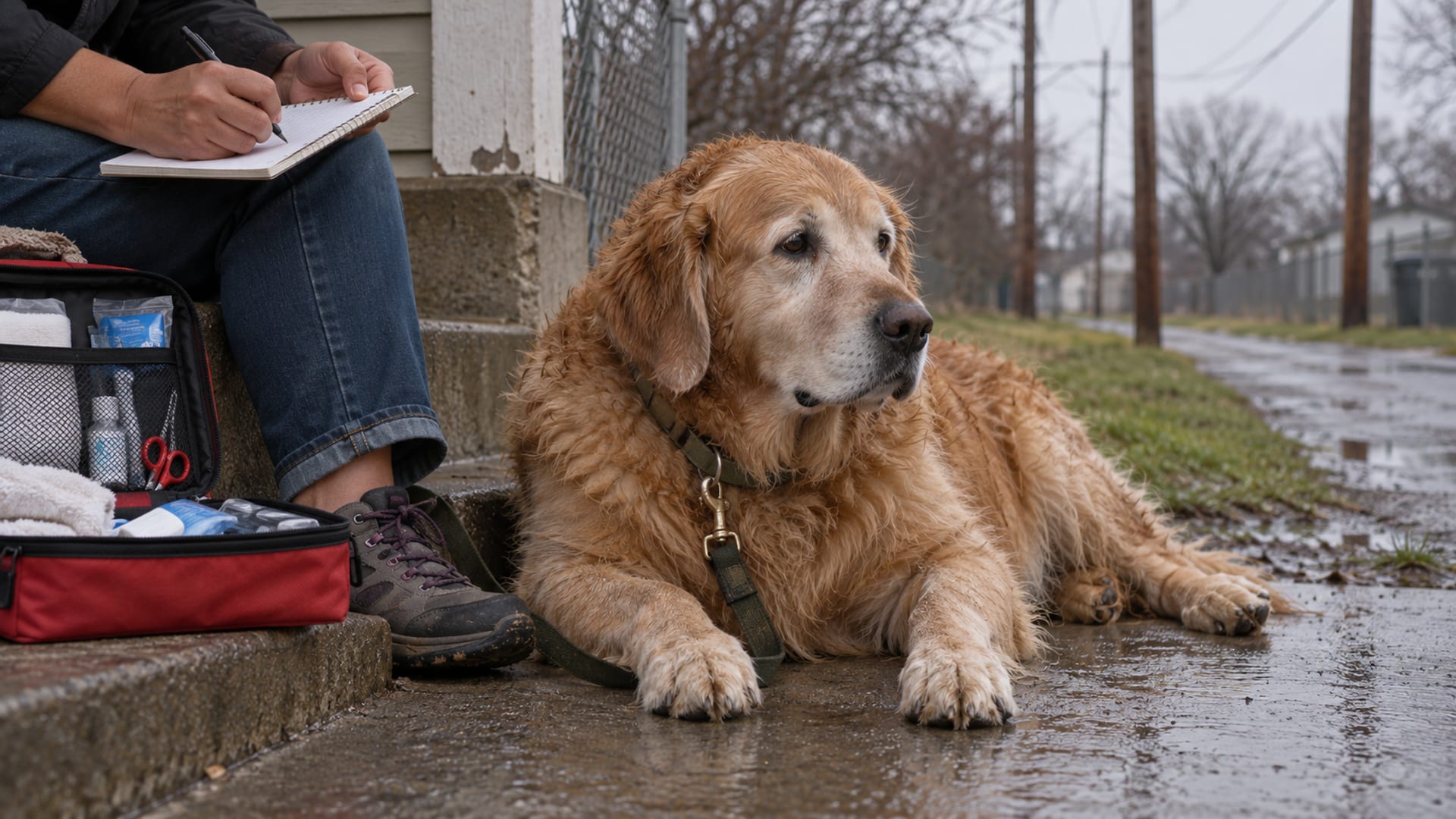
Stop the contact first. Get your dog away from the person without putting anyone else at risk, and put the dog behind a closed door or in a crate. Then check on the person, wash the wound with soap and water, and get them to a healthcare provider. Call 911 if the bleeding is deep or heavy or the bite left puncture wounds. Give them your name, address, phone number and your dog's rabies vaccination details. Do not punish the dog. Keep children and other animals away from both of them.
That is the first hour. Everything else comes after it, in the order you will probably need it.
Key takeaways
Hover or tap a card to bring it forward.
- In the first hour, restrain the dog, put it in a closed room or crate, wash the wound with soap and water, and get the person to a healthcare provider, calling 911 for deep or heavy bleeding or punctures.
- Give the person your name, address, phone number and the dog's rabies vaccination details, and do not punish the dog.
- In Maryland, report the bite right away to the local police or sheriff; the dog is quarantined for at least 10 days in a place the local health officer approves, and Baltimore City and the counties have their own procedures.
- Bites often come from familiar dogs in everyday moments, so write down what happened before the bite, the warning, the people present and the injury.
- See a veterinarian first, then a behavior professional, and keep the dog apart from children while you decide what comes next; call promptly and do not wait for a second bite.
The first hour with the dog
The American Veterinary Medical Association gives owners a short checklist, and I would follow it in this order. Restrain your dog right away. Separate the dog from the scene of the bite. Confine the dog in a safe place. Check on the person who was bitten. Make sure the wound is washed with soap and water. Encourage the person to see a healthcare provider about how serious the wound is and the risk of rabies or other infection. Call 911 if paramedics are needed. Give the person your name, address and phone number, plus the dog's recent rabies vaccination information. Follow your local rules for reporting dog bites. Then contact your veterinarian about the dog's behavior and how to prevent another incident.
Move the dog without adding risk. A closed room, a crate, a kennel or any solid barrier works, as long as you can get the dog there without another bite. Do not force handling, do not test the dog to see what it will do, and do not provoke another reaction.
Do not punish the dog afterward. The American Veterinary Society of Animal Behavior states that physical punishment carries risks including increased fear and "stimulating aggressive events." Its statement on status-based training myths adds that harsh reprimands, staring a dog down, and rolling a dog onto its back and holding it down can bring out defensive aggression.
The First Hour After a Bite
- Restrain the dogGet the dog away from the person without putting anyone else at risk.
- Confine itUse a closed room, a crate, a kennel or any solid barrier, as long as you can get the dog there without another bite.
- Check on the personMake sure the wound is washed with soap and water.
- Get medical careEncourage the person to see a healthcare provider, and call 911 if paramedics are needed.
- Share your detailsGive your name, address, phone number and the dog's recent rabies vaccination information.
- Report the biteFollow your local rules for reporting dog bites.
- Call your vetAsk about the dog's behavior and how to prevent another incident.
Caring for the wound
The CDC says to wash a minor wound thoroughly with soap and water, apply an antibiotic cream and cover it with a clean bandage. For a deep wound, press a clean, dry cloth on it to stop the bleeding and get medical attention right away. The American Red Cross says to call 911 for an open, deep, extensive or puncture wound, or for continuous or spurting blood. It also lists a bite from a stray or wild animal. If the skin is broken, even with little bleeding, the person should see a healthcare provider, because antibiotics, a rabies vaccine or a tetanus shot may be needed.

The NHS tells people to clean the wound with soap and warm water, press a clean cloth or dry dressing on heavy bleeding, pat the wound dry and cover it with a clean dressing. It advises urgent medical help for a bite that contains dirt, hair or teeth, a wound that is hot, swollen, painful, red or draining, fever or chills, and bites to the hands, feet, face or head. It advises emergency care if the wound is large or deep or the bleeding will not stop.
Tetanus is where the sources differ. The CDC says to seek care if more than five years have passed since the last tetanus shot. The NHS uses ten years. So, tell the person to ask the clinician about tetanus and let them decide.
Also have the person seek care if the dog's rabies vaccination is unknown, or if the wound shows redness, swelling, pain or fever later on. A bite that does not visibly break the skin still needs a look. The CDC notes that germs can spread even when a wound does not appear deep or serious, so any puncture, scrape, scratch or bleeding should be told to the clinician.
Hover or tap a row to highlight it.
| Situation | What to do |
|---|---|
| Minor wound | Wash thoroughly with soap and water, apply antibiotic cream, cover with a clean bandage |
| Deep wound or heavy bleeding | Press a clean, dry cloth on it and get medical attention right away |
| Open, deep, extensive or puncture wound, or continuous or spurting blood | Call 911 |
| Dirt, hair or teeth in the wound; a hot, swollen, red or draining wound; fever or chills; a bite to the hands, feet, face or head | Get urgent medical help |
| Skin broken, even with little bleeding | See a healthcare provider, since antibiotics, a rabies vaccine or a tetanus shot may be needed |
| Dog's rabies vaccination unknown | See a healthcare provider |
| Redness, swelling, pain or fever later on | See a healthcare provider |
| Unsure when the last tetanus shot was | Ask the clinician, since the CDC uses five years and the NHS ten |
Rabies records and the people who need to hear from you
Rabies is usually passed on through the bite of an infected animal. The Maryland Department of Health says infected saliva entering an open wound, or the eyes, nose or mouth, can also be an exposure. Rabies is almost always fatal once symptoms appear, but Maryland says shots given soon after exposure prevent it. That is why your paperwork matters on day one.
Have your dog's current rabies certificate ready, with the vaccination date, your veterinarian's name and contact information, and the vaccine license number if you have it. The CDC lists the vaccine license number, the veterinarian's name and the owner's name, address and phone number as details that may be needed.
Reporting and quarantine in Maryland
Maryland separates reporting from quarantine, so take them one at a time.
COMAR 10.06.02.05 says a person who knows about a bite or non-bite contact must report the facts immediately, by phone or in person, to the local police or sheriff's department. In Frederick County the report goes to the county animal control center. The police, sheriff or animal-control staff complete the Maryland Animal-Bite Report and Rabies Quarantine Agreement Form, or an equivalent local form, and make the report available to the local health officer within 24 hours.
COMAR 10.06.02.07 covers quarantine. A dog that was involved in a bite or non-bite contact with a person is quarantined for at least 10 days after the date of the bite, in a place and manner approved by the local health officer or the Public Health Veterinarian. Do not move the dog without written permission. The health officer or Public Health Veterinarian can order a veterinary examination during quarantine, and the owner pays for it and any related costs. You do not pick the quarantine location yourself.
Maryland also requires every dog four months or older to be vaccinated against rabies under Health-General Article 18-318. Your proof of that vaccination is the document that shapes what happens next.
Baltimore City handles it locally. City Code 10-302 requires immediate reporting to the Commissioner and the Baltimore City Police Department when an animal has bitten or scratched a person and broken the skin. The animal must be isolated in the manner and for the period the Commissioner directs, at the owner's expense, and release needs the Commissioner's consent. Baltimore Police Department Policy 723 says that if you can show proof of current rabies vaccination, Animal Control may order owner quarantine. If you cannot, Animal Control quarantines the dog for 10 days.
Baltimore County and other counties run their own procedures. Call your local animal services or health officer for the approved quarantine location, the inspection requirements and current fees. If you live outside Maryland, check your own state and local rules.
Hover or tap a row to highlight it.
| Topic | What the rule says |
|---|---|
| Reporting (COMAR 10.06.02.05) | Report immediately, by phone or in person, to the local police or sheriff's department, or to the county animal control center in Frederick County |
| Quarantine (COMAR 10.06.02.07) | At least 10 days after the bite, in a place and manner approved by the local health officer or Public Health Veterinarian |
| Moving the dog | Not without written permission |
| Veterinary exam during quarantine | Can be ordered, and the owner pays for it and related costs |
| Rabies vaccination | Required for every dog four months or older |
| Baltimore City | Report immediately to the Commissioner and the Baltimore City Police Department when the skin is broken |
| Baltimore City with proof of current rabies vaccination | Animal Control may order owner quarantine |
| Baltimore City without proof | Animal Control quarantines the dog for 10 days |
What Maryland law says about dangerous dogs and liability
I am a trainer, not a lawyer, so I am quoting the official texts and adding no advice.
Criminal Law Article 10-619 defines a dangerous dog as one that, without provocation, has killed or inflicted severe injury on a person, or one a county or municipality has already found to be potentially dangerous that then bites a person or attacks without provocation. "Severe injury" means "a physical injury that results in broken bones or disfiguring lacerations requiring multiple sutures or cosmetic surgery." A county or municipal unit may find a dog potentially dangerous after a bite and must give the owner written notice of its reasons. A dangerous dog may not be left unattended on the owner's property unless it is confined indoors or in a locked, enclosed pen, and it may not leave the property unless leashed and muzzled or otherwise restrained and muzzled. An owner who sells or gives away a dangerous or potentially dangerous dog must notify the determining authority of the new owner's name and address, and must notify the recipient in writing of the dog's behavior.
Courts and Judicial Proceedings Article 3-1901 says that when a dog caused a personal injury, that evidence creates a rebuttable presumption that the owner knew or should have known the dog had vicious or dangerous propensities. Questions about an individual case belong with a lawyer.
Hover or tap a row to highlight it.
| Rule | What the text says |
|---|---|
| Dangerous dog (Criminal Law 10-619) | Without provocation, killed or severely injured a person, or bit or attacked without provocation after being found potentially dangerous |
| Severe injury | Broken bones or disfiguring lacerations requiring multiple sutures or cosmetic surgery |
| Potentially dangerous dog | A county or municipal unit may find this after a bite, with written notice of its reasons |
| Dangerous dog at home | Not left unattended unless confined indoors or in a locked, enclosed pen |
| Dangerous dog off the property | Leashed and muzzled, or otherwise restrained and muzzled |
| Selling or giving the dog away | Notify the determining authority of the new owner, and tell the new owner in writing about the dog's behavior |
| Owner liability (Courts and Judicial Proceedings 3-1901) | Evidence the dog caused an injury creates a rebuttable presumption that the owner knew or should have known of dangerous propensities |
Why bites happen at home
The CDC states that most dog bites to young children happen during everyday activities with familiar dogs. Dogs may bite when they are scared, nervous, eating, playing, protecting toys or puppies, or feeling unwell and wanting to be left alone.
Reisner and colleagues looked at 111 children whose dogs were referred to a veterinary behavior clinic for child-directed aggression. In their report, familiar children were bitten around resource or food guarding, ordinary petting or hugging, handling that was unpleasant or painful, and dogs that were resting or sleeping. Unfamiliar children were bitten in the dog's home, yard or perceived territory, including when they were not interacting with the dog. These were dogs referred to a specialty clinic, so they do not stand for every household dog.
Messam and colleagues surveyed families of children aged 5 to 15 in Kingston, Jamaica, and San Francisco. Dogs that slept in a family member's bedroom had a relative risk of 2.82 for biting a child in the home (95 percent confidence interval 1.17 to 6.81). That is an association, not proof that the bedroom caused the bites, and it comes from a clinic-based sample with parents answering for their children.
Write it down while it is fresh. Note what happened just before the bite, where it happened, who was there, any warning the dog gave, and the injury. A behavior consultation will ask for every one of those details, and memory fades fast after a bad day. If you want to know what warning looks like before a bite, 10 Warning Signs Your Dog Might Bite (and How to Prevent It) goes through the body language. If a child was involved, 9 Crucial Steps to Preventing Aggression Toward Children in Dogs is the practical companion to this section, and Dog Aggression Toward Children: Understanding the Root Causes and Effective Solutions covers the causes in more depth.
What happens next for the dog
Start with the vet. The UC Davis Veterinary Behavior Service works with primary veterinarians so that pain, illness, neurological disease, sensory changes, endocrine disease and medication effects get investigated.
A behavior assessment looks at the dog, the home, the people, the history and the sequence of the incident. In a study of 65 dogs assessed after a reported bite in Montreal, evaluators recorded the warning, the pause before the bite, the number of bites, whether the dog released, how severe the injury was and who was bitten. The Dunbar Bite Scale is a named tool that sorts bites by injury level. It does not predict what the dog will do later. UC Davis also says a phone call alone cannot diagnose a behavior problem.
Meanwhile, keep the dog apart from children and visitors. A basket muzzle introduced slowly is a safety layer. Veterinary behaviorist Megan Maxwell's AVSAB article on muzzles says basket muzzles prevent bites while allowing panting, drinking and treats, and that in some serious cases a muzzle may be the main safety tool. It is not permission to relax the other barriers.
Your home matters here too. Safer Home Environment for Dog and Family covers the gates, doors and routines that keep a dog and the people around it apart while you sort out what comes next.
Can the dog be trusted after a bite?
Nobody can hand you a number for the chance of a repeat bite. What exists is individual risk assessment. UC Davis says it builds a risk assessment from the unique circumstances, looks at ways to lower risk through management, and discusses the dog's potential through therapy. In its words, "Successful treatment is possible in most cases, thus recommendation of euthanasia is rare." The AVMA says history and behavior matter more than breed, and that any dog can bite.
Keeping, rehoming and euthanasia are the three outcomes, and veterinary behaviorists decide among them on the same questions. How severe was the injury? Did the dog give a warning? Can the trigger be identified and prevented? Who was bitten: a child, a guest, a household member? Can your home keep reliable separation, with every adult following the plan? Those factors decide it, and the answer is different for each dog and each household.
The ASPCA says euthanasia should not be decided on one assessment or any single situation unless the aggression is egregious. Rehoming does not remove the risk. A dog with a bite history cannot be passed to someone else without full disclosure of the bite, and in Maryland a dangerous or potentially dangerous dog has the written-notice rules above.
When to call for help
Call a veterinarian and a behavior professional promptly after any bite. The American College of Veterinary Behaviorists says not to wait for a second one.
If you are in the Baltimore area, an evaluation visit is where I start with these dogs. I will want the facts of the bite: what happened, where, who was involved, what the dog did beforehand and how bad the injury was. Mention the bite on the first call so I can put your dog first in the schedule. I cannot give legal advice, and I cannot diagnose a medical problem. I can sit down with you and your dog and look at what is going on. When you are ready, contact DW Dog Training and tell me what happened.
Frequently asked questions
Do I have to report a bite if the skin was not broken?
COMAR 10.06.02.05 covers a bite or non-bite contact, so Maryland asks for the report either way. Call the local police or sheriff, or animal control in Frederick County, and the officials decide what comes next. The person should still be looked at, since the CDC notes that germs can spread even when a wound does not look deep.
Can I choose where my dog is quarantined?
No. The place and manner of quarantine must be approved by the local health officer or the Public Health Veterinarian, and you cannot move the dog without written permission. Ask about the approved location, inspections and fees right away, because Baltimore City, Baltimore County and other counties differ.
What should I do if my dog has never bitten anyone before?
The steps do not change. Confine the dog, care for the person, report the bite and get a veterinary exam before anything else. Then write down the facts of the incident, because the behavior assessment depends on them.
Should I get rid of my dog after one bite?
Not on the spot. Veterinary behaviorists look at injury severity, warning, trigger, who was bitten and whether your home can keep reliable separation, and the ASPCA cautions against deciding on a single assessment unless the aggression is egregious. Rehoming needs full disclosure of the bite.
Check What You Picked Up
What is the first thing to do after your dog bites someone?
How should a bite wound be cared for first?
In Maryland, how long is a dog quarantined after a bite at minimum?
Can you choose where your dog is quarantined?
What should you do soon after the bite so a behavior consultation goes well?
Can a dog with a bite history be rehomed quietly?
Answer a question to see your score.