

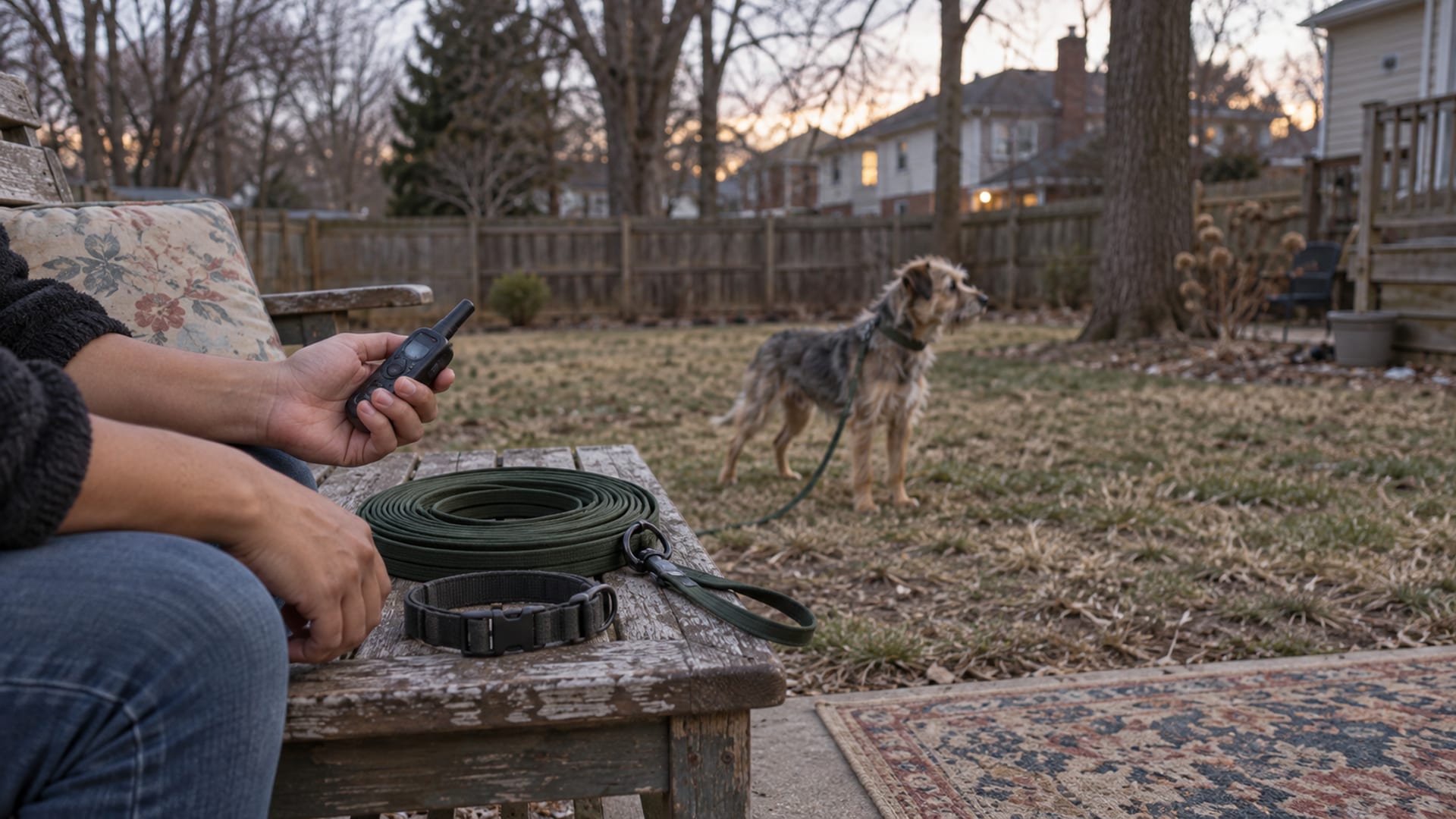
An e-collar, also called a remote collar, is a receiver that sits on your dog's neck and delivers electrical stimulation at a level the handler sets, with tone and vibration options too. It is a communication tool, and it only works on top of a dog that already knows the behavior you are asking for. Veterinary behavior groups and some trainer groups disagree about it, and I will lay out both sides below. I am a listed E-Collar Technologies dealer and trainer, and I use the tool among other tools. That is the one time I will say it, because you should know where I stand while you read the rest.
Key takeaways
Hover or tap a card to bring it forward.
- An e-collar delivers electrical stimulation at a handler-set level, and the same number on two brands can mean different outputs.
- It only belongs on top of a behavior the dog already knows, introduced at the lowest level the dog notices, with a leash or long line.
- Cooper's 2014 and China's 2020 studies of 63 referred dogs each found no clear recall advantage over reward-based training, and Schalke's lab study tied stress to unpredictable stimulation.
- AVSAB, BSAVA, RSPCA and APDT International reject the tool, the IACP allows it in proficient hands, and I use it as one part of a plan.
- Stop and call a vet or qualified trainer for yelping, shutting down, rising fear or aggression, skin marks, rising levels or a sudden behavior change, and check local animal control rules first.
What the collar actually does
When you press the button, contact points on the dog's neck deliver the stimulation. Models differ a lot, and the manufacturers publish the numbers. The E-Collar Technologies EZ-904 has 100 stimulation levels, seven vibration modes, four tones, and both momentary and continuous stimulation, with continuous lasting up to 10 seconds. The Garmin Delta SE has 10 levels and caps continuous stimulation at eight seconds. The Dogtra 200iQ and 280X have 100 levels, and the SportDOG Cabela's GS-9000 has 15.

Those numbers are not interchangeable. Lines and colleagues measured the electrical output of 13 commercial collars in a 2013 Veterinary Record paper, and output varied from model to model. So, level 10 on one brand tells you nothing about level 10 on another. The same goes for a single brand across different dogs, coats, skin moisture and fit. Read the manual for the exact model in your hands.
The manufacturers agree on how to find a starting point. Begin at the lowest level and go up one level at a time until the dog shows a small, recognizable response, such as an ear flick, a head turn, a blink or a slight change of expression. Garmin's manual adds that repeated vocalizing means the level is too high for beginning training. If your dog yelps, the level is wrong and the handler has made the error, not the dog.
Hover or tap a row to highlight it.
| Model | Levels | Other published details |
|---|---|---|
| E-Collar Technologies EZ-904 | 100 | Boost levels 1 to 60, seven vibration modes, four tones, momentary and continuous stimulation, continuous up to 10 seconds |
| Garmin Delta SE | 10 | Momentary and continuous stimulation, tone and vibration, continuous capped at eight seconds |
| Dogtra 200iQ and 280X | 100 | Nick and continuous stimulation, tone and vibration |
| SportDOG Cabela's GS-9000 | 15 | Momentary and continuous stimulation, tone and vibration |
How a trainer introduces it
The order matters more than the gear. Published trainer protocols run in roughly this sequence.
First, the behavior gets taught on leash with the collar not activated. Off Leash K9 DFW wants sit, down, place, heel and recall understood before activation, and places that foundation at about one to two weeks. If your dog does not have the basics yet, start with the first 10 commands to teach a dog who listens to you, because the collar adds nothing to a behavior the dog does not know.
Second, the dog wears the collar switched off. That trainer describes three to five days of wearing it during meals, walks and play, so the collar means nothing yet.
Third, you find the working level, starting at the lowest setting and moving up until there is a subtle acknowledgment. Off Leash K9 DFW reports 4 to 7 out of 100 for its own protocol. That figure belongs to that practice and its equipment, not to every dog or every collar.
Fourth, the signal gets paired with a cue the dog already knows. The published example is "come," followed by low-level stimulation, leash guidance if needed, then praise and a reward when the dog turns and returns.
Fifth, the leash or long line stays on while you add distance and distractions. The Electronic Collar Manufacturers Association code of practice describes a seven-metre line attached to a flat collar or harness while the trainer briefly uses the minimum recognition level.
Last, the response moves to the spoken cue and gets proofed in harder places, and the owner learns timing, level selection and when not to press the button at all.
Published timelines run from a few days of wearing the collar switched off to about two to four weeks for a full basic protocol. Those are trainer program descriptions, not controlled evidence that every dog needs the same amount of time.
My own order is the same: the dog knows the behavior first, the collar goes on and gets worn without being used, I find the lowest level the dog notices, and the owner and I work it together so the owner can handle it alone. I do not start a dog on the collar and figure out the behavior afterward.
How a Trainer Introduces the Collar
- Teach the behavior firstThe dog learns the cue on leash with the collar not activated. One published protocol places this foundation at about one to two weeks.
- Wear it switched offThe dog wears the collar during meals, walks and play, so it means nothing yet. One trainer describes three to five days.
- Find the working levelStart at the lowest setting and go up one level at a time until the dog shows a subtle response, such as an ear flick or a head turn. One trainer reports 4 to 7 out of 100 for its own protocol and equipment.
- Pair it with a known cueUse a cue the dog already knows, such as "come," with leash guidance if needed, then praise and reward when the dog turns and returns.
- Keep the line onAdd distance and distractions with a leash or long line still attached. The ECMA code describes a seven-meter line on a flat collar or harness.
- Proof the responseMove the response to the spoken cue and practice in harder places, while the owner learns timing, level selection and when not to press the button at all.
What the research says, and where it stops
Each study below comes with its sample and its limits.
Cooper and colleagues published a 2014 study in PLOS ONE on 63 pet dogs with recall problems, 21 in each of three groups. Dogs trained in two 15-minute sessions a day for four to five days. The e-collar dogs spent more time tense and yawned more than the dogs in one reward-based group. There was no significant difference in medium-term urinary cortisol, and no clear recall advantage for the e-collar. The sheep-chasing exercises used a high setting. The limits: a small sample, a short training period, professional trainers rather than ordinary owners, and differences among trainers in how they used the collar.

China, Mills and Cooper ran a similar 63-dog design, reported in 2020 in Frontiers in Veterinary Science. The dogs were over nine months old, with poor recall or livestock chasing, and training lasted up to 150 minutes over five days. The e-collar group had no advantage, and the positive-reinforcement group did as well or better on obedience. Again, these were professional settings, a short intervention and dogs referred for off-leash problems, so the results do not carry over directly to owner use or every collar protocol.
Schalke and colleagues, in a 2007 laboratory study, measured heart rate, salivary cortisol and behavior. Dogs got more stressed when the stimulation was unpredictable or unrelated to what the dog was doing, and showed fewer stress responses when it was predictable and tied to the dog's behavior. That study speaks mainly to predictability, and the dogs were laboratory dogs, not family pets.
Masson, Nigron and Gaultier surveyed 1,251 French owners in a 2018 questionnaire study. Of the owners who used a collar, 71.8 percent used it without professional advice, and 7 percent of the dogs were reported with physical wounds. It was an owner survey, so it records what owners said, not independently observed settings or stress.
Why do the studies disagree? They differ in collar model, level, duration, predictability, trainer skill, the dogs involved and what they measured. Cortisol, heart rate, yawning, owner-reported success and wounds answer different questions. Taken together, they do not show that e-collar use is uniformly safe, and they do not show that it is uniformly harmful. What changes the outcome is the level, the timing and who is holding the remote.
Hover or tap a row to highlight it.
| Study | Who or what | What it found |
|---|---|---|
| Lines and colleagues, 2013 | 13 commercial collars | Electrical output varied from model to model |
| Cooper and colleagues, 2014 | 63 pet dogs with recall problems, 21 per group, two 15-minute sessions a day for four to five days | No clear recall advantage for the e-collar, more tension and yawning than one reward-based group, and no significant difference in medium-term urinary cortisol |
| China, Mills and Cooper, 2020 | 63 dogs over nine months old with poor recall or livestock chasing, up to 150 minutes over five days | No advantage for the e-collar, and the reward-based group did as well or better on obedience |
| Schalke and colleagues, 2007 | Laboratory dogs | More stress when stimulation was unpredictable or unrelated to what the dog was doing, fewer stress responses when it was predictable |
| Masson, Nigron and Gaultier, 2018 | 1,251 French owners | Of owners who used a collar, 71.8 percent used it without professional advice, and 7 percent of dogs were reported with wounds |
What the organizations say
The AVSAB 2021 position statement says aversive methods, including electronic collars, should not be used under any circumstances, and it recommends reward-based training for all behavior modification, aggression included. The BSAVA recommends against them and supports a ban on their sale and use. The RSPCA warns of physical and behavior problems linked to pain, fear and stress. The APDT International standards of practice, amended in June 2023, do not accept them.
On the other side, the IACP position statement says the group cannot prohibit tools such as electronic collars when proficient professionals use them without undue stress, pain or injury.
I use the tool as one part of a plan, only after the dog knows the behavior, at the lowest working level, taught together with the owner.
Hover or tap a row to highlight it.
| Organization | Position |
|---|---|
| AVSAB, 2021 | Aversive methods, including electronic collars, should not be used under any circumstances |
| BSAVA | Recommends against them and supports a ban on their sale and use |
| RSPCA | Warns of physical and behavior problems linked to pain, fear and stress |
| APDT International, amended June 2023 | Does not accept them in its standards of practice |
| IACP | Cannot prohibit tools such as electronic collars when proficient professionals use them without undue stress, pain or injury |
Risks and how to keep them small
The sources list the same problems again and again. A collar that is too tight or worn too long can cause pressure sores and pressure necrosis. E-Collar Technologies' guidance for the model it cites says no more than eight hours a day, so follow the manual for your exact model and check the skin. A thick coat can keep the contact points from touching the skin properly. A level set too high, poor timing, and stimulation the dog cannot connect to anything it did all cause trouble. So does using the tool on a dog that is already fearful, in pain or aggressive, and so does owner use with no instruction.
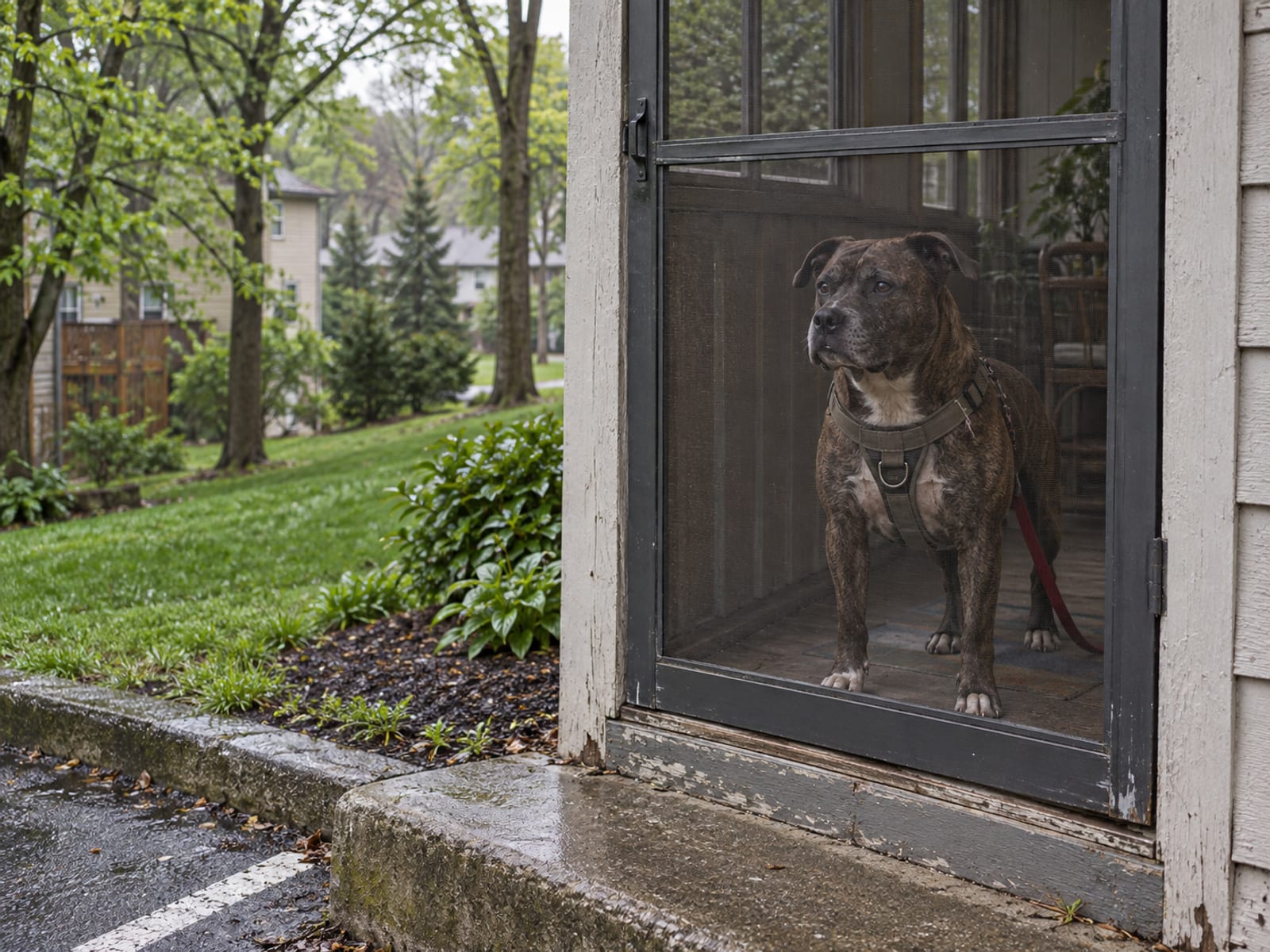
The safeguards follow from that list. Fit the collar the way the manufacturer says. Start at the lowest level. Keep the leash or long line on during introduction. Pair the signal with a known cue and reinforce right away. Press at the moment of the behavior, not after the dog has finished it. Have someone qualified teach you to fit, time and adjust the device.
Stop and get a vet or qualified behavior help if you see any of these:
- Repeated yelping, screaming or sharp startling.
- Shutting down, freezing, hiding, avoiding you or avoiding the collar.
- Rising fear, lunging, defensive behavior or aggression.
- The dog redirecting toward you, another person or another animal.
- Refusing food, or losing behaviors the dog used to know.
- Needing higher and higher levels to get a response.
- Red marks, swelling, hair loss, sores or bleeding under the collar.
- A bite, a possible bite, or any safety risk to a person or animal.
- A sudden behavior change, which can be pain or illness.
A fearful, anxious or newly reactive dog should see a vet before any tool decision. Pain can change behavior and make anything on the neck more distressing, and a vet can check the neck and skin for irritation before a collar goes on. VCA's behavior guidance says extreme fear, anxiety, phobias and aggression are serious safety problems, and recommends a check for underlying medical conditions and referral to a veterinary behaviorist when appropriate. If your dog is lunging at other dogs on walks, read the guide to overcoming leash reactivity before you think about a collar at all. If the dog has bitten or may bite, dog aggression solutions covers where to begin.
Law and local rules
Wales bans collars that can give an electric stimulation, under the Animal Welfare (Electronic Collars) (Wales) Regulations 2010. The 2023 England regulations were delayed, so confirm the current position before use. Northern Ireland has no specific law on them. In the United States there is no single federal ban on ordinary remote-collar use.
In Maryland, Criminal Law section 10-604 prohibits inflicting unnecessary suffering or pain on an animal, and section 10-603 allows unavoidable pain in animal training only when the person uses the most humane method reasonably available. Neither section mentions collars. County and city rules can differ from the state's, so check with your local animal control before you use one.
Hover or tap a row to highlight it.
| Place | Current rule |
|---|---|
| Wales | Collars that can give an electric stimulation are banned under 2010 regulations |
| England | The 2023 regulations were delayed, so confirm the current position before use |
| Northern Ireland | No specific law on them |
| United States | No single federal ban on ordinary remote-collar use |
| Maryland | Unnecessary pain or suffering is prohibited, and pain in training is allowed only with the most humane method reasonably available |
| Your county or city | Rules can differ from the state's, so check with local animal control |
Questions owners ask
Is an e-collar a good way to train a dog? It depends on the dog, the level, the timing and the person holding the remote. Cooper and colleagues and China and colleagues found no clear recall advantage over reward-based training in referred dogs, while trainers who use the collar describe it as a clear signal layered over known behavior. If you are still deciding, a vet visit and an evaluation with a trainer who teaches you to read the dog are the safest first steps.
Do vets recommend e-collar training? Veterinary behavior groups such as AVSAB and BSAVA recommend against it and advise reward-based methods. Ask your own vet, and read current AVMA guidance on humane training, before you choose a tool.
Can an e-collar help a reactive dog? A reactive, fearful or aggressive dog should see a vet first. AVSAB says aggression cases should be handled with humane, reward-based methods and referred to a veterinary behaviorist when they are hard, and the trainer protocols I quoted say the collar is not a first step. Collar use on a dog that is already afraid carries the risks listed above.
How long does e-collar training take? Published trainer programs describe anywhere from several days of wearing the collar switched off to about two to four weeks for a basic protocol. Those are program descriptions, so your dog's pace, the distractions where you live and how consistent you are will set your own timeline.
Check What You Picked Up
What does an e-collar work on top of?
How do you find the starting level?
Why is level 10 on one brand not the same as level 10 on another?
Which of these means stop and call a vet or qualified trainer?
How long should the leash or long line stay on during introduction?
Answer a question to see your score.
Working with me
If you want to talk through whether a remote collar fits your dog, the first step is an evaluation visit. After that I teach in-home lessons, and if your dog needs more than weekly lessons, board and train happens in my home. You can contact DW Dog Training to set up the evaluation, and I will tell you plainly what I think your dog needs, which is sometimes no collar at all. For dogs where bite risk is involved, aggressive dog training in Baltimore lays out how I handle it.