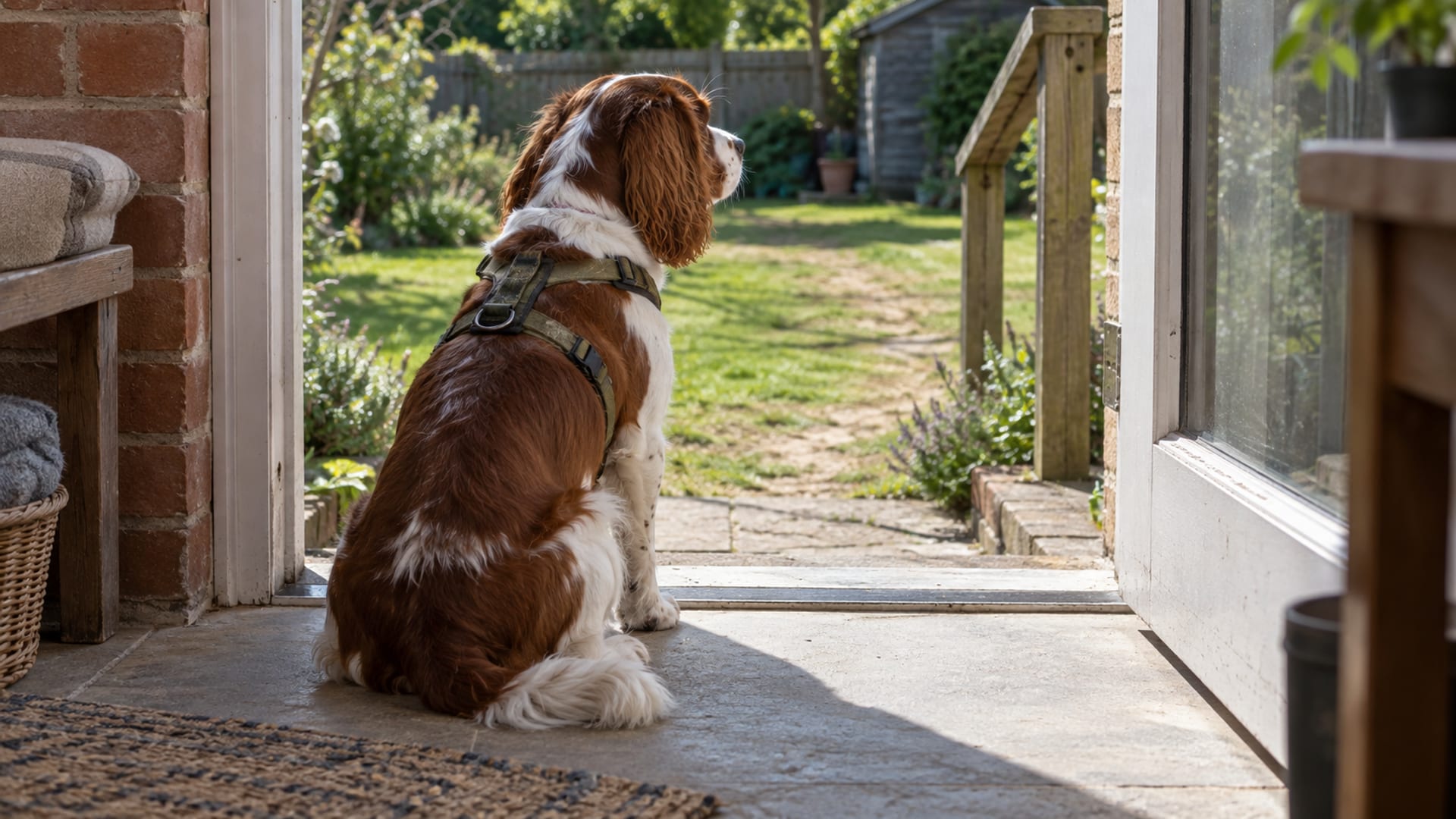
Impulse control means a dog can hold back from something that would earn it a reward, because it has learned that holding back is what opens the reward. Pat Miller, CBCC-KA, CPDT-KA, describes it as a dog resisting the temptation to do an unwanted behavior that would give it access to something it wants. It is learned, not automatic. To start, pick one everyday situation, such as a door, a food bowl, or an item on the floor. Teach the dog that waiting or backing off is what gets the reward, and work at a difficulty the dog can win.
That is a training term, not a diagnosis. The exercises below were developed by trainers. They teach a dog a skill, and they are not treatments that make reactivity or aggression go away.
Key takeaways
Hover or tap a card to bring it forward.
- Impulse control is a learned skill and a training term, not a diagnosis.
- Pick one situation, such as a door, a bowl, or an item on the floor, and reward the pause or the backing off at a level the dog can win.
- Dogs differ in delay tolerance and the skill is context-specific, so practice in several places.
- Make it harder only when the dog is relaxed, responds without repeated prompts, and has succeeded over several sessions; change one thing at a time.
- Sudden changes go to the vet first, and aggression, fear that does not improve, or a bite goes to a veterinary behaviorist.
What the studies say about self-control in dogs
Dogs differ in how well they tolerate waiting, and those abilities depend on the situation. No single game raises impulse control everywhere.
Brucks and colleagues (Scientific Reports, 2017) tested 16 pet dogs in a delay-of-gratification food task, where a lower-value reward was available now and a better one came later to dogs that waited. It measured waiting for food in a structured test, not door rushing or leash pulling. In a second 2017 paper in *Frontiers in Psychology*, Brucks and colleagues gave 67 dogs five tasks. The measures did not consistently correlate across tasks, and the authors caution that different tests may measure different abilities. So, success at one exercise does not predict success in another place, which is why you practice in several rooms and locations.
Gobbo and Zupan Šemrov (Frontiers in Veterinary Science, 2022) studied 30 dogs, 16 police dogs and 14 privately owned dogs. Dogs with high aggressive reactivity scored lower on a self-control measure. That is a correlation. It does not show that poor self-control causes aggression, or that a waiting game lowers it. Wright, Mills, and Pollux built the Dog Impulsivity Assessment Scale, an owner questionnaire validated on 41 dogs. It describes a dog's traits and does not diagnose one.
One more distinction. The *Merck Veterinary Manual* uses the term "impulse control aggression" for something narrower: a threat or attack toward people when the owner corrects the dog. It does not mean a dog that grabs food, jumps up, or rushes a door.
Hover or tap a row to highlight it.
| Study | Dogs | What it showed |
|---|---|---|
| Brucks and colleagues, Scientific Reports, 2017 | 16 pet dogs | Waiting for a better food reward in a structured test, not door rushing or leash pulling |
| Brucks and colleagues, Frontiers in Psychology, 2017 | 67 dogs, five tasks | The measures did not consistently correlate across tasks |
| Gobbo and Zupan Šemrov, 2022 | 30 dogs: 16 police dogs, 14 privately owned | Dogs with high aggressive reactivity scored lower on self-control, a correlation only |
| Wright, Mills, and Pollux, Dog Impulsivity Assessment Scale | 41 dogs | An owner questionnaire that describes traits and does not diagnose a dog |
ItsYerChoice, the choice game
Susan Garrett's ItsYerChoice frames self-control as the dog making a choice that produces access to what it wants. The steps below follow the DogsThat material on the game.
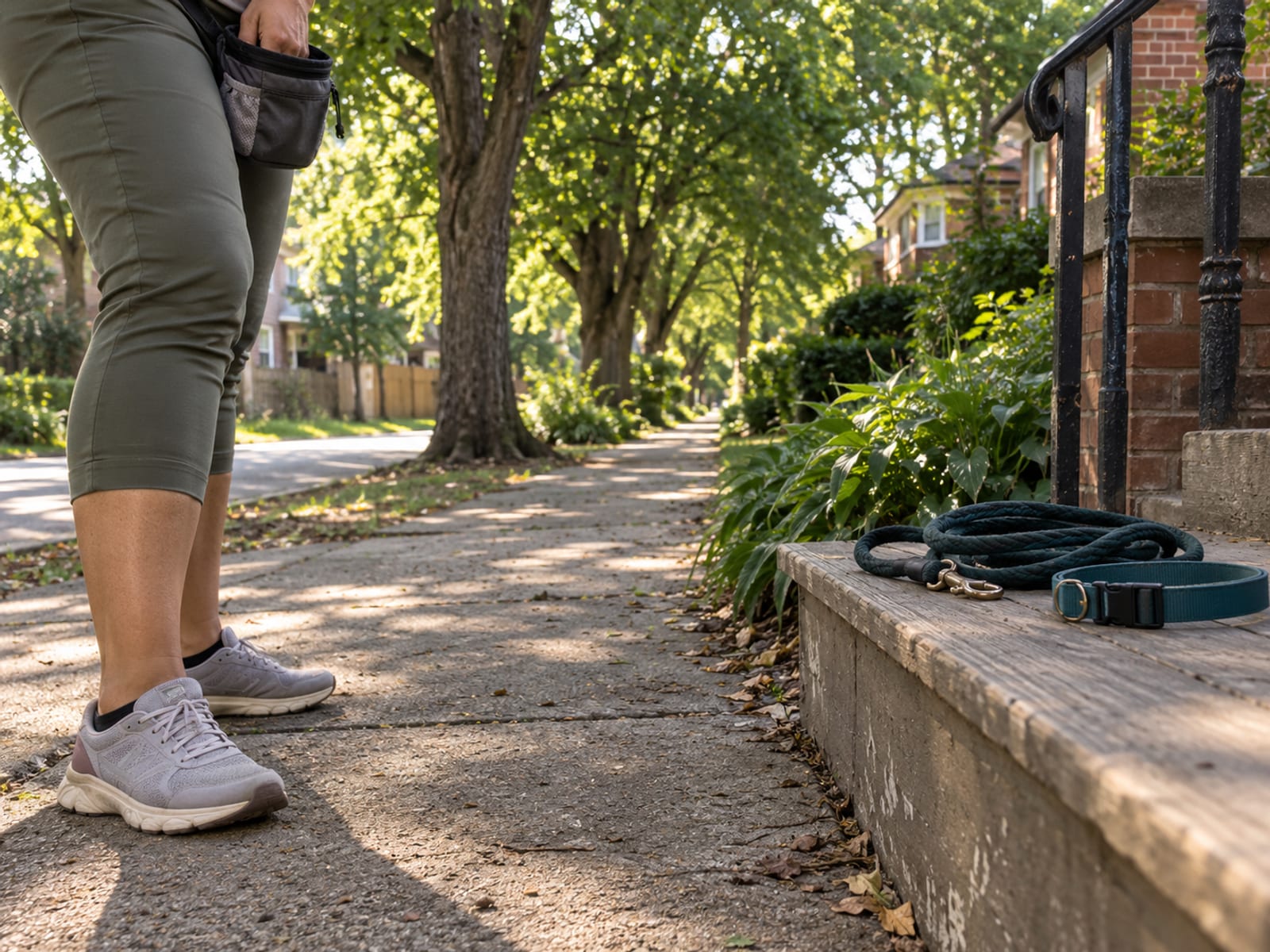
1. Hold food in an open hand. 2. If the dog moves toward it, close the hand. 3. When the dog makes a better choice, such as backing away, looking away, or staying still, open the hand again. 4. Start the treat sequence: open the hand, pick up a treat, and move it toward the dog. 5. If the dog moves forward at any point, return the treat to the hand and close it. 6. Give the treat only when the dog stays composed through the whole sequence. 7. Progress to standing, the floor, a pile of food, and more movement or distraction.
Vary whether the dog is sitting, standing, or lying down, so the reward is not tied to one posture. Garrett's point about timing matters here: if the dog lunges at the reward and gets it anyway, the lunge is what you reinforced.
Waiting at doors
A dog that bolts through doors needs this one. The American Kennel Club procedure starts with an interior door.
1. Open the door a crack. 2. If the dog approaches, close it. 3. Mark and reward any pause, stillness, backing away, or looking away. 4. Open the door a little farther each time, closing it when the dog moves forward. 5. Add "wait" once the dog can stay still while the door opens. 6. Take one step through, come back, mark, and reward. 7. Add steps gradually, then a release cue such as "Okay" or "Free." 8. Repeat at other doors, crates, and car doors, making it easier at each new place.
Going through the door is itself a reward, and the AKC also suggests a toy or a game after the release. If the dog already knows its basic cues, the sit and stay in the first ten commands to teach make this exercise go faster.
Teaching a Wait at Doors
- Crack the doorOpen an interior door a little. If the dog approaches, close it.
- Reward the pauseMark and reward any pause, stillness, backing away, or looking away.
- Open a bit fartherOpen the door a little more each time, and close it when the dog moves forward.
- Add the cueAdd "wait" once the dog can stay still while the door opens.
- Step throughTake one step through, come back, mark, and reward.
- Release cueAdd steps gradually, then a release cue such as "Okay" or "Free."
- Other doorsRepeat at other doors, crates, and car doors, making it easier at each new place.
Leave It
For the dog that grabs things off the floor or counter, Pat Miller's published version of Leave It begins with a high-value item.
1. Show the dog the item and say "Leave it" in a cheerful tone. 2. Place the item under a shoe so the dog cannot reach it. 3. Wait for the dog to stop trying to get it. 4. Mark and reward with something different, usually better. 5. Progress to an exposed item, then greater distance and more realistic settings.
Trading for an item already in the dog's mouth is a separate exercise with its own steps. If the dog guards what it picks up, start with the steps for preventing resource guarding in puppies, which cover the same idea of making giving up an item pay.
The mealtime Wait
Miller also uses meals as built-in practice, one or two chances a day depending on how often you feed. Hold the bowl at shoulder level, mark and treat a pause, and work toward placing the bowl on the floor and releasing the dog to eat. The meal becomes the reward, so the separate training treat can shrink over time. Miller notes that a highly food-motivated dog may do fine on regular food, while higher-value food makes the exercise more effective for others.
A longer program: the Protocol for Relaxation
Karen Overall's Protocol for Relaxation is a structured series of sit or down exercises, not a single game. The dog first needs to sit reliably for 15 seconds without moving. Then come task sets: you take a step away and return, walk around the dog, clap or jog, leave the dog's sight for longer periods, and open a door, knock, or ring a doorbell. Overall says the sets can be done by day, week, or at the dog's own pace. It is not a race, and if the dog cannot do a task, you go back to an easier one the dog knows well, reward, and stop.
How long, how often, and when to make it harder
Named sources give different numbers, and each applies to its own exercise.
- Karen Overall: about 15 to 20 minutes once or twice a day, or six five-minute intervals. Shorten the work when the dog or the handler stops benefiting.
- East Bay SPCA, for Look At That: five to ten treats, then a break of one to two minutes.
- Canine Origin: six to ten repetitions of one exercise, since this work is mentally demanding. That is a trainer's recommendation, not a veterinary standard.
- VCA, for desensitization and counterconditioning: at least twice a week, daily is better, and after two or three successful sessions you may increase the intensity slightly.
There is no single repetition count or fixed order that fits every dog. So, use the dog to decide when to make it harder. Move up when the dog is relaxed and can eat, offers the response without repeated prompting, looks to you for the reward, keeps a loose body instead of a tense or frantic one, and has succeeded over several sessions at the current level. The AKC puts it the same way: the dog looks to the handler for the reward and its body language is calm.
Change one thing at a time: distance, movement, duration, or sound. If you add a second thing and the dog falls apart, you will not know which one did it.
Hover or tap a row to highlight it.
| Source | Exercise | Amount |
|---|---|---|
| Karen Overall | Protocol for Relaxation | About 15 to 20 minutes once or twice a day, or six five-minute intervals |
| East Bay SPCA | Look At That | Five to ten treats, then a break of one to two minutes |
| Canine Origin | Wait and Leave It | Six to ten repetitions of one exercise |
| VCA | Desensitization and counterconditioning | At least twice a week, daily is better; five to 45 minutes depending on the trigger; raise intensity slightly after two or three successful sessions |
Rewards, and how to fade them
Use food the dog truly wants. East Bay SPCA lists small pieces of hot dog, cheese, beef, chicken, bacon, pork, or baby food. Life rewards count too, such as going through the door or getting a toy after the release. A marker, either a clicker or a word like "Yes," tells the dog exactly which moment earned the reward.
When a perfect response is too hard, Overall's protocol rewards approximations and asks for a closer one later. This is called shaping.
To fade rewards, vary and replace them instead of removing them all at once. Miller's Wait moves from treating pauses to releasing the dog to its meal. The AKC door exercise rewards some trials with food and others with the release and a game. Garrett's program keeps the dog earning what it wants while the distractions grow.
For a reactive or over-threshold dog
If your dog barks, lunges, or fixates on other dogs, people, or noises, impulse games alone will not carry you through, and they need a change in how you set up the work. East Bay SPCA defines threshold as the point where the dog can no longer attend to anything but the trigger. Signs include barking, lunging, fixation, tension, and refusing favorite food. Work below that point.
1. Start at a much greater distance than seems necessary. 2. Use a quiet, low-intensity version of the trigger. 3. Let the dog notice it without reacting, then mark and reward the noticing or the looking away. 4. If the dog tenses, fixates, vocalizes, or stops eating, add distance right away. 5. Keep sets short, and close the distance only after calm, repeated success.
Leslie McDevitt's Look At That, from Control Unleashed, fits here. Mark the instant the dog looks at the trigger, then give a high-value reward in a way that turns the dog away from it. Add a cue such as "Look" only once the glances are already quick. The dog must be able to look and then turn back, and if it cannot, increase distance or lower the trigger's intensity.
If the real trigger is too hard at any distance, East Bay SPCA suggests starting indoors with a neutral object, a recorded sound, a toy, a food bowl, or a familiar person moving across the room. From there you move to a backyard, a quiet park, and more realistic settings. These are named training exercises, not treatments for reactivity, and my guide to leash reactivity covers the walking side in more detail.
When it falls apart
- Too hard. If the dog is over threshold, the only goal is to get it back below threshold, usually with distance. VCA advises ending the session or dropping to an easier version.
- Too long. Stop while you both are still benefiting. A tired dog makes worse choices.
- Wrong reward. If the dog cannot turn back, it may be too close, or the reward may not matter enough to this dog.
- Marking the wrong moment. Mark the pause, not the movement toward the reward.
- No generalization. Success with a bowl or in a quiet room does not carry to a doorway or sidewalk. The AKC advises stepping back a few steps whenever you change doors or locations.
If a behavior changes suddenly, call your veterinarian before you change the training. The Merck Veterinary Manual lists pain, neurological disease, thyroid and other endocrine problems, gastrointestinal disease, and age-related cognitive change among medical causes of restlessness, irritability, or aggression. VCA says behavior changes at any age warrant a physical exam, and the AAHA behavior guidelines cover the same ground. Nobody should diagnose thyroid disease, pain, or cognitive change from behavior alone.
Hover or tap a row to highlight it.
| What went wrong | What to do |
|---|---|
| Too hard | Get the dog back below threshold, usually with distance, or end the session |
| Too long | Stop while you both are still benefiting |
| Wrong reward | Check whether the dog is too close or the reward does not matter enough to this dog |
| Marking the wrong moment | Mark the pause, not the movement toward the reward |
| No generalization | Step back a few steps whenever you change doors or locations |
Getting help
A certified trainer helps with choosing exercises, setting up safe repetitions, and timing rewards. If you are in the Baltimore area, I can start with an evaluation visit, and from there the work can be in-home lessons or board and train in my own home. You can contact DW Dog Training to ask what fits your dog.
Aggression, fear that does not improve, or a bite belongs with a veterinary behaviorist. The American College of Veterinary Behaviorists says a board-certified behaviorist can diagnose medical conditions that affect behavior and prescribe medication when it is indicated. AAHA lists aggression, deep bites, and failure to respond to ordinary treatment among its referral reasons, and the AVSAB advises avoiding trigger situations and keeping everyone safe while qualified help is arranged. Where a dog has bitten, safety management comes first: keep children and vulnerable people separated from the dog, with strict adult supervision.
Common questions
Is impulse control a medical condition? No. It is a training term for a learned skill. If your dog's behavior changes suddenly, a veterinarian should check for pain or illness first.
Will these games stop my dog's reactivity? They are named training exercises and not a treatment for reactivity or aggression. For a reactive dog, the work starts below threshold, with far more distance than seems necessary.
How many repetitions should I do in one session? Named sources differ. Canine Origin suggests six to ten repetitions of one exercise, and East Bay SPCA suggests five to ten treats and then a one to two minute break. End the session while the dog is still succeeding.
Why does my dog wait at the door but not at the gate? Each place is a new learning context. When you change location, step back to an easier version of the exercise.
Check What You Picked Up
What does impulse control mean for a dog?
At a door, what do you do when the dog moves forward as you open it?
Why should you practice in several rooms and locations?
When is it time to make an exercise harder?
In Leave It, what do you do after the dog stops trying to get the item under the shoe?
Your reactive dog tenses and stops eating during a session. What comes first?
Answer a question to see your score.