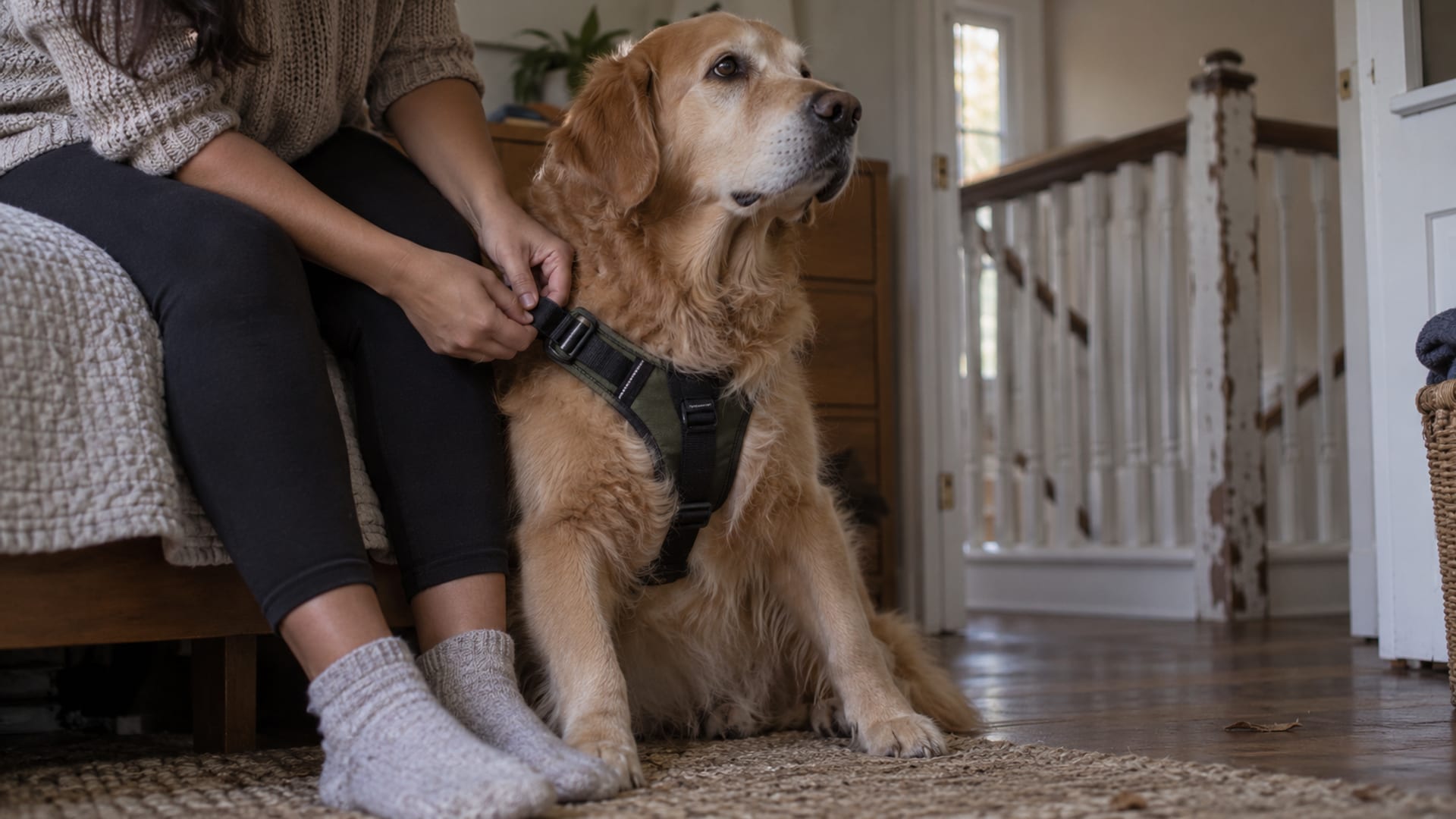
If your dog stiffens, stares or growls when someone comes near you, start with distance. Give the dog more room the moment you see the body go still, and do not wait for a lunge. Nobody, whether a partner, a child or a visitor, should reach for you, hug you or move you past a dog who is guarding. Do not scold the dog, grab it or pull it off your lap. Put a gate, a closed door or a leash between the dog and the person. If the dog has bitten, tried to, or might, keep strict separation and bring in a professional.
Key takeaways
Hover or tap a card to bring it forward.
- Add distance at the first stiffening, stare or growl, and keep people from reaching for, hugging or moving you past a guarding dog.
- Do not scold the dog or pull it off a lap or sofa; use a gate, closed door or leash to separate.
- A sudden change in behavior is a vet question first, and treating pain may not end a learned response right away.
- Training described by named sources rewards calm and builds up distance in small steps, with limits: reduced guarding is likely, and long-term safety management is typical.
- Get professional help after a bite or near-bite, or when the dog guards a person, children are in the home, or visitors cannot enter safely.
What guarding a person actually is
A dog can treat a person, a lap, a bed or a spot on the sofa as something worth holding onto. It is not proof of love, and it is not jealousy as such.
The sources use different words, so I will use each one's own. VCA Animal Hospitals uses both "possessive aggression" and "protective aggression." Possessive aggression can involve what VCA calls social companions the dog values, and protective aggression is aimed at someone who threatens one of them. The Merck Veterinary Manual defines protective aggression as guarding the owner from an approaching person when no real threat is present.
The American Veterinary Society of Animal Behavior (AVSAB) calls aggression toward an approaching person, while the dog sits on a lap, resource guarding. In its case example, the dog was guarding a warm, cozy lap, not defending the person from danger. The dog had learned that an approaching person could end the petting or move it.
The label alone does not tell you the motive. In a 2018 expert-opinion study, Jacobs and colleagues found that experts use "resource guarding," "possessive aggression," "food-related aggression" and other terms in different ways. Of the 14 experts who completed the relevant stages, 10 preferred "resource guarding," partly because it covers behaviors that are not aggressive, such as staring and body blocking.
Fear, anxiety, learning history, pain, frustration and how much the person or place means to the dog can all be part of it, and one dog can have several at once. It is not a rank or status problem.
Early signs of guarding a person
Dogs show these in different orders, and a dog may show only some of them. Here is what the named sources list:
- Stiffening or freezing. VCA lists both among escalating aggression signals, and AVSAB's lap case describes the dog's whole body stiffening.
- A hard stare. Seattle Humane lists a "hard eye," and Dogs Trust lists staring at the person the dog sees as a threat.
- A lip lift. Seattle Humane describes a snarl as one or both lips lifted to show teeth.
- Lip licking and whale eye. Dogs Trust lists both as early signs.
- Tension in the face and body. Dogs Trust lists both.
- Standing or hovering over the resource. Dogs Trust lists standing over it and lowering the body over it.
- Body blocking. Dogs Trust lists using the body to block access, and the Jacobs expert-opinion study records it as a guarding behavior.
- Moving away with the resource. Dogs Trust lists running off or hiding the item.
- Growling and barking. Dogs Trust, Seattle Humane, VCA and AVSAB all list these as warnings.
- Lunging, snapping or biting. Seattle Humane separates a snap, which is an air bite, from a bite, which makes contact.
- Jumping up or barking when someone approaches you. Dogs Trust says dogs guarding a person may growl, lunge, bark or jump at anyone who comes near the owner.
- Refusing to get off the sofa or bed. Dogs Trust lists refusing to move, and darting back to the favored spot once the dog is moved.
A written breakdown such as Decoding Your Dog: 15 Body Language Signals helps you learn to spot the early ones, which are the ones you can still act on.
Hover or tap a row to highlight it.
| Sign | What you may see |
|---|---|
| Stiffening or freezing | The whole body goes still when someone approaches |
| Hard stare | A fixed "hard eye" at the person coming near |
| Lip lift | One or both lips lifted to show teeth |
| Lip licking and whale eye | Tongue flicks and the whites of the eyes showing |
| Tension | A tight face and body |
| Standing over the resource | Standing or lowering the body over you, the lap or the spot |
| Body blocking | The dog uses its body to block access to you |
| Moving away with the item | Running off with it or hiding it |
| Growling and barking | A warning aimed at whoever approaches |
| Jumping up | Jumping or barking at anyone who comes near you |
| Refusing to move | Will not get off the sofa or bed, or darts back to the spot |
| Lunging, snapping or biting | A snap is an air bite; a bite makes contact |
When it happens, and why
A person approaches you while the dog is on the sofa, bed, chair or your lap. A partner tries to hug you, sit beside you or move you. A visitor comes through the door, and doorways are where visitor arrival, territory and access to you can overlap. You try to move the dog off the furniture or end contact.
Fear adds to it. VCA says fear-related aggression can follow an unpleasant or frightening experience, and that it can be strengthened when the aggression makes the other person retreat. Merck says fear underlies many types of aggression, and that a dog may turn aggressive when staying close to a family member or a prized spot is the only way it can feel safe.
Learning matters just as much. If a growl makes the visitor back off, the dog may learn that the growl works. AVSAB's lap case follows the same path: the dog learned that an approaching person could end its comfort or petting, then used growling and snarling to keep the lap.
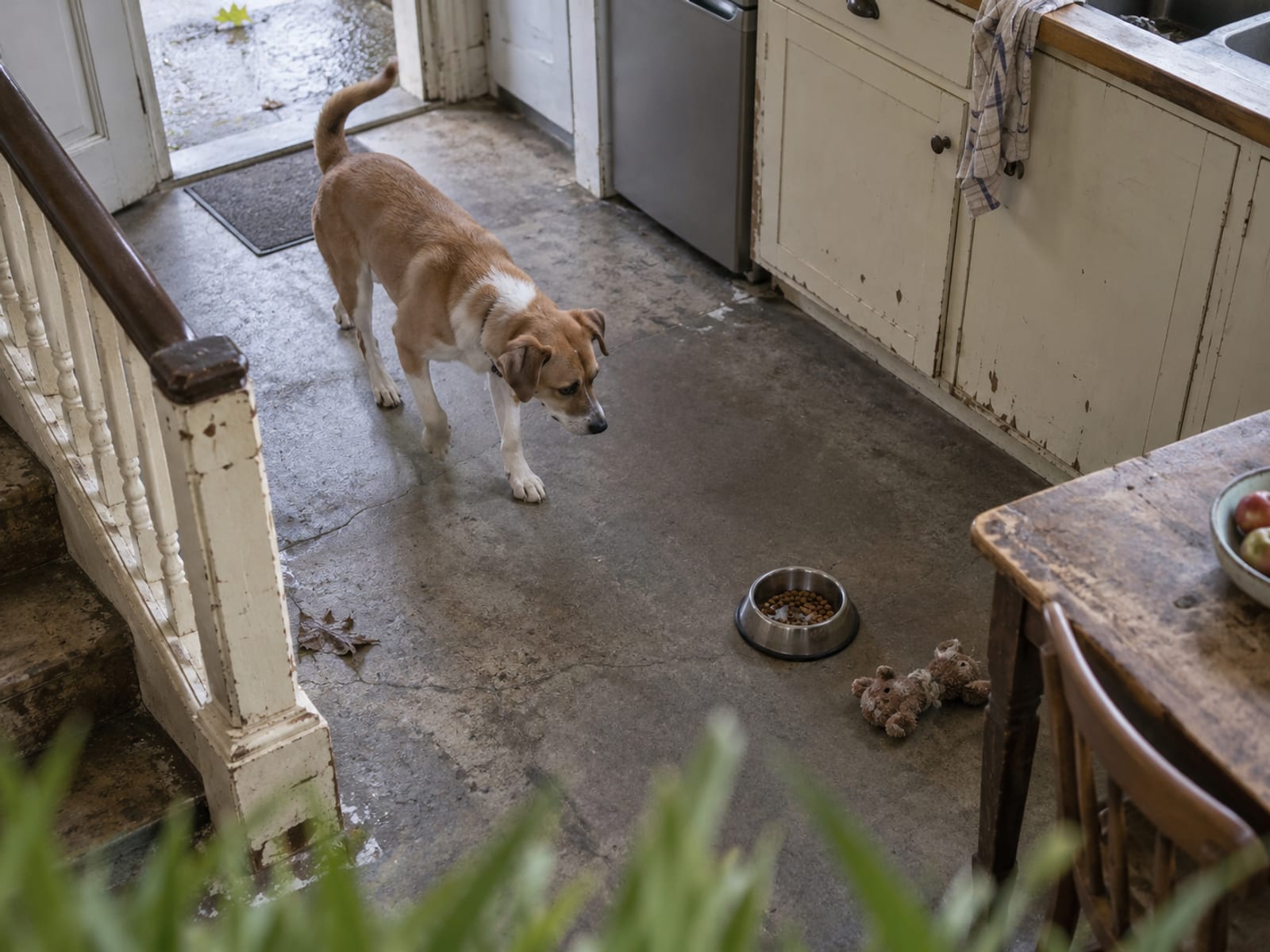
Stressors include visitors, a new family member or pet, changes in routine and illness. Preventive Vet and Dogs Trust both note that guarding can be specific to one person, one place or one kind of approach.
A sudden change is a vet question first
If this started suddenly, or got worse fast, or happens when someone touches or approaches the dog, the first appointment is with your veterinarian, not a trainer. VCA and Merck list pain from dental disease, arthritis, ear or skin problems, anal sac disease and spinal or joint trouble. They also list illness with fever or fatigue, kidney or liver disease, neurological disease and seizures, hearing or vision loss, thyroid and adrenal disease, and metabolic disease. Medication effects and age-related changes in mobility, sleep and tolerance can also play a part.
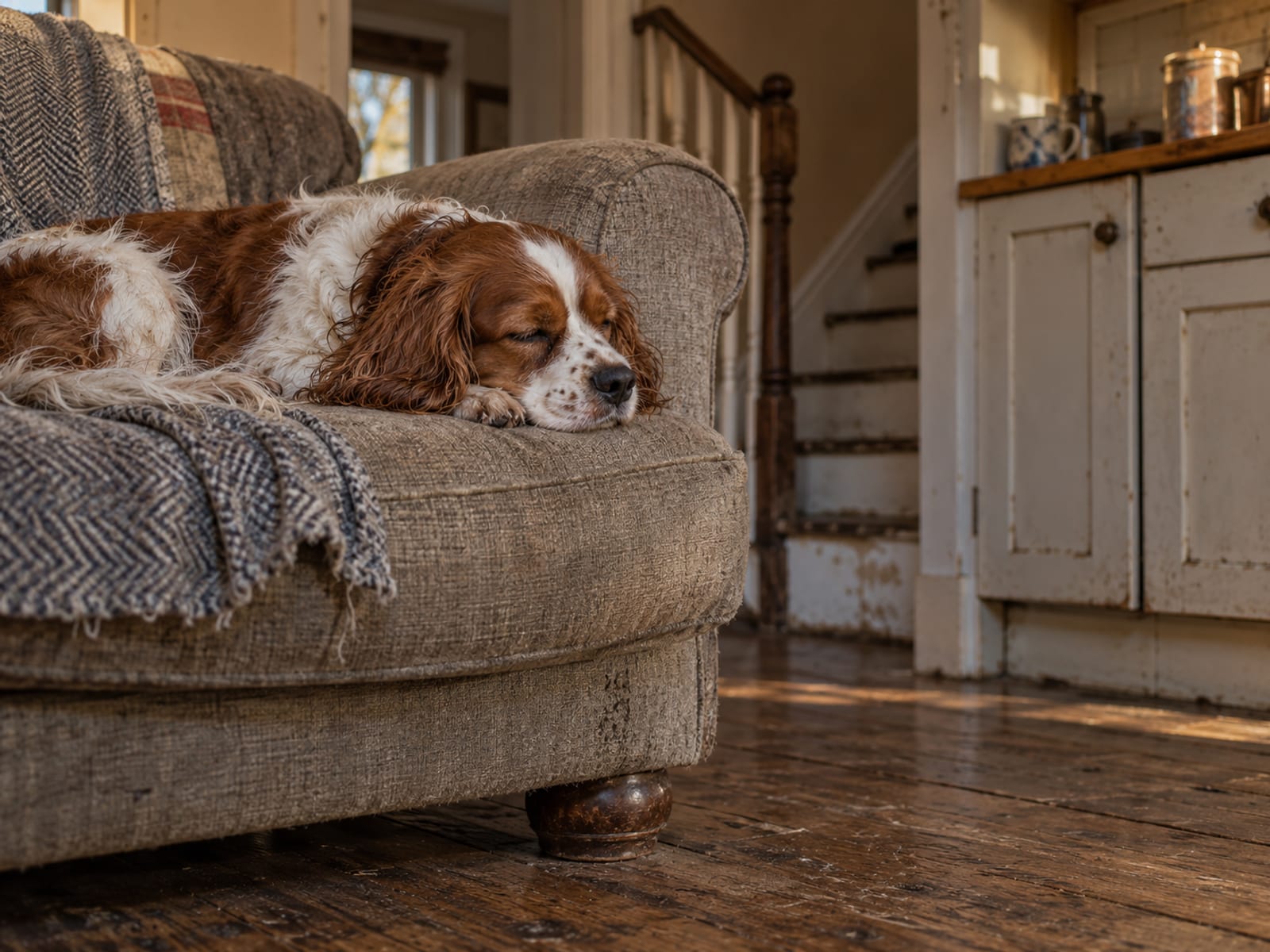
VCA's diagnosis overview advises a veterinary exam for aggressive behavior because pain, rabies and nervous-system disease can contribute. Treating a medical cause may not remove a learned defensive response straight away, because the fear that grew up around the pain can stay behind. If no physical cause is found, VCA advises seeing a veterinary behaviorist.
What to do, and what not to do
Management comes first, and it is the longest part of the plan, because it stops the dog from rehearsing the behavior while you work on the cause. Dogs Trust, Seattle Humane, ASPCA and Best Friends Animal Society describe these steps:
- Add distance as soon as the dog stiffens, stares, freezes or growls.
- Use closed doors, baby gates, pens or crates.
- Leave a buffer zone around the sofa, bed or chair the dog guards.
- Give the dog a quiet place to rest that nobody disturbs and that is always available.
- Block the dog's access to the furniture it guards, or keep a leash on it when visitors are expected.
- Greet visitors with the dog out of sight or behind a barrier, and keep visitors and children from approaching, touching or hugging a guarding dog.
- Feed dogs separately, and put away food, chews and any other item the dog guards.
- Do not physically remove a person, child, dog or object from a guarding dog's space, and do not force the dog to greet a visitor.
Seattle Humane says a trainer may recommend a tether, leash or muzzle during behavior-modification exercises.
Your own reactions can backfire, and this is where good intentions go wrong. VCA says that petting a dog or using soothing words while it threatens someone can read to the dog as praise. If the other person backs away, the dog may learn that growling works, and challenging or confronting the dog can raise aggression and cause injury. Preventive Vet says that if someone repeatedly takes a chew away, the dog may learn that guarding is necessary and warn that person off in future.
So, in practice: do not scold the growl, and do not reach over or grab the dog from a lap, sofa or bed. Do not pet the dog while it is threatening someone. Use distance or a barrier, and reward calm behavior and a safe alternative before the dog reaches the warning stage. If your dog guards food or objects too, 5 Simple Hacks to Stop Your Dog's Resource Guarding covers that side of it.
Hover or tap a row to highlight it.
| Situation | Do this | Not this |
|---|---|---|
| The dog stiffens, stares or growls | Add distance right away | Wait for a lunge |
| Someone approaches you on the sofa | Use a gate, closed door or leash | Reach over or grab the dog |
| The dog growls at a person | Use distance or a barrier and reward calm behavior | Scold the growl or pet the dog while it threatens someone |
| Visitors arrive | Keep the dog out of sight or behind a barrier | Let visitors pet the dog or offer treats, or force a greeting |
| The dog guards a spot | Leave a buffer zone, block access and offer a quiet rest place | Pull the dog off the furniture |
| The dog guards food or chews | Feed separately and put guarded items away | Keep taking the chew away |
How training is described, and what it can promise
The training described by named sources is desensitization and counter-conditioning, which means building a good association with the thing the dog reacts to, in small steps. Here is how each source lays it out.
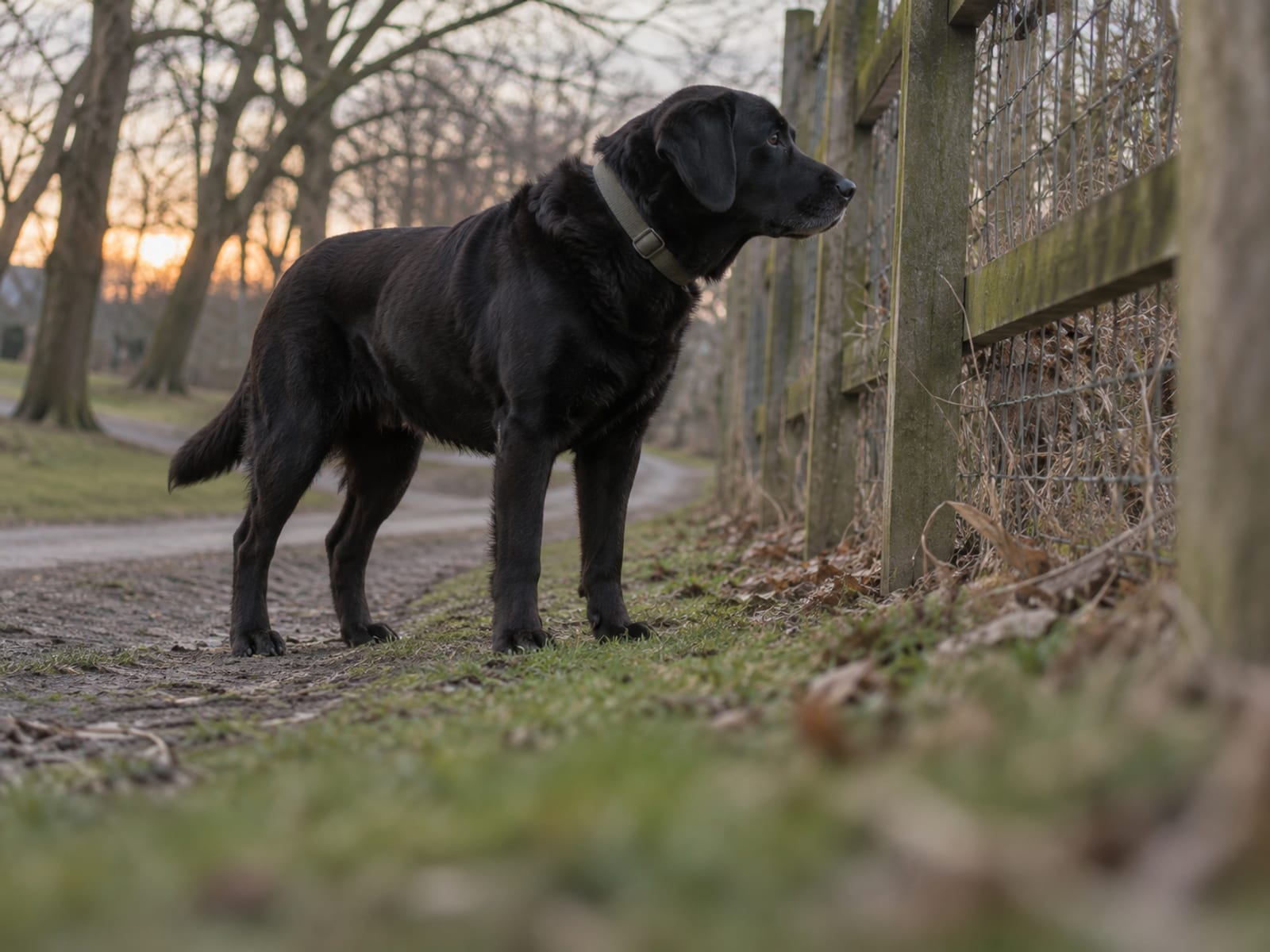
For the lap case, AVSAB's behaviorist Megan Maxwell first taught the dog to hop down on a cheerful cue, with no tension. The owners then called the dog from another person's lap and rewarded it with food, a walk or affection when it came. They practiced the cue from gradually closer. By the end of the case, the dog was anticipating a reward instead of tensing.
Seattle Humane starts with something the dog does not guard, such as an empty bowl or a boring toy. The person approaches only as far as the dog stays relaxed and delivers food, then the difficulty rises step by step toward guarded items and guarded beds. For objects, it describes a trade: reward the dog with a high-value treat for giving up the item, then hand the item back, so the dog learns that letting go does not mean losing it for good.
For food, ASPCA stages the approach. You stand a few feet away and toss a high-value treat toward the bowl, then step a little closer only while the dog stays relaxed. If the dog stiffens, stares, growls, snaps, bites, chases, refuses food or stops progressing, ASPCA says to stop and call a qualified professional.
A mat or place behavior gives the dog something else to do. Preventive Vet describes practicing "Go to Bed" while the owner cooks; the same idea can be adapted to a visitor arriving or sofa access.
The published research is small, and the limits belong beside the methods. Mehrkam and colleagues worked in 2020 with one dog in a home. Its food guarding involved escape, attention and tangible consequences, and three function-based treatments brought the guarding to zero. The effects held with the owner, with an untrained handler, with a highly preferred treat, in an untrained setting and after two weeks without training. That was one dog guarding food, not a person, a lap or a sofa, so it does not promise the same result for yours.
The 2018 survey by Jacobs and colleagues covered 2,207 participants reporting on 3,589 dogs after screening. These were owner reports, and they show associations only. A reliable drop cue was linked with a lower likelihood of aggressive guarding, while fearfulness and impulsivity were linked with more of it.
VCA says aggression can often be reduced in frequency or intensity but may not be eliminated, and that long-term safety management is typical. No source sets a fixed timeline, and I will not give you one. Plan on managing the setup long term.
How a Lap-Guarding Case Was Trained
- Teach a cheerful cueThe dog first learned to hop down on a happy cue, with no tension.
- Call the dog from another person's lapThe owners called the dog away and rewarded it with food, a walk or affection when it came.
- Practice from closerThey practiced the cue from gradually closer distances.
- A new expectationBy the end, the dog anticipated a reward instead of tensing.
Children, visitors and other pets
Dogs Trust says to separate the dog from children while you get professional support. Use physical barriers, tell children not to approach or interact with the dog, and actively supervise whenever children and the dog are together. A child cannot be expected to read a growl, remember every rule or handle a guarding dog. If you cannot supervise actively, separate them.
For visitors, keep the dog behind a barrier or in another room, and ask them not to offer treats or pet it. Dogs Trust recommends removing guarded items, giving each dog a safe retreat, and separating dogs behind doors or barriers before feeding or enrichment. Preventive Vet recommends separate, secure feeding areas and putting away toys or chews that have caused guarding. Separate the dogs before arousal climbs, not by pulling them apart mid-fight. If one dog is guarding you from the others, Stop the Squabbles: How to Manage Resource Guarding Between Dogs goes through the dog-to-dog side.
When to get help
Call your veterinarian for any sudden change, new aggression or escalation. Bring in a veterinary behaviorist or a qualified behavior professional when:
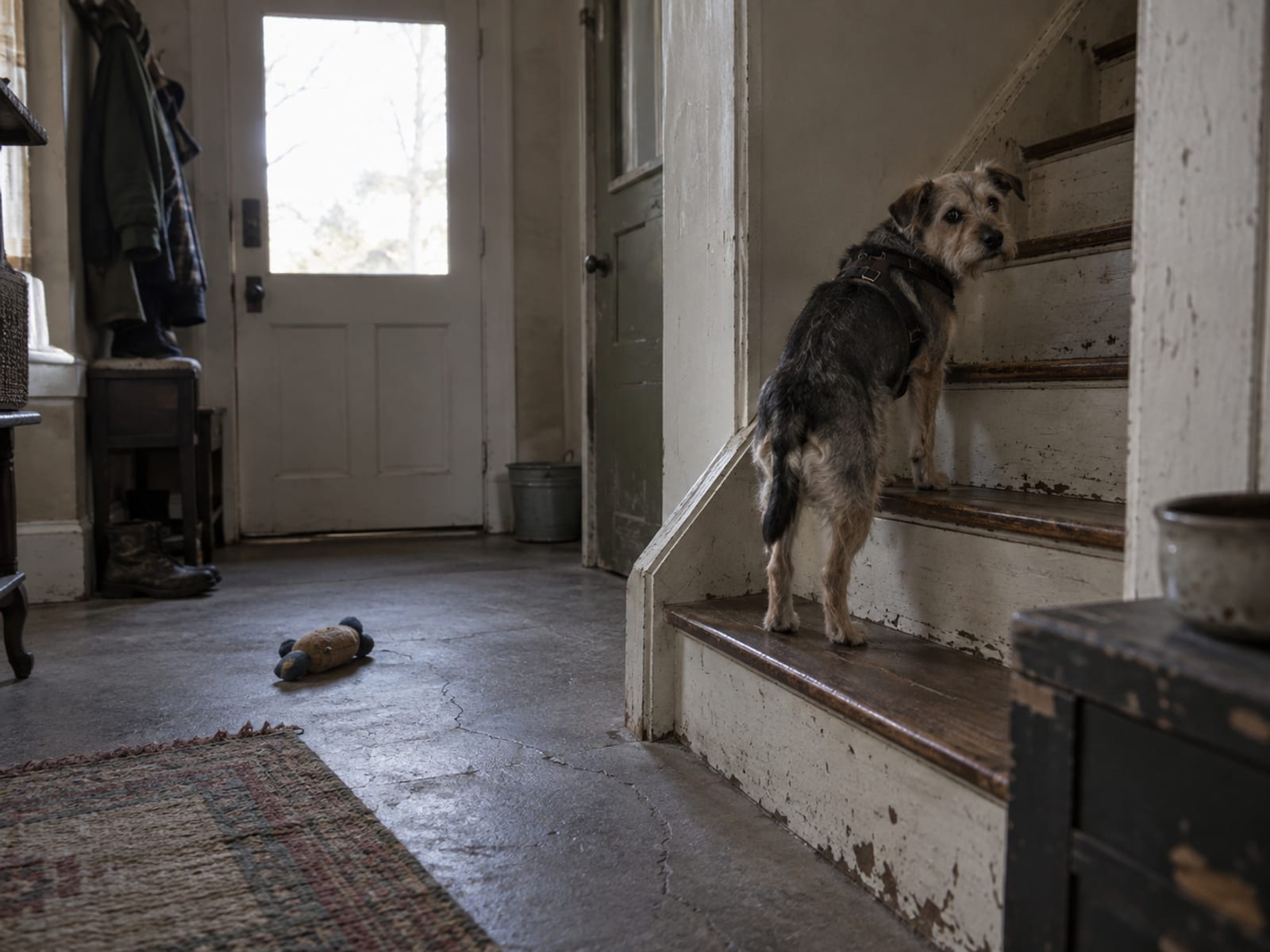
- The dog has bitten or tried to bite, or is likely to.
- The dog guards a person, a doorway, a sofa, a bed or another common space.
- Children live in the home or visit.
- Visitors cannot come in safely.
- The dog lunges, snaps or chases people away, or leaves its spot to go after someone.
- The dog guards more than one thing, or in more than one setting.
- The warnings are getting stronger or showing up from further away.
- The dog cannot stay relaxed during basic exercises, refuses food during training while still guarding, or stops progressing.
ASPCA names a Certified Applied Animal Behaviorist, a board-certified veterinary behaviorist or a qualified Certified Professional Dog Trainer. Best Friends recommends a certified trainer, behavior consultant or veterinary behaviorist when a dog guards people or common spaces, or when there has been a bite or a threat to bite. VCA says diagnosis and treatment are usually best handled by a veterinary or applied animal behaviorist, because several types of aggression can overlap.
Working with me
If you want help in Baltimore, I start with an evaluation visit, where I see the dog, the furniture and the people involved. From there it can be in-home lessons, or board and train in my own home. If your dog has bitten or nearly bitten anyone, say so on the first call, so we can plan the safest way to begin; you can contact DW Dog Training to set that up.
FAQ
Why does my dog growl at my husband only when I am on the sofa? Guarding can be specific to one person, one place or one kind of approach, according to Dogs Trust and Preventive Vet. The sofa, your lap and you together may add up to something the dog is keeping, so the same man in the kitchen may get no reaction at all.
Is it protective or possessive? It depends on whose word you read. VCA uses protective aggression for a dog aimed at someone who threatens a companion, and possessive aggression for guarding a companion it values. AVSAB's lap case was neither a rescue nor a rank issue; the dog was guarding comfort and petting.
Will treating a medical problem fix it? It may remove part of the cause, but VCA notes that a learned defensive response can last after the pain is treated. So, the vet visit comes first, and the behavior plan can follow it.
Check What You Picked Up
Your dog stiffens and growls as your partner approaches the sofa. What comes first?
Why can a person backing away make guarding worse?
A dog that has never guarded suddenly starts. Who should you see first?
What is desensitization and counter-conditioning?
Which is a reason to bring in a professional?
What can you expect from training over the long term?
Answer a question to see your score.