Some links in this post are Amazon affiliate links. If you buy through one I may earn a small commission, at no extra cost to you. It never changes what I recommend. Full disclosure.
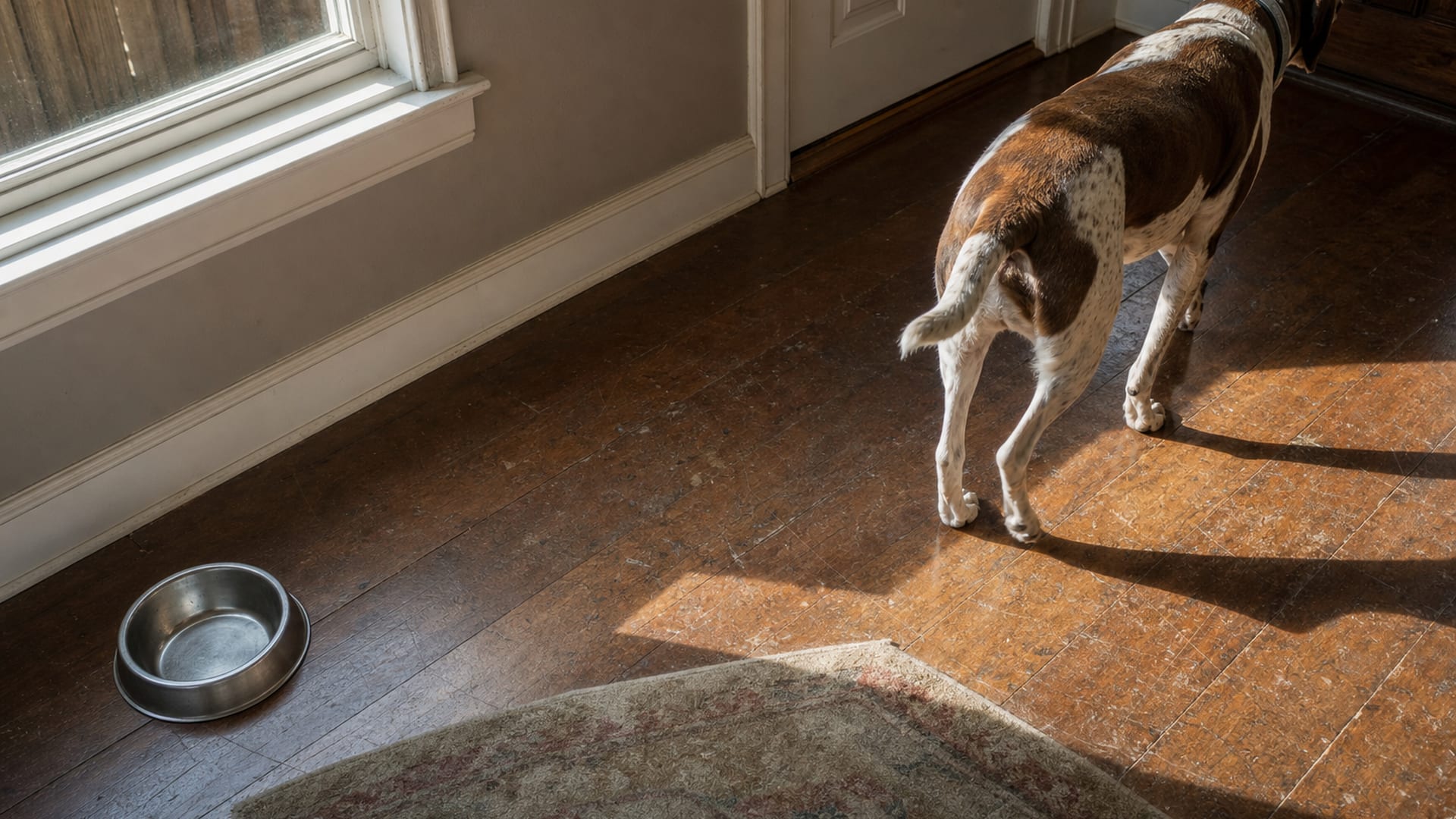
Resource guarding is a dog keeping control of something it values when a person or another animal comes near. The safest first moves are to stop taking things away from the dog, feed it where nobody walks up to it, and add value from a distance instead of reaching in. How serious it is depends on what the dog does, from eating fast to freezing, growling and biting. I'll say this plainly: five simple hacks will not fix a dog that bites. The steps below are the safe ones, and they come with the limits attached.
Key takeaways
Hover or tap a card to bring it forward.
- Stop taking food and items away from a guarding dog, and feed it where no one walks up to it.
- Rapid eating and avoidance are not always aggression, but stiffening, staring, growling, snapping and biting are warnings that call for distance.
- The safe steps are passing at a distance and paying the dog, trading up with cues taught on low-value items first, and adding value in small steps.
- Children never approach a dog that is eating or sleeping, and in some homes management is safer than active treatment.
- A bite, snap or lunge, children in the home, or sudden guarding means getting a professional involved, with a vet check first when the change is sudden or the dog is older.
Is it guarding, or just fast eating?
Start with what you are actually seeing. Researchers led by Jacobs, in a 2018 expert-opinion study in Frontiers in Veterinary Science, define guarding as avoidance, threatening or aggressive behavior used to keep control of food or non-food items around a person or another animal. That covers a lot of ground, and the dog does not have to be aggressive for it to count.
The resources vary. VCA lists food, chews, toys, places and people. Landsberg and colleagues list the same. Jean Donaldson's book *Mine!* adds bowls, objects, beds, crates and owners. Karen Overall separates food-related aggression, which involves food, bones, rawhides, treats or scraps, from possessive aggression over non-food objects and toys. She treats some food-related aggression as its own safety problem, not just a mild version of guarding.
What I watch for in the dog's body:
- Eating faster when you come near
- Body blocking, or grabbing an item and running off with it
- Stiffening, lowering the head and hovering over the item
- A hard stare, or whale eye, where you can see the white of the eye
- Lip lifting, growling or snarling
- Lunging, snapping, chasing or biting
All six experts in the Jacobs discussion group identified growling, lunging, snapping and biting as guarding. Not every expert counted stiffening or rapid eating. A dog that gulps its dinner is not always being aggressive, but it is telling you how safe that item feels. A dog that freezes and stares is telling you a lot more.
Hover or tap a row to highlight it.
| What you see | What it tells you |
|---|---|
| Eating faster when you come near | Not always aggression, but it shows how safe that item feels |
| Body blocking, or grabbing the item and running off | The dog is working to keep the item |
| Stiffening, lowering the head, hovering over the item | The dog is tense and wants space |
| A hard stare or whale eye, where the white of the eye shows | A stronger warning than gulping dinner |
| Lip lifting, growling, snarling | An open warning, so give distance |
| Lunging, snapping, chasing, biting | Guarding that calls for professional help |
How common is it, and why does it happen?
The honest answer is that it depends on the dog and the household, and the studies describe particular groups, not all dogs.
In a 2018 online survey in Preventive Veterinary Medicine, Jacobs and colleagues recruited 3,068 owners; 2,207 passed a video-identification screen, covering 3,589 dogs. Higher impulsivity went with rapid eating, avoidance and aggressive guarding. Fearfulness went with aggressive guarding. Neutered males and mixed-breed dogs more often showed aggressive guarding in that sample. Those are associations in a social-media sample, not causes. A breed label cannot tell you what your dog will do. A 2017 follow-up in Applied Animal Behaviour Science with 1,438 owners found that people recognized aggressive guarding from videos more easily than rapid eating or avoidance.
A U.S. shelter study followed 96 adult dogs that guarded a bowl on the SAFER assessment for three months after adoption. Six adopters reported a guarding incident in the first three weeks, and only one of those happened at the bowl. The return rate for food guarders was 5 percent, against 9 percent for other adult dogs. The sample came from shelter dogs and relied partly on adopter reports.
Why does a dog guard? The Merck Veterinary Manual points to genetics, early experience and learning, along with how much the dog values the item and how risky the approach feels. A dog that growls and watches you back away learns that growling works. Overall adds competition for food, limited access and feeding history. Dogs Trust links guarding with fear, frustration, stress, pain, and medication that raises hunger. If fear drives your dog's guarding, my page on anxiety and nervousness is worth a read.
Hack 1: Set up the house so the dog can eat alone
This comes before any training, because it is what keeps people safe while you work.
Overall's protocol says the safest strategy is to feed the dog where it will not be disturbed. VCA gives the same advice: feed away from people and other pets, behind a baby gate, in a crate or in a separate room. Overall also says management means avoiding the situations that trigger the behavior and not letting the dog rehearse it. Every time a dog practices guarding and it works, the habit gets stronger.
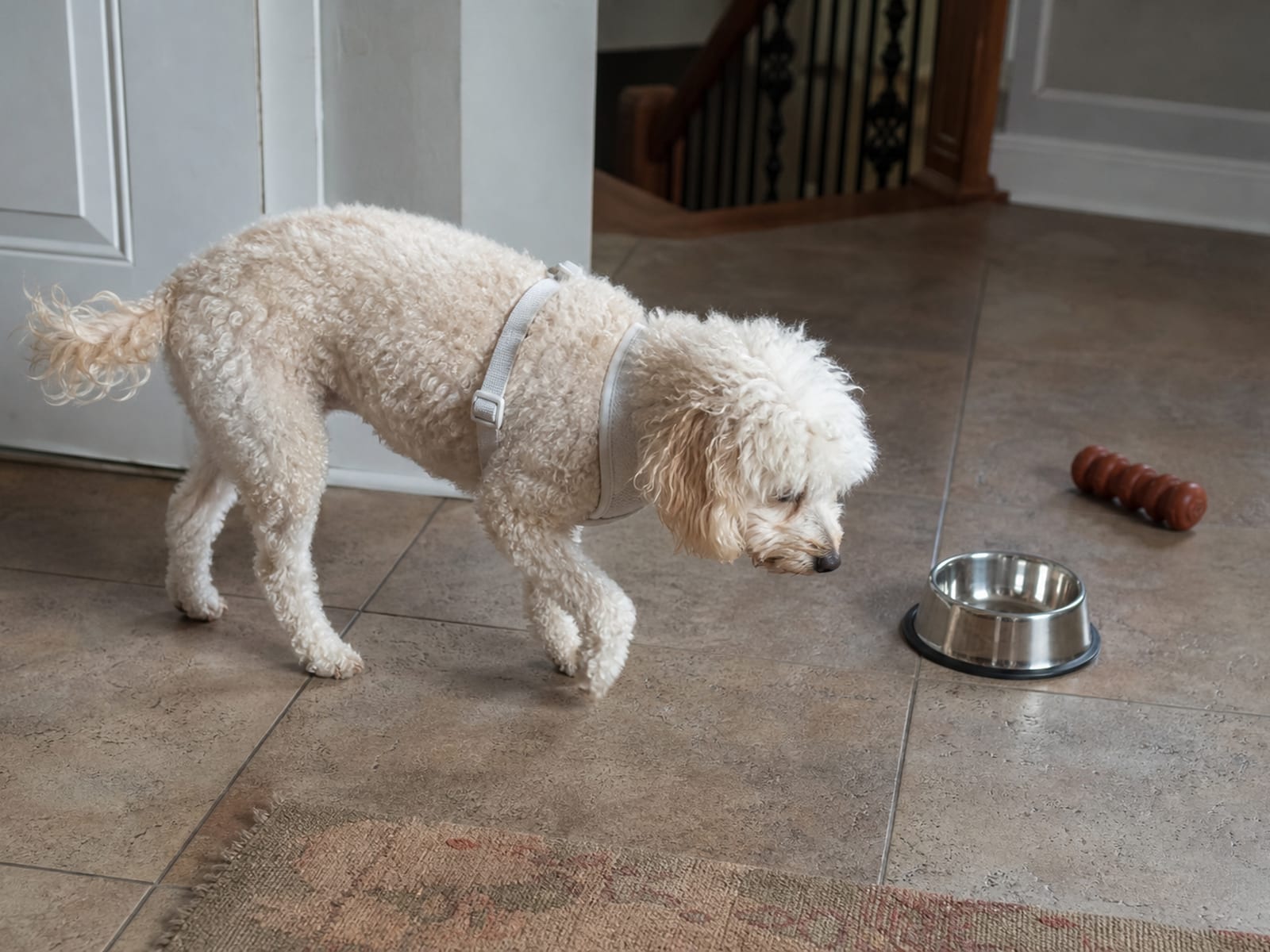
In a normal house, that looks like this:
- Children never approach a dog that is eating or sleeping, and nobody expects a child to read the warning signs. Gates, closed doors and a separate feeding spot do that job.
- Skip high-value chews and the toys that set the dog off until you have a plan. VCA says the same.
- Keep stealable items out of reach. Merck recommends giving high-value chews in a crate or pen, away from traffic.
- Put beds and crates where the dog can rest without anyone walking up to it.
- If leaving the bowl down is the trigger, pick it up after meals, once the dog has walked away from it.
- After a growl or snap, do not reach for the dog or the item. Quietly walk away. VCA and Landsberg and colleagues both say so.
Overall adds that in a home with children, managing the problem may be a safer choice than actively treating it. I agree with her. Management is the safest piece of the plan.
Hover or tap a row to highlight it.
| Situation | What to do |
|---|---|
| Meals | Feed away from people and other pets, behind a baby gate, in a crate or in a separate room |
| Children | They never approach a dog that is eating or sleeping; gates and closed doors do the work |
| High-value chews and trigger toys | Skip them until you have a plan, or give chews in a crate or pen away from traffic |
| Stealable items | Keep them out of reach |
| Beds and crates | Place them where the dog can rest without anyone walking up to it |
| The bowl, if it is the trigger | Pick it up after meals, once the dog has walked away from it |
| After a growl or snap | Do not reach for the dog or the item; quietly walk away |
Hack 2: Stop taking things away
This one surprises people, because it feels like the obvious fix. If the dog guards the bowl, take the bowl, and the dog learns you are in charge. It does not work that way.
The American Veterinary Society of Animal Behavior (AVSAB) says that repeatedly taking food from an eating dog can teach defensive aggression, because it creates competition over the bowl. VCA says not to take the bowl away mid-meal, because it can cause bites. Overall says not to provoke the dog by moving your hands around the bowl, and notes that hungry dogs can be more reactive. Landsberg and colleagues say there should be no confrontation, forced removal, scolding or hitting, and no reaching for the dog or the item afterward. They link those moves to more anxiety, lost trust and escalation.
Hand-feeding is not a universal fix either. Some trainers use it to build good feelings around food, but putting a hand into the bowl, or handling the food while the dog eats, is not a safe exercise for a dog that guards. The safe approach is to add value from a distance and only come closer while the dog stays relaxed.
Hack 3: Pass at a distance and pay the dog
The safe steps come from AVSAB's guidance on preventing food guarding and the VCA advice above. You need a dog that is not aggressive over this item, or a distance large enough that it truly is not.
1. Feed the dog in its own spot. 2. Walk past at a distance where the dog stays loose and keeps eating. 3. Say the dog's name. 4. When the dog looks up, toss something better than what is in the bowl, a bit of chicken or cheese, and keep walking. 5. Over many meals, pass a little closer, but only while the dog stays relaxed.
The dog learns that a person coming near means something good arrives, not that something goes away. If the dog stiffens, stops eating or growls, you are too close. Go back to the distance where the dog was comfortable and stay there longer.
Pass at a distance and pay the dog
- Feed in its own spotGive the dog its own place to eat.
- Walk past at a distancePass where the dog stays loose and keeps eating.
- Say the dog's nameUse a pleasant voice.
- Toss something betterWhen the dog looks up, toss something better than what is in the bowl, like a bit of chicken or cheese, and keep walking.
- Move closer over many mealsPass a little closer each time, but only while the dog stays relaxed. If it stiffens, stops eating or growls, go back to the distance where it was comfortable.
Hack 4: Trade up
Trading is for items the dog picks up, like a stolen sock or a chew. The dog gives up the item and gets something better, and the first item goes back when that is safe. The dog learns that letting go predicts a better outcome, not permanent loss.
First, though, the cues need to be solid. Teach "leave it," "drop it," come when called and moving away from an item on low-value objects, long before you need them around a real trigger. The Academy of Dog Trainers' protocol starts with those cues, and AVSAB has a page on teaching leave it. A trade only works if the dog already understands the game when it is relaxed. If you try it for the first time with a chicken bone on the floor and a stiff dog standing over it, you are asking for a bite.
Hack 5: Add value in small steps, from far away
This is the slow one, and it is the one that changes how the dog feels.
Counter-conditioning pairs your approach with something the dog loves. You start far enough away that the dog stays relaxed, toss high-value food, and then you retreat. Over sessions, you reduce the distance bit by bit. The American Animal Hospital Association (AAHA) defines desensitization and counter-conditioning as gradual exposure paired with something desirable. It separates this from flooding, which is exposure at a level that triggers fear or aggression, and does not recommend flooding.
Donaldson's Mine! uses small steps that start with low-value resources and move up to high-value ones. The Academy of Dog Trainers' protocol warns that raising the difficulty too fast can make guarding worse. So, if you are unsure whether to move on, stay put one more week.
A dog that stiffens, stops eating or growls is telling you the step is too hard. Make it easier. Do not push through it.
How big is the bite risk, and where does doing this yourself stop?
Reisner and colleagues looked at records for 111 children bitten by dogs that were referred to a university behavior clinic, in a 2007 study in Injury Prevention. In children under six, resource guarding was involved in 44 percent of the bites. Food guarding was the most common circumstance for bites to children the dog knew, at 42 percent. Among the 103 dogs screened, resource guarding was recorded as a stimulus for aggression in 61 percent. Those are referred cases, not all dog bites, so do not read them as the rate for every household. They do show why I take a guarding dog and a young child in the same house seriously. Overall notes that food-related aggression can cause severe injury and that children are a particular concern because they may carry food. The ASPCA says that a home with children and a guarding dog can be unacceptably risky in some cases.
A growl is information. It is a dog asking for distance, and punishing it only removes the warning while the feeling underneath stays. A dog that has learned not to growl can go straight to a bite.
Methods differ among trainers, so I will be straight about mine. Reward-based sources, including AVSAB and the Academy of Dog Trainers, describe management, distance, counter-conditioning and trades. Some balanced trainers combine food and toy work with obedience, leash work and, in some programs, remote-collar or prong-collar equipment. Shield K9's resource guarding course lists an e-collar, a prong collar, a leash, an elevated cot, treats and toys, and it describes its own method. AAHA takes the opposite position: it says aversive tools, including electronic collars, prong collars, choke collars and physical punishment, can increase fear, suppress warning signals and make an aggressive dog more dangerous. Ziv's 2017 review of 17 studies reports welfare risks with aversive methods, with limits in the underlying studies. I use e-collars among other tools in a balanced approach. A dog that guards starts with the safe steps above, not with a tool.
Hover or tap a row to highlight it.
| Finding | Number |
|---|---|
| Bites to children under six that involved resource guarding | 44 percent |
| Bites to children the dog knew that happened around food guarding | 42 percent |
| Dogs screened where resource guarding was a stimulus for aggression (103 dogs) | 61 percent |
When to get help, and when to call the vet first
Get a professional involved if any of these are true:
- The dog has bitten, snapped, lunged, chased or made contact with a person.
- It guards several kinds of things, such as food, chews, beds, furniture or people.
- You cannot read its warnings.
- Children live in the home or visit it.
- The dog guards from a distance or from several people.
- The guarding is getting worse or spreading.
- You cannot keep other people or animals away from the dog.
- The dog stops eating, cannot disengage from the item, or reacts at distances where safe practice is impossible.
- Punishment or confrontation has made it worse.
The ASPCA says to stop the exercise and call a Certified Applied Animal Behaviorist, a board-certified veterinary behaviorist or a qualified Certified Professional Dog Trainer. The Academy of Dog Trainers says to find a veterinary behaviorist or a trainer who does not use intimidation when a dog might bite or the owner cannot read the warnings.
Call the vet first if the guarding is sudden, changes fast, or shows up in an older dog. Dental pain, gut trouble, sore joints, neurological problems, sensory loss, illnesses that raise appetite, and medication effects can all lower a dog's tolerance. The research on pain and problem behavior in cats and dogs supports checking for them. Treating a medical cause may reduce the guarding, but a vet exam does not settle the behavior diagnosis by itself.
Questions owners ask
Is my dog guarding if it just eats fast?
Not always. Rapid eating and avoidance can sit under the guarding label without any aggression, and the Jacobs expert group did not all count them. Watch what changes when you walk near: if the dog stiffens, stares or growls, that is guarding in the sense that matters for safety.
Does my dog guard because it is neutered or a mixed breed?
Neutered males and mixed-breed dogs showed more aggressive guarding in the Jacobs survey sample, but that is an association in one group of dogs. Nobody should decide what a particular dog will do from its sex or breed.
My dog guards a bed or a person, not food. Does the same plan apply?
The approach is the same: give the dog room, do not reach in, and add good things at a distance. Guarding a place or a person is harder to manage, because you cannot put it behind a gate, so I would bring in a professional sooner.
Can I leave the food bowl down all day?
Only if the bowl is not the trigger. If it is, VCA says to remove the bowl after meals, once the dog has walked away from it. Do not pick it up while the dog is eating.
Check what you picked up
Why should you not take the food bowl away while a dog is eating?
What do you do when the dog looks up as you walk past its bowl?
What does trading up teach the dog?
Where should the first trade and drop practice happen?
Which of these means call a professional?
Answer a question to see your score.
Final Thoughts
If you want a trainer to look at your dog, I start with an evaluation. I work through in-home private lessons in the places where the guarding happens, and some dogs do better with board and train in my home. You can reach me through the contact page, and for more on the behavior, see my page on resource guarding. I run DW Dog Training in Baltimore, MD.