

Some links in this post are Amazon affiliate links. If you buy through one I may earn a small commission, at no extra cost to you. It never changes what I recommend. Full disclosure.
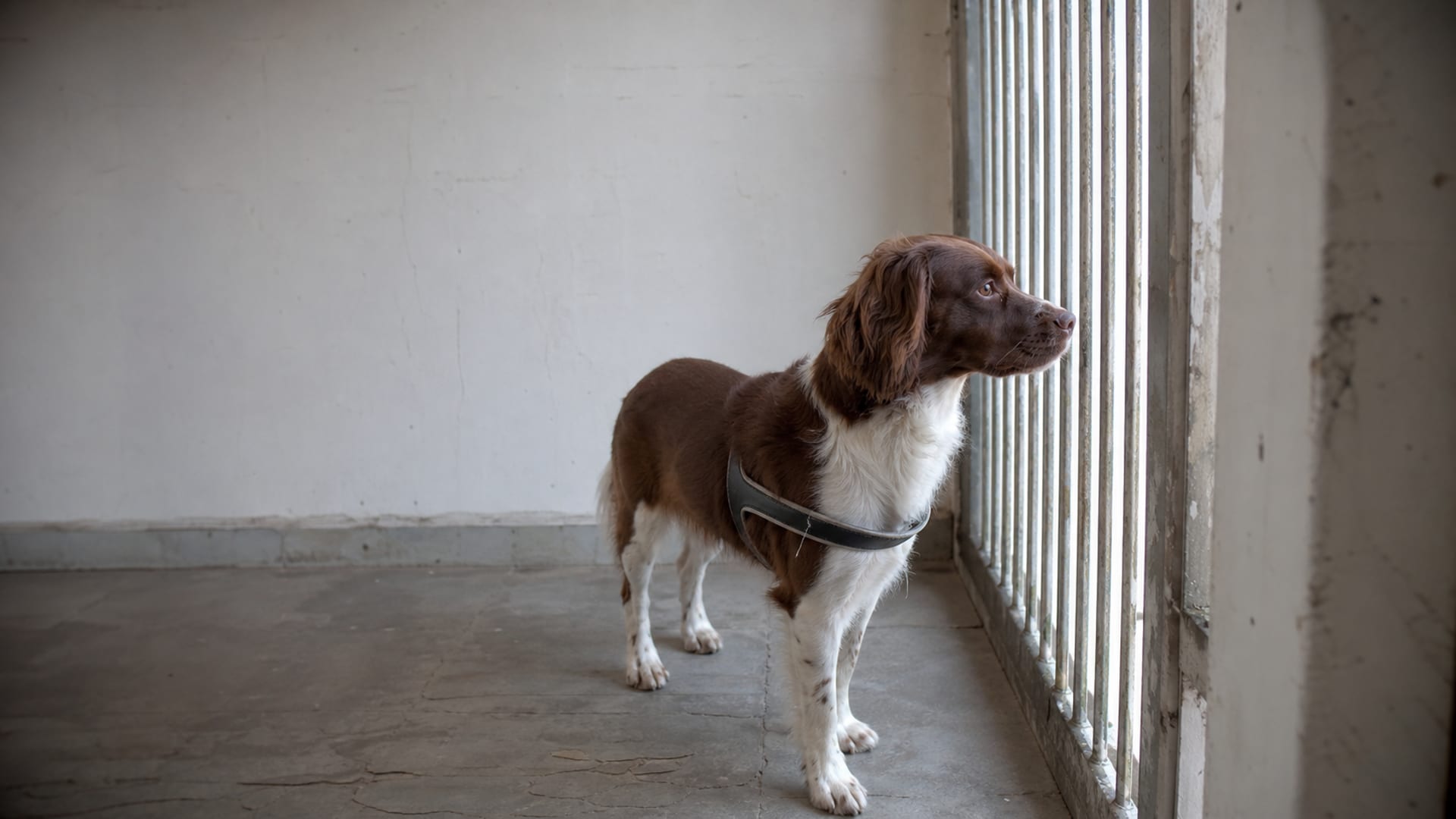
If your rescue dog has shown aggression, the order I follow is simple. Get a vet exam first, because pain and illness can sit behind a dog that snaps. Then give the dog a quiet, predictable first stretch at home, with management in place so nobody gets bitten. Then hire someone for a behavior plan, after you have asked them about their credentials and their methods. The shelter notes and the short history you were given are information about one dog on one day, not a forecast, so watch the dog in front of you.
Key takeaways
Hover or tap a card to bring it forward.
- Get a vet exam first for any new, worsening or unexplained aggression, then plan the behavior work.
- A shelter assessment is one observation, so ask for the history and watch the actual dog at home.
- Give the dog a quiet, predictable first stretch with management in place, and let behavior set the pace.
- Treatment is management first, then desensitization and counter-conditioning below the dog's reaction threshold, with medication as a vet's decision.
- Ask every trainer, including me, about credentials, methods and what happens if the case is beyond them, and bring in a veterinary behaviorist after a bite, with children, or when training is not safe.
What a shelter assessment can and cannot tell you
Shelter staff do their best with a stressed dog in a loud building, and the tests they use give structured observations. They do not predict how a dog will behave in your living room. A 2016 review by Patronek and Bradley in the Journal of Veterinary Behavior found that shelter dog tests lacked the validation needed for high-stakes decisions. A later review by Patronek, Bradley and Arps in the same journal covered more than 25 years of research. It reported a mean false-positive rate of 35.1 percent in study populations and an estimated 63.8 percent in typical shelter populations.
The detail matters when you read a kennel card. In a study of the SAFER assessment, 33 dogs at two municipal shelters were tested at intake and again after three days. Agreement between the two days ran from a weighted kappa of 0.28 to 0.78 depending on the subtest. Some dogs that could not finish one test because of severe aggression scored low for aggression on another. A UK temperament test was reproducible for several measures, but its authors called it a partial screen to combine with longer-term monitoring. The ASPCA, as summarized by Maddie's Fund, recommends repeated observation over time rather than one assessment.
Dogs Trust says shelter behavior can differ from behavior at home, and that staff may not know the dog's full history. So, before you sign anything, ask for the history. Ask what was observed and when. Ask about triggers, and about how the dog has acted around children, other dogs and other animals. Then expect the dog at your house to look different from the dog in the kennel, in either direction.
Hover or tap a row to highlight it.
| Study | What it looked at | What it found |
|---|---|---|
| Patronek and Bradley review (2016) | Published research on shelter dog tests | The tests lacked the validation needed for high-stakes decisions |
| Patronek, Bradley and Arps review (2019) | More than 25 years of shelter test research | Mean false-positive rate of 35.1 percent in study populations and an estimated 63.8 percent in typical shelter populations |
| SAFER assessment study | 33 dogs at two municipal shelters, tested at intake and after three days | Agreement between the two days ran from a weighted kappa of 0.28 to 0.78 depending on the subtest. Some dogs too aggressive to finish one test scored low for aggression on another. |
| UK temperament test | Kennel behavior, sociability, leash response, playfulness, cognitive skills and reactivity | Reproducible for several measures, but the authors called it a partial screen to combine with longer-term monitoring |
What happens after adoption, and what it does not prove
The numbers on returned and adopted dogs are worth knowing, with their limits attached. In a study of 102 dogs returned to one U.S. shelter over four months, aggression-related behavior was the most commonly recorded reason for return, at 38.2 percent of the returned dogs. That was a first look at a single shelter, so it does not describe all adopted dogs.
A U.S. cohort of 99 shelter dogs was followed for six months after adoption with the C-BARQ questionnaire. Owners reported stranger-directed aggression at some point in 81.7 percent of the dogs, owner-directed aggression in 32.3 percent, dog-directed aggression in 75 percent and familiar-dog aggression in 37.8 percent. Those are owner reports, not bite counts. The same study found that shelter and home behavior agreed only partly. At three months, about half of the dogs classed as food aggressive in the shelter showed it at home, and 22 percent of the dogs not classed that way later did. An Australian study of 123 adult dogs found some link between the shelter assessment and later behavior, but not enough to predict aggression with confidence.
None of this shows that rescue dogs are more or less aggressive than other dogs. Treat your dog's history as individual information, and let what you see in the first weeks add to it.
Hover or tap a row to highlight it.
| What owners reported | Share of dogs |
|---|---|
| Stranger-directed aggression at some point | 81.7 percent |
| Dog-directed aggression at some point | 75 percent |
| Familiar-dog aggression at some point | 37.8 percent |
| Owner-directed aggression at some point | 32.3 percent |
| Food aggression at home at three months, among dogs classed food aggressive in the shelter | About half |
| Food aggression at home at three months, among dogs not classed food aggressive in the shelter | 22 percent |
The vet check comes first
New, worsening or unexplained aggression deserves a veterinary exam before anyone builds a training plan. The Merck Veterinary Manual, VCA and the American College of Veterinary Behaviorists all describe the same starting point: a detailed history, a physical exam and a neurological exam, with tests when they are indicated.
The list of possible contributors is long. Pain from dental disease, arthritis or another injury is a common one. Others include sensory loss, neurological disease, kidney or liver problems, thyroid, adrenal or reproductive hormone disorders, infection, toxicity and medication effects. A medical problem can lower a dog's threshold for fear and irritability. An exam does not always find a cause, though, and plenty of dogs need both medical care and behavior treatment. Only a vet diagnoses a medical condition or prescribes medication, and I send every aggression case to one before I plan anything.
If you want a wider look at why dogs turn aggressive in the first place, I wrote about it in causes of dog aggression.

The first weeks at home
Keep the first stretch quiet and boring on purpose. Dogs Trust says the first few days are hard for a dog that is adapting to new people, smells, sounds and routines. Let the dog adjust at its own pace, supervise interactions, and keep a settling-in diary for the first three months. Write down eating, habits, preferences and any changes in behavior. The diary gives your vet and your trainer something better than memory.
You may have heard of the "3-3-3" rule, with three days to decompress, three weeks to settle and three months to feel at home. It is a popular timetable and a fair rough guide, but it is a guess, not a schedule. Some dogs settle faster and some slower. A stressful transition makes behavior hard to read; the SAFER study and Maddie's Fund both show how much a dog's behavior shifts between the shelter and home. So, set the pace by the dog's behavior rather than the calendar.
In practice that means management from day one. Use baby gates, closed doors and a crate or pen the dog likes. Keep introductions to visitors and other pets slow, and keep known triggers out of reach. No training plan makes up for a bite that a gate would have prevented.
The first weeks, in order
- Vet examNew, worsening or unexplained aggression gets a vet exam now, not after the dog settles in. Bring your notes to the appointment.
- Management from day oneBaby gates, closed doors and a crate or pen the dog likes, with known triggers kept out of reach.
- First few daysKeep things quiet and boring while the dog adjusts at its own pace to new people, smells, sounds and routines. Supervise interactions.
- Slow introductionsIntroduce visitors and other pets slowly, and let the dog's behavior set the pace rather than the calendar.
- First three monthsKeep a settling-in diary of eating, habits, preferences and any changes in behavior, so your vet and trainer have notes, not memory.
- Behavior planHire someone for a behavior plan after you have asked about their credentials and their methods.
What treatment looks like
Veterinary sources describe treatment as an individual plan built around safety, management, medical assessment and behavior modification. VCA, AAHA, the UC Davis Veterinary Behavior Service and the Merck manual agree on the main pieces.
Management comes first. That means barriers, separation, controlled exposure to triggers, changes to household routines and supervised interactions. VCA says some triggers may need to be managed permanently, because a dog can improve and still carry a bite risk. That is hard to hear, and it is true.
Desensitization shows the dog a trigger at a level below its reaction and raises the intensity slowly. Counter-conditioning pairs the trigger with something the dog values so the feeling behind the reaction changes. AAHA describes the two as commonly combined, with rewards given while the dog stays below its reaction threshold. Plans often add alternative behaviors, such as a hand target or a turn away, along with changes to the environment.
A basket muzzle can be part of the plan. VCA's muzzle guidance describes it as a safety skill, not a treatment for the cause. A properly fitted basket muzzle lets the dog pant and drink, and depending on the design, take treats. Teach it gradually and happily, so the muzzle does not become a frightening event. VCA notes that a muzzle can make counter-conditioning harder if the dog cannot take treats.
Medication is a vet's decision. Merck and AAHA describe it as one possible part of a plan when fear, anxiety or arousal gets in the way of learning or safety. It does not replace management or behavior work. If fear is a big part of your dog's story, my page on anxiety and nervousness in dogs covers that side.
Children and dogs need supervision at all times, and the ASPCA says a baby or young child should never be left alone with a dog. A dog that has bitten or may bite should be kept apart from children and visitors according to the safety plan your professional gives you. Keep the dog on leash in public and steer around known triggers. If children live in your home or visit it, read about dog aggression toward children before the dog comes home.

Lunging and barking at the end of a leash can come from different feelings. Patricia McConnell describes fear, frustration and a wish to create distance as separate causes, so the function of the behavior drives the plan. Two dogs can look identical on a walk and need different work.
Methods and credentials, said plainly
You will meet three broad camps. Reward-based trainers reinforce wanted behavior with food, play and praise while managing the environment. The American Veterinary Society of Animal Behavior recommends reward-based methods and says aversive tools should not be used for aggression. Karen Pryor Academy teaches marker-based training and offers a course on dog-dog and dog-human aggression.
Balanced trainers use rewards alongside corrections. Buck's Dog Training describes balanced training as rewards plus leash pressure, prong collars and remote collars. That is a practitioner describing a method, not an outcome study.
Remote collars have one controlled study worth naming. Cooper and colleagues in PLOS ONE compared three groups of 21 dogs, 63 in all, who were referred mainly for recall problems and livestock chasing, not aggression. It says nothing about treating aggressive rescue dogs. A separate owner survey on e-collar use asked about reasons, risk factors and perceived success, and a survey is not a controlled trial.
I use e-collars among other tools in a balanced approach, and I say so up front. For a dog like yours, what matters more is my process: an evaluation first, management in place, and a vet check before any training tool comes out. I make no claim that any tool is proven for aggression, and AVSAB's position is the one above.
Then come the letters after a trainer's name. Dog training is not a licensed profession in the U.S., so credentials are voluntary, and none guarantees a method or an outcome. Here is what each one means.
- CPDT-KA is the Certification Council for Professional Dog Trainers' credential. CCPDT requires at least 300 hours of training experience in the previous three years, an attestation and an exam. It does not allow diagnosis or medication.
- CAAB is the Animal Behavior Society's Certified Applied Animal Behaviorist. It requires advanced academic training. A CAAB is not a veterinarian, so no prescriptions or medical diagnoses.
- DACVB is a Diplomate of the American College of Veterinary Behaviorists. This is a veterinarian with specialty training who can assess health and behavior together and prescribe where the law allows. It is not a dog-training certification.
- IAABC CBC is the IAABC Certified Behavior Consultant, meant for consultants with at least three years of complex-case experience, including aggression, fear and anxiety. It carries no veterinary authority.
- KPA CTP is a Karen Pryor Academy graduate who has shown technical knowledge and hands-on skill. KPA describes its graduates as using force-free training.
The word "behaviorist" on its own does not tell you which of these someone holds. Ask.
Hover or tap a row to highlight it.
| Credential | Who holds it | What it does not allow |
|---|---|---|
| CPDT-KA | Dog trainer certified by the Certification Council for Professional Dog Trainers. Requires 300 hours of training experience in the previous three years, an attestation and an exam. | Diagnosis or medication |
| CAAB | Animal Behavior Society's Certified Applied Animal Behaviorist, with advanced academic training | Prescriptions or medical diagnoses, because a CAAB is not a veterinarian |
| DACVB | Veterinarian with specialty training, a Diplomate of the American College of Veterinary Behaviorists | Not a dog-training certification. It can prescribe where the law allows. |
| IAABC CBC | Certified Behavior Consultant with at least three years of complex-case experience, including aggression, fear and anxiety | Carries no veterinary authority |
| KPA CTP | Karen Pryor Academy graduate who has shown technical knowledge and hands-on skill | Not a veterinary credential |
What to ask before you hire, including me
AVSAB's guidance on choosing a trainer gives you questions that work on any trainer, and I want you to use them on me too.
- What credentials do you hold, and what experience do you have with dogs that have bitten or may bite?
- How will you prevent the dog from rehearsing the behavior during training?
- What equipment and techniques will you use?
- What are the risks of those techniques, and how do you handle them?
- What will you do if my dog gets more fearful, distressed or aggressive?
- How will you work with my veterinarian or veterinary behaviorist?
- What will you do if the case is beyond you?
AVSAB also lists red flags: physical force, rolling a dog onto its back and holding it down, pushing a dog into position, hitting, and choke or pinch corrections. Watch a session when you can, and pick someone who treats both you and the dog with respect. A good trainer explains why a technique is used, shows you what it looks like and tells you its drawbacks.
When you need a veterinary behaviorist
Some cases belong with a veterinary behaviorist. The list, drawn from AVSAB, the Merck manual and the ACVB, includes a bite or serious injury, children in the home, attacks that seem to come from nowhere, several triggers, severe fear, a sudden change in behavior and a suspected medical cause. Referral also makes sense when ordinary training cannot be done safely, when the dog is too fearful or too aroused to learn, or when earlier training failed or made things worse.
The ASPCA says aggression toward children is especially hard to treat because of the safety stakes, and that trust in the dog may stay low. A veterinary behaviorist can look at pain, neurological, hormonal and medication causes, prescribe if needed and write the plan. A trainer can stay on the team, but a trainer alone cannot diagnose medical causes or prescribe.
Frequently asked questions
Can a shelter's behavior test tell me if my dog will bite? No test has been validated for that kind of prediction. The Patronek review found false-positive rates of 35.1 percent in study populations, so treat the result as one observation. Your own notes over the first months carry more weight.
Should I wait to see a vet until the dog settles in? No. New or worsening aggression gets a vet exam now, because pain, thyroid trouble or a neurological problem can drive the behavior and settling in will not fix those. Bring your settling-in diary to the appointment.
Is a muzzle cruel for a rescue dog? A properly fitted basket muzzle, taught slowly with treats, is a safety skill that VCA recommends for many dogs. It lets the dog pant and drink, and it protects people while the real work goes on.
Does a credential mean the trainer is good with aggression? Not by itself. CPDT-KA, CAAB, IAABC CBC and KPA CTP each cover different training and none guarantees a method. Ask about experience with dogs that have bitten, and ask what they do when a case is beyond them.
Check what you learned about aggressive rescue dogs
What comes first when a rescue dog has shown aggression?
How should you treat a shelter behavior assessment?
What should the first stretch at home look like?
What does counter-conditioning do?
Who can prescribe medication for a dog's behavior problem?
Which of these is a reason to see a veterinary behaviorist?
Answer a question to see your score.
Final Thoughts
If you want to start with me, the first step is an evaluation visit, where I meet you and the dog and look at what is happening before I suggest anything. From there I work through in-home lessons, or board and train in my own home when that fits the dog. You can reach DW Dog Training through the contact page.