

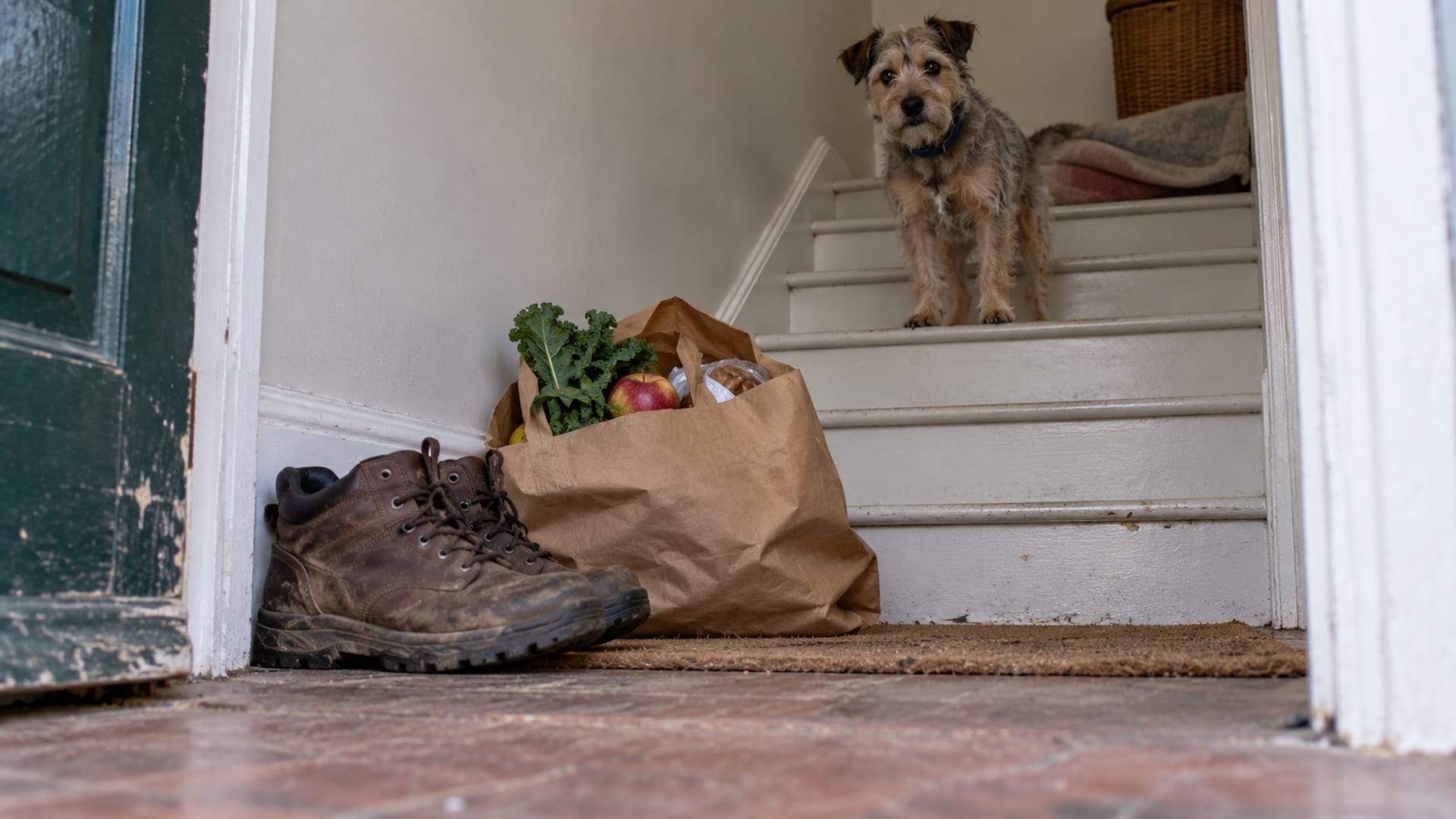
If your dog has ever lunged, snapped or bitten at someone who came to the house, the plan for the next visit is distance. Put the dog behind a gate or a closed door, or on a leash well back from the entrance, before anyone walks in, and ask your guests to ignore the dog completely. If the change is sudden, and a dog that used to love company is now afraid, see your vet first. Training the fear is a separate, slower job, and the dog should not be loose with guests while that work goes on.
The rest of this is how I would set up the door, what I would tell visitors, why dogs react this way, and when it is time to bring in a professional.
Key takeaways
Hover or tap a card to bring it forward.
- If a dog has lunged, snapped or bitten, keep it behind a gate or closed door, or on a leash well back from the entrance, before guests come in.
- Guests ignore the dog completely, never reach, corner or force a greeting, and toss treats from a distance instead of offering them by hand.
- A dog that suddenly becomes afraid of visitors needs a vet exam first, and medication is a veterinary decision.
- Training uses distance the dog can eat at, small steps and reward; short visits of 10 to 15 minutes are the session length, and progress is measured by recovery time and distance.
- Get professional help the first time a dog growls, lunges, snaps or bites at a person, and never rely on a muzzle or head halter to make guest contact safe.
Set up the arrival before the knock
The risky moment is the arrival: the doorbell, the open door, a stranger stepping inside, and a dog with nowhere to go. You can take most of that away with a few decisions made ahead of time.
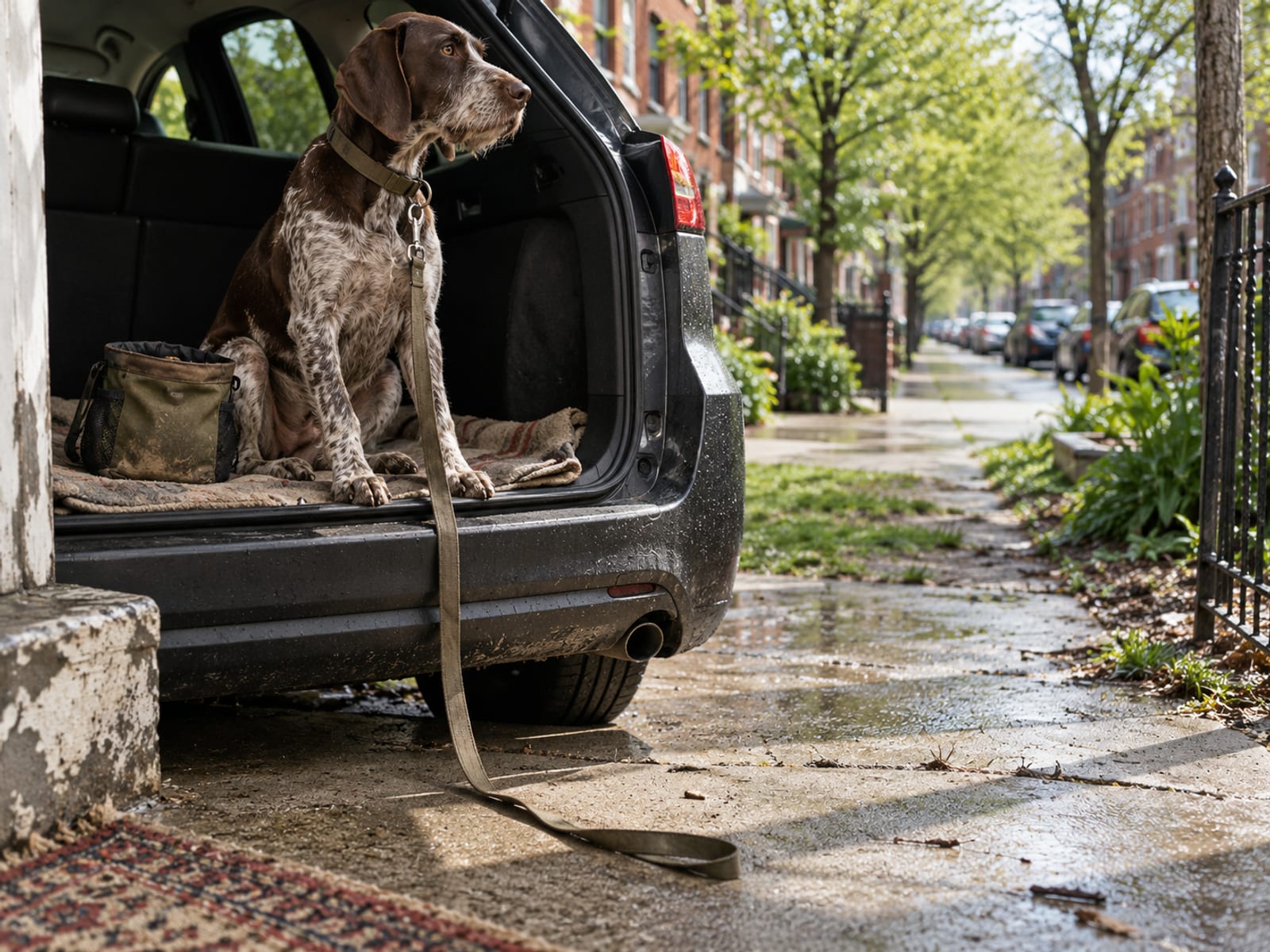
For a dog with any history of lunging, snapping or biting, AVSAB (the American Veterinary Society of Animal Behavior) and its Dr. Jen Summerfield recommend one of two setups. Either the dog is on a leash at a distance from the door, or the dog is behind a baby gate or other barrier in a separate room. Either way, the visitor should not walk into a chaotic doorway greeting. Summerfield also suggests skipping the doorbell and the knock when you can, because those sounds may already predict something upsetting. A text that says "come on in" or "I'm outside" does the job quietly.
A closed-door room is the simplest answer for repair workers, delivery people, children and any guest who will not follow instructions. AVSAB specifically advises putting the dog elsewhere before plumbers, repairmen and cable workers come in. You do not owe a stranger a test of your dog's patience, and the plumber does not need to find out the hard way.
A crate works too, if the dog already likes it. Cornell's College of Veterinary Medicine suggests a quiet spot with comfortable bedding and familiar toys, and sending the dog there when visitors arrive. That only helps if the crate was a good place long before the first guest. A crate the dog has learned to dread adds one more bad thing to the evening. VCA Animal Hospitals recommends secure confinement in a crate, room or pen, practiced while the house is calm, and a gate gives you the same separation while the dog can still see and hear the home.
If your dog can settle in the same room, VCA recommends that an adult hold the leash securely, and that visitors do not interact until a behaviorist says interaction is appropriate. "Settle" means the dog is lying down or eating, not standing stiff and staring. If you are not sure which one you are looking at, put the dog in the other room.
What your guests should do
Give guests their instructions before they arrive, not at the door. Keep it short.
AVSAB's instruction is plain: guests should ignore the dog completely. They should not look at the dog, talk to it, reach for it or try to pet it, even if the dog comes over for a cautious sniff. Nobody forces a greeting, reaches over the dog, corners it or tries to pull it closer. If the dog is afraid of people leaning over, Cornell suggests the guest sit down.
Treats are where well-meaning guests get into trouble. Guests often want to win the dog over with food from the hand. AVSAB's Summerfield says to toss treats from a distance instead, and warns that a very fearful dog may come forward to take the food and then bite the hand once the food is gone. The dog decides whether to approach. The treat builds a good association without asking for contact. Unless a qualified professional has told you hand-feeding is safe for your dog, toss.
Cornell veterinarian Brian Perry puts the principle in two lines: "Owners should never force a dog to confront fears head-on," and "If the dog can approach someone voluntarily (and be rewarded for doing so), he will be less fearful." A dog that walks up is not asking to be petted, though. The guest keeps ignoring the dog until the dog's behavior professional gives a specific plan for interaction.
A muzzled dog is not an invitation either. VCA says visitors should not try to approach or pet a muzzled dog, because that invades the dog's safe space and can raise fear and future bite risk. And children are never helpers in this kind of training. The ASPCA says children and dogs should always be supervised and a baby or young child should never be left alone with a dog.
Hover or tap a row to highlight it.
| Guest action | What to do | Why |
|---|---|---|
| Greeting the dog | Ignore the dog completely: no looking, talking, reaching or petting | The dog decides whether to approach |
| Getting closer | Never force a greeting, reach over, corner or pull the dog closer | Fear bites happen when a dog cannot get away |
| If the dog walks up | Keep ignoring it unless a behavior professional has given a plan | Approaching is not asking to be petted |
| Treats | Toss them from a distance, never from the hand | A fearful dog may take the food and then bite the hand |
| Posture | Sit down if the dog is afraid of people leaning over | Leaning over can feel threatening |
| A muzzled dog | Do not approach or pet it | It invades the dog's safe space and raises fear and bite risk |
| Children | Never use them as helpers in training | Children and dogs should always be supervised |
Can this dog actually bite?
Yes, and I would plan as if it can. Fear bites happen when a dog cannot get away, is cornered or restrained, or believes the person will keep coming. VCA says a fearful dog may snap or bite when a visitor reaches toward it. The ASPCA describes fear aggression as a fight response when escape is not available, and notes that some fearful dogs bite quickly and retreat.
So, a dog with a bite history, a lunging history or any credible chance of biting should not be loose with visitors. AVSAB recommends a closed door in a separate room while visitors arrive and stay in the home, and VCA recommends secure confinement until the visitors have settled.
A basket muzzle adds a layer of safety when it is introduced slowly and fitted properly. VCA's muzzle guidance says a good basket muzzle lets the dog pant, eat treats and show body language while preventing a bite. Teach it well before the visit, in small comfortable steps, never in the minute before the doorbell. VCA also describes the leash, head halter, gate, crate and basket muzzle as safety and management tools, not training. A head halter may redirect attention, but it does not stop a bite.
Hover or tap a row to highlight it.
| Tool | What it does | What it does not do |
|---|---|---|
| Closed room or gate | Separates the dog from visitors; a gate lets the dog still see and hear the home | Does not train the fear |
| Crate | Gives a quiet, familiar spot during visits | Only helps if the dog already liked it before the first guest |
| Leash held by an adult | Keeps the dog back from the entrance or settled in the room | Is management, not training |
| Head halter | May redirect attention | Does not stop a bite |
| Basket muzzle | Lets the dog pant, eat treats and show body language while preventing a bite | Does not make it safe for visitors to approach or pet |
Why dogs do this
There is rarely one cause. The Merck Veterinary Manual lists fear, uncertainty, inheritance, previous learning, poor socialization and punishment as factors in fear aggression. VCA adds pain, medication effects and illness, and in older dogs arthritis, sight or hearing loss and cognitive change.
The numbers give some shape to it, with limits. In a 2020 Scientific Reports study by Tiira and Lohi, 896 of 5,932 Finnish dogs were classified as fearful of strangers. Stranger fear was linked with breed, poorer socialization in puppyhood, less training or activity and more urban living. Those were owner reports collected at one point in time, so they show associations, not causes for your dog. A dog from a busy city apartment is not doomed, and a country dog is not safe from it.
Behavior toward visitors in the home is common enough that you are not the only one dealing with it. A UK owner survey by Casey and colleagues in 2014 found that about 7 percent of owners, 258 respondents, reported aggression toward unfamiliar people entering the house. That counted everything from barking through biting, so it covers more than fear alone. The authors also found that aggression varied by context: a dog can be fine on a walk and a different animal in the front hall.
Fear can look a lot like territorial or protective behavior. Merck describes territorial aggression as protecting a place such as a home, yard or car from an approaching person, even one who is not acting threateningly. Protective aggression is guarding the owner, and it grows as the person gets closer. A dog can be mixed. Fear can start the barking, and territorial learning can keep it going, because the visitor always leaves. From the outside you cannot reliably tell which one you have by watching a single reaction. What matters is the whole sequence: what happens before, the dog's posture, whether there was a way out, how far away the person was, how fast the dog recovered, and whether it happens anywhere else. If your dog's pattern sounds more like guarding, my pieces on managing territorial dog aggression in the home and how to manage your dog's territorial aggression cover that side.
Hover or tap a row to highlight it.
| Pattern | What it is about | What you may see |
|---|---|---|
| Fear | Getting away from a person the dog finds scary | Cowering, looking away, tucked tail, lip licking, trembling, hiding or freezing, then barking, lunging or snapping when it cannot escape |
| Territorial | Protecting a place such as a home, yard or car | Barking, chasing, growling or biting at an approaching person, even one who is not threatening |
| Protective | Guarding the owner | Reactions that grow stronger as the person gets closer to you |
| Mixed | Fear that starts the barking, kept going by territorial learning | Barking that seems to work because the visitor always leaves |
If it changed suddenly, call the vet first
A dog that used to welcome visitors and is now afraid or aggressive needs a veterinary exam before anyone treats it as only a training problem. Pain is the one I worry about most. Merck, VCA and the ASPCA between them name dental disease, arthritis, injury, ear disease, sight or hearing loss, neurological and hormone problems such as thyroid disease, organ disease, medication effects and cognitive decline. Merck calls pain aggression a defensive reaction, and says kidney, liver, neurological, adrenal, sex-hormone and thyroid disorders can contribute to aggression. For senior dogs, the ASPCA says cognitive dysfunction is considered only after medical and unrelated behavior causes are ruled out.
Watch for changes in vision, hearing, sleep, orientation, appetite, mobility and elimination, and tell the vet about all of them. If fear persists or gets worse, or the dog could hurt someone, the next step after the exam is a board-certified veterinary behaviorist or a qualified behavior professional.
Medication is a veterinary decision. AVSAB says serious fear and aggression may need medication as part of a plan, but a veterinarian should evaluate the dog first so medical causes can be excluded and the diagnosis and plan are accurate. It is not a trainer's call, and it is not something to pick up from an internet forum.
What training looks like, and how long it takes
The approach with the most support in the veterinary behavior world is desensitization and counter-conditioning. VCA describes desensitization as introducing the person, or any trigger, gradually, at an intensity low enough that the dog stays calm enough to eat. Counter-conditioning pairs the trigger with something the dog values, like food, so the feeling about the trigger changes. UC Davis says the process should be slow and gradual, and warns against flooding, punishment and moving too fast.
For a visitor problem, that means practicing at the distance where your dog can still take a treat. If the dog stops eating, you are too close, and the fix is more distance, not more treats.
A few named methods fit into that:
Karen Overall's Protocol for Relaxation teaches calm body behavior in small, structured steps, and the exercise gets harder only after real progress. When anxiety shows, you go back to an easier step. Overall also says medication, when it is used, goes with behavior modification, not in place of it.
Leslie McDevitt's Control Unleashed program includes Look at That, where the dog notices the trigger and then turns back to the handler for a reward. It is practiced while the dog is still able to think and disengage.
Grisha Stewart's Behavior Adjustment Training sets up safe situations where the dog controls the distance and can choose calmer behavior. Stewart describes following the dog on a loose leash and making things easier when stress goes up. It is a trainer-developed method, not a controlled trial for visitor fear.
On the question everyone asks, I can't give you a number of weeks, and nobody can for your dog. The pace depends on how easily the dog is pushed over threshold, its history, how intense the reactions are, how well it can eat and learn, how often visitors come, and whether you can keep the dog from rehearsing the barking and lunging. AVSAB says desensitization and counter-conditioning are not instant fixes and that progress is often slow at the beginning. Overall notes that some dogs get a little worse for a few days to a few weeks while they learn a new pattern, which is not a sign you did something wrong.
AVSAB describes short helper visits of 10 to 15 minutes as useful sessions. That is the length of a practice visit, not the time the fear takes to change. Measure progress by what you can see: how fast the dog recovers, whether it will eat, whether it can look away, how much less distance it needs, and fewer or milder warning signs. If you want a sense of the wider picture for a shy dog, The Shy Dog's Guide to Conquering Fear: 10 Simple Techniques lays out everyday exercises, and socializing your fearful dog covers building confidence around people and places.
AVSAB advises reward-based methods for fear. I work the fear through distance and reward first.
Hover or tap a row to highlight it.
| Method | What it teaches | How it works |
|---|---|---|
| Desensitization | Staying calm near the trigger | Introduce the person gradually at a level the dog can still eat at |
| Counter-conditioning | A new feeling about the trigger | Pair the trigger with something the dog values, like food |
| Protocol for Relaxation (Karen Overall) | Calm body behavior | Small, structured steps that get harder only after real progress |
| Look at That (Leslie McDevitt) | Noticing the trigger, then turning back to you | The dog looks, then turns to the handler for a reward, while it can still think |
| Behavior Adjustment Training (Grisha Stewart) | Choosing calmer behavior | The dog controls the distance on a loose leash |
When to get help
Get help the first time your dog barks, growls, lunges, snaps or bites at a visitor. The ASPCA says to seek professional help the first time a dog shows aggression toward any person, even when nobody is hurt. Do the same if you cannot keep the dog under threshold during normal visits, if the dog has already injured someone, or if its history makes a bite plausible. VCA adds that a behavior professional is the right call when fear or frustration is high, or you worry the dog could injure a visitor.
Whoever you hire should be able to explain the management plan, name your dog's warning signals and triggers, tell you how visitors will be protected and change the training when the dog shows distress. AVSAB recommends credentialed professionals, and warns against intimidation, flooding, physical force and aversive tools.
My evaluation visit looks at your dog in its own front hall, which is where this problem lives. In-home lessons then practice the arrival with your real door and your real guests, and board and train in my home is an option for dogs that need more than lessons can give. If you are in the Baltimore area and a visit is coming up, contact DW Dog Training and tell me what has happened so far.
Frequently asked questions
Should I let my dog meet the visitor so it gets used to them? No. Cornell's Brian Perry says a dog should never be made to confront fears head-on. Let the dog choose to approach while the guest ignores it, and keep the dog behind a gate or on a leash if there has ever been a lunge, snap or bite.
Is a muzzle a good way to let guests pet my dog? No. A basket muzzle is a safety layer, and VCA says visitors should not approach or pet a muzzled dog, because it invades the dog's safe space and can raise fear and bite risk. Introduce it gradually, well before the visit.
Why does my dog only react to people in the house? The same dog can behave differently by place. Casey and colleagues found that aggression toward people varied by context, and Merck describes territorial behavior as protecting a home, yard or car. Fear can also be mixed in, so have a professional look at the full sequence before you settle on a label.
Can I use medication to fix this? Only a veterinarian can decide that. AVSAB says serious fear and aggression may need medication as part of a plan, after a vet has ruled out medical causes. Medication goes alongside behavior work, not in place of it.
Check What You Picked Up
What is the simplest setup for a dog with a history of lunging or biting at visitors?
How should guests give treats to a fearful dog?
A dog that used to love company suddenly fears visitors. What comes first?
In training, what does it mean if the dog stops taking treats?
What does a basket muzzle do?
How long is a practice visit with a helper?
Answer a question to see your score.