

Some links in this post are Amazon affiliate links. If you buy through one I may earn a small commission, at no extra cost to you. It never changes what I recommend. Full disclosure.
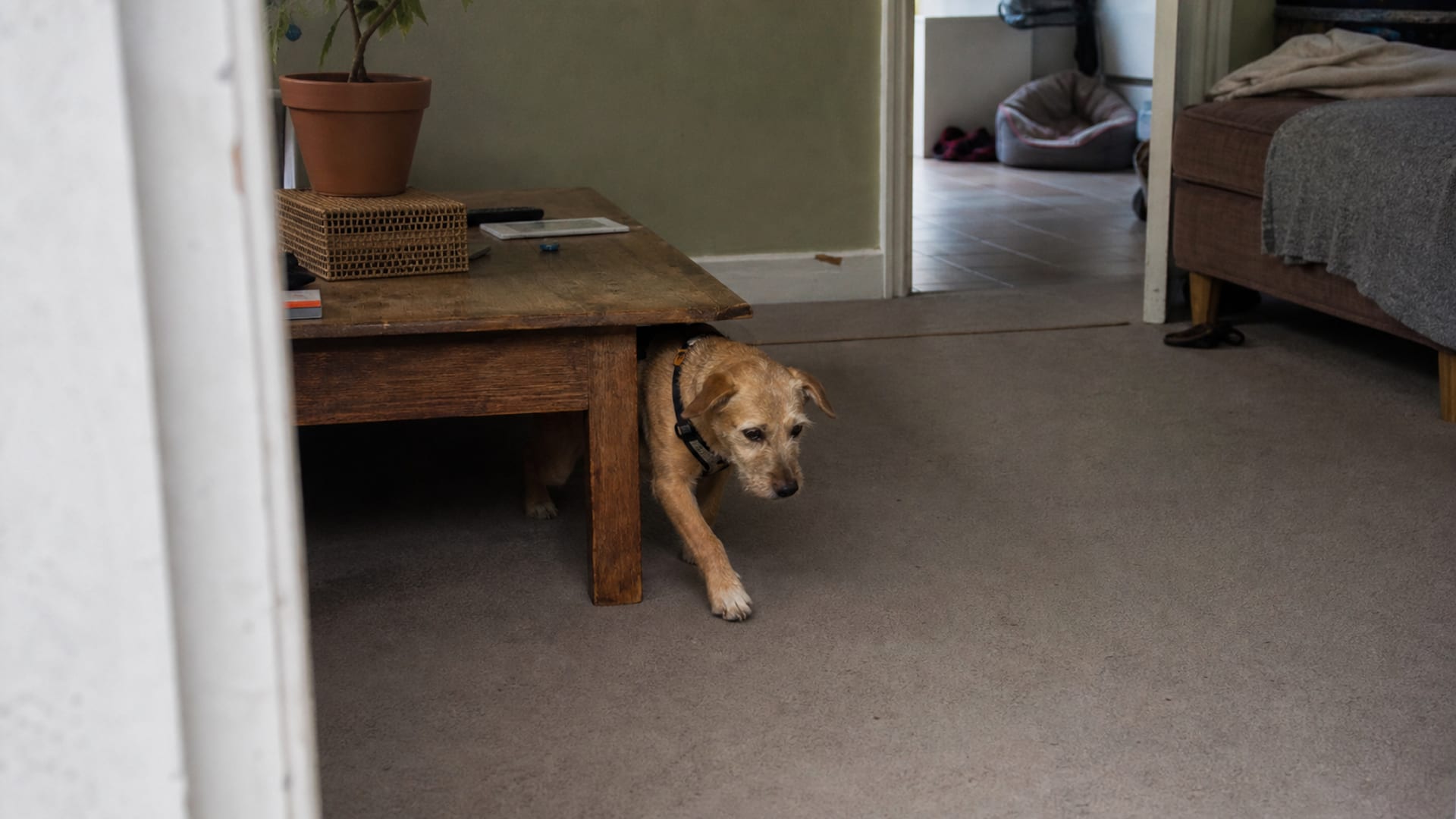
A shy dog is a frightened dog, and the work is to lower the fear in steps your dog can handle while letting your dog choose how much distance it needs. You do not push a dog toward the thing it fears. If the fear is new, or it has gotten worse, start with a visit to your vet, because pain and illness can look a lot like shyness. After that, the day-to-day plan is small, quiet and repeated: food, distance, a safe place and a steady routine. Planned meetings with new people and new dogs come later and are a separate subject.
Key takeaways
Hover or tap a card to bring it forward.
- A shy dog is a frightened dog; lower the fear in small steps and let your dog choose its distance.
- When fear is new, worse or unexplained, see your vet first, because pain, sensory loss and illness can look like shyness.
- Work below your dog's threshold: weak trigger, far distance, high-value food, one change at a time, and back up when fear shows.
- A quiet retreat, a steady routine and a calm owner support the work but do not replace it.
- Get a vet or veterinary behaviorist involved for severe, widespread or persistent fear, panic, fear aggression or no progress, and after any bite or near-bite.
How does a frightened dog show it?
VCA's veterinary behaviourists list freezing, hiding, fleeing, pacing, fidgeting, trembling, panting, urinating and defecating. When a frightened dog cannot get away, the list also includes growling, lunging, snapping and biting.
The quiet signs are easy to miss. A dog may look away, lower its head or body, pin its ears, tuck its tail, lick its lips, yawn or raise a paw. Read these as a group and in the setting where they happen. A yawn in a sunny living room can just be a yawn. A yawn with a lowered body, a turned head and a tucked tail, while a stranger walks toward the couch, is a dog telling you it is uneasy.
Fear-based aggression usually has one goal, which is more distance from something the dog finds threatening. It is not a bid for status. If your dog is growling and you are not sure whether it is play, fear or something else, the difference between aggression and playfulness is worth reading before you decide what you are dealing with. For a fuller list of warning signals, the signs of aggression in dogs and how to respond to them covers what to do in the moment.
One more point on reading your dog. Beerda and colleagues documented low posture, retreat, freezing, trembling, panting, whining, lip licking, gaze aversion, paw lifting and body shaking as fear and stress behaviors. A dog that shows none of these is not automatically relaxed. During long-term stress, a dog may go quiet and withdrawn instead, and that can pass for being "good."
Hover or tap a row to highlight it.
| Kind of sign | What you may see | When it tends to show |
|---|---|---|
| Obvious signs | Freezing, hiding, fleeing, pacing, fidgeting, trembling, panting, urinating, defecating | When a frightened dog is uneasy and can still get away |
| Signs when the dog cannot get away | Growling, lunging, snapping, biting | When distance is not an option |
| Quiet signs | Looking away, lowering the head or body, crouching, pinned ears, tucked tail, lip licking, yawning, raised paw, rolling onto the back | Read them as a group and in the setting where they happen |
| Long-term stress | Going quiet and withdrawn | It can pass for being "good" |
What is behind shyness?
Usually more than one thing. Genetics, early life, too little gentle exposure when the dog was young, bad experiences, punishment, and pain or illness all contribute. Nobody should assign one cause to your dog without a history and a vet check, including me.
Here is what the named sources add:
- Scott and Fuller spent about twenty years on controlled work at the Jackson Laboratory, published in Genetics and the Social Behavior of the Dog in 1965. Their work helped establish an early socialization period of roughly 3 to 12 weeks. Some of it came from experimental and kennel-raised dogs, so it is not a profile of the average pet.
- Appleby, Bradshaw and Casey put the period at about 3.5 to 12 weeks, with variation by breed. Early exposure protects when it is gradual and positive. Overwhelming exposure can raise fear.
- Tiira and Lohi surveyed the owners of 3,264 Finnish family dogs. Anxiety traits were linked to early-life experiences, maternal care and exercise. It was a questionnaire, so it shows links and cannot show that one thing caused another.
- Svartberg and Forkman analyzed behavioral test data from 15,329 dogs of 164 breeds and found stable differences in boldness and sociability between dogs. Those scores do not tell you why your own dog is afraid.
If you want more background, the causes of dog aggression overlap heavily with the causes of fear, and how breed shapes temperament is one piece of the genetic side.
Why does the vet come first?
When fear is new, suddenly worse, unusually intense, shows up in an adult or senior dog, or has no clear trigger, the exam comes before any training plan. The Merck Veterinary Manual says a behavior diagnosis should not replace a medical evaluation, and your vet decides which tests make sense after taking a history and doing physical and neurological exams.
The medical list is long:
- Pain lowers the threshold for fear, irritability and defensive behavior. A dog that hurts will often react sooner and harder. This is one reason aggression after surgery can show up in a dog that was easygoing before.
- Hearing or vision loss makes ordinary events unpredictable, so a dog startles at a person it never heard coming.
- Neurological disease, focal seizures and cognitive dysfunction can change how a dog responds to people, places and sounds. That is part of why aggression in older dogs needs a medical look first.
- Endocrine and metabolic conditions matter too. The Merck Veterinary Manual lists hypothyroidism with lethargy, irritability and aggression.
Hover or tap a row to highlight it.
| Problem | How it can show up |
|---|---|
| Pain | Lowers the threshold for fear, irritability and defensive behavior, so the dog reacts sooner and harder |
| Hearing or vision loss | Ordinary events become unpredictable, so the dog startles at a person it never heard coming |
| Neurological disease, focal seizures, cognitive dysfunction | Changes how a dog responds to people, places and sounds |
| Hypothyroidism | Lethargy, irritability and aggression |
| Other illness, such as hyperadrenocorticism, liver or kidney disease, or anemia | Can change anxiety, sleep, activity and how the dog responds to things around it |
What to do day to day
Here is the plan I would hand an owner whose vet has said the dog is physically fine. Take it in order, and go slowly.
1. Find the trigger and break it into parts
A "scary visitor" is really several things: distance, movement, voice, smell, a hat, a loud laugh. Name which parts bother your dog. VCA describes the whole process as desensitization and counter-conditioning, and it starts with this breakdown.
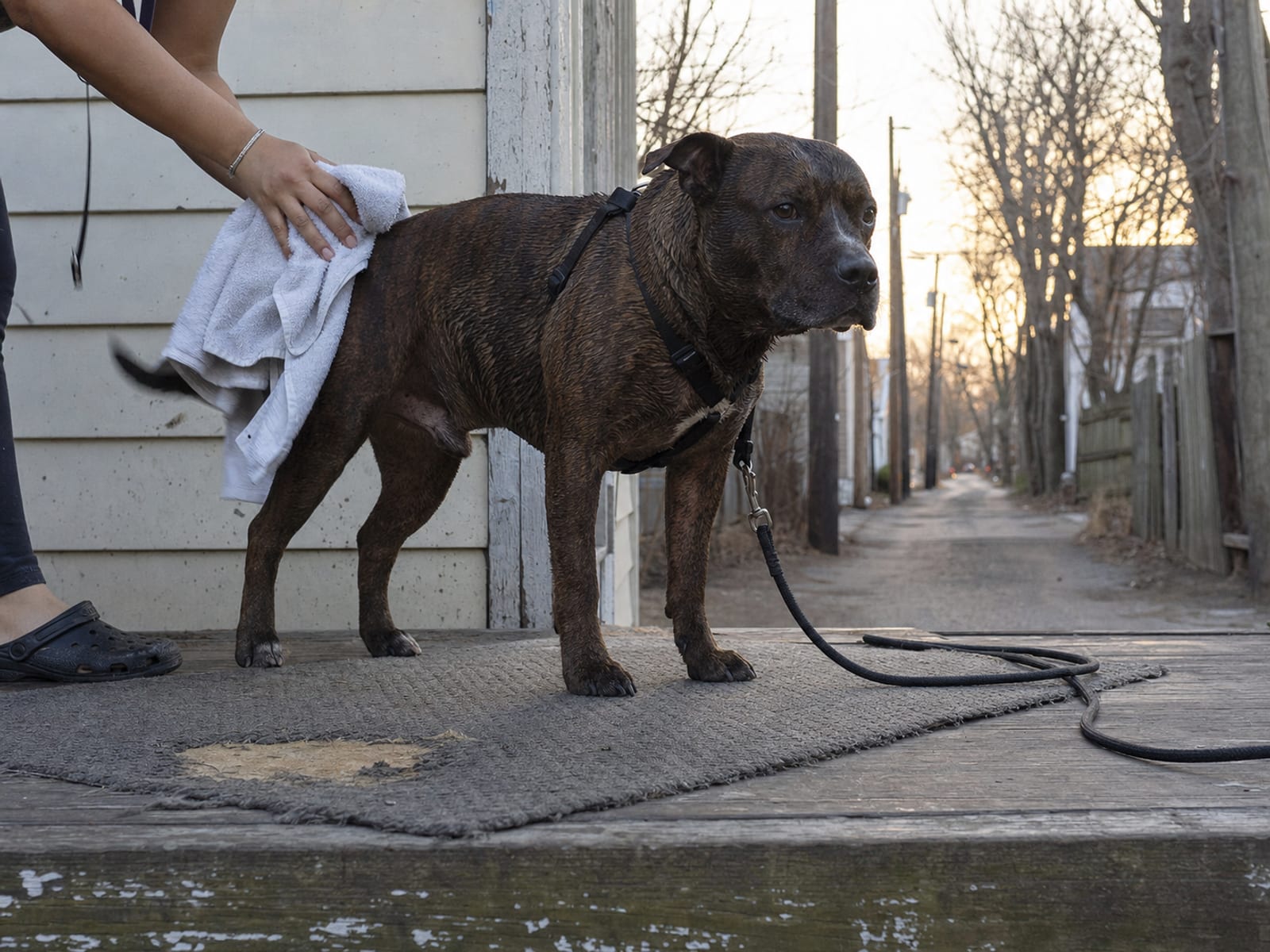
2. Start with the weakest version
Begin with the least intense piece, or the greatest distance at which you can still work. If you are not sure where that is, pick farther.
3. Keep your dog below the fear line
The right level is one where your dog notices the trigger and can still eat. A dog that refuses a piece of chicken is telling you the level is too high.
4. Pair the trigger with something your dog loves
High-value food or play, appearing as the trigger appears, is how the feeling changes over time. The trigger shows up, good things follow.
5. Change one thing at a time
Move closer, or add movement, or add sound. Do not do two at once.
6. Go back a step when fear shows
Going back is part of the plan. If your dog freezes, stops taking food or pulls away, drop to an easier version and let the dog recover.
7. Let your dog approach and never force it
Cornell's veterinary guidance is to avoid forced interaction, let the dog come forward on its own, and reward calm. Flooding, punishment and forced confrontation are discouraged by the veterinary sources I rely on. If a guest wants to pet your dog, the dog gets a vote, and "no" is a complete answer.
8. Give your dog a retreat nobody can invade
Cornell recommends a familiar crate or other safe space with comfortable bedding, with access controlled so children and other pets cannot crowd in. Introduce it with good things. Never pull your dog out of it, and never use it as punishment. If you have children at home, a dog with a place to go is safer for everyone, and aggression toward children is worth understanding before a frightened dog and a loud kid end up in the same room.
9. Keep a steady routine, with sniffing walks and food puzzles
Feeding, play, training, departures and greetings at predictable times take surprises out of the day. Add walks where your dog gets to sniff, short reward-based skill work, and food puzzles. These are support, not stand-alone treatment. Menor-Campos and colleagues reported less stress and better welfare in shelter dogs given exercise and human contact. Herron and colleagues saw better desirable behavior and less undesirable behavior in enriched shelter dogs, but fearfulness was not significantly different between their groups. Both were shelter dogs, and what works in a kennel may not carry over to a dog living in your house.
10. Stay calm yourself, and slow down if you are not
VCA says an owner's anxiety can pass to the dog during fear work and recommends slowing down if you feel uncertain. Siniscalchi and colleagues tested 52 dogs under a lab stress procedure and saw owner and dog stress move together. Sundman and colleagues and Gácsi and colleagues found the same kind of link in heart rate. That link does not mean you caused your dog's fear. It does mean a loose leash, a quiet voice and a calm body are worth practicing.
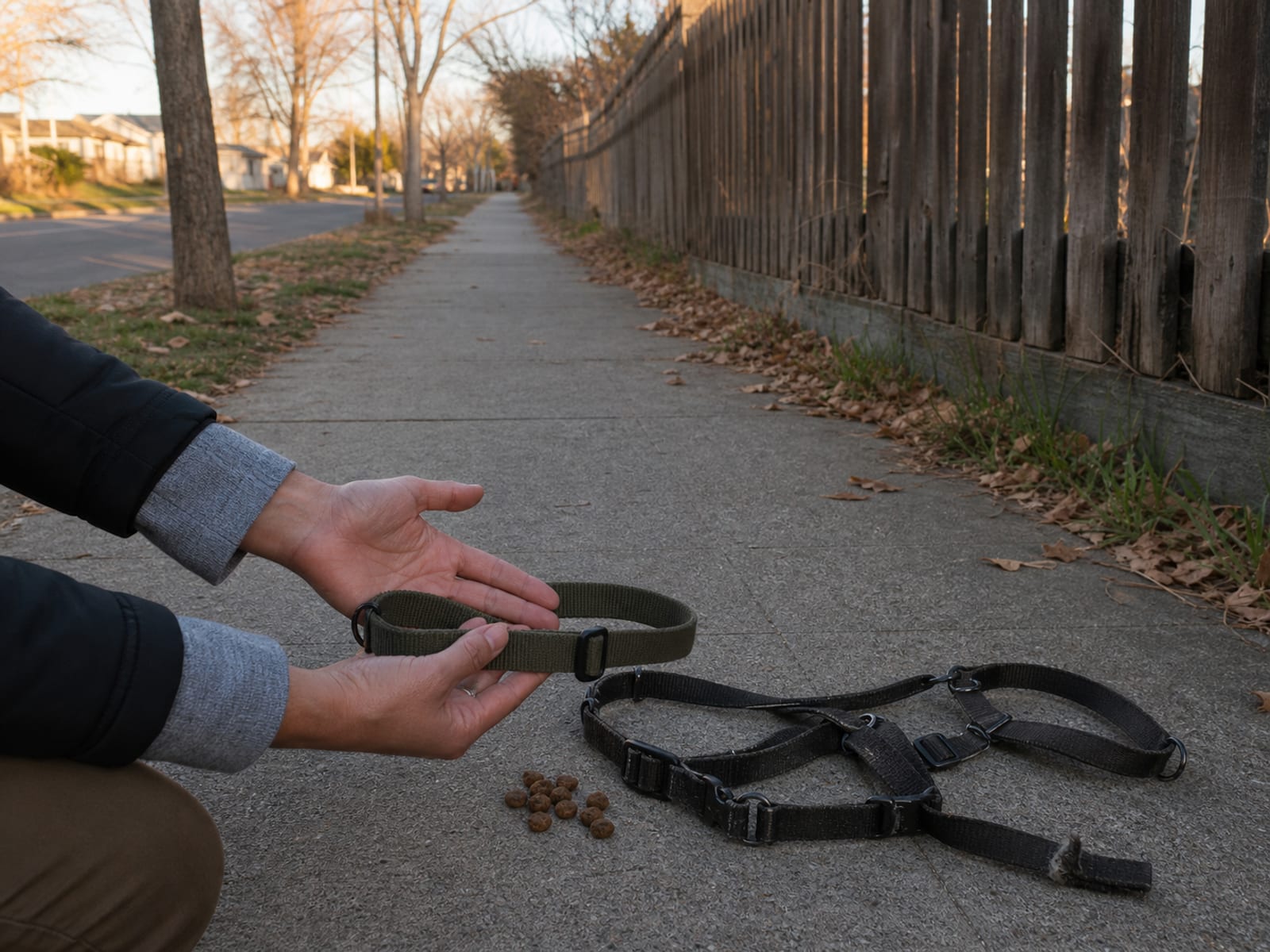
Desensitization and counter-conditioning, step by step
- Find the trigger and break it into partsA "scary visitor" is really distance, movement, voice, smell or a hat. Name which parts bother your dog.
- Start with the weakest versionBegin with the least intense piece or the greatest distance. If you are not sure, pick farther.
- Stay below the fear lineYour dog should notice the trigger and still be able to eat. Refusing a piece of chicken means the level is too high.
- Pair the trigger with something your dog lovesHigh-value food or play appears as the trigger appears, so the feeling changes over time.
- Repeat in short sessionsRepeat until your dog stays relaxed at that level, with breaks between short sessions.
- Change one thing at a timeMove closer, or add movement, or add sound. Never two at once.
- Go back a step when fear showsIf your dog freezes, stops taking food or pulls away, drop to an easier version and let the dog recover.
- Combine the partsOnce each piece is easy on its own, put the trained pieces together gradually.
- Let your dog approachNever force it. The dog gets a vote, and "no" is a complete answer.
What about tools and training methods?
You will meet strong opinions on this, so here is what the professional bodies say.
Ziv reviewed 17 studies on aversive training methods and reported risks to physical and mental welfare, including stress and fear effects. The studies had small samples and some possible bias, and the review did not show that every use of every tool has the same result. Vieira de Castro and colleagues compared 92 dogs from training schools. Dogs trained with aversive methods showed more stress behavior and higher cortisol after training. The study was not randomized, so it cannot prove the method alone caused the difference.
AVSAB recommends against electronic collars for training or behavior treatment and cites a study in which experienced trainers got no recall advantage from remote collars over reward-based training. BSAVA likewise lists electric collars, prong collars, choke chains and leash jerks as aversive and recommends reward-based training. These are professional positions, not a claim that every dog responds the same way to every tool.
My own practice includes e-collar work among other tools. For a frightened dog, though, the work is food, distance below the dog's threshold, and no force. That is all the fear work needs.
When is medication part of the plan?
Medication is one possible part of a plan that also includes management and behavior work. VCA's behaviorists describe it as an option when fear is severe, shows up in many places, prevents learning, causes panic or self-injury, involves triggers you cannot avoid, or stays disabling despite a sound behavior plan. It does not replace training or trigger control. It may lower fear enough for a dog to eat, recover and learn, and no outcome is guaranteed.
The evidence is stronger for some situations than for confidence-building in general. Moffat's review of pre-appointment medications found evidence involving four medication classes for short-term situational fear in dogs and cats, from a small body of data. Your vet prescribes and monitors. A veterinary behaviorist can assess medical and behavioral factors together, prescribe where the law allows, and coordinate the training plan. The board-certified credential is the DACVB. According to AVSAB, that means a two- to three-year residency with more than 400 supervised behavior cases, plus a board exam. You can search the American College of Veterinary Behaviorists for one.
When should you get help?
Ask for professional help when fear is extreme, persistent or widespread, when your dog panics, stops eating, tries to escape, or shows fear aggression, or when careful work has stopped making progress. AVSAB and VCA say the same. The RSPCA adds that a dog frightened of many things should get a veterinary assessment and, where needed, a referral to a qualified clinical animal behaviourist.
If a bite or near-bite has already happened, separate your dog from whoever was the target, see your vet, and bring in qualified support. Where fear has turned into aggression, a full guide to stopping aggressive behavior in dogs gives you the management steps while you wait for that help.
Credentials come in several kinds. A CAAB is certified through the Animal Behavior Society. The IAABC certifies Certified Dog Behavior Consultants (CDBC). CPDT-KA and KPA-CTP are trainer certifications. "Trainer" and "behaviorist" are not protected titles, so a certificate is a start and not a guarantee. AVSAB's advice on selecting a consultant is to ask how the person handles fear, whether the dog can opt out, and what tools they use. A good professional works with your dog's vet.
Hover or tap a row to highlight it.
| Credential | What it means |
|---|---|
| DACVB | Board-certified veterinary behaviorist. Two- to three-year residency with more than 400 supervised behavior cases, plus a board exam. Can check medical causes and prescribe medication. |
| CAAB | Certified Applied Animal Behaviorist, certified through the Animal Behavior Society |
| CDBC | Certified Dog Behavior Consultant, certified by the IAABC |
| CPDT-KA and KPA-CTP | Trainer certifications |
Questions owners ask
What should I tell the vet? Report pain, confusion, changes in sleep, tremors, seizures, and any trouble hearing or seeing. Also say when the fear began and whether it came on suddenly, because BSAVA advises contacting a vet promptly for newly shown fear, avoidance or aggression toward people or pets the dog knows.
How do I know I am going too fast? Your dog stops taking food, freezes, stares, turns away, or shows any of the signs listed above. Go back to an easier step and rest before trying again. Short sessions with breaks between them work better than one long push.
Will my dog ever be bold? Some dogs are naturally bolder than others, and those differences are stable. The goal is a dog that copes, recovers faster and has more good days. I cannot promise a different personality, and no honest trainer can.
What if my dog has already snapped? Keep your dog apart from the person or animal it snapped at, and schedule a vet visit. Then get qualified help. Do not try to handle it alone by pushing your dog closer to the trigger.
Check what you learned about shy dogs
What should you do first when a dog's fear is new or has gotten worse?
What is fear-based aggression usually trying to get?
How do you know the training level is right for your dog?
Your dog freezes and stops taking food during a session. What now?
What is the right way to treat a retreat space like a crate?
When should you get professional help?
Answer a question to see your score.
Final Thoughts
Some dogs need more than advice from a page. I offer an evaluation visit, in-home lessons, and board and train in my own home for dogs whose problem needs hands-on work. If your dog has bitten or nearly bitten anyone, say so on the first call so I can plan safely. You can reach DW Dog Training through the contact page.