

Some links in this post are Amazon affiliate links. If you buy through one I may earn a small commission, at no extra cost to you. It never changes what I recommend. Full disclosure.
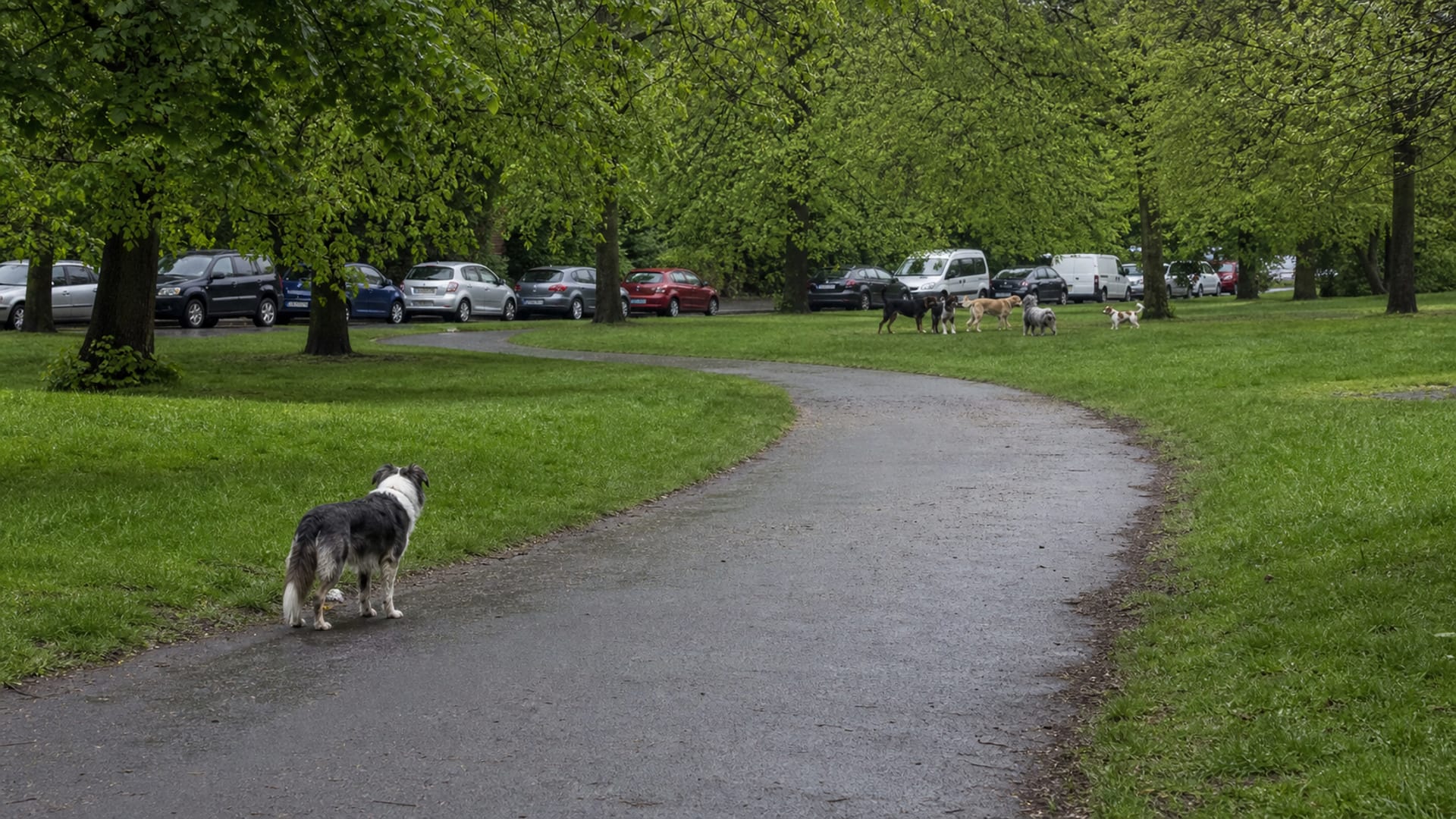
For an adolescent or adult dog that is afraid, socializing does not mean meeting as many dogs and people as you can. It means planned practice below the point where your dog gets scared, with your dog choosing the distance. A good result may be calmly passing a stranger, watching a dog from across the street, or turning away on its own. A greeting is not the goal. For causes and signs of fear in general, start with The Shy Dog's Guide to Conquering Fear: 10 Simple Techniques.
Key takeaways
Hover or tap a card to bring it forward.
- For a fearful adult dog, socializing means planned practice below threshold, not meeting everyone.
- Set distance where your dog sees the trigger and still takes food, and end sessions while it is still coping.
- Move closer only after repeatable calm responses, change one variable at a time, and go easier after a reaction.
- Skip flooding, forced greetings, dog parks for a dog afraid of dogs, and dragging a dog toward a trigger.
- Get a vet check first, and call a professional right away for any bite, snap, panic or fast change.
Why "socializing" means something different for an older dog
Puppies get a different job. The AVSAB puppy socialization statement calls the first three months the primary and most important period, and it asks for exposure to new people, animals and places without over-stimulation. A VCA handout by Ellen Lindell, Kenneth Martin, Debra Horwitz and Gary Landsberg, all veterinary behavior specialists, puts the flexible window at roughly 3 to 14 weeks and says a bad experience in that window can leave lasting fear. If you have a young one at home, 10 Essential Tips for Socializing Your Puppy (And What NOT to Do!) covers that stage.
Your dog is past it. For an adult, the work is behavior modification: you name the triggers, prevent the encounters that overwhelm, and slowly change how the dog feels when a trigger shows up. Karen Overall's protocol for fearful aggression separates it from ordinary shyness. A fearful dog may bark, growl, tuck its tail, drop low or urinate when approached, and Overall is plain that treatment must not make the fear worse.
Alexandra Horowitz makes a point I agree with: a dog does not have to greet every person and dog to be socially competent. Many good adult dogs ignore strangers politely and are happy that way.
What a good outcome looks like, and what is still unknown
Adult dogs can improve, and the biggest study on it shows how much. Collins and colleagues followed 441 shelter and rescue dogs from 2013 to 2020 in Applied Animal Behaviour Science: 52 juveniles, 368 adults and 21 seniors. Of those, 380 (86%) met the program's graduation goals, after an average of 96 days and 78 treatment sessions. Of 301 graduates with records, 297 were adopted, and 121 of 137 adopters who answered a survey said they were very satisfied.
Read those numbers with their limits beside them. It was a program evaluation with no untreated comparison group, run by specialists with unusual resources, on dogs selected for it. It shows what is possible. It does not promise your dog will end up comfortable with everyone.
Bohland and colleagues tracked 99 dogs adopted from five Ohio shelters for six months in PLOS ONE. Fear of strangers and fear of other dogs did not change significantly, and stranger-directed aggression, touch sensitivity and chasing went up. A new home alone does not fix fear, and "give him time" is not a plan.
There is also no set number of exposures, session length or distance that fits every fearful dog. You set those by watching your own dog's body and how fast it recovers. For severe cases, do it with a professional.
Hover or tap a row to highlight it.
| Study | Who it followed | What it found |
|---|---|---|
| Collins and colleagues | 441 shelter and rescue dogs in a specialist program, 2013 to 2020: 52 juveniles, 368 adults and 21 seniors | 380 (86%) met the graduation goals, after an average of 96 days and 78 treatment sessions. Of 301 graduates with records, 297 were adopted, and 121 of 137 adopters who answered a survey were very satisfied |
| Bohland and colleagues | 99 dogs adopted from five Ohio shelters, tracked for six months | Fear of strangers and fear of other dogs did not change significantly. Stranger-directed aggression, touch sensitivity and chasing went up |
Read your dog and find the threshold
Threshold is the point where your dog stops coping. A coping dog notices the trigger and can still eat, sniff, move, answer you and settle again. An over-threshold dog freezes, flees, hides, barks, growls, lunges, snaps, refuses food or cannot recover once the trigger leaves.
VCA lists the classic fight, flight, freeze and fidget responses: cowering, tucked tail, lip licking, trembling, panting, stiffening, running away, growling. It also says a dog that stiffens while being petted or sniffed by another dog is telling you it wants the contact to end. Sophia Yin's low-stress handling work adds avoidance, turning away, yawning, whale eye (the white showing at the edge of the eye) and trying to escape, and she reads them in clusters, not one sign alone. Decoding Your Dog: 15 Body Language Signals You Need to Know is a good one to keep open while you practice.
Leslie McDevitt's Control Unleashed gives a simple test. Can your dog look away from the trigger, take food, respond to a cue it knows and recover? If any of those fail, the exercise is too hard today. Make it easier.
Hover or tap a row to highlight it.
| What to check | A coping dog | An over-threshold dog |
|---|---|---|
| Notices the trigger | Yes | Yes |
| Looking away | Can look away from the trigger | Stares and cannot look away |
| Eating | Takes food | Refuses food |
| Moving and sniffing | Can still move and sniff | Freezes, flees or hides |
| Answering you | Responds to a cue it knows | Stops responding to cues it knows |
| Sounds and reactions | Calm | Barks, growls, lunges or snaps |
| Recovery | Settles again | Cannot recover once the trigger leaves |
The plan, step by step
The sequence below comes from VCA, AAHA and UC Davis, and it works for people, dogs and places alike.
1. Find the exact trigger and what makes it easier or harder. 2. Prevent avoidable overwhelming exposure while you start. 3. Pick an intensity below the point where your dog gets afraid. 4. Show your dog the person, dog or place at that level. 5. Pair what it sees with food or play. 6. Retreat before your dog reacts. 7. Repeat until your dog is relaxed and can turn away from the trigger on its own. 8. Change one thing at a time. 9. After a reaction, go easier and reassess.
AAHA describes the pairing step as counterconditioning: teaching a fearful dog to feel happy about something by linking it with something it wants.
Set the distance with food. Distance is right where your dog sees the trigger and still takes treats. If it refuses food, trembles, freezes, lunges or tries to leave, add distance or end the session. You have more than distance to adjust: movement, how long the trigger is in view, the angle, the place, how many triggers there are and how familiar they are. A calm, still dog across a big field is easier than a dog trotting straight toward you. A seated adult is easier than a running child. A quiet path is easier than a crowded sidewalk.
Keep sessions short. End while your dog is still coping, and stop right away after an especially good response. Today's Veterinary Practice says to end on a positive reaction, and notes that a calm walk-by can be a fine result even if the dog never wants to greet. Several easy, successful repeats beat one long, risky encounter.
Move closer only on repeatable calm. One good attempt is not progress. Move the trigger nearer when your dog notices it without freezing, eats or does a trained behavior, looks back at you, can walk away by choice, and recovers quickly, session after session.
When it goes badly, make the next one easier. Seattle Humane tells owners to take a step back when either dog shows stress. A rough session is information about the distance, not a failure.
Starting points. For a dog afraid of dogs, begin with a calm dog far away, maybe behind a barrier such as a fence or a parked car. For a dog afraid of people, begin with a person your dog can see from a distance where it still takes treats.
Grisha Stewart's BAT, short for Behavior Adjustment Training, puts the emphasis in a different place. Your dog notices the trigger below threshold, offers a choice like looking away, and gets more distance as its reward. Some versions also use treats. Either approach respects the same rule: the dog is never forced closer.
The Step-by-Step Plan
- Find the exact triggerWork out what makes it easier or harder for your dog.
- Prevent overwhelming exposureAvoid encounters that overwhelm your dog while you start.
- Pick a low intensityChoose a level below the point where your dog gets afraid.
- Show the triggerLet your dog see the person, dog or place at that level.
- Pair it with something goodLink what it sees with food or play. This is counterconditioning.
- Retreat earlyMove away before your dog reacts.
- Repeat until relaxedKeep going until your dog is relaxed and can turn away from the trigger on its own.
- Change one thing at a timeAdjust only one variable, such as distance, movement or duration.
- After a reaction, go easierMake the next session easier and reassess.
Walks, introductions and gear
Plan walks to prevent surprises. AVSAB's management guidance for fearful dogs recommends quiet times and places, parked cars or trees as barriers, high-value food in your pocket, and moving away before your dog is overwhelmed. Do not walk a fearful dog straight toward another dog for a nose-to-nose hello. Early on, do not ask your dog to pass close to people or dogs while it is upset.
When you are ready for two dogs to meet, parallel walking is a gentler method than a face-to-face greeting. Seattle Humane starts two dogs about 10 feet apart on neutral ground, walking in the same direction on loose leashes. Close the gap only while both dogs stay relaxed, and keep any greeting brief. If either dog shows stress, add distance or pause. Not every fearful dog needs this step, and a calm pass-by may be the finish line.
A long line gives your dog more choice and distance in a fenced or otherwise secure area, but only if you can handle it well. A leash adds safety and also takes away escape, so keep it loose.
If your dog could bite, a basket muzzle lowers the risk, though it does not change the fear underneath. Cornell's muzzle training guide says to build up wearing it with treats, go slowly, start before you urgently need it, and never leave a dog alone in one. It is never a replacement for supervision.
Head collars, front-clip harnesses, gates and visual screens can all help with management. If one makes your dog panic, choke, struggle or avoid, it is the wrong tool for that dog.
What to skip
- Flooding. Putting a dog in front of the full strength of what it fears, or blocking its escape until it stops reacting, makes fear worse. UC Davis and AAHA both say to avoid it, and so does the AVSAB humane training position statement.
- Forced greetings. VCA says not to hold a dog still to make it greet. Cornell's fearful dog advice says not to push a dog into visitors or crowds. Let your dog retreat or approach by choice.
- Dog parks, if your dog is afraid of dogs. You cannot control distance, speed, approach angle or the other dogs. Cornell tells owners of dogs afraid of other dogs to stay away from them.
- Dragging or holding a dog toward a trigger. It takes away the dog's ability to make space and ties the trigger to restraint and panic. Overall says fear-aggressive dogs should not be physically corrected and that it can make them worse, and she says not to reach toward a cornered dog.
AVSAB and the European Society of Veterinary Clinical Ethology both treat e-collars as aversive tools and warn of fear, pain, stress and aggression, particularly when level and timing are off. Some trainers use them. I do e-collar work among other tools in my own training, and I will say so plainly; the distance, food and choice plan above does not depend on one.
Hover or tap a row to highlight it.
| Skip this | Why |
|---|---|
| Flooding | Putting a dog in front of the full strength of what it fears makes the fear worse |
| Forced greetings | Holding a dog still to greet takes away its choice. Let it retreat or approach |
| Dog parks, if your dog is afraid of dogs | You cannot control distance, speed, approach angle or the other dogs |
| Dragging a dog toward a trigger | It takes away the dog's ability to make space and ties the trigger to restraint and panic |
Where medication fits
A veterinarian decides on medication, and a board-certified veterinary behaviorist can manage it alongside training. Merck says drugs can help normalize emotional responses and improve a dog's ability to learn, and the best results usually come from combining medication with behavior work. Overall says many dogs with fear aggression may benefit from anti-anxiety medication, and VCA describes daily medication for dogs with ongoing social triggers.
The proof is specific to the problem. A randomized, placebo-controlled pilot study of dexmedetomidine gel showed a benefit for fear of veterinary visits, and two randomized studies of fluoxetine support some reduction in separation anxiety and compulsive behaviors. Neither shows medication treats fear of dogs or people in general. If fear is severe enough that your dog cannot learn, is in panic, or has hurt itself, ask your vet whether medication could make humane training possible.
When to get help
Call a professional promptly if your dog:
- has bitten, tried to bite, snapped or made contact with a person or dog
- is afraid of children and shows aggression toward them
- panics, hurts itself or stays upset after the trigger leaves
- reacts to many kinds of people, dogs, places or handling
- changes suddenly or gets worse fast
- shows pain, neurological signs, confusion or altered sleep
- stops making progress despite steady, careful work
- cannot be walked, handled, transported or examined
- lives with children or other animals where separation cannot be kept up every day
VCA says very frightened dogs should see a qualified professional as soon as the fear is recognized, because fear responses can escalate quickly. Overall adds that a fear-aggressive dog and a child should not be left unsupervised together until the parent is certain both are safe. A conditioned muzzle does not change that.
Start with your veterinarian. For complex cases, look for a board-certified veterinary behaviorist (DACVB) or a Certified Applied Animal Behaviorist (CAAB). The American College of Veterinary Behaviorists describes the DACVB as a veterinarian trained to diagnose medical conditions that affect behavior and to treat behavior problems. Titles like "behaviorist" and "trainer" are not regulated, so ask what the person studied, who awarded the credential, how they handle fear and aggression, how they manage bite risk, which tools they use, and when they refer to a vet.
A good first assessment covers medical history, the exact triggers, bite history, who lives in the home, daily routine, past methods, video of the behavior when it is safe to get, a safety plan, and a written plan with measurable steps.
Questions owners ask
Should my dog see the vet before I start? Yes, especially if the fear is new, getting worse, or comes with aggression. Pain, vision or hearing loss, thyroid and other hormone problems, and age-related cognitive change can all make a dog less tolerant of approach and handling, and sudden changes in sleep, appetite or touch sensitivity should go to your vet.
How long should a session last? Stop while your dog is still eating and responding, which is often only a few minutes. Several short, easy sessions work better than one long one, and the right length depends on how fast your dog recovers.
Can my dog ever be friends with another dog? Some can. A calm, steady dog that stays relaxed on a parallel walk is the usual place to start, with brief greetings only while both dogs stay loose. For many fearful dogs, walking past each other quietly is the realistic and healthy result.
Does a muzzle fix the problem? No. It lowers bite risk while you train, but the fear is still there. Condition it with treats well before you need it and keep supervising your dog.
Check What You Picked Up
What does socializing mean for a fearful adult dog?
How do you know the distance is right?
When do you move the trigger closer?
A session goes badly. What do you do next?
Which is a gentler way to introduce two dogs?
What does a basket muzzle do for a dog that could bite?
Answer a question to see your score.
Final Thoughts
I offer an evaluation visit, in-home lessons, and board and train in my own home for dogs whose problem needs more than advice from a page. If your dog has bitten or come close to it, tell me on the first call, before anything else.
If your dog came from a shelter, From Rags to Riches, the guide to rescue dog behavior covers rescue dogs in particular, and How to Help Your Scaredy-Dog: 6 Common Dog Phobias and Their Solutions covers fears of specific things. You can reach DW Dog Training through the contact page.