

Some links in this post are Amazon affiliate links. If you buy through one I may earn a small commission, at no extra cost to you. It never changes what I recommend. Full disclosure.
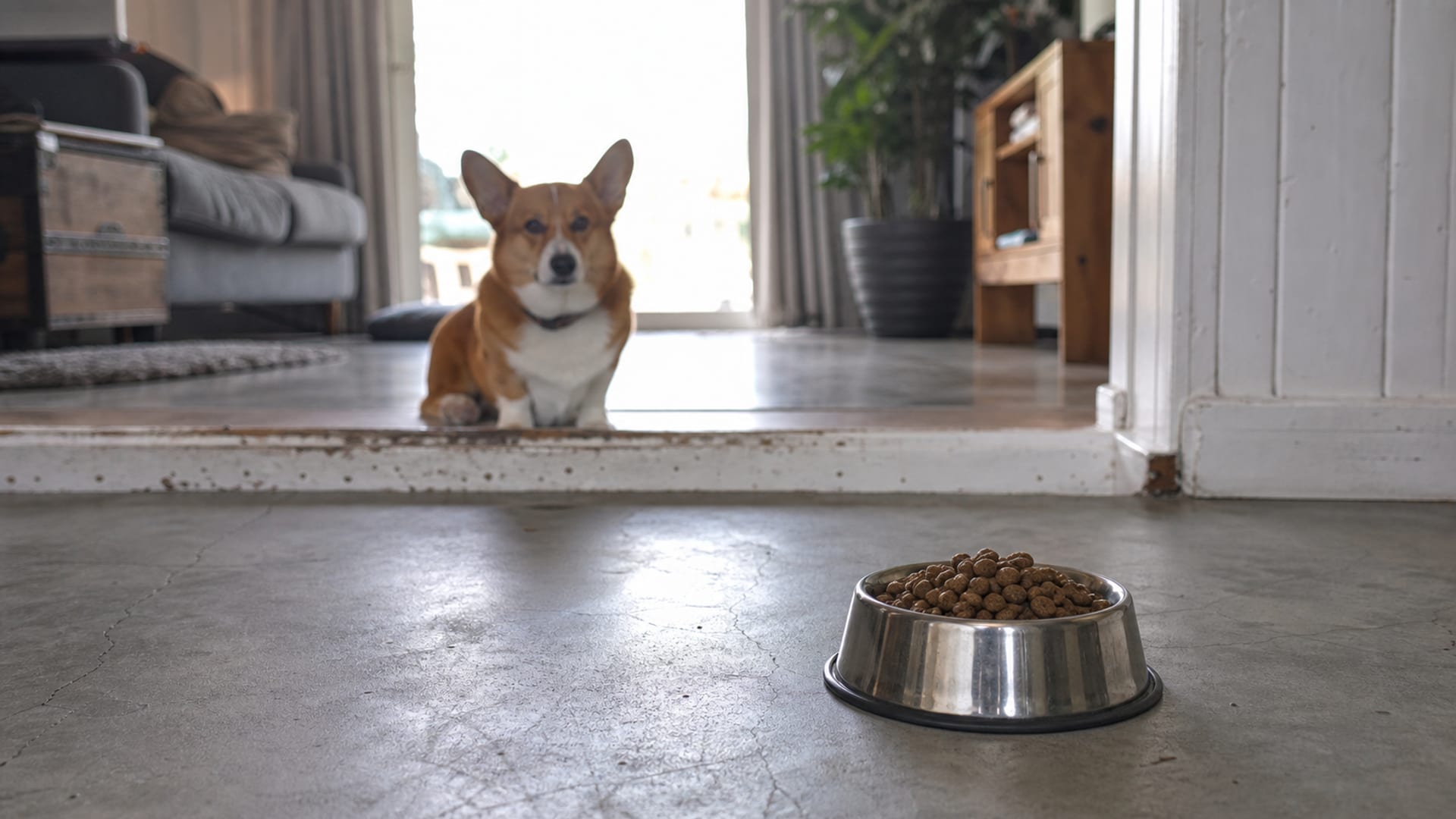
High-protein food has not been shown to cause aggression, and no food or supplement has been shown to reliably reduce it. Diet is one piece of what your vet will ask about, and if your dog's behavior changed suddenly, the vet comes first, not the pet-food aisle. Your dog's safety and that vet visit come before any diet trial. If your dog has snapped, guarded, or lunged, here is what is actually known about food, and what I would do this week. For the bigger picture on stopping the behavior itself, start with Dog Aggression Solutions: A Complete Guide to Stopping Aggressive Behavior in Dogs.
Key takeaways
Hover or tap a card to bring it forward.
- High-protein food has not been shown to cause aggression, and the small protein trials show no general effect.
- No food, calming diet, or supplement has been shown to reliably reduce aggression, and your vet should choose any add-on.
- A sudden behavior change goes to the vet first, with a full diet history and a factual log of each incident.
- Hunger, meal timing, and food guarding are separate issues; never starve a dog for training or take the bowl as a confrontation.
- A bite, a near-bite, guarding from children, or worsening aggression means professional help now, alongside your vet.
What the protein studies measured
The idea that protein makes dogs aggressive comes from a handful of small trials, and the details matter.
Dodman and colleagues, in the Journal of the American Veterinary Medical Association in 1996, tested 12 dogs with one type of aggression, 12 hyperactive dogs, 12 dogs with territorial aggression, and 14 controls. Every dog ate food with 17%, 25%, and 32% protein for two weeks each, and owners logged behavior daily. Most groups did not change. Territorial aggression scores were lower on the lower-protein diets, but that drop was concentrated in seven dogs whose territorial aggression was tied to fear. The authors concluded that cutting protein was not generally useful and might help a narrow group of fearful dogs. If your dog defends the house and the yard, my piece on Defending the Homefront: How to Manage Your Dog's Territorial Aggression covers what to do about that behavior directly.
DeNapoli and colleagues in 2000 followed 33 dogs, each fed four diets for one week apiece in random order: high or low protein, with or without added tryptophan. Within each behavior group, nothing reached statistical significance. A pooled analysis hinted at lower territorial aggression on low protein plus tryptophan. The sample was small, each diet lasted a week, owners scored the behavior, and the hint depended on combining two changes at once.
A 2025 study of Golden Retrievers by Davis and colleagues used owner questionnaires and commercial dry foods sorted into low, medium, and high protein. Compared with medium protein, high protein was linked to 1.3 times the odds of dog rivalry, and low protein was linked to 1.4 times the odds of separation-related behavior. That is an association in owner reports, not a feeding trial, and it does not show protein caused anything. It also measured questionnaire answers, not bites. If your dog's trouble is with other dogs, my 5 Proven Strategies to Stop Your Dog's Aggression Towards Other Dogs is the better place to spend your energy.
So, the honest summary is that the effect has not been shown to hold across dogs, ages, aggression types, or brands. Do not switch to a low-protein diet because of aggression without a vet's assessment. Houpt and Zicker's 2003 review and the veterinary behaviorists at VCA both note that a reduced-protein diet is not right for every dog and belongs in a conversation with your vet.
Hover or tap a row to highlight it.
| Study | Dogs | What it found |
|---|---|---|
| Dodman, 1996 | 12 with one type of aggression, 12 hyperactive, 12 territorial, 14 controls; 17%, 25% and 32% protein for two weeks each | Most groups did not change; territorial scores were lower on lower protein, mainly in seven fearful dogs |
| DeNapoli, 2000 | 33 dogs, four diets for one week each, high or low protein, with or without added tryptophan | Nothing reached statistical significance within behavior groups; a pooled analysis hinted at lower territorial aggression on low protein plus tryptophan |
| Davis, 2025 (Golden Retrievers) | Owner questionnaires, dry foods sorted into low, medium and high protein | Compared with medium protein, high protein linked to 1.3 times the odds of dog rivalry and low protein to 1.4 times the odds of separation-related behavior; an association, not a feeding trial |
What veterinary nutrition guidance actually says
WSAVA's global nutrition guidelines treat feeding as a job of meeting energy, nutrient, life-stage, and medical needs. They point to a diet history, body condition, muscle condition, calorie intake, and a complete and balanced food. They do not present high protein as a cause of aggression.
The 2021 AAHA Nutrition and Weight Management Guidelines say a healthy dog at a good weight usually does not need a major diet change unless a nutritional risk is found. They call for looking at the whole diet: calories, how often the dog eats, treats, supplements, body condition, and muscle condition. When food does change, they recommend doing it gradually over four to seven days to spare the gut.
A protein percentage on a bag, or a marketing claim about ingredients, cannot tell you whether food is behind a behavior problem. Your vet can, because your vet knows your dog's weight, history, and health.
Supplements, calming diets and probiotics
Plenty of products are sold to calm dogs. Here is the evidence on the main ones, without brand names or doses. Dosing is your vet's decision.
Tryptophan. Tryptophan is a building block of serotonin, so the idea is reasonable. In the 2024 Veterinary Evidence review by Sofyan, Bosch and colleagues in 2009 compared anxious dogs in groups of 66, 72, and 69, and tryptophan had no overall effect on anxiety. Kato and colleagues in 2012 reported lower owner-rated anxiety, but urine cortisol did not differ. The review concluded tryptophan should not be a sole treatment.
Omega-3, magnesium and zinc. Rahimi Niyyat and colleagues gave a combined supplement to 42 Iranian dogs with behavior problems, with six controls. Fearfulness, destructiveness, and house soiling scores fell. Aggression toward dogs and toward unfamiliar people did not change significantly. Because three nutrients were given together and owners did the scoring, that pilot cannot show omega-3 alone reduces aggression.
Milk-derived calming ingredients. An appraisal of casozepine in Veterinary Evidence found no evidence of a rapid calming effect, and the long-term evidence was weak and at high risk of bias.
Nutraceuticals in general and CBD. The veterinary behaviorists at VCA say these products carry no standard efficacy testing, and purity, quality, and ingredient amounts vary. In its 2025 update, VCA states that no study had confirmed CBD helps behavior problems in dogs.
Senior dog and brain-health diets. Better thinking in an older dog on a cognitive diet does not mean the product treats aggression in a young or adult dog. Those are different problems.
Probiotics. A 2023 systematic review of gut bacteria and behavior in animals described small canine studies with very different methods. One crossover trial used 24 reactive Labrador Retrievers, giving a single Bifidobacterium strain and a placebo in six-week periods; reported changes were in stress-related behaviors, not aggression in general. A 40-dog trial of a Lactiplantibacillus plantarum strain called LP815 was exploratory, with 12 dogs on placebo, and needs repeating in larger trials. A 2025 critical review calls gut-microbiome findings in dogs not definitive. A probiotic is something your vet may pick as an add-on, never a substitute for a medical exam, safe handling at home, or behavior work.
Hover or tap a row to highlight it.
| Product | What was found |
|---|---|
| Tryptophan | No overall effect on anxiety in one study; lower owner-rated anxiety but no difference in urine cortisol in another; should not be a sole treatment |
| Omega-3, magnesium and zinc | Fearfulness, destructiveness and house soiling scores fell; aggression did not change significantly |
| Milk-derived calming ingredients | No rapid calming effect found; long-term evidence was weak and at high risk of bias |
| Nutraceuticals in general | No standard efficacy testing; purity, quality and ingredient amounts vary |
| CBD | No study had confirmed it helps behavior problems in dogs |
| Probiotics | Small studies with very different methods; one trial changed stress-related behaviors, not aggression in general; a 40-dog trial was exploratory and needs repeating |
| Senior brain-health diets | Better thinking in an older dog does not mean the product treats aggression in a young or adult dog |
Hunger, meal timing and food guarding are three different things
A diet too low in calories can leave a dog hunting for food and irritable around meals. AAHA's guidance asks vets to count every calorie, including meals, treats, table scraps, chews, and supplements, and to recheck weight and body condition. That makes hunger a feeding-plan issue. It does not make hunger a general cause of aggression.
Food guarding is its own behavior: a dog protecting a bowl, a chew, a stolen scrap, or your sandwich. It happens on a complete diet, and changing the protein source does not treat it. In Gunter and colleagues' study of 900 dogs from cruelty cases, 83 dogs, or 9.2%, showed aggression over food, chews, or both, and underweight dogs were no more likely to than normal-weight dogs. The ASPCA, the American Veterinary Society of Animal Behavior, the Merck Veterinary Manual, and Dr. Jeannine Berger of PetMD all describe guarding as tied to a specific situation, such as someone approaching or another dog nearby.
A dog guarding food usually stiffens, hovers over the bowl, eats faster, freezes, stares, growls, or snaps. A diet or medical problem would come with other clues: a recent change in behavior, a different appetite, weight change, vomiting, loose stool, itching, or signs of pain.
Two things I will say plainly. Do not make a dog hungry to raise the value of food in training. And do not take the bowl away to confront a dog. Feed a guarder behind a barrier or in another room, and keep children and visitors out of the area.
Hover or tap a row to highlight it.
| Issue | What it looks like | What to do |
|---|---|---|
| Hunger | Hunting for food and irritability around meals on a diet too low in calories | Have your vet count every calorie, including treats and chews, and recheck weight and body condition |
| Food guarding | Stiffening, hovering over the bowl, eating faster, freezing, staring, growling or snapping over a bowl, chew, scrap or sandwich | Feed behind a barrier or in another room, and keep children and visitors out of the area |
| A diet or medical problem | A recent change in behavior, a different appetite, weight change, vomiting, loose stool, itching or signs of pain | Call your vet with a full diet history |
What to do before changing the food
Call your vet and bring a full diet history: the main food, treats, chews, table food, supplements, amounts, feeding times, and any recent changes. Also tell the vet about appetite, stool, vomiting, itching, weight change, pain signs, sleep changes, and medications. Merck's guidance on diagnosing behavior problems backs this, and your vet decides which exams and tests make sense.
Medical problems can lower a dog's threshold for snapping, and they are the vet's to rule out. Amat, Le Brech and Manteca's 2024 review covers the link between aggression and physical disease. The usual categories are:
- Stomach and gut trouble, which can mean nausea, belly discomfort, restlessness, and poor sleep.
- Pain from arthritis, teeth, ears, skin, or injury.
- Neurological disease, including seizures and brain tumors, which can bring confusion and sudden irritability.
- Endocrine and metabolic disease. Merck says the link between low thyroid and aggression is inconclusive, so a thyroid test is the vet's call.
- Medication effects on sleep, appetite, or arousal.
While you wait for the appointment, keep a factual log. Write down what happened just before, whether the dog had eaten and what you offered, who or what the target was, the dog's body language, how long it lasted and how often, and what people did afterward. Learning to read the signals matters here, and Understanding Dog Body Language will help you see what a stiff body or a hard stare looks like before the snap. Record a short video only if you can do it safely without provoking the dog.
Then keep the food steady while the dog is assessed. Changing diets again and again makes it harder to tell what caused what, and it can upset the stomach. If your vet does change the food, expect a four-to-seven-day transition and weight checks.
Before You Change the Food
- Call your vetBring a full diet history: main food, treats, chews, table food, supplements, amounts, feeding times and recent changes.
- Report the cluesTell the vet about appetite, stool, vomiting, itching, weight change, pain signs, sleep changes and medications.
- Keep a logWrite down what happened just before, whether the dog had eaten, who or what the target was, body language, how long it lasted and what people did afterward.
- Keep the food steadyHold the current diet while the dog is assessed.
- Change gradually if the vet advisesExpect a four-to-seven-day transition and weight checks.
When this is a safety problem, not a feeding problem
Stop the home exercises and get professional help if any of these is true:
- Your dog has bitten or tried to bite.
- Your dog guards food from children.
- Your dog leaves the bowl to chase people.
- Exercises make the behavior more intense.
- The aggression shows up in several settings or toward family members.
- It is unpredictable or getting worse.
Merck describes the outlook as guarded to poor when aggression is unpredictable, disproportionate, causes substantial injury, or targets people who cannot reliably avoid the dog, children included. In those cases a board-certified veterinary behaviorist works alongside your regular vet, to build a plan covering safety management, behavior work, and any medical treatment. Diet can be one part of your dog's medical history, but it should never push aside a risk assessment. If you are trying to judge how close your dog is to biting, read 10 Warning Signs Your Dog Might Bite (and How to Prevent It).
When a dog's problem needs more than advice from a page, I offer an evaluation visit, in-home lessons, and board and train in my own home. I will tell you straight what I see and what I would do. If your dog has bitten or come close, say so on the first call, so we start from what is true.
Quick answers
Can a low-protein diet stop my dog's aggression?
A low-protein diet was linked to lower territorial aggression in Dodman's 1996 trial, but the change was concentrated in seven fearful dogs, and most groups did not change at all. Use it only if your vet recommends it for your dog.
Does my dog guard food because it is hungry?
Usually not. In the 900-dog cruelty-case study, underweight dogs were no more likely than normal-weight dogs to show food aggression. Guarding is about protecting a prized item, so manage it with barriers and distance, and do not withhold meals.
Will a calming supplement or diet fix reactivity?
No product has been shown to reliably reduce aggression. Ask your vet before giving anything, because quality varies between products and your vet knows your dog's medications and health.
Should I switch foods right after my dog snaps?
Call the vet first and keep the current food steady while your dog is examined. A sudden change in behavior can come from pain or illness, and repeated food changes blur the picture.
Check What You Picked Up
Has high-protein food been shown to cause aggression?
Your dog's behavior changes suddenly. What comes first?
Does a calming diet or supplement reliably reduce aggression?
What should you do with a dog that guards its food?
Which is a reason to get professional help right away?
If your vet does change the food, how should the switch go?
Answer a question to see your score.
Final Thoughts
Some dogs need more than advice from a page. I offer an evaluation visit, in-home lessons, and board and train in my own home for dogs whose problem needs hands-on work. If your dog has bitten or nearly bitten anyone, say so on the first call so I can plan safely. You can reach DW Dog Training through the contact page.